Insights
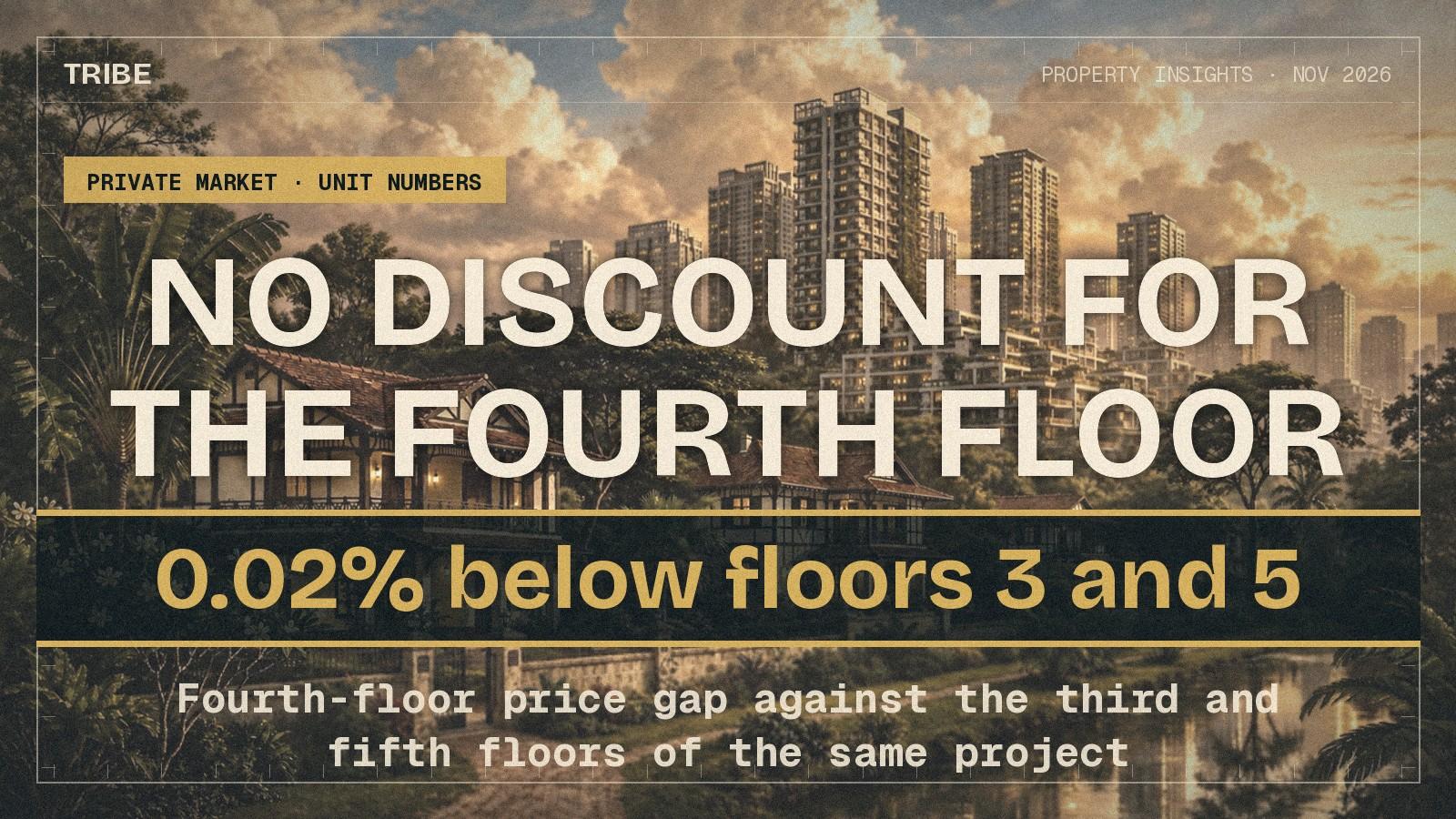
No Discount for the Fourth Floor. Moving One Storey Up to Avoid It Costs 0.67%.
Matched against the third and fifth floors of the same project, in the same size band and the same half-year, a fourth-floor condo sold within 0.02% of them across 1,598 groups. One real storey is worth 0.67%.
By TRIBE Research · 21 November 2026 · 10 min read
The decision
- Who this is for
- Condo buyers comparing two units in the same project where one is on the fourth floor, and fourth-floor owners weighing an offer
- The question
- Is a fourth-floor unit worth less, and is it worth paying more to avoid one?
- The short answer
- No on both counts. Matched against the third and fifth floors of the same project, same size band and same half-year, a fourth-floor unit traded at -0.02%, inside a range of -0.13% to +0.09%, and sold dearer in 52.8% of 1,598 matched groups. The storey is priced. One floor up between the third and fifth is worth 0.67%, about S$11,273 on the median S$1,680,000 sale.
- Next step
- Price the storey, not the digit. Before paying up to leave the fourth floor, check what the floors either side of it have actually transacted at in that project.
The numbers behind it
- -0.02%Fourth-floor gap against the third and fifth floors, same project
- -0.65% and +0.66%How cheap it looks against the fifth, how dear against the third
- 0.67% a storeyWhat one floor up is worth between the third and fifth storeys
Ask around the Singapore market and you will hear two things about the number four. Buyers avoid it, so a fourth-floor unit should come cheap. Sellers of fourth-floor units should expect less. Across 116,963 private condominium caveats registered between October 2021 and October 2026, neither is true.
Compare a fourth-floor unit with the third and fifth floors of the same project, in the same size band and the same half-year, and it traded at -0.02% against them. The range the data still allows runs from -0.13% to +0.09%. On the median S$1,680,000 sale that is about S$350 either way.
What the market does charge for is the storey. Between the third and fifth floors one floor up is worth 0.67%, about S$11,273 on that same median sale. The digit is free. Moving a floor to avoid it is not.
The question in front of a buyer
Two units in the same project, the same size, the same quarter. One is #04-12 and the other is #05-12. The first is supposed to carry a discount for its number; the second is supposed to cost more for not having one.
The comparison is available tens of thousands of times over, because the number is not rare here. The fourth floor accounts for 9,333 of these transactions, against 8,866 on the third and 8,940 on the fifth. Floors ending in four, which is 4, 14, 24, 34 and 44, account for 14,636 sales, or 12.5% of the dataset.
Singapore developers also do not skip the numbering, which some markets do. In the transaction record the thirteenth floor sits on trend between its neighbours at 4,267 sales, against 4,792 on the twelfth and 3,801 on the fourteenth. Unit numbers ending in four are 10.88% of all sales, between 11.46% for three and 10.17% for five.
The answer in plain language
There is no discount. Sales were grouped by project, bedroom count, 100-square-foot size band and half-year of sale, and each fourth-floor sale was compared with the third and fifth floors inside its own group. The fourth floor traded at -0.02%. That is 1,598 matched groups across 313 projects, and the fourth floor was the dearer side in 52.8% of them, a coin flip.
The same test on the fourteenth floor gives +0.00%. On floors 24, 34 and 44 together it gives -0.05%. Wherever the four appears in the storey, it is worth nothing in either direction.
The mirror image does not hold either. The lucky eight, meaning floors 8, 18, 28 and 38, comes in at +0.06%, inside a range of -0.07% to +0.19%. The thirteenth floor reads +0.21%, which is the largest of the ten digits and still a fifth of one percent, and in the wrong direction for the belief.
The strongest supporting numbers
Why comparing the fourth floor with the fifth misleads
Most of the folk evidence for the discount comes from one comparison, and that comparison works. Inside the same project, size band and half-year, a fourth-floor unit sold 0.65% below the fifth floor on average and 0.52% below at the median. It was the dearer of the two in only 31.8% of 1,590 groups. That looks like the superstition, priced.
Run the same comparison against the third floor and the sign flips. The fourth floor sold 0.66% above it, 0.52% above at the median, and was the dearer side in 64.1% of 1,779 groups.
Both figures are real and both are the same thing: the climb. One storey is worth about two-thirds of a percent at this height, so the fourth floor sits below the fifth and above the third by almost exactly that much. Averaging the two neighbours removes the height premium and leaves whatever the number by itself is worth. What is left is -0.02%.
The unit number tells the story twice. Compare units whose number ends in four against the rest of the same project, size band and half-year, and they look 0.27% cheap, with a t-statistic of -3.06 across 2,854 groups. Add the storey to the grouping, so the comparison runs between units on the same floor of the same project, and the gap falls to -0.01% across 2,189 groups.
The apparent discount was floor composition: units in stacks numbered four happened to sell from lower floors. Units ending in eight read +0.26% on the same-floor test, also not distinguishable from zero.
What the method can and cannot see
A null is only worth reading if the method could have found the effect. This one can. On the same groups, in the same form, it prices one extra storey at 0.49% per square foot with a t-statistic of +27.4 across 13,701 comparisons. It sees a half-percent effect at twenty-seven standard errors and finds nothing at the fourth floor.
The null also survives every cut taken at it.
| Cut | Fourth-floor effect | Matched groups |
|---|---|---|
| Main test | -0.02% | 1,598 |
| 50-square-foot size bands | -0.03% | 1,637 |
| Quarter instead of half-year | -0.04% | 1,313 |
| Same stack, so same facing | +0.04% | 2,624 |
| Two floors either side | -0.01% | 1,155 |
| Core Central Region | +0.10% | 267 |
| Rest of Central Region | +0.04% | 557 |
| Outside Central Region | -0.10% | 774 |
| Freehold | +0.26% | 249 |
| 99-year | -0.07% | 1,325 |
| Sales 2021 to 2023 | -0.05% | 689 |
| Sales 2024 to 2026 | -0.00% | 909 |
The widest cut is resale-only, excluding sub-sales, at -0.26% on 358 groups, and its range still runs from -0.61% to +0.10%. Nothing here finds a four-specific discount.
What this does not prove
These are transacted prices, not asking prices. A seller who prices a fourth-floor unit above the market may still wait longer for a buyer. The dataset carries no listing dates and no time on market, so it cannot prove anything about how long a sale takes.
Turnover gives no four-specific signal. Floors ending in four traded at 0.946 times the rate of the floors either side across 1,839 project-floors, but floors ending in three ran at 0.964 and floors ending in seven at 0.947, so the shortfall is not about the four.
The test measures the number, not the unit. Facing, outlook, noise and layout differ between units on the same storey and are not recorded. They add noise rather than bias, because a storey number is not assigned by any of them, but they are the reason a single pair of units proves nothing.
Ten digits were tested, so one of them will look largest by chance. That is how the +0.21% on the thirteenth floor should be read, and it is why the headline rests on the four rather than on the biggest number in the table.
Private condominiums only. HDB's resale register reports the storey in bands of three, such as 04 to 06, so the same test cannot be run on flats. The dataset is a five-year brokerage export of caveat records rather than the complete register.
On returns, the same-unit repeat sales in the dataset show no difference either. Units on floors ending in four earned +0.010 percentage points a year against the rest of their own project and purchase year, inside a range of -0.03 to +0.05, across 2,573 groups in 708 projects. Those returns are price to price and exclude rent, financing, stamp duties, maintenance, property tax, agent commission and renovation.
This is a five-year reading of one market, not a law, and it says what buyers collectively paid, not what any particular buyer will pay.
What it means for a buyer or a seller
For a buyer, there are two moves in this and the second is the valuable one. The first is that there is no bargain to hunt. A fourth-floor unit is not quietly 2% or 3% cheaper than its neighbours, so a search built around finding one is a search for a discount the market does not give.
The second is that avoiding the fourth floor has a price, and the price is the storey. Moving from #04-12 to #05-12 costs about 0.67% at this height, roughly S$11,273 on the median sale and more in the Core Central Region, where a storey runs 0.62% on a larger base. If the number matters to you, that is a reasonable thing to pay for peace of mind. It is worth knowing it is being paid for the number and not for the view.
For a seller on the fourth floor, the number is not a reason to accept less. If an offer comes in 2% under what the floors either side of you have transacted at in your own project, the four is not the explanation and the transaction record will say so.
For both sides, the useful discipline is the same. Compare against the floors immediately above and below in the same project, not against the project median, and not against a rule of thumb about numbers.
Where to start
Put the project and the storey into the Resale Price Check below and compare the asking price against what the floors either side of it have actually transacted at. Related reading: what a floor costs to buy and what it returns, why top of the block is worth nothing and what a storey is worth in HDB resale.
Sample: 116,963 private condominium resale and sub-sale caveats carrying a usable storey number, across 2,233 projects, registered between 11 October 2021 and 4 October 2026, from TRIBE's own transaction dataset, which is built from five-year brokerage exports of caveat records for the Core Central, Rest of Central and Outside Central regions with unit stack numbers matched in from the raw URA exports. It is not the complete caveat register. Executive condominiums, landed homes, HDB flats and new sales from developers are excluded. The digit effect is the mean, across matched groups of project, bedroom count, 100-square-foot floor-area band and half-year of sale, of log price per square foot on the target floor minus the average of the floors immediately above and below, with standard errors clustered across projects; the storey premium is half the gap between those two neighbouring floors in the same groups. Unit-number tests add the storey to the grouping where stated. Figures are transacted prices before stamp duty, agent fees, legal fees and renovation, and exclude maintenance charges, property tax and financing. General information, not advice on any particular property or transaction. Methodology published. No spin.
Your next step
Comparing a fourth-floor unit against one a storey or two higher in the same project? Send us the project name and the two unit numbers. We will show what the floors either side have actually transacted at.
A consultant replies on WhatsApp. No registration, no obligation.
Prefer a personal read on your situation? Arrange a consultation →Keep reading
20 November 2026Private Property Market
The Two-Year Run Does Not Carry. The Ten-Year Record Is Worth 3.5 Points.
17 November 2026Private Property Market
Tenure Is 10% of the Score and 51% of What the Market Pays
16 November 2026Private Property Market
Freehold Costs No More Than Leasehold Under 10 Years Old. At 20 to 30, 13.6% More.
Next step
TRIBE Research
Written with AI assistance from TRIBE's own data and the public sources listed, then checked against them. General information, not financial advice. How we write
Data as of October 2026.
How TRIBE scores and checks its analysis
Spotted an error, or a figure that has moved since publication? Tell us and we will correct it.
General information only, not financial, investment, legal or tax advice. It does not consider your own circumstances; check your own numbers before you commit.