Insights
Flats Above Shops Sell 15% Below the Rest. Matched, the Gap Is 0.8%.
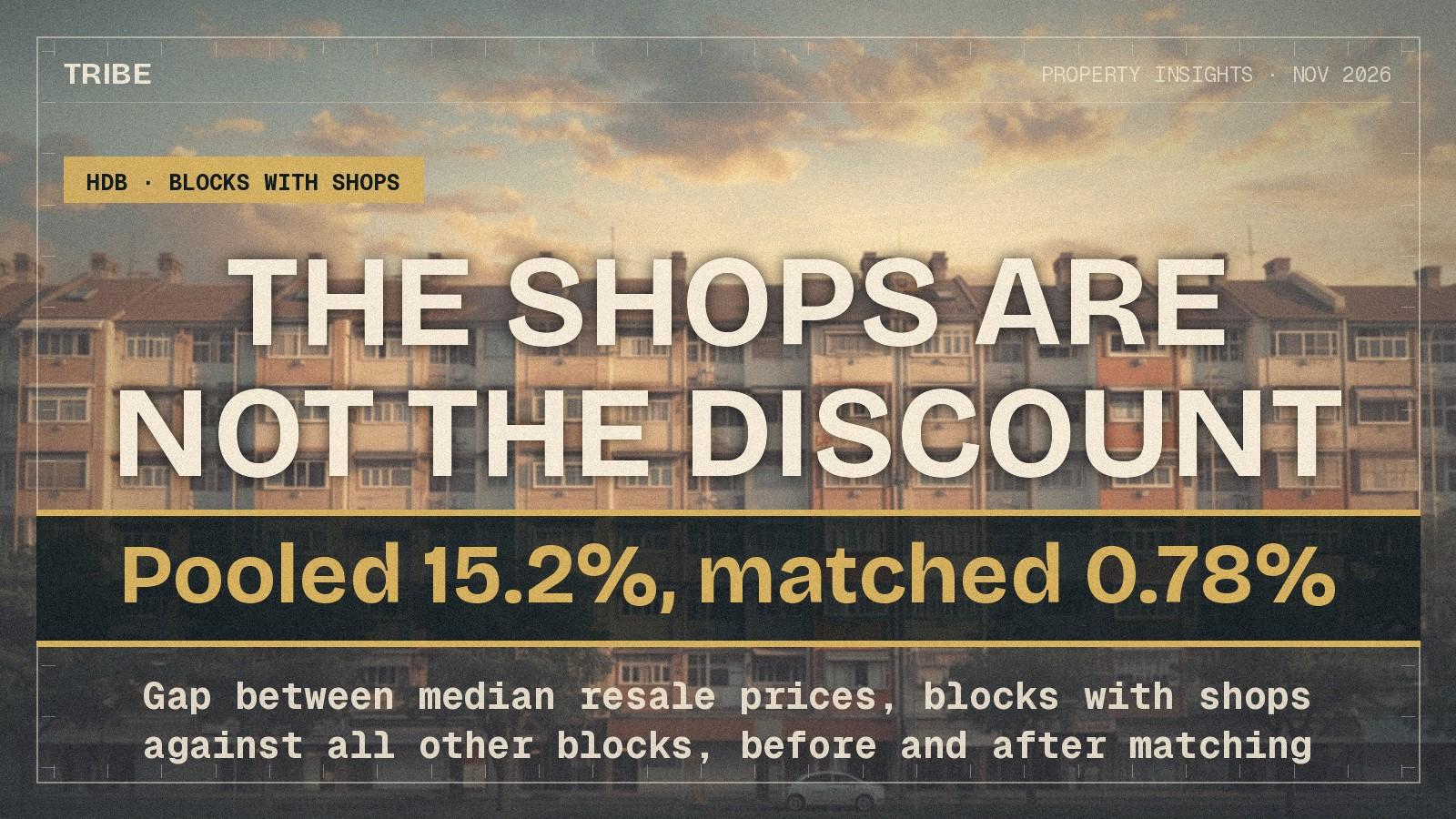
Flats in blocks with shops underneath sell for a median 15.2% less than the rest. Those blocks are older and hold far more three-room flats. Matched on town, flat type, remaining lease, size, storey and half-year across 238,541 resales, the gap is 0.8%.
By TRIBE Research · 18 November 2026 · 7 min read
The decision
- Who this is for
- HDB buyers looking at a flat with shops underneath, and owners of one who expect to be marked down for it.
- The question
- Does the shop podium under the block cost me real money?
- The short answer
- Barely. Pooled, these flats sell 15.2% below the rest, but that is lease and flat mix. The blocks are older, with a median 64.1 years of lease left against 75.8, and 38.7% of their sales are three-room flats against 21.4%. Matched on town, flat type, lease, size, storey and half-year, the gap is 0.78%, about $3,978 on the $510,000 median flat. Compared block to block on the same street it is not measurable.
- Next step
- Price the flat against matched sales in the same town, lease band and size before accepting or offering a discount for the shops.
The numbers behind it
- 15.2% belowGap in median resale price, shop blocks against all others, unmatched.
- 0.78% belowSame gap, holding town, flat type, lease, size, storey and half-year constant.
- about $3,978What 0.78% is worth on the $510,000 median flat in the sample.
A flat in an HDB block with shops at the bottom sells for a median $445,000. A flat in a block without them sells for $525,000. That is 15.2% less, and it is roughly the number people have in mind when they ask what the coffee shop downstairs is costing them.
Almost none of it is the shops. Across 238,541 resale transactions registered between January 2017 and October 2026, matched on town, flat type, remaining lease, floor area, storey band and the half-year of sale, flats in blocks with commercial premises sell 0.78% below the rest. On the $510,000 median flat in the sample that is about $3,978.
The question a buyer under the shops is actually asking
The shop podium is one of the few features of a flat that a buyer can see from the street and form a view on in ten seconds. It cuts both ways in conversation. Some buyers want the convenience and the lift lobby that never feels deserted. Others picture late-night noise, cooking smells and strangers in the lift.
What almost nobody has is a price. The useful question is not whether the shops are pleasant. It is how many dollars the market actually takes off, because that is the figure a buyer should be arguing over and a seller should be defending.
The answer
The market takes off very little. The honest answer to "what do the shops cost me" is under one percent of the price, and most of the gap people have noticed is something else entirely.
Holding town, flat type, remaining lease, floor area, storey band and the half-year of sale constant, the discount is 0.78%, with a 95% confidence interval from 1.32% to 0.24% below. It is a real effect in the statistical sense and a trivial one in dollars. Compare blocks on the same street and it stops being measurable at all.
The strongest numbers
The sample is every HDB resale of a three-room, four-room, five-room or Executive flat registered from January 2017 to October 2026, joined to HDB's own block register on block number and street. That register flags whether a block contains commercial premises. The join covers 238,541 sales across 9,717 blocks, of which 1,792 blocks carry shops and account for 39,638 of the sales.
| Comparison | Gap |
|---|---|
| Pooled median price | 15.2% below |
| Matched on town, type, lease, size, storey, half-year | 0.78% below |
| Same comparison, plus block-height band | 0.82% below |
| Blocks on the same street, same half-year | 0.24% below, not distinguishable from zero |
| Four-room flats only | 0.32% below, not distinguishable from zero |
A second estimator agrees. Grouping sales into cells of town, flat type, five-year lease band, three-storey band, five-square-metre size band and half-year, and keeping the 15,214 cells that contain both kinds of block, the median gap is 0.16% in the other direction, and the shop blocks are dearer in 51.0% of cells. That is a coin flip. The two methods bracket the truth between about zero and 0.8% below.
Why the pooled gap misleads
The 15.2% is almost entirely the kind of flat that sits above shops. Blocks with commercial space were built to anchor an older generation of estates, so the stock is older and smaller.
The median flat in a shop block has 64.1 years of lease left. In every other block it is 75.8. That difference alone is worth most of the gap: in this same data, each year of remaining lease carries roughly 0.98% of price once town, type and size are held constant, a figure consistent with what a short lease costs per year.
The flat mix compounds it. Three-room flats are 38.7% of sales in shop blocks against 21.4% elsewhere, and Executive flats are 3.8% against 8.0%. Shop blocks also run shorter, a median 12 storeys against 15. A pooled median comparing these two populations is mostly comparing old small flats with newer larger ones.
What survives the controls, and what does not
Two patterns are worth stating precisely, because they point in different directions.
The discount is largest on the lowest floors. Run the comparison separately by floor band and flats on floors 2 to 4 of a shop block sell 1.20% below their matched equivalents, against 0.47% on floors 5 to 7 and 0.47% on floors 8 to 10. That is the shape anyone would predict from noise and smell.
It does not pass the proper test. Putting the floor interaction directly into the regression gives 0.28 percentage points, with a t-statistic of 1.23, which is indistinguishable from no floor gradient at all. Flats on floors 11 and above also come in at 0.91% below, which the noise story does not explain. We report the floor-band figures because they are what the data shows, and we are not claiming a confirmed gradient from them.
What this does not prove
The block register records whether a block itself contains shops. It says nothing about a hawker centre, market or coffee shop in the next block, which is how most Singaporeans actually experience living near amenities. A flat facing a neighbouring block's wet market is counted here as having no shops.
The register carries no information on renovation, interior condition, lift access, orientation or which way a unit faces. If shop blocks are systematically better or worse kept, that sits inside the 0.78%.
Prices are transacted resale prices before stamp duty, agent fees, legal fees and renovation, and exclude conservancy charges, property tax, financing and any rent. The data is registration-dated, so it lags the agreed price by a few weeks. These are realised sales only, so flats that were listed and never sold are invisible, and a seller who refused a low offer does not appear.
This is a measurement of what buyers have paid, not a law about what they will pay. A single estate where the shops are genuinely noisy can depart from the average by far more than 0.78%.
What it means for a buyer or a seller
If you are buying, the shops are not a bargaining chip worth much. Asking for five percent off because of the coffee shop is asking for roughly six times what the market has ever charged for it. The lease and the flat type under you are where the real money is, and those are comparable across the whole town.
If you are selling, you do not need to accept a markdown for the podium. What you do need is the matched comparison in hand, because a buyer quoting the raw town median against your block is quoting a number built mostly from newer, larger flats.
Either way, the question to settle first is the one that moves tens of thousands of dollars rather than thousands: what flats of your type, lease band and size have actually sold for in that town this half-year.
Where to start
Put the block, the flat type and the remaining lease into the planner below, and compare the asking price against matched sales rather than the town median. If the gap you are being quoted is larger than about one percent, it is coming from the lease or the size, not from the shops.
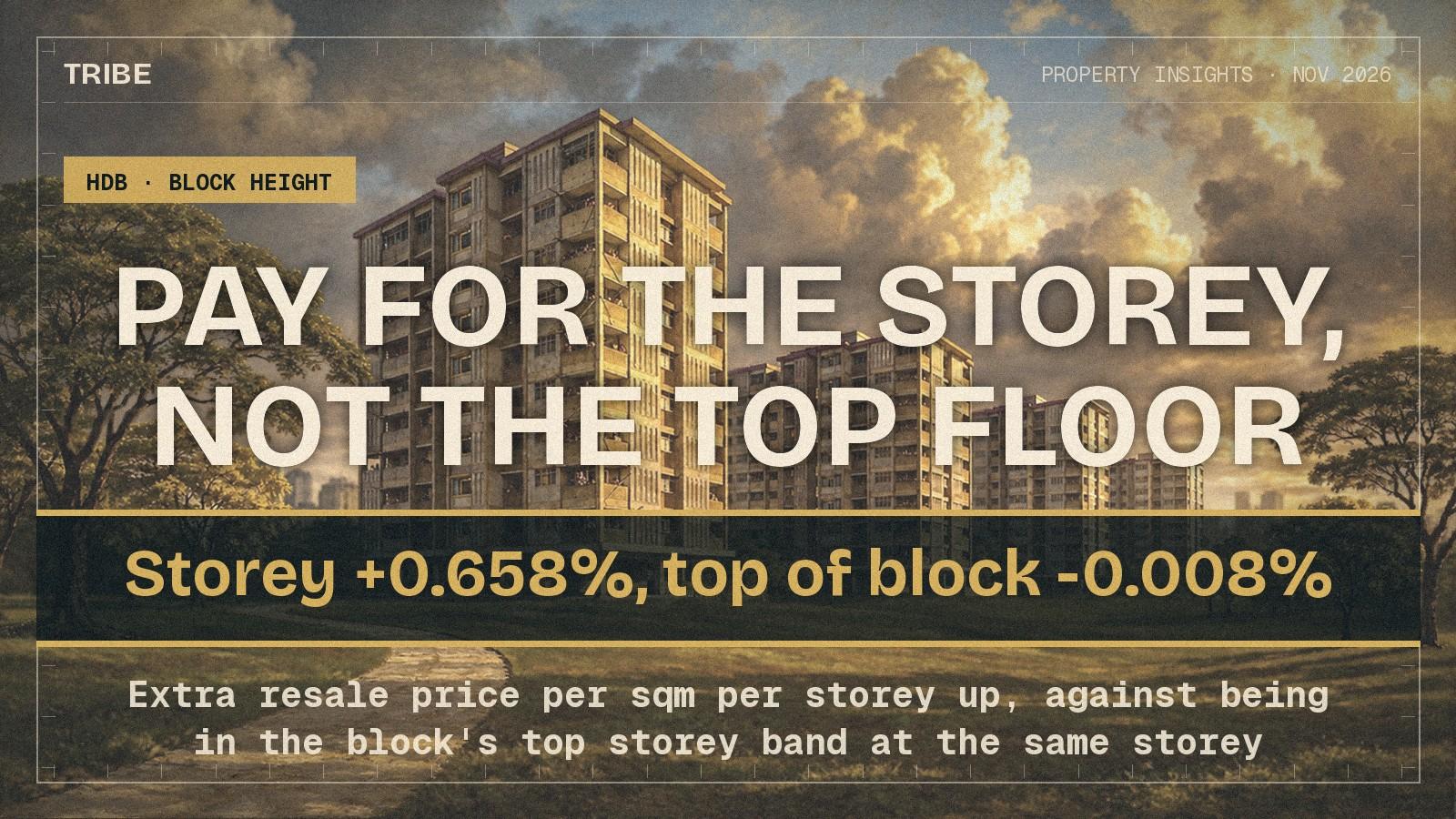
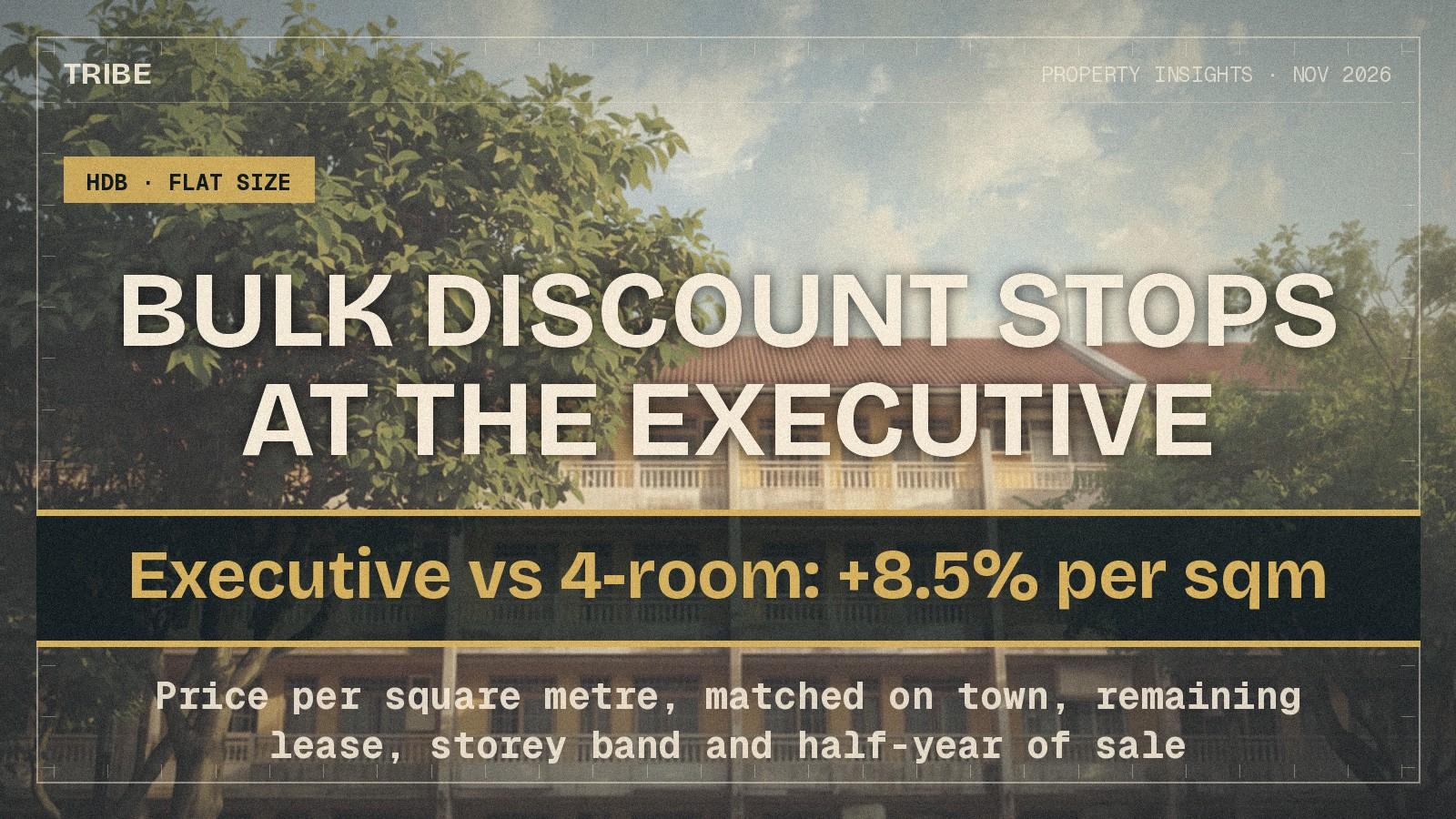
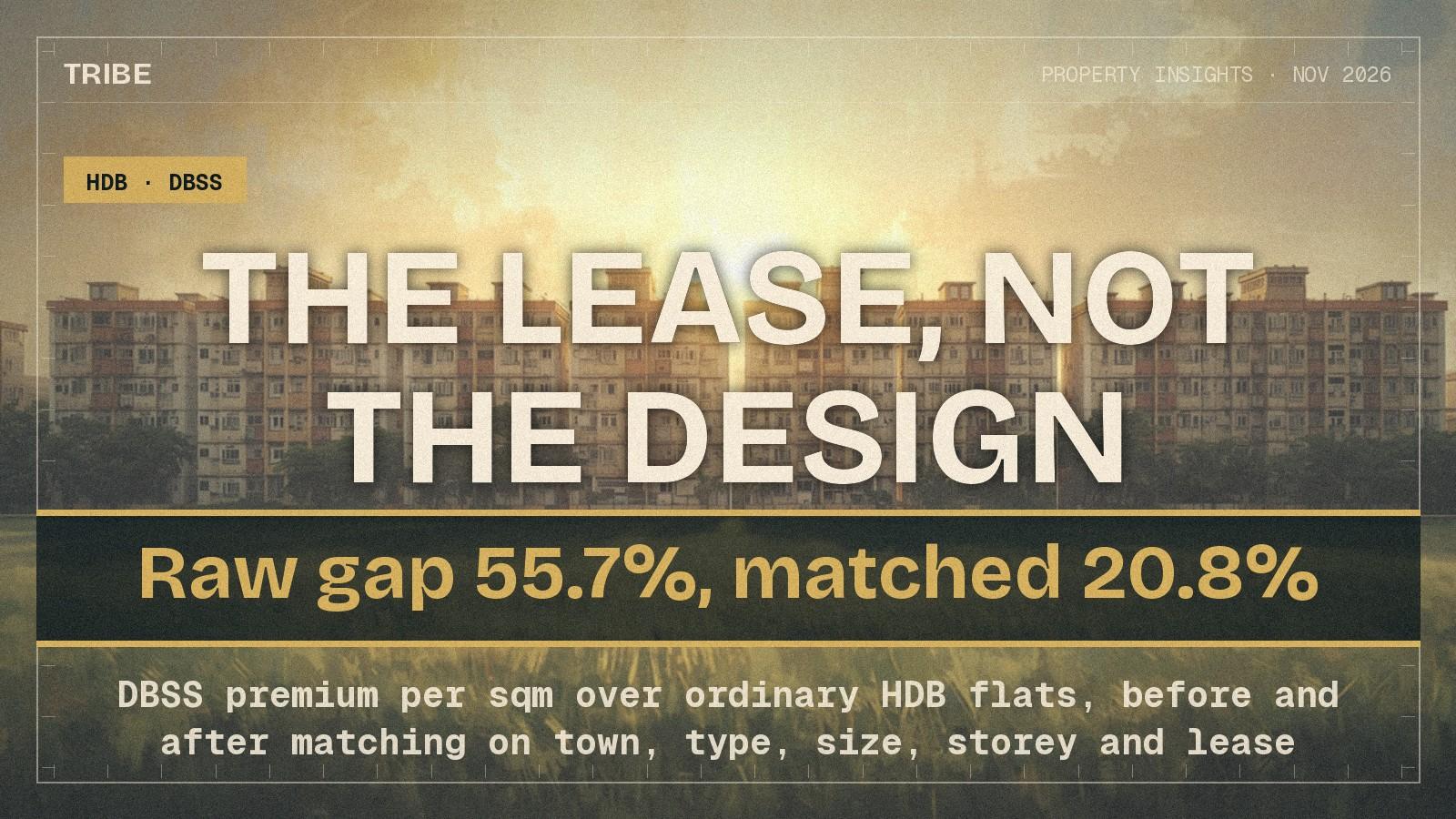
Related: what a short lease costs per year, where the bulk discount on space stops and what a storey is worth.
Computed from 238,541 HDB resale transactions of three-room, four-room, five-room and Executive flats registered between January 2017 and October 2026, published by HDB on data.gov.sg, joined on block and street to HDB Property Information, which flags whether a block contains commercial premises. November 2026 is a partial month and is excluded. The controlled figure is a regression of log price on a commercial-block indicator with fixed effects for town, flat type, half-year of sale, five-year remaining-lease band, five-square-metre floor-area band and three-storey band, plus log floor area, storey and age, with standard errors clustered by block across 9,717 blocks. The matched-cell figure groups sales on the same six dimensions and keeps cells containing both kinds of block. Figures are transacted resale prices before stamp duty, agent fees, legal fees and renovation, and exclude conservancy charges, property tax and financing. General information, not advice for any particular flat or household. Methodology published. No spin.
Your next step
Looking at a flat with shops downstairs, or selling one and braced for a lowball? Send us the block, flat type and remaining lease. We will show you what matched sales in the same town and lease band actually paid.
A consultant replies on WhatsApp. No registration, no obligation.
Prefer a personal read on your situation? Arrange a consultation →Keep reading
Next step
TRIBE Research
Written with AI assistance from TRIBE's own data and the public sources listed, then checked against them. General information, not financial advice. How we write
Sources
- Resale flat prices based on registration date, from Jan 2017 onwards · Housing and Development Board, via data.gov.sg · retrieved 18 November 2026
- HDB Property Information · Housing and Development Board, via data.gov.sg · retrieved 18 November 2026
Data as of October 2026.
How TRIBE scores and checks its analysis
Spotted an error, or a figure that has moved since publication? Tell us and we will correct it.
General information only, not financial, investment, legal or tax advice. It does not consider your own circumstances; check your own numbers before you commit.