Insights
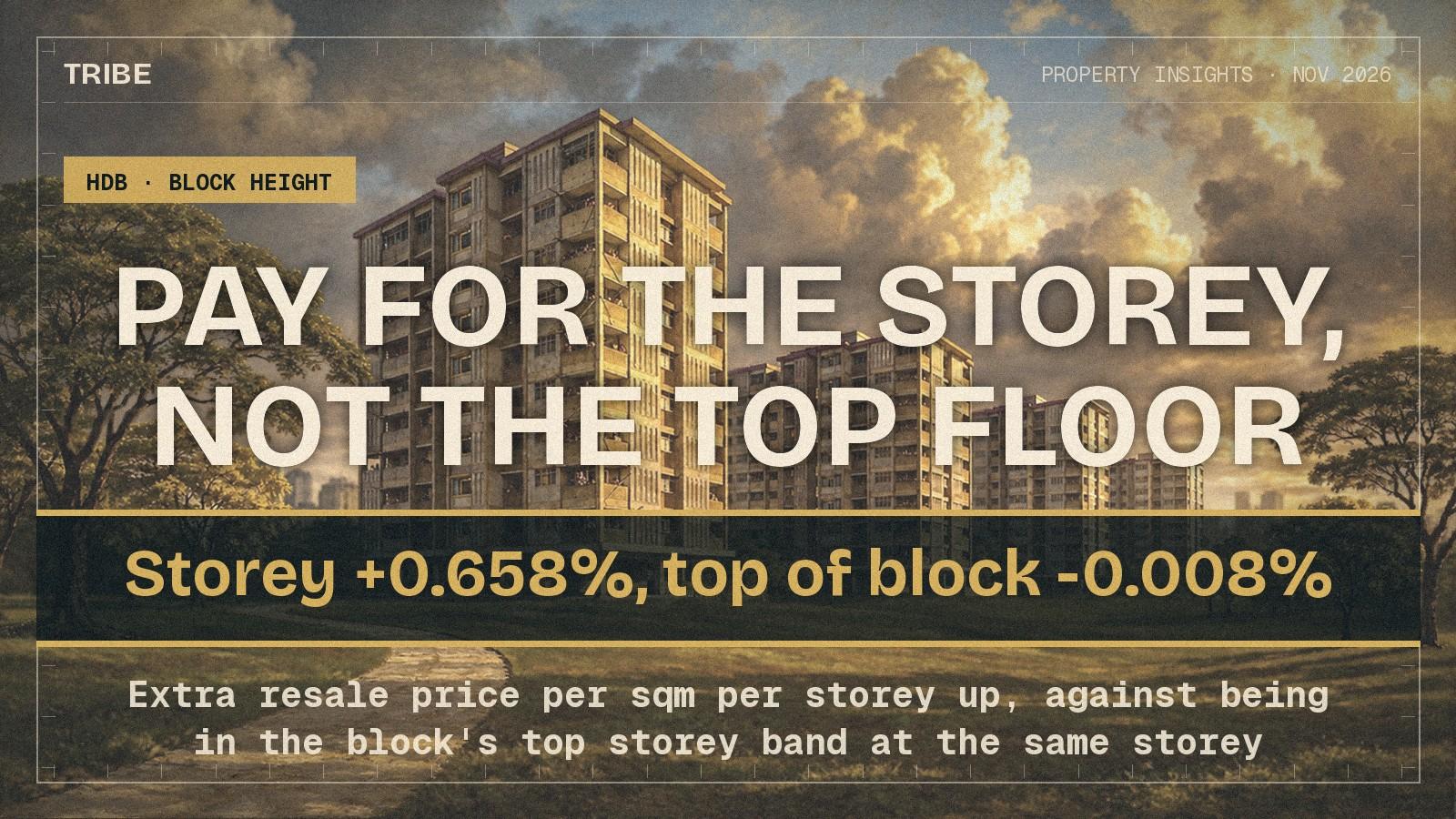
Top of the Block Is Worth Nothing. The Storey Itself Is Worth 0.66%.
Compare flats on the same storey in the same town, flat type, lease band and half-year, and being in the block's top storey band changed the price by -0.008%. Each storey of real height is worth 0.658%.
By TRIBE Research · 19 November 2026 · 8 min read
The decision
- Who this is for
- HDB resale buyers quoted a premium because the flat is the highest in its block, and sellers pricing a top-floor flat
- The question
- Is the top floor of the block worth more than the same storey in a taller block?
- The short answer
- No. Comparing flats on the same storey in the same town, flat type, five-year lease band and half-year, being in the block's top storey band changed the price by -0.008%, inside a range of -0.32% to +0.31%. The top-of-block flat sold dearer in 47.9% of matched groups, a coin flip. Height itself is worth 0.658% a storey.
- Next step
- Price the storey, not the label. Ask what that storey band has actually transacted at in that block and that town before accepting a top-floor premium.
The numbers behind it
- 0.658% a storeyExtra resale price per sqm for each storey up, same block and half-year
- 47.9% of 6,302 groupsMatched groups where the top-of-block flat sold dearer, against 50% for a coin flip
- -6.8%Discount on the first three storeys under the same method, which detects real height effects
The highest flat in a block gets sold as a different product. No neighbours overhead, the best view the block has, and an asking price to match. Across 238,541 HDB resale transactions, that premium does not exist. Comparing flats on the same storey, in the same town, flat type, lease band and half-year, being in the block's top storey band changed the price by -0.008%.
Height itself is priced, and priced consistently: 0.658% more per square metre for every storey up, measured inside the same block. What the market pays for is the storey you are on, not how much building happens to sit above you.
The question in front of a buyer
Singapore's HDB blocks are not one height. Across the 9,717 blocks in this dataset the median is 13 storeys, and 42.8% are 12 storeys or shorter. So the same storey number means very different things: the 12th floor is the roof of a point block and the halfway mark of a 25-storey slab.
That gives a buyer a real choice. Two flats, same storey, same town, similar lease, one at the top of its block and one with thirteen floors above it. One of them is usually described as the better buy. 14.4% of all resale transactions are in the top storey band of their block, so this is not a rare comparison.
The answer in plain language
The top one is not worth more. Holding the storey band, town, flat type, five-year remaining-lease band, five-square-metre floor-area band and half-year of sale the same, the top-of-block flat traded at -0.008% against the rest, with a range running from -0.32% to +0.31%. On the median four-room flat sold in 2026 at S$630,000, that range is about S$2,000 either way.
The plain comparison agrees. Across 6,302 matched groups containing both kinds of flat, the top-of-block flat sold dearer in 3,019 of them. That is 47.9%, against 50% for a coin flip.
The strongest supporting numbers
Ten storeys of real height, compounding at 0.658%, is worth 6.8% — about S$42,700 on that median four-room flat. Five storeys is 3.3%, or S$21,000. Being at the top of the block is worth S$50 on the same flat, which is to say nothing at all.
Why the raw comparison misleads in both directions
Taken straight off the transaction file, top-of-block flats look marginally cheap: a median S$5,290.9 per square metre against S$5,314.3 for everything else, a 0.4% discount. That number is not measuring what it appears to.
Top-of-block flats sit in shorter blocks, with a median height of 12 storeys against 15, and shorter leases, 67.9 years of remaining lease against 74.3. Shorter blocks are older blocks in older estates. But those flats are also on higher storeys, a median 11 against 8, because a flat can only be top of its block by being near the top.
So two large confounders pull in opposite directions and happen to cancel. The raw figure is right by accident and wrong by construction, which is the reason to control rather than to compare medians.
The controlled comparison, and what survives it
The result does not move when the controls are tightened or the sample is cut.
| Variation | Top-of-block effect |
|---|---|
| Main specification | -0.008% |
| Two-year lease bands instead of five | -0.023% |
| Same street rather than same town | -0.284% |
| Exact floor area instead of a 5 sqm band | +0.035% |
| Blocks of 12 storeys or taller only | -0.092% |
| 2017 to 2019 | -0.190% |
| 2020 to 2022 | +0.044% |
| 2023 to 2026 | +0.066% |
By flat type it bounces around zero without a consistent sign: +0.44% for three-room, +0.09% for four-room, -0.63% for five-room, -0.79% for Executive. By remaining lease it does the same: +0.75% under 60 years, -0.66% between 60 and 80, +0.57% above 80.
There is one small effect in the other direction. Each floor of building above a flat's own storey band is associated with +0.054% more, not less. Over thirteen extra floors, the difference between a 12-storey block and a tall one, that is +0.71%. Compared directly, flats on the same storey in blocks of 21 storeys or more sold 1.96% above those in 12-storey blocks, and were dearer in 58.1% of 614 matched groups.
If anything, then, the mid-floor of a tall block is worth slightly more than the top floor of a short one at the same height. That is the opposite of how the premium is usually sold.
What this analysis does not prove
It does not prove that a taller block is a better building. The +1.96% almost certainly reflects what a tall block tends to come with, newer construction, more lifts, a denser and better-served precinct, which five-year lease bands and town boundaries only partly remove. That is a correlation with block quality, not a payment for floors overhead.
It also cannot fully separate the top floor from the top storey band. HDB publishes storeys in three-floor bands, so the top band of a 12-storey block covers the 10th to the 12th. A premium or a penalty on the literal top floor alone, from roof heat or leaks, would be diluted by the two floors below it.
The figures are transacted resale prices before stamp duty, agent fees, legal fees and renovation, and exclude conservancy charges, property tax and financing. They describe how the market has priced these flats over ten years. They are not a law, and a block with an unusual view, a rooftop garden or a known defect can sit far from any of these averages.
What this means for a buyer or a seller
For a buyer, the useful move is to separate the two things being sold. Height is real and worth paying the market rate for: 0.658% a storey, so roughly 6.8% for ten floors. Top-of-block status is a description, not a value. If a flat on the 12th floor of a 12-storey block is priced above what 12th-floor flats transact at nearby, the extra is coming from the label.
The same logic cuts the other way and is worth knowing. A mid-floor flat in a tall block at the same storey is the same product by price, and sometimes a slightly dearer one. Buyers who rule out tall blocks looking for a top floor are narrowing their search for something the market does not pay for.
For a seller, the top floor is still a genuine selling point to the right buyer. It is not a pricing argument. The storey is.
Where to start
Put the block and the storey into the Resale Price Check below and compare the asking price against what that storey band has transacted at in that block and that town, rather than against the block's own median. Related reading: what a storey is worth in HDB resale, what a short lease costs per year and where the bulk discount on space stops.
Computed from 238,541 HDB resale transactions of three-room, four-room, five-room and Executive flats registered between January 2017 and October 2026, published by HDB on data.gov.sg, joined on block and street to HDB Property Information, which publishes each block's highest floor. All 243,864 of 243,867 joinable rows matched. November 2026 is a partial month and is excluded. The top-of-block figure is a regression of log price per square metre on an indicator for the block's highest storey band, with fixed effects for town, flat type, half-year of sale, five-year remaining-lease band, five-square-metre floor-area band and storey band, standard errors clustered across 9,638 blocks. The storey premium is the same regression within block, flat type, half-year and area band. Figures are transacted resale prices before stamp duty, agent fees, legal fees and renovation, and exclude conservancy charges, property tax and financing. General information, not advice for any particular flat or household. Methodology published. No spin.
Your next step
Being quoted extra because the flat is the top of its block? Send us the block, the storey and the asking price. We will show what that storey band has actually transacted at in that block and that town.
A consultant replies on WhatsApp. No registration, no obligation.
Prefer a personal read on your situation? Arrange a consultation →Keep reading
Next step
TRIBE Research
Written with AI assistance from TRIBE's own data and the public sources listed, then checked against them. General information, not financial advice. How we write
Data as of October 2026.
How TRIBE scores and checks its analysis
Spotted an error, or a figure that has moved since publication? Tell us and we will correct it.
General information only, not financial, investment, legal or tax advice. It does not consider your own circumstances; check your own numbers before you commit.