
Insights
Does Buying a New Launch in Singapore Beat Nearby Resale Around TOP?
Early launch purchases beat nearby resale in 22 of 47 matched pairs. The launch trailed by 1.9 percentage points at the median, and the result depended on the comparable and sale window.
By TRIBE Research · 6 November 2026 · 6 min read
The decision
- Who this is for
- Buyers deciding between a first-phase new launch and a comparable completed condo nearby.
- The question
- If I buy the launch and sell around TOP, did buyers like me see more price growth than buyers of nearby resale?
- The short answer
- Launch purchases beat nearby resale in 22 of 47 matches and trailed by 1.9 percentage points at the median before costs. The results varied with the comparable and the sale window. The launch purchases that won generally started with a smaller premium over nearby resale.
- Next step
- Put the launch price beside a recent sale of a completed unit you would actually live in. Compare the price per square foot, the total price and when you could move.
The numbers behind it
- 22 of 47Early launch purchases that beat nearby resale on gross price growth
- −1.9 pointsMedian launch price growth gap against its matched resale unit
- 6 of 22Launch wins when we matched again within 1 km
You’re at a showflat looking at a three-bedroom in the first release. Down the road, there’s a completed condo you could move into this year. If both homes suit you, which one is likely to have gained more by the time the new condo is ready?
We tested that question using 47 matched pairs across 22 Singapore launches. The early launch purchases beat their nearby resale matches 22 of 47 times. At the median, the launch gained 1.9 percentage points less before costs. Give each launch project equal weight and the gap was close to zero.
When did the early launch come out ahead?
Buying in the first phase and selling around completion showed no consistent price-growth edge. The clearest difference was the price buyers paid relative to nearby resale at the start.
The launches that beat resale cost a median 16% more per square foot than their resale match at entry. The launches that trailed cost 37% more.
| Launch price per sq ft at entry | Launch wins | Median price-growth gap |
|---|---|---|
| At or below nearby resale | 7 of 7 (100%) | +11.2 points |
| More than 0%, up to 10% higher | 1 of 3 (33%) | −2.1 points |
| More than 10%, up to 25% higher | 6 of 15 (40%) | −1.9 points |
| More than 25% higher | 8 of 22 (36%) | −4.5 points |
The gap is the median of the differences within each pair. A positive gap means the launch gained more in percentage terms.
Should you compare with buyers in the same project?
There are two comparisons to make. Other buyers in the launch help you judge the quote for your unit. A comparable completed home nearby is the benchmark for deciding whether buying the launch beat the resale option.
In our supplementary check, 46 of the 47 launch units had enough similar first-month sales in their own project. The winners had paid a median 0.39% below their own launch peers, and the ones that trailed paid 0.27% above. That was a much smaller separation than the one we saw against nearby resale.
Pasir Ris 8 shows why the resale benchmark matters. The eight matched launch purchases gained a median 26.8%. Their nearby resale matches gained 32.1%, and the launch came out ahead in one pair. At Park Colonial, all three matched launch units came out ahead, with a median advantage of 9.9 points. Both examples are small samples.
Does the result hold within 1 km?
When we ran the matching again with a hard 1 km limit, the launches won 6 of 22 pairs and trailed by 4.6 points at the median. Both premium bands above 10% trailed at the median. We found one close match at or below resale pricing and none with a positive premium up to 10%.
Of the seven launches bought at or below the resale price per sq ft in the original sample, six had resale matches more than 1 km away. We have too few close comparisons near price parity to tell whether that result would repeat.
The result also moved when we changed the sale window. Restricting sales to the recorded completion quarter itself gave the launch a 1.7-point median lead across 29 pairs. The choice of comparable and the timing of the sale can both change the answer.
How we matched the sales
We used TRIBE’s Singapore private residential transaction archive. The matched launch purchases were made from 2018 to 2022, within the first 30 days of recorded developer sales. We tracked the same physical unit from purchase to its next recorded sale and checked the earlier transaction against the recorded purchase date and price.
For this study, “around TOP” means the reported completion quarter plus 30 days on either side. That window can include sales before or after the Temporary Occupation Permit. BCA’s guide to TOP and CSC · URA’s completion reporting · Savills’ completion reporting
Each launch unit was matched to a resale unit that also changed hands twice. We required the same bedroom count and tenure category, floor area within 15%, a floor difference of no more than 10 storeys, and purchase dates, sale dates and holding periods each within 120 days. The initial radius was 2 km in a straight line between projects. For shorter leases, lease start dates had to be within 20 years. Each resale transaction pair was used once.
For the separate comparison inside each launch, we required at least eight other first-month sales with the same bedroom count, floor area within 10% and a floor difference of at most five storeys.
Limitations of the comparison
The study covers units with recorded sales at both ends and a usable match. 46 of 47 launch units were on 99-year leases. The sample can tell us how the matched sales turned out. It cannot tell us how the units still held would have fared or what caused the performance gap.
The figures measure sale-price growth. They exclude stamp duties, financing, legal and agency fees, renovation, maintenance, property tax and rent.
What does the extra price buy you?
Say the launch you’re considering is S$2,000 per sq ft and a comparable resale sold for S$1,800 per sq ft. That’s an 11% entry premium. If the resale later reaches S$2,000 per sq ft, the launch would need to reach about S$2,222 per sq ft to match its percentage gain. To come out ahead, the launch would have to sell at a higher premium than it commanded at purchase.
Then compare the homes. Can you use the space the way you want? How different is the walk to the MRT or school? When can you move in, and would you have to rent while waiting? A better layout, a fresher lease or a move-in date that suits your family can change what you’re willing to pay.
Put your two options side by side
Use the two unit prices and your move date to compare the cost of waiting, financing and renovation. TRIBE’s New Launch vs Resale Calculator
If you already own a launch unit and are deciding when to sell, there’s a separate comparison for that decision. TRIBE’s research on selling before or after completion
Source: TRIBE’s archived Singapore private residential transaction records through 14 June 2026 and published project completion records. This analysis is for general information. Verify your own costs and terms with your lender, IRAS and your conveyancing lawyer.
Condos in this article


Your next step
Choosing between a new launch and nearby resale? Share both prices, floor areas and your move date to compare the launch premium and cost of waiting.
A consultant replies on WhatsApp. No registration, no obligation.
Prefer a personal read on your situation? Arrange a consultation →Keep reading

3 November 2026Private Property Market
Less Than Half of an Entry Premium Comes Back. It Costs 0.69 Points a Year.
2 November 2026Private Property Market
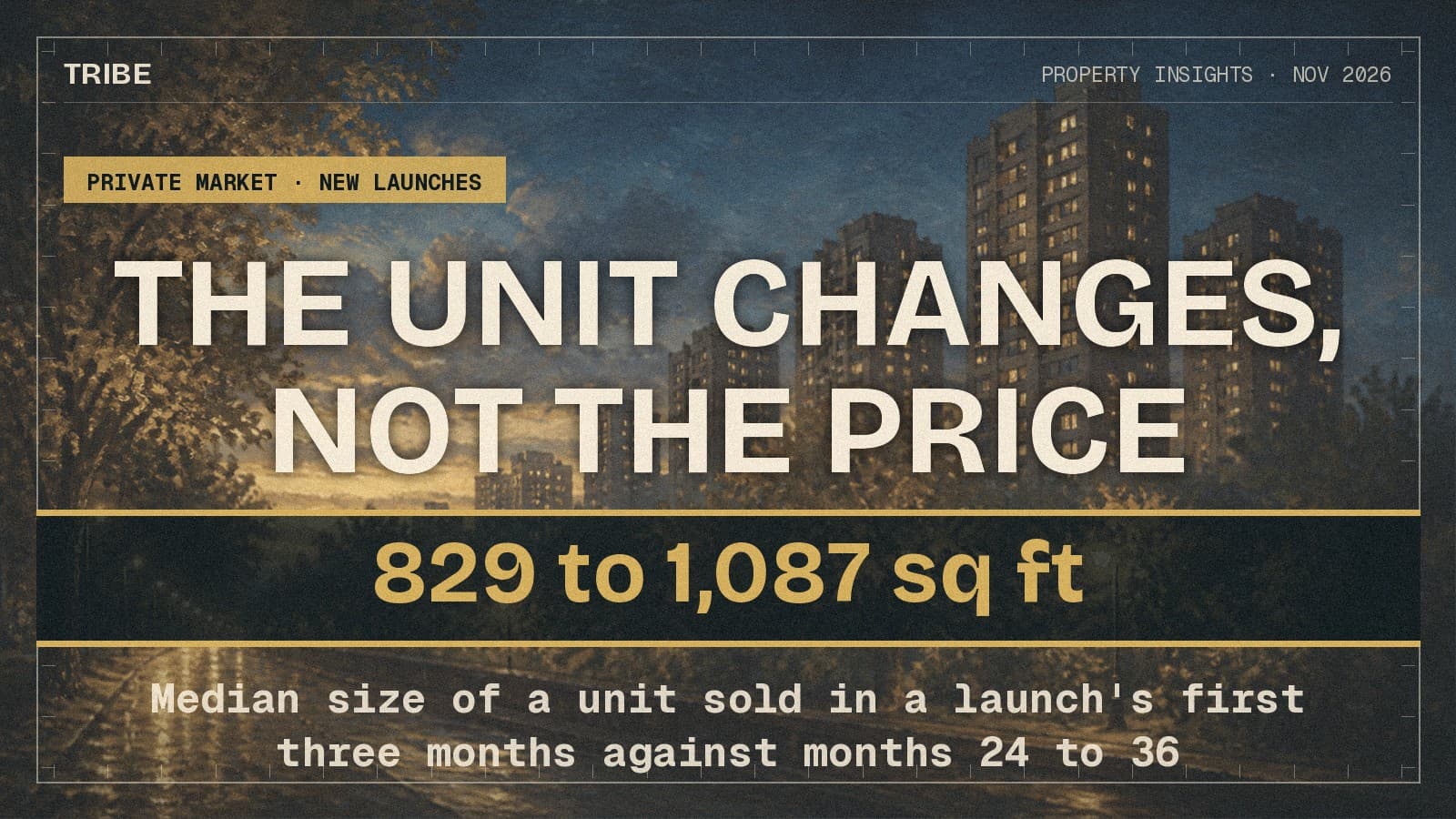
Waiting Out a Launch Changes the Unit More Than It Changes the Price
1 November 2026Private Property Market
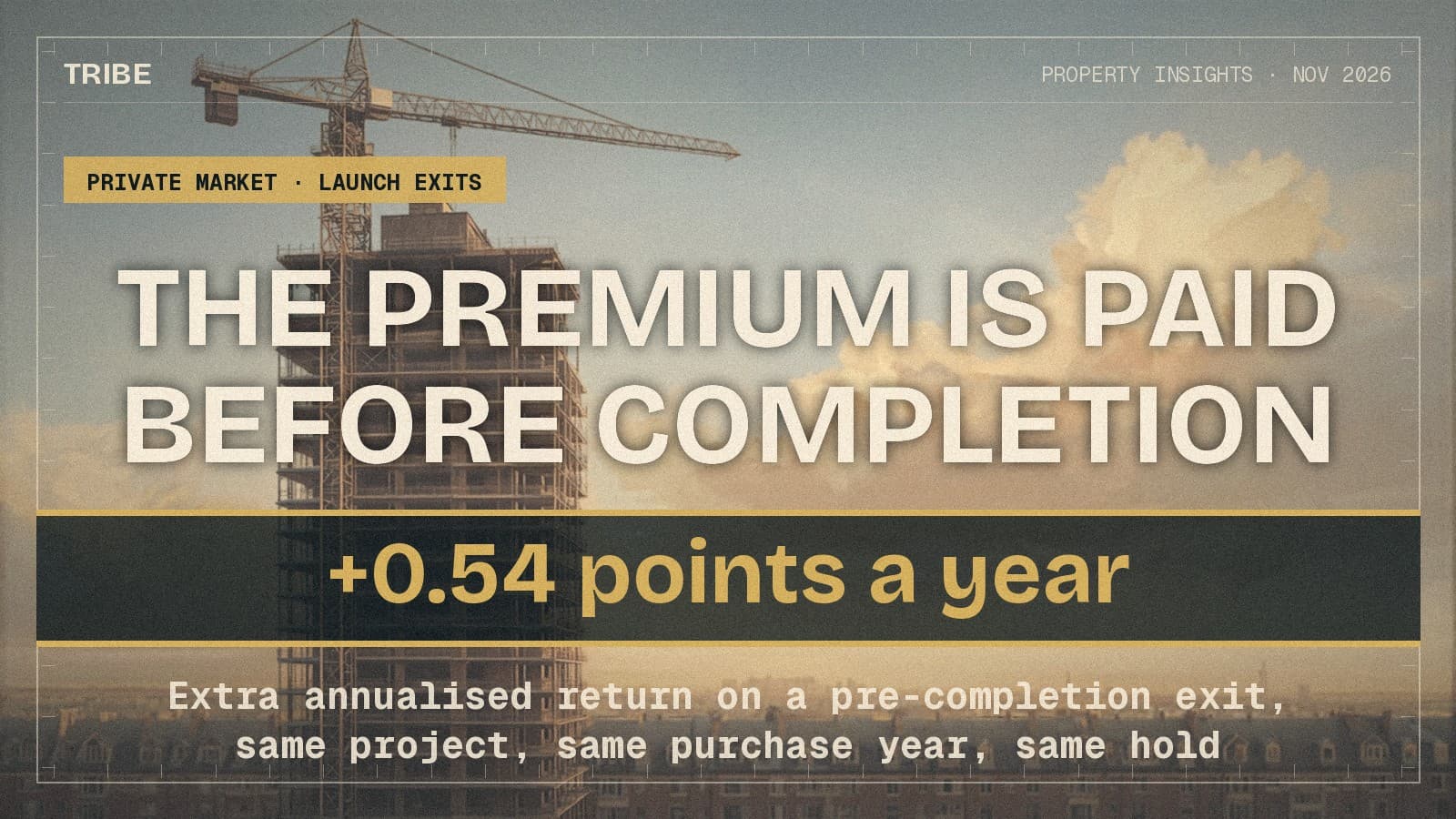
A Launch Sold Before Completion Earns Half a Point a Year More
Next step
TRIBE Research
Written with AI assistance from TRIBE's own data and the public sources listed, then checked against them. General information, not financial advice. How we write
Sources
- Application for TOP and CSC · Building and Construction Authority
- Fourth quarter 2023 real estate statistics and project completions · Urban Redevelopment Authority
- First quarter 2025 residential leasing and project completions · Savills Singapore
Data as of 14 June 2026.
How TRIBE scores and checks its analysis
Spotted an error, or a figure that has moved since publication? Tell us and we will correct it.
General information only, not financial, investment, legal or tax advice. It does not consider your own circumstances; check your own numbers before you commit.