Insights
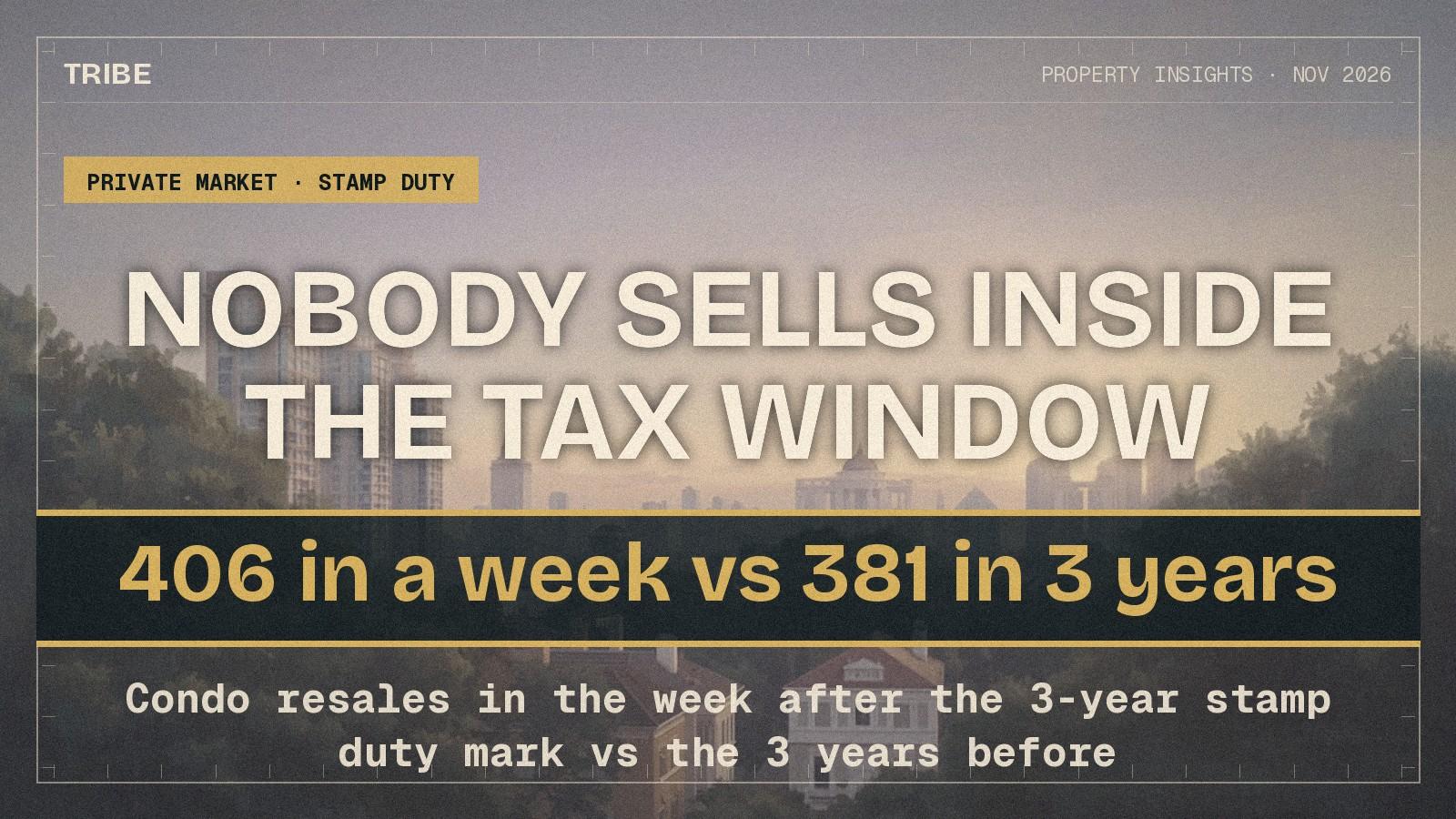
406 Sales in the Week the Stamp Duty Expired, 381 in the Three Years Before It.
Across 11,873 same-unit condo resales where the owner could have sold on any day, 406 sold in the seven days after their own three-year stamp duty mark and 381 in the entire three years before it. Buyers from July 2025 wait four years.
By TRIBE Research · 13 November 2026 · 9 min read
The decision
- Who this is for
- Anyone who bought a private home on or after 4 July 2025, and anyone buying one now, who may want to sell within five years
- The question
- When is my earliest exit without seller's stamp duty, and what does selling before it cost me?
- The short answer
- Four years from your purchase date, not three. Among 11,873 comparable resales, 406 units sold in the seven days after the old three-year mark and 381 in the entire three years before it, so almost nobody sells inside the window. Of those sellers, 36.4% used months 37 to 48, which the rules now tax at 4% of the sale price. On the median year-four exit that is $55,600, or 22.2% of the gain.
- Next step
- Put your own purchase date into the exit arithmetic before you plan a move, so you know which month your duty reaches zero and what an earlier sale costs at 4% of the sale price.
The numbers behind it
- 406 against 381Units sold in the week after the three-year stamp duty mark against the whole three years before it
- 36.4%Share of these resales that fell in months 37 to 48, the window the new rules tax at 4%
- $55,600Stamp duty now due on the median year-four exit at the 4% rate
Seller's stamp duty is usually filed under costs you hope never to pay. The transaction record files it somewhere else. It is the clearest single predictor of when a private home changes hands.
Across 11,873 same-unit condo resales where the owner bought an already-completed unit and could have sold on any day they chose, 406 units sold in the seven days after their own three-year stamp duty mark. In the entire three years before that mark, 381 sold. More units left in one week than in the preceding thirty-six months.
From 4 July 2025 that week moved. The duty now runs for four years, and the exit 36.4% of these sellers used is inside it.
The question in front of anyone who bought after July 2025
Nobody buys a home planning to sell it in year three. People nonetheless do: a posting, a baby, a separation, a second property they would rather fund with the first. The practical question is when that becomes possible without a tax bill.
Under the rules that applied to purchases from 11 March 2017 to 3 July 2025, the answer was three years. Sell inside one year and the duty was 12% of the sale price, inside two 8%, inside three 4%, and after three years nothing. For a purchase on or after 4 July 2025 the schedule is 16%, 12%, 8%, 4% and then nothing after four years.
One extra year, one extra band. The question is whether that year is a technicality or a real constraint on real sellers.
The answer in plain language
It is a real constraint, and the record shows sellers already treat it as one. They do not sell inside the duty window. They wait for the day it reaches zero and then they sell, in numbers large enough to be visible at the resolution of a single week.
That is not a forecast. It is what 11,873 owners did under the old three-year rule. The same behaviour against a four-year rule puts the earliest realistic exit for a buyer from July 2025 twelve months later than for the buyer ahead of them.
The strongest supporting numbers
Counting each sale by the number of months the owner held the unit, the step sits exactly where the duty does:
| Months held at sale | Duty then due | Resales |
|---|---|---|
| 33 | 4% | 9 |
| 34 | 4% | 11 |
| 35 | 4% | 4 |
| 36 | 4% | 9 |
| 37 | nil | 766 |
| 38 | nil | 357 |
| 39 | nil | 322 |
| 40 | nil | 350 |
Month 37 is the busiest single month in the whole holding-period distribution, and it is more than double the months either side of it, which settle at 320 to 360. That excess is a queue clearing.
Taking each deal against its own purchase anniversary rather than a rounded month, 10 units sold in the fortnight ending at the three-year mark and 556 in the fortnight after it. Across the whole taxable period, only 381 of 11,873 sales, or 3.21%, happened while any duty was owing.
Why the obvious reading of that spike is wrong
The first objection is construction. A buyer at a new launch cannot resell a completed unit until the project completes, which typically takes three to four years, so a pile-up around month 37 could be nothing more than keys being handed over.
That is why the sample excludes it. Every unit here was bought at least a full calendar year after its project was completed, and every sale is a resale rather than a sub-sale, so each owner was free to sell on any day. The step is sharper in this sample than in the unfiltered one: 85 times the volume between month 36 and month 37, against 81 times across all 26,740 matched resales.
The second objection is habit. Three years is a round number, and people may simply think in anniversaries. The placebo answers that.
The controlled comparison
The old rules put a cliff at two years and another at three, and nothing at four. If the spikes are about tax, they should appear at the first two and not the third. They do:
| Anniversary | What it meant under the old rules | Fortnight before | Fortnight after | Ratio |
|---|---|---|---|---|
| Two years | Duty falls from 8% to 4% | 1 | 36 | 36.0x |
| Three years | Duty falls from 4% to nil | 10 | 556 | 55.6x |
| Four years | Nothing | 134 | 137 | 1.0x |
The four-year mark is the test that matters. It is as round a number as three, it sits inside the same sample, and it produces no step whatsoever. Sellers were not responding to anniversaries. They were responding to the rate.
What the new schedule does, then, is move a cliff that sellers demonstrably respect from month 37 to month 49. The window 36.4% of these owners used, months 37 to 48, now carries 4%:
| Median year-four exit | |
|---|---|
| Purchase price | $1,120,000 |
| Sale price | $1,390,000 |
| Holding period | 3.42 years |
| Gross gain | $260,000, or 21.74% |
| Duty at 4% of the sale price | $55,600 |
| Share of the gross gain | 22.2% |
| Gross annualised return | 5.91% |
| Annualised return after the duty | 4.65% |
The duty takes 1.26 percentage points a year off that return. In 216 of the 4,326 year-four sales, 4.99%, it would have exceeded the entire gross gain.
What this analysis does not prove
It does not prove the new rule will reproduce the old behaviour one year later. The cliff is the same shape, but the first purchases under it only reach their fourth anniversary in July 2029, and nobody has yet had to live with it.
It does not measure what waiting costs. An owner who holds twelve more months pays twelve more months of interest, maintenance and property tax, and carries the price risk in either direction. None of that is in these figures.
In this sample the owners who sold in months 49 to 60 recorded a median gross gain of $300,000 against $260,000 for the year-four sellers. That is history in a rising market, not a reason to expect waiting to pay.
Gains here are price to price on the same unit. They exclude rent, financing and interest, buyer's stamp duty and additional buyer's stamp duty, maintenance, property tax, agent commission, renovation and every other transaction cost, so the gross gain is larger than the money an owner kept. The duty figures are what the current schedule would charge on these sale prices, not what these sellers paid, since every one of them was taxed under the old rules.
Dates are registered transaction dates, which can lag the day an option was exercised, and duty is assessed on that earlier date, so the precise day of the step is approximate. Its size cannot be explained by a few weeks of lag. Sales are observed only on units that sold, so owners still holding at a loss are absent, and executive condominiums, landed homes and HDB flats are outside the dataset.
What this means for a buyer or a seller
If you are buying now, your earliest clean exit is the day after your fourth anniversary, and you should know that date before you sign rather than discover it later. The purchase date on your option, not the completion date and not the date you move in, is the one that starts the clock.
If you may have to sell before then, the cost is not an abstraction. It is 4% of the sale price in year four, rising to 8% in year three and 12% in year two, charged on the whole sale price rather than on the gain. On a $1,390,000 sale that is $55,600, $111,200 and $166,800 respectively, whether or not the sale makes money.
If you are deciding between a home you might outgrow in four years and one you would keep for six, the duty belongs in that comparison alongside the price. A four-year window is long enough that it should shape what you buy, not only when you sell.
Next step
The arithmetic is specific to your purchase date and your sale price. Work out which month your duty reaches zero, what an earlier sale would cost, and whether the plan you have in mind clears it.
Send us your purchase date, your purchase price and the year you expect to move, or run the dates yourself on the Exit Strategy Forecast. The rate schedule and both regimes are set out on IRAS.
Sample: 11,873 same-unit private condominium resales drawn from TRIBE's own transaction dataset, with sales registered between 11 October 2021 and 2 October 2026 and purchases between 11 March 2017 and 6 May 2025, so every owner in the sample was taxed under the three-year seller's stamp duty schedule. Each unit was bought at least one full calendar year after its project was completed and sold as a resale rather than a sub-sale, which removes construction lock-in and leaves the owner free to sell on any day. The sample covers 1,485 projects across 26 districts: 6,211 sales outside the central region, 3,912 in the rest of the central region and 1,750 in the core central region. The unfiltered comparison uses all 26,740 matched resales by buyers under the same schedule. Holding periods are measured from the recorded purchase date to the recorded sale date; registered dates can lag the date an option was exercised. Gains are price to price on the same unit and exclude rent, financing and interest, stamp duties, maintenance, property tax, agent commission, renovation and all transaction costs. Duty figures apply the current schedule to these sale prices and are not what these sellers paid. Figures are medians unless stated. This article is general information about market data and rules in force at the date shown, not advice on any particular property, transaction or tax position.
Your next step
Bought on or after 4 July 2025 and may need to sell inside five years? Send us your purchase date, your purchase price and the year you expect to move. We will show you the month your duty reaches zero and what an earlier exit costs you.
A consultant replies on WhatsApp. No registration, no obligation.
Prefer a personal read on your situation? Arrange a consultation →Keep reading
21 November 2026Private Property Market
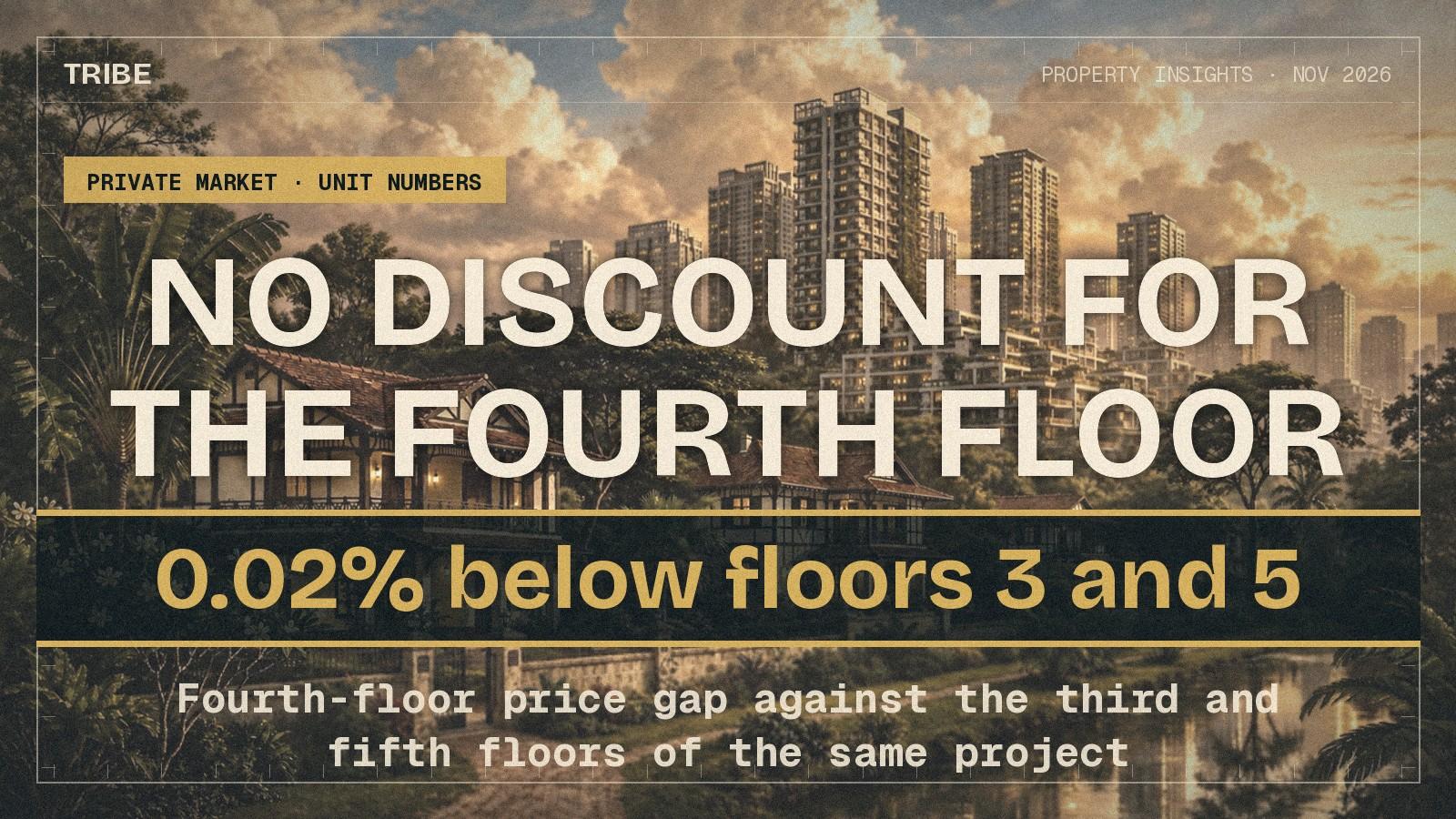
No Discount for the Fourth Floor. Moving One Storey Up to Avoid It Costs 0.67%.
20 November 2026Private Property Market
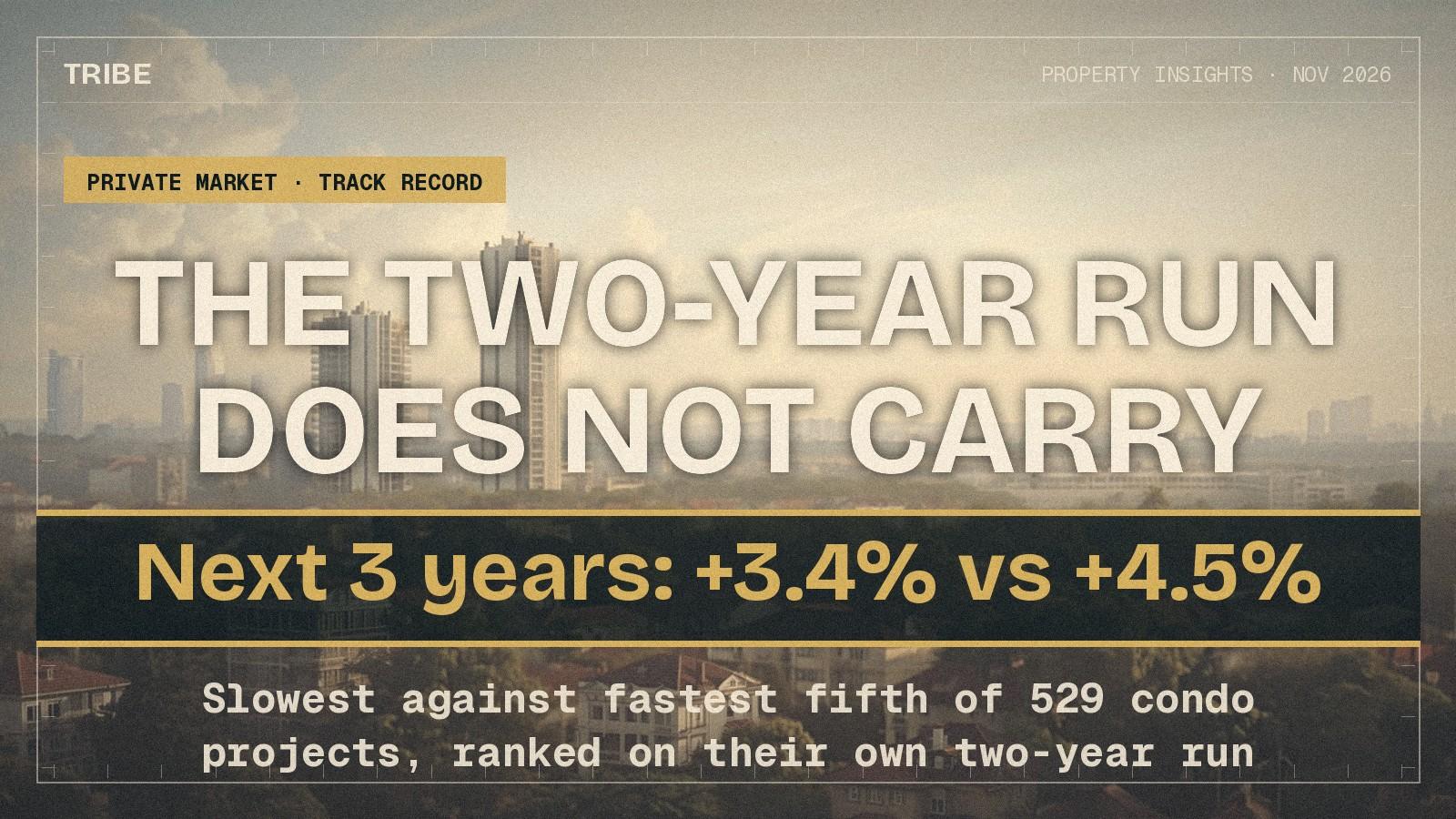
The Two-Year Run Does Not Carry. The Ten-Year Record Is Worth 3.5 Points.
17 November 2026Private Property Market
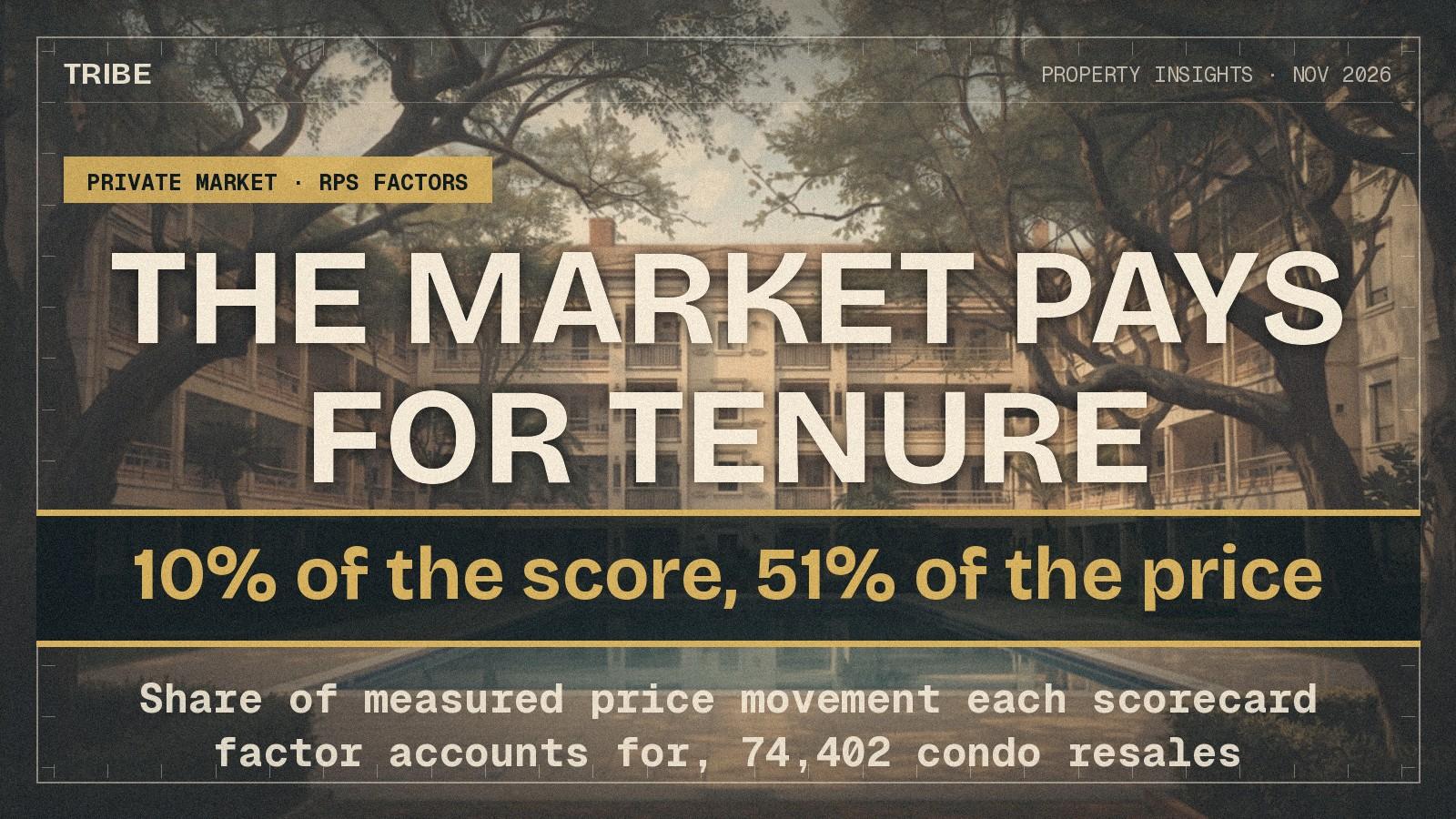
Tenure Is 10% of the Score and 51% of What the Market Pays
Next step
TRIBE Research
Written with AI assistance from TRIBE's own data and the public sources listed, then checked against them. General information, not financial advice. How we write
Sources
- Seller's Stamp Duty (SSD) for Residential Property (rates and holding periods by date of acquisition) · Inland Revenue Authority of Singapore · retrieved 13 November 2026
- Extension of the Holding Period of Seller's Stamp Duty and Higher SSD Rates · Monetary Authority of Singapore · retrieved 13 November 2026
Data as of October 2026.
How TRIBE scores and checks its analysis
Spotted an error, or a figure that has moved since publication? Tell us and we will correct it.
General information only, not financial, investment, legal or tax advice. It does not consider your own circumstances; check your own numbers before you commit.