Insights
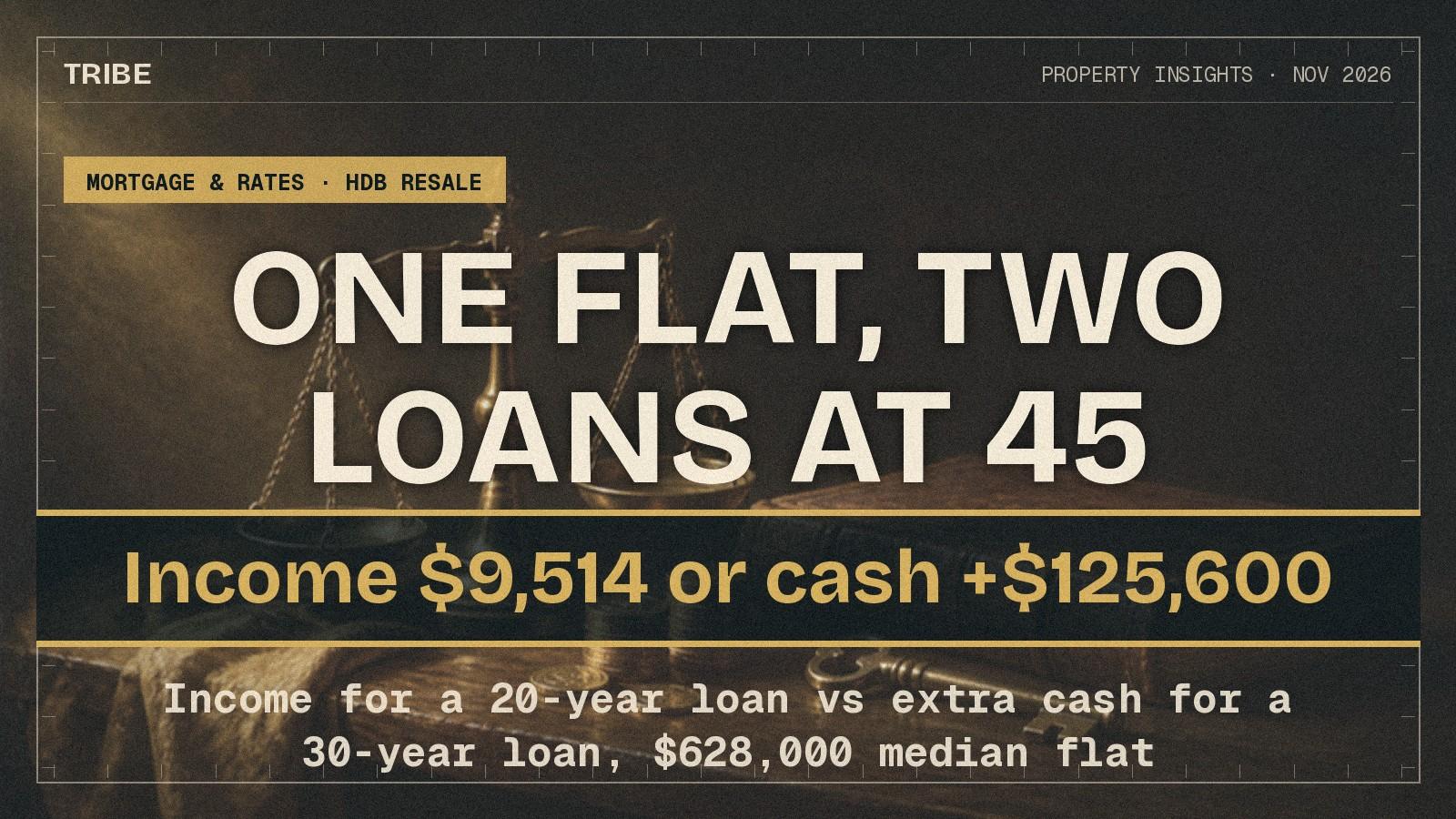
One Flat, Two Loans at 45. Either $9,514 a Month of Income or $125,600 More Cash.
MAS lets a 75% loan run only to age 65. On the median four-room resale flat at $628,000, a 45-year-old's 20-year loan needs $9,514 a month of household income. Stretching to 30 years cuts that to $5,497, but drops the loan to 55% and asks $125,600 more in cash and CPF. Before 41, the rule costs nothing.
By TRIBE Research · 9 November 2026 · 9 min read
The decision
- Who this is for
- People aged 40 and over buying an HDB resale flat with a bank loan
- The question
- Does my age change what this flat costs me, and is a longer loan the answer?
- The short answer
- Yes, from 41 onwards. A 75% loan must be repaid by 65, so each year after 40 shortens the loan and raises the household income the bank needs to see. On the $628,000 median four-room flat, that is $8,287 a month at 40 and $9,514 at 45. The 30-year loan lowers the income bar to $5,497, but cuts the loan to 55% and asks $125,600 more in cash and CPF.
- Next step
- Run your own age, town and household income through the Age-to-Mortgage Projection before you shortlist flats, so you know which of the two routes your numbers clear.
The numbers behind it
- $9,514 a monthHousehold income a 45-year-old needs for a 20-year loan on the median four-room flat
- $125,600Extra cash and CPF needed to take the 30-year loan instead on the same flat
- 91.8%Rise in the income needed for the same flat between ages 40 and 55
A bank may lend 75% of an HDB flat's price only if the loan is repaid by the borrower's 65th birthday. For a 40-year-old that is no constraint at all, because 25 years is already the longest tenure a 75% loan on an HDB flat can run. For a 45-year-old buying the same flat, the loan has to fit into 20 years, and the household income the bank must see rises from $8,287 a month to $9,514.
The flat has not changed. The price has not changed. One number on the application form has, and after 40 it tightens every year.
The question a buyer over 40 is actually facing
Most affordability advice treats age as background. It is not. Two rules from the Monetary Authority of Singapore turn it into the single variable that decides what a flat costs you, and they pull in opposite directions.
The first sets the loan at 75% of price for a buyer with no other housing loan, on the condition that the loan ends by 65. The second lets you run the loan longer, to a maximum of 30 years on an HDB flat, at the price of a loan-to-value limit 20 percentage points lower, so 55% instead of 75%.
So a buyer over 40 is not choosing a loan tenure. They are choosing which constraint to be bound by: monthly income, or cash on hand.
The answer in plain language
Take the national median four-room resale flat. Across 6,005 registered four-room resale transactions from May to October 2026, the median price was $628,000.
At 45, the two routes on that flat look like this. Both assume one housing loan, no other debt, and the assessment rate MAS requires the bank to use, which is the higher of 4% a year or the loan's thereafter rate.
| 20-year loan, 75% | 30-year loan, 55% | |
|---|---|---|
| Loan | $471,000 | $345,400 |
| Instalment at the 4% assessment rate | $2,854 a month | $1,649 a month |
| Household income needed, MSR 30% | $9,514 a month | $5,497 a month |
| Cash and CPF needed | $157,000 | $282,600 |
The longer loan cuts the income you must prove by 42.2%. It raises the cash and CPF you must produce by $125,600, which is 80% more. Neither route is cheaper in any general sense. They are priced in different currencies, and which one you can pay is a fact about your household, not a preference.
What the rule costs at each age
Because the income test is a ratio, the shape of the cost is the same at every price. Here it is on the $628,000 median flat, on the 75% route.
| Age at purchase | Longest 75% loan | Household income needed | Against age 40 |
|---|---|---|---|
| 30 to 40 | 25 years | $8,287 | — |
| 41 | 24 years | $8,489 | +2.4% |
| 45 | 20 years | $9,514 | +14.8% |
| 48 | 17 years | $10,619 | +28.1% |
| 50 | 15 years | $11,613 | +40.1% |
| 55 | 10 years | $15,895 | +91.8% |
Two things in that table matter more than the individual numbers.
The first is that nothing happens before 41. A 32-year-old and a 40-year-old face an identical bar, because the 25-year tenure cap binds first and the age rule has no work to do. Buyers often assume the penalty accrues smoothly from their twenties. It does not begin at all until 40.
The second is that the yearly cost accelerates. The step from 40 to 41 is $202 a month. The step from 54 to 55 is $1,174. The rule is cheap when it starts and expensive by the time most people notice it.
Why comparing towns misleads a buyer over 40
The usual response to an affordability problem is to look at a cheaper town. On our six months of data that lever is real but bounded. The dearest four-room median was Queenstown at $1,056,888 and the cheapest was Jurong West at $525,000, across the 24 towns with at least 30 four-room transactions. Moving from the dearest town to the cheapest cuts the required income by 50.3%.
A 15-year delay raises it by 91.8%. No town switch available in the data offsets it. For a buyer who is 40 now, when they buy is a larger lever on what they can borrow than where they buy, and it is the only one of the two that is still in their hands.
The controlled comparison: same flat, different buyer
Everything above holds the flat still. Same town, same price, same loan-to-value, same assessment rate, same assumption of no other debt. The only input that moves is the buyer's age, which is what isolates the rule from everything else that makes flats expensive.
The second route, the 55% loan, works the same way. Because the gap between the two routes is a fixed 20 percentage points of price, the extra cash it demands scales with the town.
| Town | Median four-room | Income needed, 20y at 75% | Income needed, 30y at 55% | Extra cash and CPF |
|---|---|---|---|---|
| Queenstown | $1,056,888 | $16,011 | $9,251 | $211,378 |
| Toa Payoh | $1,027,000 | $15,559 | $8,989 | $205,400 |
| Bukit Merah | $948,000 | $14,362 | $8,297 | $189,600 |
| Bishan | $768,444 | $11,642 | $6,726 | $153,689 |
| Tampines | $670,000 | $10,150 | $5,864 | $134,000 |
| Sengkang | $638,000 | $9,665 | $5,584 | $127,600 |
| Bedok | $600,000 | $9,090 | $5,252 | $120,000 |
| Woodlands | $545,000 | $8,256 | $4,770 | $109,000 |
| Jurong West | $525,000 | $7,953 | $4,595 | $105,000 |
The escape hatch costs $105,000 in Jurong West and $211,378 in Queenstown, a spread of 2.01 times. The towns where a 45-year-old is most likely to need the longer loan are exactly the towns where taking it demands the most cash.
What this does not prove
This is the arithmetic of a published rule applied to observed prices. It is not a claim about what will happen to prices, and not a statistical finding about buyers.
Town medians here are not quality-matched. They pool remaining lease, storey, floor area and flat model, so a flat transacting at a town's median is not a standard flat. We showed last week that matching on remaining lease moves town figures by as much as 21.7 percentage points, and the same caution applies to every median in the tables above. Use them as the scale of the decision, not as a valuation.
The 4% assessment rate is a regulatory floor for testing capacity, not a forecast and not what you would pay. The same $471,000 over 20 years costs $2,519 a month at a 2.60% package rather than $2,854. These figures answer what a bank will lend, not what the month will feel like.
The income figures are gross recognised household income with no other debt. Variable income takes a 30% haircut in the MAS calculation, and a car loan or any other commitment would raise the bar further. They also assume the Mortgage Servicing Ratio of 30% binds, which it does for an HDB flat whenever the household carries no other large debt; a household with other loans may be bound by the 55% Total Debt Servicing Ratio instead.
Nothing here models CPF Ordinary Account balances, which is usually the real limit on the 55% route rather than the price itself. And HDB's own concessionary loan is a separate product with separate terms, not modelled above.
What this means for a real buyer
If you are 38 and thinking about moving in three years, the rule is about to start charging you, and the first years are the cheap ones. Buying at 40 rather than 43 is worth $665 a month of required income on a $628,000 flat.
If you are 45 and the $9,514 bar is out of reach, the 30-year loan is a real option rather than a worse one, but it is a cash question. You need $282,600 of cash and CPF against $157,000, and that is before Buyer's Stamp Duty of $13,440 on a $628,000 flat, legal fees, agent fees and renovation. Check the CPF balance first, because that is what decides it.
If you are over 50, run the numbers before you shortlist. At 55 the 75% route on the median flat asks $15,895 a month. In Queenstown, the dearest town in our table, a 45-year-old is already past that figure at $16,011.
One cost the longer loan does carry: at a 2.60% package, the 30-year 55% loan pays $152,398 of interest over its life against $133,524 for the 20-year 75% loan, despite being $125,600 smaller.
Next step
Put your own age, household income and target town into the Age-to-Mortgage Projection. It applies the same two MAS rules used above and shows both routes side by side, including what a three-year wait does to each. The Affordability Assessment does the same from the income side if you want to start from what you earn rather than from a flat you have seen.
Computed from 13,829 registered HDB resale transactions for May to October 2026, of which 6,005 were four-room flats, retrieved from data.gov.sg on 9 November 2026; town figures cover the 24 towns with at least 30 four-room transactions in the period. Loan rules are MAS limits for an individual borrower with no outstanding residential property loan, read on 9 November 2026. Income figures are gross recognised monthly household income under the 30% Mortgage Servicing Ratio at the required assessment rate, assuming no other debt. They exclude Buyer's Stamp Duty, legal and agency fees, renovation, property tax, the HDB resale levy where it applies, and any housing grants. Median prices are not matched for remaining lease, storey, floor area or flat model. General information, not financial advice; your own figures depend on your lender's assessment.
Your next step
Over 40 and shortlisting HDB resale flats? Send us your age, target town and household income. We will show you which of the two loan routes your numbers clear, and what the shorter loan costs each month.
A consultant replies on WhatsApp. No registration, no obligation.
Prefer a personal read on your situation? Arrange a consultation →Keep reading
23 October 2026Mortgage & Rates
The New Income Ceiling Buys 11% More Loan — at a Point More Interest

11 October 2026Mortgage & Rates
Three Weeks Ago, Certainty Cost One Basis Point. It Still Does — If Your Loan Is Big Enough.

4 October 2026Mortgage & Rates
Floating Only Wins Now If SORA Falls. Here Is the Breakeven.
Next step
TRIBE Research
Written with AI assistance from TRIBE's own data and the public sources listed, then checked against them. General information, not financial advice. How we write
Sources
- Macroprudential Policies in Singapore (LTV limits, maximum tenure, TDSR and MSR caps) · Monetary Authority of Singapore · retrieved 9 November 2026
- Rules for New Housing Loans · Monetary Authority of Singapore · retrieved 9 November 2026
- Resale Flat Prices (registered resale transactions) · Housing & Development Board via data.gov.sg · retrieved 9 November 2026
Data as of October 2026.
How TRIBE scores and checks its analysis
Spotted an error, or a figure that has moved since publication? Tell us and we will correct it.
General information only, not financial, investment, legal or tax advice. It does not consider your own circumstances; check your own numbers before you commit.