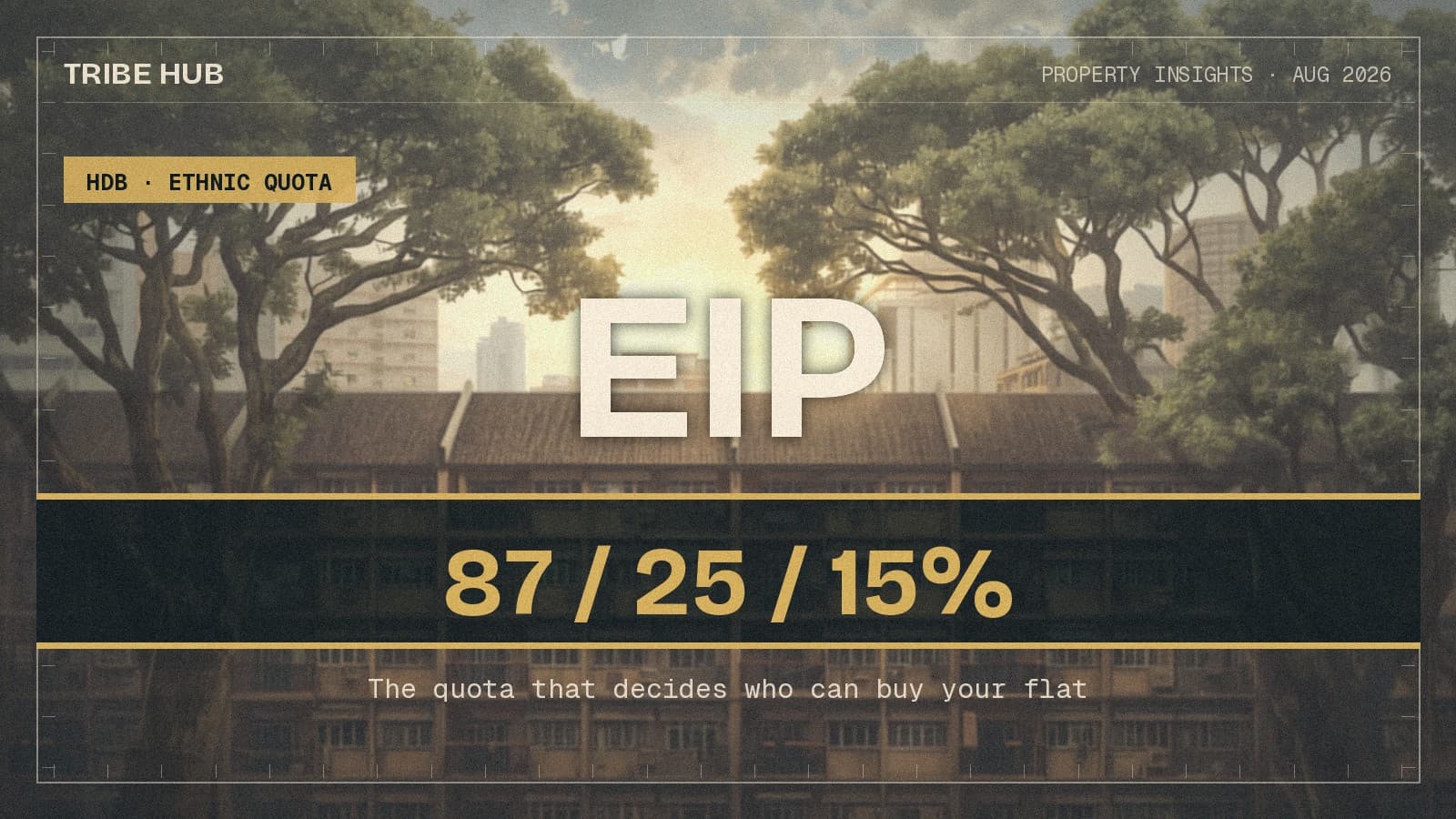
Insights
The Quota That Decides Who Is Allowed to Buy Your Flat
Two HDB quotas can remove most of your buyers before you list. Most published guides print the block and neighbourhood limits the wrong way round — and the group with the least room to spare is not the one people assume.
By TRIBE Editorial · 11 August 2026 · 6 min read
Every other constraint on an HDB sale is about money. The Ethnic Integration Policy is not. It is a rule about who is legally permitted to buy the flat you own, and when it binds it can remove more than eight in ten potential buyers from your market in a single stroke — without changing your valuation, your lease, or anything a listing would show.
It is also the rule most often printed incorrectly. A large share of the 2026 guides currently circulating have the block and neighbourhood limits transposed. The direction matters, because the tighter of the two numbers is the one that decides your sale.
The actual limits
From HDB's own release setting the current figures, the maximum ethnic limits are:
| Ethnic group | Neighbourhood | Block |
|---|---|---|
| Chinese | 84% | 87% |
| Malays | 22% | 25% |
| Indians & Others | 12% | 15% |
Note the direction. The neighbourhood limit is the tighter one in every row; the block limit sits two to three percentage points above it. Guides that print "Chinese 84% block, 87% neighbourhood" have it backwards, and a seller who plans around the wrong number plans around a ceiling that does not exist.
Both limits apply at once. A flat can be inside its block limit and still be blocked at neighbourhood level.
Running alongside it is a second, separate cap: the SPR quota, set at 5% at neighbourhood level and 8% at block level, applying to non-Malaysian Singapore Permanent Resident households. Malaysian SPRs are not subject to it. A non-Malaysian SPR buyer must satisfy both the EIP and the SPR quota — clearing one is not enough.
What actually happens when a limit is reached
The rule is not "no sales in this block." It is narrower than that, and the exemption is the part worth understanding.
When a group's limit has been reached, a transaction that would increase that group's proportion is not allowed. A transaction that leaves the proportion unchanged still is. In practice that means a seller in a capped block can still sell — but only to a buyer of the same ethnic group, because that swap adds nothing to the count.
The SPR quota works identically. If a block is at its SPR limit, a Citizen seller or a Malaysian-SPR seller cannot sell to a non-Malaysian SPR household. But a non-Malaysian SPR seller still can, because replacing one such household with another does not raise the total.
So the constraint does not freeze the flat. It replaces an open market with a single-group market.
What that costs in buyers
This is where the asymmetry sits, and it is arithmetic rather than opinion. Singapore's resident population as at June 2025, from the Department of Statistics series on data.gov.sg, is 4,204,515, split as follows.
| Group | Residents | Share | Buyer pool if your block is capped | Share of buyers lost |
|---|---|---|---|---|
| Chinese | 3,109,075 | 73.95% | 73.95% | 26.05% |
| Malays | 569,134 | 13.54% | 13.54% | 86.46% |
| Indians & Others | 526,306 | 12.52% | 12.52% | 87.48% |
A Chinese seller in a block that has hit the Chinese limit keeps roughly three-quarters of the resident buyer pool. A Malay seller in a block at the Malay limit keeps about one in seven. The same rule, the same block, and a difference of sixty percentage points in how many people are allowed to make an offer.
None of that changes the flat's valuation. It changes how long you wait and how much competition sets your price — which is the part that shows up in the eventual transacted number rather than in the HDB valuation.
The limit that is easiest to hit
There is a second, less obvious asymmetry. Compare each group's national share against its own block cap:
| Group | National share | Block cap | Headroom |
|---|---|---|---|
| Chinese | 73.95% | 87% | 13.05pp |
| Malays | 13.54% | 25% | 11.46pp |
| Indians & Others | 12.52% | 15% | 2.48pp |
Indians and Others sit 2.48 percentage points below their own ceiling nationally, against 13.05 points for Chinese households. A group that close to its cap on the national average will hit that cap in far more individual blocks — a modest local concentration is enough. The Indian and Others limits were in fact raised in 2010, from 10% and 13% at neighbourhood and block level to the current 12% and 15%, precisely to widen that margin.
The timing detail that catches sellers
Quota status is updated on the first day of each month and holds for the rest of that month. Prevailing EIP and SPR quotas for each listing are shown on the HDB Flat Portal.
Two consequences follow. A block that is open when you list can close on the 1st, mid-negotiation, and a buyer who was eligible in July may not be in August. It also cuts the other way: a block that is capped this month can reopen next month if a household of that group moves out. The status is checked when the resale application reaches HDB — not when you granted the option.
That gap between granting an option and submitting the application is where the risk lives. It is worth checking the portal for the specific block before granting an option, and again before submitting, rather than assuming a status that was true a month ago.
What to do with this
If you are selling, check your block's status before you price the flat, not after an offer falls through. A capped block does not mean a lower valuation, but it does mean a thinner queue, and the marketing period should be planned for that rather than discovered.
If you are buying, the quota is a reason a flat may be sitting unsold that has nothing to do with the flat. It can be an opportunity when you happen to be in the group the block still has room for — and it is a hard stop when you are not, regardless of how strong your offer is.
Either way it is one of the few constraints in Singapore property that money cannot solve. Worth knowing which side of it you are on before you commit to a price.
Sources: HDB, EIP and SPR Quota; Housing & Development Board press release and annexes, 5 March 2010, setting the current Indians & Others limits and introducing the SPR quota; Department of Statistics resident population by ethnic group, June 2025, via data.gov.sg. Population shares computed from the published counts. Quota status is block-specific and changes monthly — check the HDB Flat Portal for any particular flat.
Methodology published. No spin.
Know what you can afford
Loan, stamp duty, CPF, and monthly repayments — work out your real budget before you commit. No registration required.
Plan my purchase →Prefer a personal read on your situation? Arrange a consultation →Keep reading


TRIBE Editorial · Reviewed by Silas Tan
Co-Founder, TRIBE · District Director, Huttons Asia · Ex-Mortgage Banker (AVP) · >1,000 families advised · CEA R000303I
How TRIBE scores and checks its analysis
Spotted an error, or a figure that has moved since publication? Tell us and we will correct it.
This article is for informational purposes only and does not constitute financial or investment advice.