Insights
What You Need to Know About Primary School Registration Vacancies
MOE fixes every school's Primary 1 places before the exercise opens, then splits them across the phases by a published formula. Here is the formula, where the numbers are posted, what the 2026 exercise showed, and what changes at 12 schools from 2027.
By TRIBE Editorial · 10 September 2026 · 13 min read
Yes, it is public. The Ministry of Education publishes both the rules for splitting each school's Primary 1 places across the registration phases and the per-school numbers at every phase, updated within days of each phase closing. What is less well understood is how the split actually works, and what the numbers say about where the squeeze really is. This piece walks through both, using MOE's published rules and the three years of Phase 2C data that feed our Resale Project Scorecard. Rules stated here are as at 10 September 2026, the day MOE announced the changes for 2027.
How a school's places are split across the phases
Every school's total Primary 1 intake is fixed by MOE before the exercise opens and posted on the MOE vacancies and balloting page before Phase 1 begins. Most schools have 180 places or more. From that total, the split works like this:
- Places are reserved before anything else. MOE sets aside 20 places for Phase 2B and 40 places for Phase 2C at every school. Phase 1 and Phase 2A cannot touch them.
- Phase 1 has no cap. Every child with a sibling already in the school gets a place.
- Phase 2A draws from what is left after Phase 1, minus the 60 reserved places. Phase 2A is for children with a parent or sibling who is a former student, children of staff and of school advisory or management committee members, and children from an MOE Kindergarten under the school's purview and located within it.
- Whatever remains after Phase 2A is split again. One-third goes to Phase 2B and two-thirds to Phase 2C, on top of the reserved 20 and 40.
- Unfilled places roll forward. Phase 2B places not taken up go into Phase 2C. Phase 2C places not taken up go to Phase 2C Supplementary. Anything left after that is what Phase 3, for children who are neither citizens nor permanent residents, gets.
A worked example makes the arithmetic concrete. Take a school with 210 places, which is seven classes of 30. This is an illustration, not a specific school.
| Step | Places | Open places after this step |
|---|---|---|
| Total intake | 210 | 210 |
| Reserved for Phase 2B (20) and Phase 2C (40) | 60 set aside | 150 |
| Phase 1 takes up | 70 | 80 |
| Phase 2A takes up | 50 | 30 |
| Split of the 30: one-third to 2B, two-thirds to 2C | 10 and 20 | 0 |
| Phase 2B pool | 20 reserved + 10 | 30 |
| Phase 2C pool | 40 reserved + 20, plus any 2B leftovers | 60 or more |
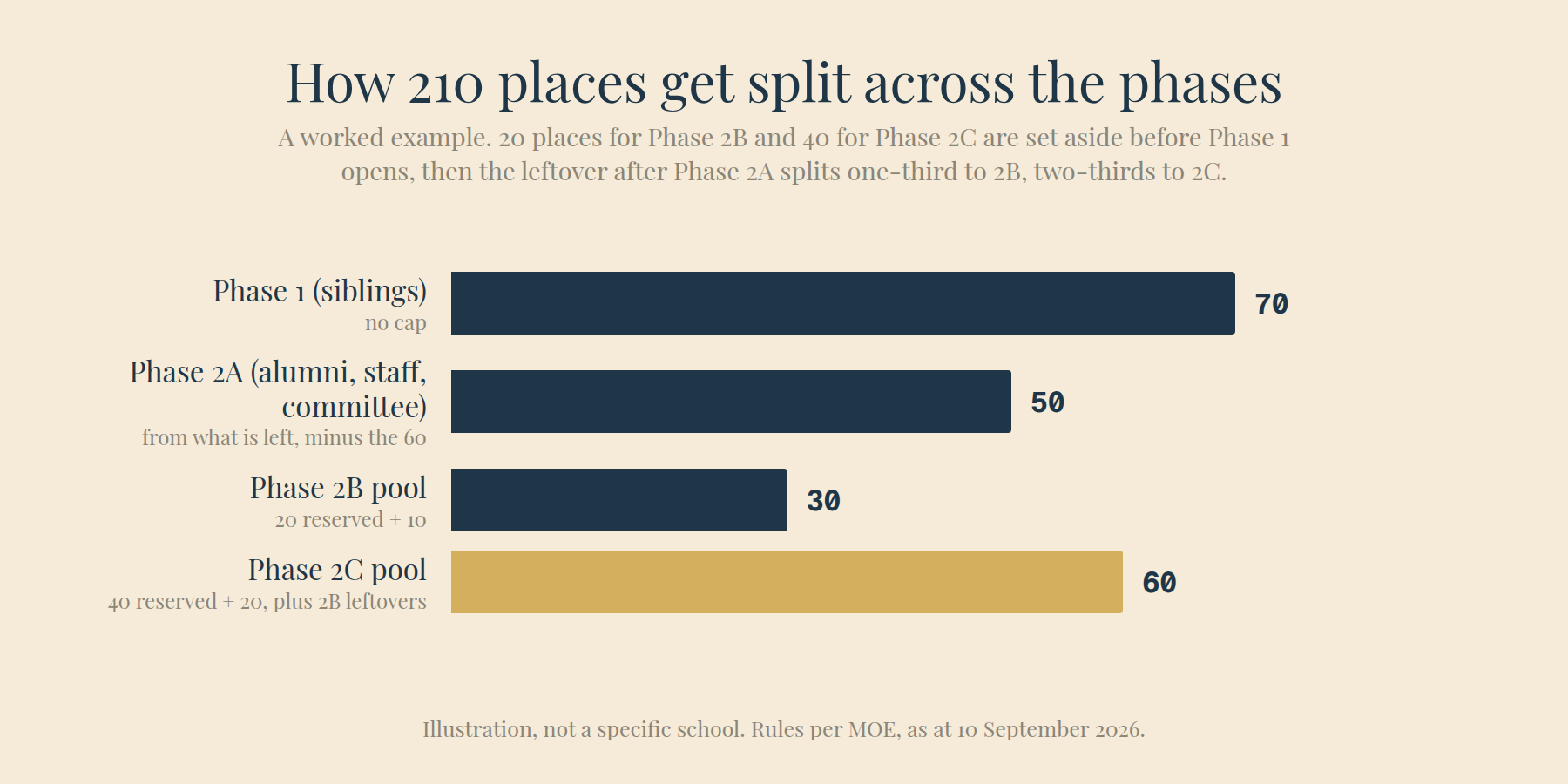
Two things follow from this. First, a school with a large Phase 1 and Phase 2A intake can still have a healthy Phase 2C, because the 40 reserved places are untouchable. Second, the Phase 2C pool is never known until Phase 2B closes, which is why MOE re-posts the vacancy figures the day before each phase opens.
Who gets priority when a phase is oversubscribed
From Phase 2A onwards, if a phase has more applicants than places, MOE ranks applicants in a fixed order before it ballots:
- Singapore citizens living within 1km of the school
- Singapore citizens living between 1km and 2km
- Singapore citizens living beyond 2km
- Permanent residents within 1km, then 1km to 2km, then beyond 2km
Everyone in a group above the cut-off gets in. Balloting only happens inside the one group where the places run out. When you read that a school "balloted for citizens within 1km", it means every within-1km citizen faced a draw and everyone further out had no chance in that phase.
Three fine-print rules matter for anyone buying a home for this purpose. The distance is not something you measure yourself. MOE keeps a per-school list of addresses that fall within 1km and 2km, and the OneMap school query is the place to check a specific address. The address is normally the one the child lives at when you register, with one exception: a property you have bought but not yet moved into can be used if its contractual vacant possession or delivery date falls within two years of the child entering Primary 1, which for the 2026 exercise means by the end of 2028. You undertake on the portal to move in by then and submit the sale agreement or, for an HDB flat, the agreement for lease. A probable completion date is not accepted. And if the address wins the place, the child must stay at it for at least 30 months. For an ordinary address the clock starts at the start of the exercise. For a new property used under the exception it starts on the day you move in, and for a resale property used under it, at the start of the child's first school term.
Where the numbers are published
MOE posts per-school vacancies before each phase, then applicant counts, whether a ballot was needed and for which group, after each phase closes. Results go out on the P1 Registration Portal from 8am on each results day. Several independent sites compile the MOE tables across years, and our own dataset does the same for Phase 2C, which is the phase where a family with no prior connection to the school enters and therefore the cleanest measure of demand. That dataset drives the Primary School Effect factor, weighted at 20%, on the Resale Project Scorecard.
What the 2026 exercise showed
The 2026 exercise, for children starting school in January 2027, ran to form, going by the press tallies of MOE's phase results. At Phase 2B, 33 of the 179 schools were oversubscribed and 31 balloted. At Phase 2C, 79 schools were oversubscribed and 73 balloted, with Princess Elizabeth Primary in Bukit Batok the most contested at 159 applicants for 40 places.
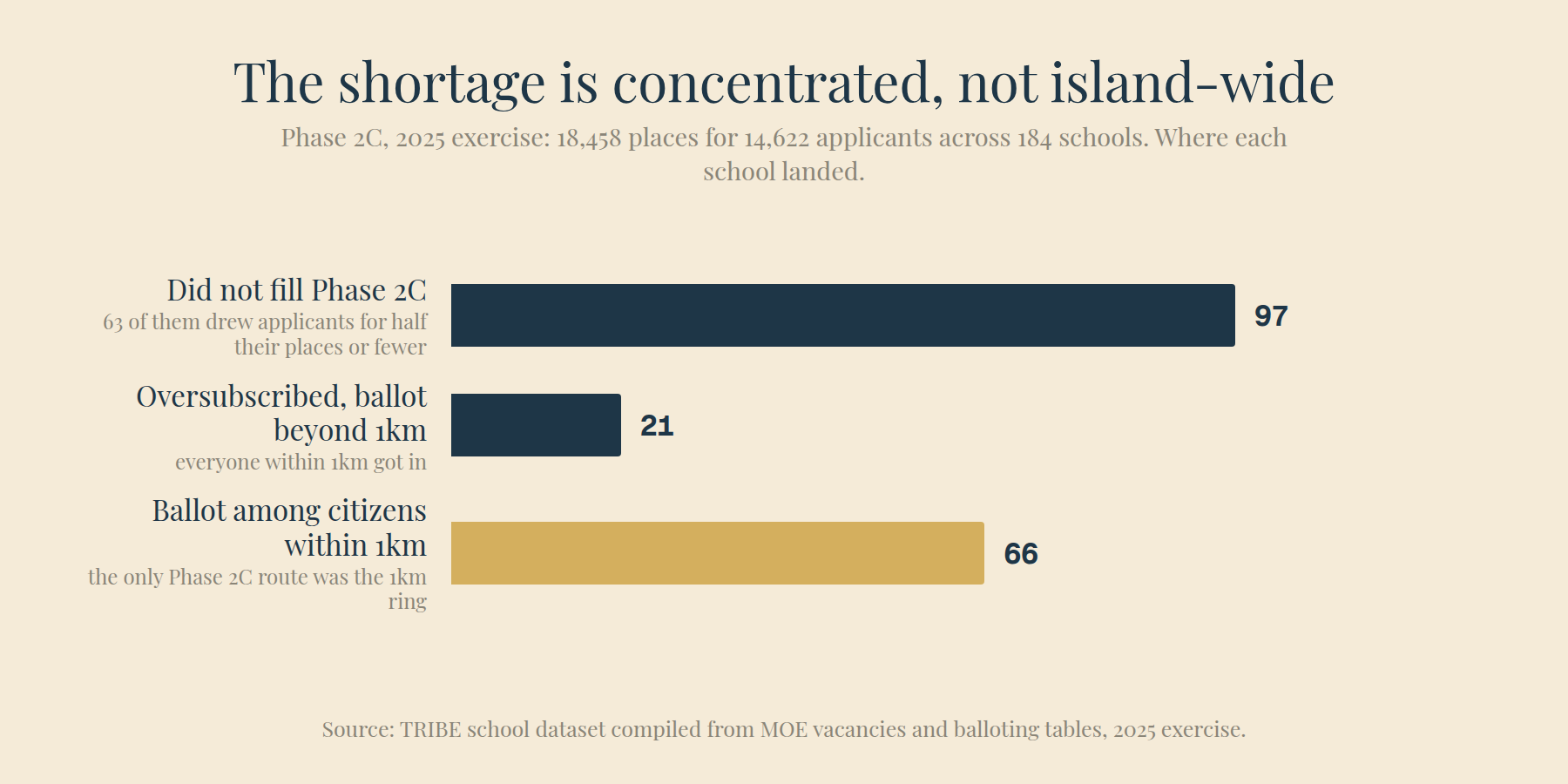
The headline hides the more useful number. Across the 184 schools in our dataset for the 2025 exercise, Phase 2C had 18,458 places and 14,622 applicants. Island-wide, there were about 26% more Phase 2C places than children applying for them. Yet 87 schools were oversubscribed, 66 of them balloting among citizens within 1km, while 63 schools drew applicants for half their places or fewer. The shortage is not island-wide. It is concentrated in 87 of 184 schools, and at three-quarters of those the draw was settled inside the 1km ring.
| School (2025 exercise, Phase 2C, MOE figures) | Applicants | Places | Ratio | Ballot decided among |
|---|---|---|---|---|
| Princess Elizabeth | 232 | 41 | 5.66 | Citizens within 1km |
| Nan Hua | 166 | 41 | 4.05 | Citizens within 1km |
| South View | 155 | 41 | 3.78 | Citizens within 1km |
| Northland | 142 | 40 | 3.55 | Citizens within 1km |
| Chongfu | 138 | 40 | 3.45 | Citizens within 1km |
All five sit in HDB towns: Bukit Batok, Clementi, Choa Chu Kang and Yishun. Phase 2C demand follows where young families live, not where the old brand names are.
What changes from the 2027 exercise
On 10 September 2026, MOE announced two changes that take effect from the 2027 exercise, for children starting Primary 1 in 2028.
Phase 2C reserved places go from 40 to 60 at every school with an intake of 180 or more. Schools with fewer than 180 places keep 40. The extra 20 places come out of the earlier phases, which in practice means a smaller Phase 2A pool.
Twelve schools move to a two-track Phase 2C. At schools where public housing makes up less than 40% of homes within 2km, the Phase 2C places will be split equally between two tracks, one for children living within 2km and one for children living beyond 2km. With 60 reserved places that means at least 30 in each track, and places carried into Phase 2C from the earlier phases are split the same way. Inside a track there is no home-school distance priority: a citizen 500m from the gate and a citizen 1.9km away rank the same. Citizens still come before permanent residents, a track with more applicants than places ballots, and places left unfilled in one track go to the applicants in the other. The twelve are Anglo-Chinese School (Junior), Anglo-Chinese School (Primary), CHIJ (Katong) Primary, Methodist Girls' School (Primary), Nanyang Primary, Ngee Ann Primary, Pei Hwa Presbyterian Primary, Raffles Girls' Primary, Singapore Chinese Girls' Primary, St Margaret's School (Primary), Tanjong Katong Primary and Tao Nan School.
Here is how those twelve looked at Phase 2C in the 2025 exercise, from our dataset:
| School | Applicants | Places | Ballot decided among |
|---|---|---|---|
| Nanyang Primary | 63 | 42 | Citizens within 1km |
| Tao Nan | 81 | 43 | Citizens within 1km |
| Pei Hwa Presbyterian | 84 | 40 | Citizens within 1km |
| Singapore Chinese Girls' | 58 | 41 | Citizens within 1km |
| Methodist Girls' | 78 | 45 | Citizens within 1km |
| ACS (Primary) | 96 | 66 | Citizens within 1km |
| ACS (Junior) | 95 | 60 | Citizens within 1km |
| Tanjong Katong | 83 | 53 | Citizens 1km to 2km |
| St Margaret's | 125 | 113 | No ballot, every citizen applicant placed |
| Raffles Girls' | 143 | 115 | Citizens beyond 2km |
| Ngee Ann | 148 | 126 | PRs within 1km |
| CHIJ (Katong) Primary | 71 | 107 | No ballot |
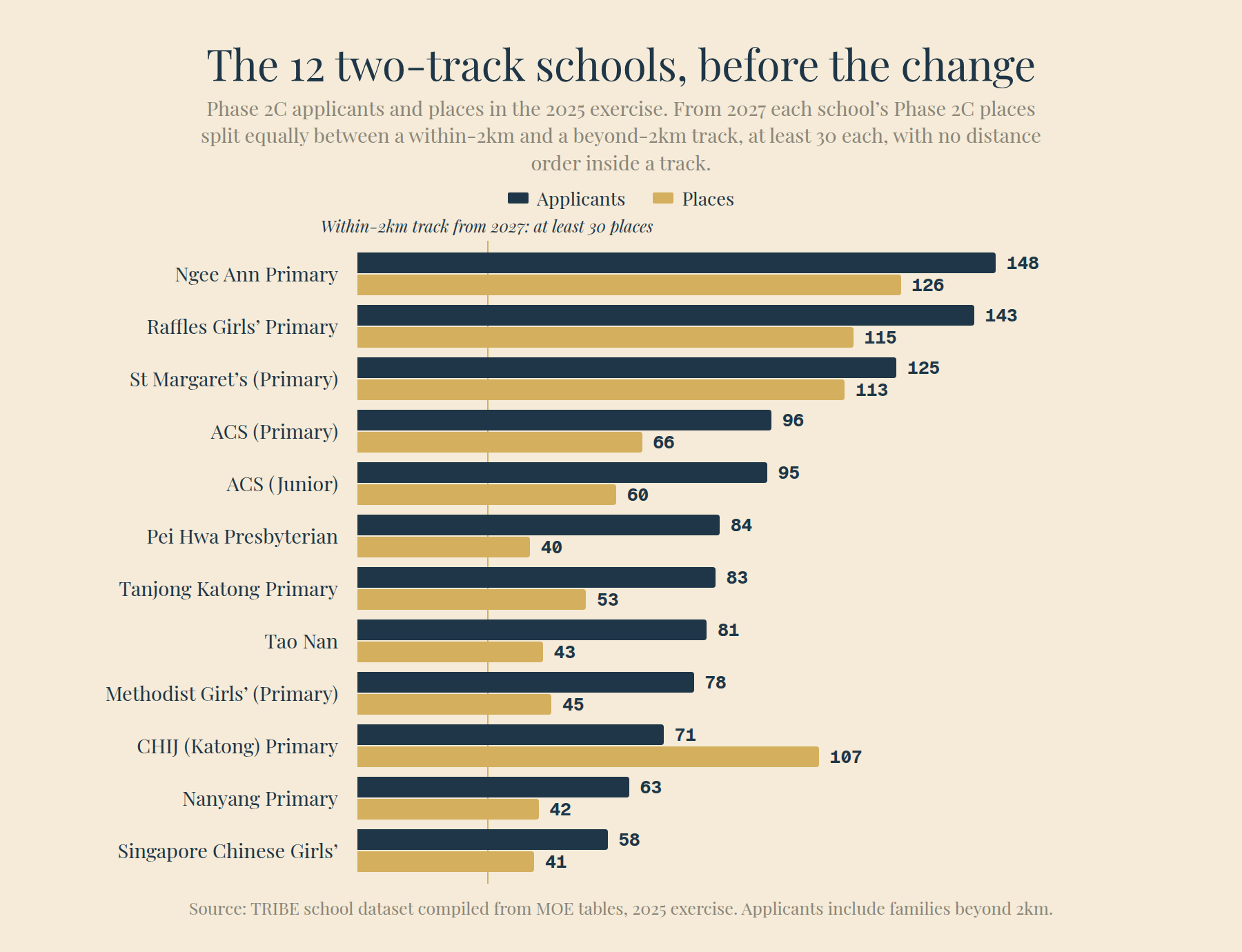
Seven of the twelve settled their 2025 ballot inside 1km. At those seven, two things change at once. The within-2km track holds half the Phase 2C pool, and the 1km ring counts for nothing inside it, so a family within 1km goes from first in line to an equal draw with every citizen out to 2km, for fewer places. Whether that draw ends up tighter than 2025's depends on the final pool and on how many families apply in each track, but the direction is clear. The beyond-2km track, on the other hand, opens a door that was effectively closed.
What this means before you buy near a school
The 1km premium is real, and it is real at a specific list of schools. In the 2025 exercise, 66 schools balloted among citizens within 1km. At those schools, an address inside the ring is the only Phase 2C route that works. Whether buyers pay a premium for it is a pricing question the registration data alone cannot settle, and our read that they do is editorial. At the roughly 100 schools that did not fill Phase 2C, the same address buys nothing the registration system would not have given you anyway. Before you pay for proximity, check which group the school's ballot was actually decided in, across three years, not one.
For the twelve two-track schools, the logic shifts from 2027. Inside the within-2km track, 1km buys nothing: every citizen within 2km ranks the same, for half the pool. A buyer weighing a Bukit Timah or Katong purchase mainly for one of these schools should re-run the numbers on a track of at least 30 places with no distance order, rather than on the old pool.
Timing is the part most families get wrong. The usual case is an address the child already lives at, held for 30 months from the start of the exercise. A resale unit you can move into before the exercise is the simplest route. A new launch can work too, but only under MOE's exception: vacant possession within two years of the child starting Primary 1, an undertaking to move in, and the 30 months counted from the day you do. A launch that completes later than that does not qualify, however close it is to the gate. The Primary School Effect on the Resale Project Scorecard uses this same three-year Phase 2C history for every condo it scores, so a project next to a school that never ballots gets no school uplift, and one inside the ring of a school that ballots every year does. Check the school's ballot history first, then the home.
Sources: Allocation rules, reserved places and priority order per the Ministry of Education, Changes to the Primary 1 Registration Framework and Registration phases and key dates; per-school figures per the MOE vacancies and balloting page. 2026 exercise results per AsiaOne, 73 primary schools to ballot for Phase 2C places and SG School Finder, Phase 2B 2026. Changes from 2027 per MOE's press release of 10 September 2026, Enhancing the Primary One Registration Framework for Greater Access and Inclusivity, as reported by AsiaOne and Mothership. Address and 30-month rules per MOE, Address used for P1 registration and How distance affects priority admission. 2023 to 2025 Phase 2C applicant and vacancy figures per the TRIBE school dataset compiled from MOE's published tables, as used in the Resale Project Scorecard. The worked example is illustrative. Rules and figures as at 10 September 2026 and subject to MOE's further announcements. Revised 11 September 2026: corrected the two-track balloting rules, the uncompleted-property exception, the 30-month clock, the Phase 2A summary and South View's town.
Silas Tan is a District Director at Huttons Asia and co-founder of TRIBE. He built the Resale Project Scorecard (RPS) using 236,000+ URA REALIS transactions. This article is for informational purposes and does not constitute financial or investment advice. CEA Registration R000303I.
Check how your condo scores
2,357 condos independently scored across 7 weighted factors. No registration required.
Score my resale →Prefer a personal read on your situation? Arrange a consultation →Keep reading
19 September 2026Private Property Market
A 42-Year-Old Block, a Fourth Attempt, and a New Law Worth Two Signatures
18 September 2026Private Property Market
The Cheapest PSF and the Cheapest Apartment Are Two Different Units

17 September 2026Private Property Market
Seven Developers Bid for the Same Site. The Winner Still Paid 11% More Than Anyone Else.

TRIBE Editorial · Reviewed by Silas Tan
Co-Founder, TRIBE · District Director, Huttons Asia · Ex-Mortgage Banker (AVP) · >1,000 families advised · CEA R000303I
This article is for informational purposes only and does not constitute financial or investment advice.