Insights
Land Betterment Charge Rose in 70 Sectors on 1 September. One S$198 Million En Bloc Pays Nothing.
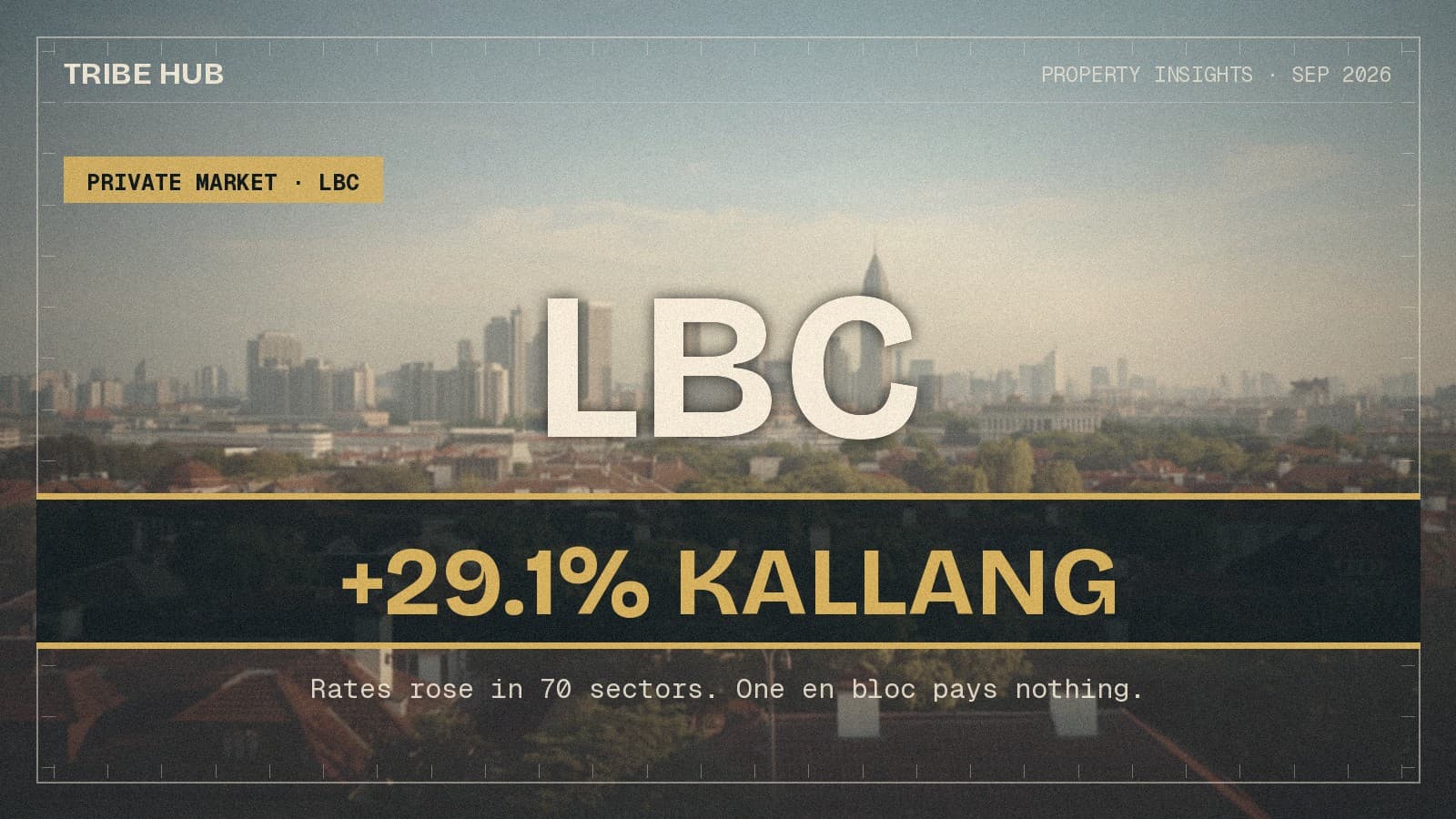
SLA's half-yearly revision lifted non-landed residential LBC rates 3.4% on average, with Kallang up 29.1%. A day before it took effect, the agent marketing Gilstead Court said the revision would not cost that site a cent. The number reconciling them is the development baseline.
By TRIBE Editorial · 2 September 2026 · 10 min read
On 1 September the Singapore Land Authority's new land betterment charge rates took effect, and they went up almost everywhere: 70 of 118 non-landed residential sectors, all 118 industrial sectors, 108 of 118 landed sectors. Kallang rose 29.1%. Two days earlier, the agent marketing a S$198 million collective sale in prime District 11 told the market the revision would not cost that site anything at all — that its high development baseline "insulates" it from the half-yearly revisions entirely. Both statements are correct. The number that reconciles them is one almost nobody outside a valuation department can name.
What the charge actually taxes
The land betterment charge replaced Differential Premium, Development Charge and Temporary Development Levy on 1 August 2022. SLA describes it as "a tax on the increase in value of land arising from a chargeable consent" — a planning permission, a plan lodgment, or the variation of a restrictive covenant.
The arithmetic is a subtraction. LBC is computed as the post-chargeable valuation minus the pre-chargeable valuation. The post-chargeable side comes from the use and intensity in the permission you have just been granted. The pre-chargeable side — the baseline — comes from the restrictive covenants in the State title, or from the last authorised or approved development on the site, with the historical Master Plans of 1958, 1980 and 2003 taken into account where applicable.
Most commentary treats the twice-yearly rate revision as if it were the whole story. It is only half of one. The rate table sets the price per square metre of uplift. If a site has no uplift, the rate can double and the bill stays at zero.
Why an old building can be worth more than a new rate table
This is where the baseline does its quiet work. A development built in the 1970s to a plot ratio the current Master Plan would not grant today carries that historical intensity forward as its pre-chargeable valuation. Redevelop it to roughly the same envelope and there is no betterment to tax — the value was already there, and was already paid for.
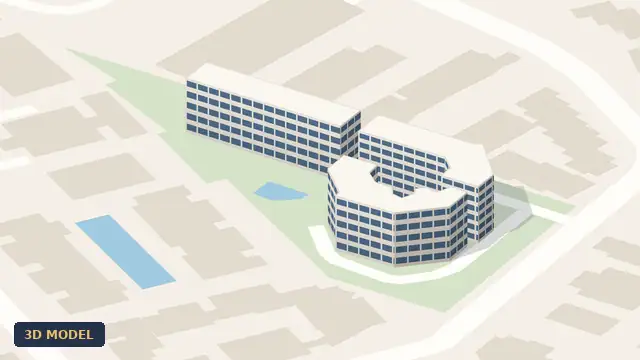
Gilstead Court is the case in point. Completed in 1978, it is 48 three-bedroom units across three four-storey blocks on a 75,479 sq ft freehold site off Newton Road. Launched for collective sale on 31 August at a reserve of S$198 million, the site reflects S$1,874 psf per plot ratio, or S$1,751 psf ppr after the 7% bonus GFA for balconies. Work backwards from those two rates and the deal implies 105,656 sq ft of gross floor area before the bonus and 113,078 sq ft with it — a plot ratio of 1.40 and a bonus allowance of 7,422 sq ft.
Two things follow. The first is a check on the unit count: the site sits in the Stevens–Chancery area, one of nine locations where URA's October 2018 guideline caps the average unit at 100 sq m (1,076 sq ft) of GFA. At up to 98 apartments, that is 105,448 sq ft — within a rounding error of the 105,656 sq ft of non-bonus GFA. The cap binds on the base envelope, not the balconies.
The second is the point of this article. On a site with a low baseline, that 7,422 sq ft of bonus balcony GFA would be pure betterment and would be charged at the September rate for its sector. Here, per JLL, it is not chargeable at all. The rate table moved; this site did not notice.
The September 2026 revision, by use group
| Use group | Average change | Range of increases | Sectors up | Sectors unchanged |
|---|---|---|---|---|
| Industrial (D) | +3.9% | 1.8% – 10.1% | 118 | 0 |
| Landed residential (B1) | +3.5% | 1.8% – 8.1% | 108 | 10 |
| Non-landed residential (B2) | +3.4% | 0.9% – 29.1% | 70 | 48 |
| Place of worship / CCI (E) | +2.9% | — | — | — |
| Commercial (A) | +1.7% | 2.5% – 19.0% | 46 | 72 |
| Hotel / hospital (C) | Unchanged | — | 0 | all |
Figures as reported from SLA's tables by CBRE, Newmark, ERA, Huttons and Knight Frank, via EdgeProp. Rates apply 1 Sep 2026 to 28 Feb 2027.
Read the non-landed row carefully. A 3.4% average across 118 sectors, with 48 of them flat and one up 29.1%, is not a market-wide repricing — it is a handful of sectors being marked to specific land bids. Sector 54 (Kallang) moved on the Kallang Close award. Sectors 55 (Upper Boon Keng/Sims Avenue) and 56 (Geylang) both rose 23.6%. Sector 48 (River Valley/Kim Yam Road) rose 8.7% and sector 109 (Dunearn/Sixth Avenue/Holland Road) 6.9%. On the commercial side, sector 96 (Bayshore and Bedok) rose 19% behind the Bayshore Drive GLS award at S$1,323 psf ppr, and sector 99 (Changi) 12% behind the S$467 million sale of White Sands Mall.
The mechanism is circular by design and worth naming: developers bid, SLA marks the table to the bids, and the next developer pays more for the same uplift. A GLS site that draws four aggressive bids raises the cost of every low-baseline redevelopment in its sector for the following six months.
What a rate rise is actually worth
Because LBC is charged on uplift rather than on land value, a headline rate change scales only the portion of a deal that is uplift. On a S$198 million site, a 3.4% rate rise costs the following, depending on how much of the land cost the charge represents:
| LBC as share of land cost | Effect of a +3.4% rate rise | Extra cost on a S$198m site |
|---|---|---|
| 5% | +0.17% of land cost | S$336,600 |
| 10% | +0.34% | S$673,200 |
| 15% | +0.51% | S$1,009,800 |
| 20% | +0.68% | S$1,346,400 |
Those are illustrative shares, not Gilstead Court's — its share is nil. The table's purpose is to size the thing honestly: for most sites a half-yearly revision is a rounding item against tender risk, and for a high-baseline site it is nothing. What moves the needle is not the rate but whether you are exposed to it at all.
The four attempts, priced
Gilstead Court is on its fourth try since 2008. The sequence is a useful record of what a decade of policy does to a reserve price.
| Attempt | Reserve | Land rate | Outcome |
|---|---|---|---|
| 2008 | — | — | Failed to reach 80% consent |
| 2013 | S$150.2 million | — | Tuan Sing agreed; Court of Appeal struck it down in Oct 2015 |
| Jun 2018 | S$168 million | S$1,590 psf ppr | Overtaken by the Jul 2018 cooling measures |
| Jan 2019 | S$153 million | S$1,448 psf ppr | Relaunched 8.9% lower; tender closed with no bids |
| Aug 2026 | S$198 million | S$1,751 psf ppr effective | Tender closes 13 Oct |
From the January 2019 relaunch to today the reserve is up 29.4%, or 3.46% a year compounded; the effective land rate is up 20.9%. Against the 2013 figure, 13 years produced 2.15% a year. For owners, the reserve works out to an average S$4,125,000 a unit before costs. The last resale in the development was S$2.998 million for a 1,464 sq ft unit in June 2025 — so the average gross payout is about S$1,127,000, or 37.6%, above that benchmark. On a per-square-foot basis, if the 48 units split evenly between the 1,389 and 1,464 sq ft layouts, the reserve values strata area at roughly S$2,892 psf against S$2,048 psf achieved on the open market, a 41.2% premium. (That split is our assumption; the actual mix is not public.)
The comparison that should give a developer pause
Two 99-year GLS sites near Newton have sold in the past year. Bukit Timah Road went for S$1,820 psf ppr in November 2025 on eight bids. Peck Hay Road went to a CDL–Hong Realty joint venture at S$1,865 psf ppr in June 2026 on four bids — the highest rate paid for a residential GLS site since 2018.
Gilstead Court is asking S$1,751 psf ppr, freehold — 6.1% below Peck Hay and 3.8% below Bukit Timah, both leasehold, and with no LBC on top. Those are different districts and different sites, so this is not a like-for-like valuation. But it does frame the question a bidder has to answer by 13 October: whether a freehold D11 site with a baseline that neutralises the charge is worth less per square foot than a 99-year parcel a few minutes away.
The end-price evidence next door is not discouraging. 32 Gilstead, built on land Kheng Leong bought in December 2021, sold out its 14 units between S$3,402 and S$3,579 psf. At S$1,751 psf ppr, land is 48.9% to 51.5% of that achieved price — before construction, finance, marketing and the developer's own ABSD clock.
What this means if you own in an ageing development
Three things travel beyond this one site.
Your building's age is not the same as its redevelopment value. The baseline, not the year on the plaque, decides whether a buyer pays a charge on top of your reserve. An older block built to a generous historical intensity can be cheaper to redevelop than a newer one — and that shows up in the price a developer can afford to offer you.
The consent threshold is about to move. The Land Titles (Strata) (Amendment) Bill introduced in August would lower the threshold for developments aged 40 to under 60 years from 80% to 70%. Gilstead Court, at 48 years old, would qualify — though its owners had already passed 80% before the Bill was announced. For committees still short of consent, the arithmetic of a fourth attempt changes materially. We covered the threshold change here and why most en bloc hopes still do not convert here.
A reserve price is not a payout. The average S$4,125,000 above is gross, before legal and marketing costs, before any CPF refund with accrued interest, and before the cost of buying your next home in the same market that just repriced your old one. That gap between headline and cheque is the same one we worked end to end on a S$3.1 million resale profit.
The revision itself is public, and so is the tool. SLA publishes the full Table of Rates and sector maps for every cycle since September 2022, and its LBC Estimator on OneMap will price a proposal for you. What it will not tell you without a formal application is your baseline — and that, on the evidence of 1 September, is the number that decides whether any of the rest of it matters.
Methodology published. No spin.
Condos in this article
Check how your condo scores
2,350 condos independently scored across 7 weighted factors. No registration required.
Score my resale →Prefer a personal read on your situation? Arrange a consultation →Keep reading
12 October 2026Private Property Market
Five Foreigners Were Approved to Buy a Good Class Bungalow in a Decade. None Since 2021.

11 October 2026Private Property Market
One S$70 Million Deal Decides Whether the Shophouse Quarter Was Up or Down
10 October 2026Private Property Market
A Record S$42.4 Billion. A Quarter of It Was the Government Selling Land.
Next step

TRIBE Editorial · Reviewed by Silas Tan
Co-Founder, TRIBE · District Director, Huttons Asia · Ex-Mortgage Banker (AVP) · >1,000 families advised · CEA R000303I
How TRIBE scores and checks its analysis
Spotted an error, or a figure that has moved since publication? Tell us and we will correct it.
This article is for informational purposes only and does not constitute financial or investment advice.