Insights
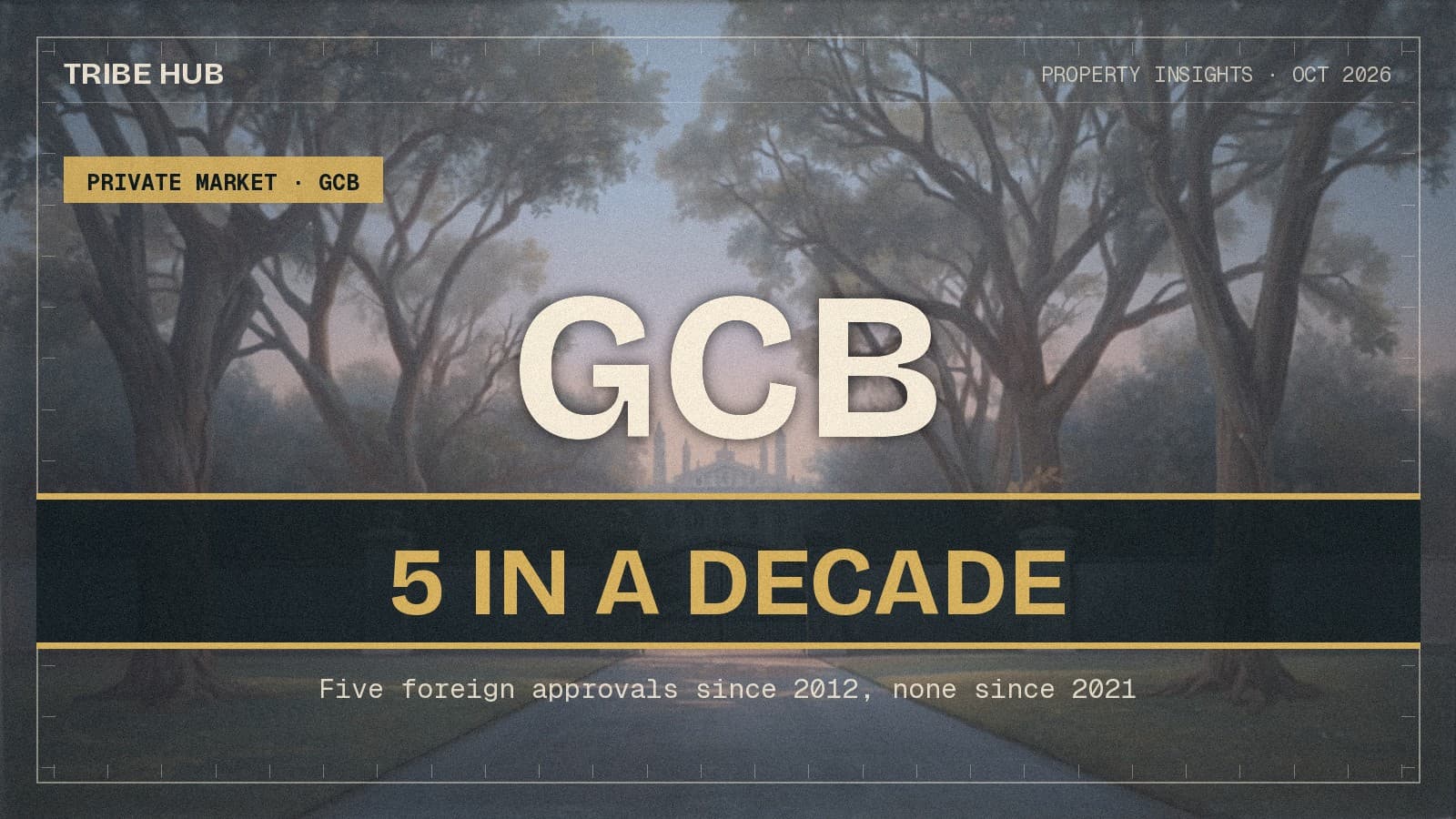
Five Foreigners Were Approved to Buy a Good Class Bungalow in a Decade. None Since 2021.
Landed homes drove the third quarter's price rise. The most expensive landed segment of all is invisible inside it — Good Class Bungalows turn over at about one house in a hundred per year, in a market the law closes to everyone but citizens.
By TRIBE Editorial · 12 October 2026 · 10 min read
Landed homes did the heavy lifting in the third quarter. URA's flash estimate of 1 October put overall private residential prices up 1.4%, with landed up 2.8% against non-landed's 0.9%.
Sitting at the top of that landed segment is a market almost nobody can enter and nobody can measure. Singapore's Good Class Bungalows turn over at roughly one house in a hundred per year. The reason is not the cycle, and it is not the 60% foreign-buyer stamp duty. It is that the gate is a permission, not a price — and the Ministry of Law has put the numbers on the record.
The gate is a permission, not a price
A Singapore citizen buying a Good Class Bungalow needs no approval at all. Everyone else does, and the approvals are not being given.
In a written answer of 14 October 2024, Second Minister for Law Edwin Tong stated that between 2012 and 2021, five Residential Property Act approvals were granted to foreigners — permanent residents — to buy a GCB, and two of those five were inheritance cases. None has been granted since 2021. No approval was granted for a trust company to acquire a GCB for foreign beneficiaries at any point from 2019 onwards.
The framework around that is from an earlier answer by Minister for Law K Shanmugam, 2 September 2019: foreign ownership of landed residential property requires the Minister's approval; an approved foreigner may own only one landed home and must live in it; and the criteria are explicitly stricter for land above 15,000 sq ft and inside Good Class Bungalow Areas. Only permanent residents may be approved for landed property on mainland Singapore.
The 60% stamp duty is not what is keeping anyone out
It is worth seeing what the duty actually is, because the number everyone quotes turns out to be beside the point.
On a S$40 million purchase, using the BSD tiers in force since 15 February 2023 and the ABSD rates since 27 April 2023 (IRAS; full ABSD schedule here):
| Buyer | Duty on S$40m | Effective rate |
|---|---|---|
| Citizen, first property | S$2,339,600 | 5.85% |
| Citizen, second property | S$10,339,600 | 25.85% |
| Foreigner | S$26,339,600 | 65.85% |
| Entity | S$28,339,600 | 70.85% |
A foreign buyer willing to write a S$26.3 million cheque for duty still cannot buy a Good Class Bungalow, because the Residential Property Act gate is binary and it has not opened in five years. The 65% entity rate closes the company route, and the RPA closes the trust route independently. The only live arithmetic in this market is the citizen's: 5.85% on a first home, 25.85% on a second.
The contrast with the condominium market is sharp. Foreign buyers did not disappear there — they were 4.0% of Core Central Region condo purchases in the first half of 2026, up from 3.3% a year earlier. In GCBs the comparable figure is zero approvals in five years.
What the market does instead is visible in who buys. The S$76 million Tanglin Hill sale that completed in February 2026 went to a naturalised citizen acting as trustee for a minor child; a conserved Dalvey Estate bungalow above S$60 million to a new citizen; the 2023 record, three Nassim Road houses at S$206.7 million, to Indonesian-born Singapore citizens of one family. The route into this market is naturalisation, and it takes years.
The market is too thin to have a price
Here is the half-yearly series PropNex compiles from URA Realis caveats, defined as detached-home transactions inside the 39 gazetted GCB Areas:
| Period | Deals | Value |
|---|---|---|
| 1H2023 | 9 | S$231m |
| 2H2023 | 9 | S$202m |
| 1H2024 | 10 | S$233m |
| 2H2024 | 14 | S$441m |
| 1H2025 | 7 | S$253m |
| 2H2025 | 18 | S$634m |
| 1H2026 | 10 | S$304m |
List Sotheby's called 2023's 18 deals the lowest since URA Realis records began in January 1995.
Against an industry estimate of roughly 2,800 bungalows — more on that figure below — that is a turnover rate of 0.64% in 2023, 0.82% in 2024 and 1.00% in 2025 on caveated deals; about 1.25% to 1.29% once off-market sales are added; and an annualised 0.71% to 0.79% in the first half of 2026. Even 2021, the boom, managed 3.21%. At 2025's caveated rate the implied average holding period is close to a century.
For scale: we recently put shophouse turnover at 1.05% annualised for the first nine months of 2026, against a 1995–2023 norm of 3.08%. The GCB market's boom-year peak is roughly the shophouse market's long-run normal.
At those volumes a single house moves the whole series. Peirce Road at S$148 million in December 2025 was 23.3% of the caveated value of its half-year and 15.3% of the full year. The S$64.9 million Nassim Road sale was 21.4% of the first half of 2026 — and 52% of the value of the three named deals in its quarter.
The biggest deals are not in the series that measures the market
This is the part that should stop anyone quoting a GCB total as a market reading.
2024's largest transaction never generated a caveat. The record-setting Tanglin Hill house at S$93.888 million had no caveat lodged; neither did the year's second-largest, Bin Tong Park at S$84 million. Two deals worth S$178 million sat outside a caveat series that reported the entire year at around S$652 million. List Sotheby's, which tracks off-market deals separately, counted 22 caveated sales worth S$612 million in 2024 plus 13 non-caveated sales worth over S$700 million — more than half the year's money invisible to the series most people read.
2023's largest transaction cannot be in there either. The three Nassim Road houses sold as a portfolio for S$206.7 million. PropNex's two halves of 2023 total S$433 million across 18 deals. Had the portfolio been inside the first half, the other six deals would have averaged S$4 million each — impossible for plots of at least 15,070 sq ft. It is arithmetic, not a source, but the conclusion is unavoidable.
And the same deal is dated three ways. Tanglin Hill was optioned in March 2024, completed in February 2025, booked to 2024 by one house, and described by another as a 2025 sale not reflected in caveat data at all.
Caveat lag compounds it. List Sotheby's counted 28 caveated 2025 deals worth S$966.24 million in December 2025; by October 2026 a caveat-based tracker read 30 and over S$1.009 billion. The 2024 count was restated from 22 to 23 a year after the fact. And the published "half-years" are not half-years: PropNex's 1H2026 is caveats to 7 June 2026.
Which is why no two houses agree. For the first half of 2026: PropNex counts 10 deals worth S$304 million; Knight Frank counts 8 deals worth S$474.6 million; Realion counts 11. Fewer deals at higher value is not a contradiction — it is a different treatment of off-market sales.
Nobody publishes how many there are
The denominator in every turnover figure above, including ours, is an estimate nobody stands behind. "About 2,800 GCBs" traces to law-firm and press commentary from 2020 and 2021 with no attribution. URA publishes no count. Asked in Parliament in February 2025 what proportion of landed households live in GCBs, the Ministry of Trade and Industry answered that the breakdown "is not available."
What URA does publish is precise and current. There are 39 gazetted Good Class Bungalow Areas, named in full on its development control pages. Inside them a plot must be at least 1,400 sqm (15,070 sq ft), at least 18.5 m wide and 30 m deep; site coverage is capped at 45% with a 35% sub-control. Note the asymmetry this creates: the minimum governs new subdivision, not existing stock, which is how the S$64.9 million Nassim Road house sits on 14,264 sq ft.
Treat 2,800 the way we treat the "6,500 shophouses" figure — a conventional denominator, never restated by the authority, and a reason to read every turnover rate as indicative.
What "GCB prices" actually means
There is no GCB price index. What gets quoted as a price is an unweighted arithmetic mean of land rates across a handful of heterogeneous deals, unadjusted for plot size, age, condition or street.
PropNex's half-yearly mean ran S$2,053, S$2,017, S$2,242, S$2,048, S$2,121 per sq ft of land across the five half-years to 1H2026. Quarterly it is worse: Realion's average land rate was S$1,803 psf in 1Q2026 on four deals, then S$2,341 psf in 2Q2026 on seven — a 29.8% move in a quarter that tells you about the plots, not the market.
Put that next to URA's hedonic landed index, which rose 7.6% in 2025 and 4.9% over the first nine months of 2026, and the two series disagree outright: the GCB mean fell 8.7% between the halves of 2025 while the index rose. They are not measuring the same thing, and charting them together would be a category error.
The record land rate is S$6,197 psf — the S$93.888 million Tanglin Hill house on 15,150 sq ft. It is sometimes printed as S$6,017; the arithmetic gives S$6,197. Before it, S$4,500 psf for the Nassim Road portfolio in 2023 and S$4,291 psf for a Cluny Hill house in April 2021. The highest of 2026 so far is about S$4,550 psf, at Nassim Road, and it is a street record, not a market record.
Method and limits
Parliamentary answers, URA planning rules and the URA flash estimate are primary. Stamp duty figures are computed from the BSD and ABSD schedules in force since 15 February 2023 and 27 April 2023 respectively, on the higher of price or market value, with no remission applied. Transaction counts and land rates are attributed to the house that published them, with the date.
The limits are severe and need stating. There is no published third-quarter 2026 GCB data — as at 11 October no house had released a 3Q2026 count or value, and URA's full third-quarter statistics are due 23 October. Any 3Q2026 GCB number before then is somebody's estimate. Every count is a floor, not a total, because a material share of this market never generates a caveat. Caveat lag is large, and published half-years are partial. Most houses do not publish their scope, which is why the same half-year ranges from 8 to 11 deals. The S$76 million Tanglin Hill sale rests on a single publication, as do several individually reported deals; we have not repeated figures carried only by aggregators whose other numbers we could not reconcile. And SLA does not collect general data on property acquired through trust companies — the trust channel is unquantified, which is a gap in the record, not evidence of anything.
Check how your condo scores
2,352 condos independently scored across 7 weighted factors. No registration required.
Score my resale →Prefer a personal read on your situation? Arrange a consultation →Keep reading

11 October 2026Private Property Market
One S$70 Million Deal Decides Whether the Shophouse Quarter Was Up or Down
10 October 2026Private Property Market
A Record S$42.4 Billion. A Quarter of It Was the Government Selling Land.
9 October 2026Private Property Market
The Last Auction Cleared 15%. The Next One Is Guided 21% Above the Only Matching Sale.
Next step

TRIBE Editorial · Reviewed by Silas Tan
Co-Founder, TRIBE · District Director, Huttons Asia · Ex-Mortgage Banker (AVP) · >1,000 families advised · CEA R000303I
How TRIBE scores and checks its analysis
Spotted an error, or a figure that has moved since publication? Tell us and we will correct it.
This article is for informational purposes only and does not constitute financial or investment advice.