Insights
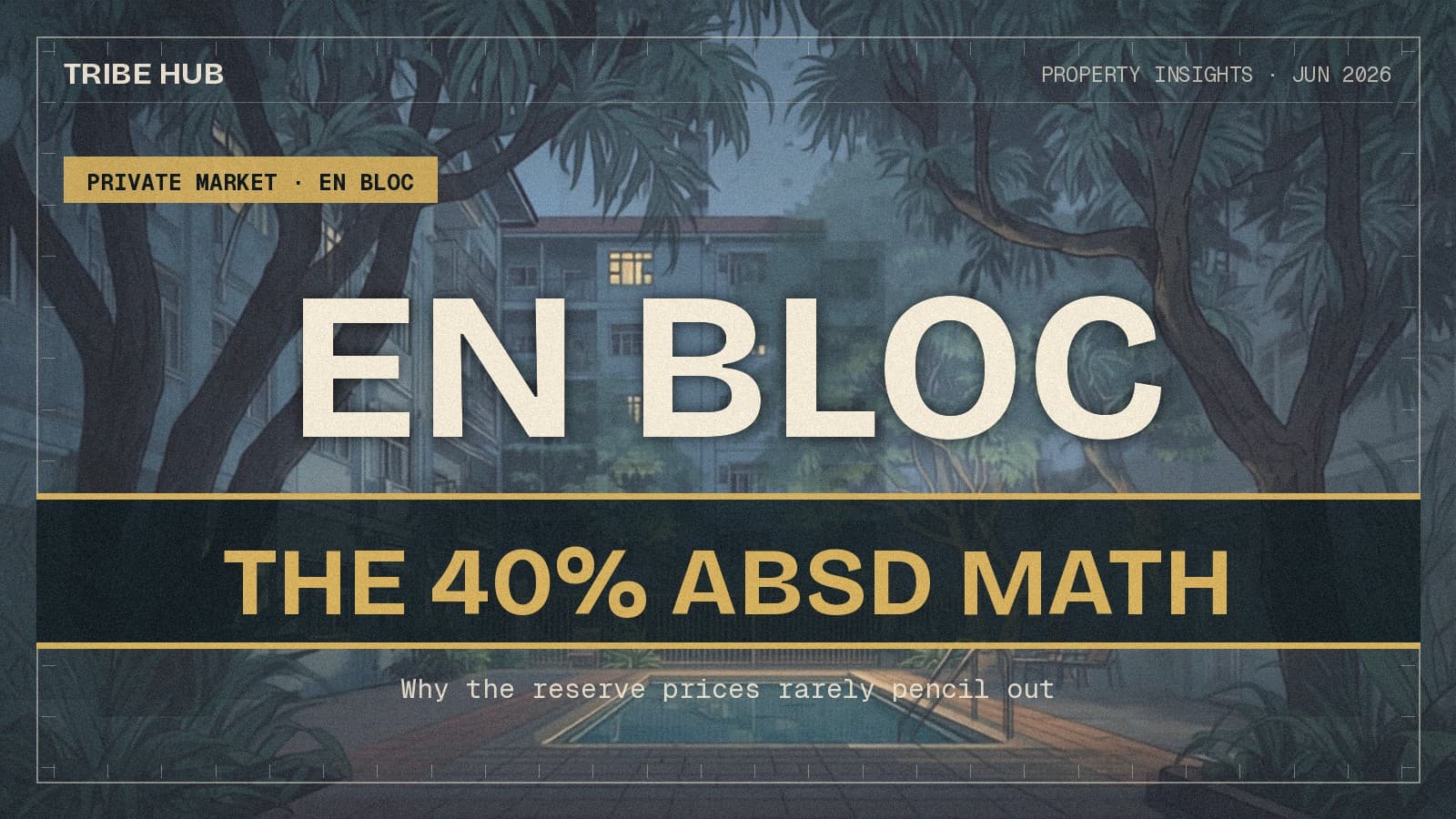
These Condos Are Waiting for an En Bloc That Probably Won't Come. Here's the Math.
A whole class of ageing condos treats the collective sale as a retirement plan. We run the developer's sum — 40% ABSD, construction, lease top-ups — and show why the reserve prices owners want rarely pencil out.
By TRIBE Editorial · 17 June 2026 · 11 min read
In dozens of ageing Singapore condos, there is a quiet financial plan that never appears on a CPF statement: the en bloc. Buy the old unit, hold it, and one day a developer arrives with a cheque that pays off the mortgage and funds the next chapter. It is a real phenomenon — Singapore has minted en bloc millionaires before — and for a certain kind of owner it has become the entire investment thesis. The problem is that the math behind a collective sale has quietly turned against most of these estates, and the wait many owners are sitting through may not end.
This isn't pessimism. It's arithmetic. A collective sale only happens when a developer can buy the whole site, pay the taxes, build, and sell the new units at a profit — and clear an 80% consent hurdle among owners first. In 2026, with developer stamp duty at 40% and construction costs up sharply, that chain breaks more often than it holds. Here is the sum that actually decides it.
The dream: the replacement-cost premium
Start with why owners wait, because it isn't irrational. To leave the old flat, an owner needs enough to buy something comparable in the same area — and replacement homes have only got pricier. So collective sale committees set a reserve price built on a fat premium over current resale value, often 40–80% above what the units trade at today. At that number, the en bloc genuinely is a windfall. The question is never whether owners would like that price. It's whether any developer can pay it and still make money.
The developer's sum
A developer doesn't value your estate on what you paid or what you hope for. They work backwards from the price they can sell new units at, and subtract every cost until they hit the most they'd bid for the land. The chain looks like this.
| Developer's cost stack (per sq ft of new floor area) | Amount |
|---|---|
| Land (the reserve price, expressed per sq ft per plot ratio) | ~$1,230 |
| + ABSD (5% non-remittable now; 35% more if they don't sell out in 5 years) | $60–$490 |
| + Construction & professional fees | ~$550 |
| + Financing, marketing, contingency | ~$150 |
| + Developer margin (~15%) | applied on top |
| = Breakeven selling price | ~$2,350–$2,850 psf |
The figures above use the land rate from a real, publicly reported reserve price (Laguna Park's ~$1,231 psf per plot ratio). Run it through and the developer's breakeven lands between roughly $2,350 and $2,850 per square foot — the lower end only if they are confident of selling every new unit within five years to claw back the 35% ABSD; the higher end if they price that tax in conservatively. Achievable new-launch prices in those city-fringe locations sit around $2,400–$2,900 psf. The margin, in other words, is somewhere between thin and negative before a single risk goes wrong. That is the whole story of the stalled market: the gap between the owner's reserve and the developer's breakeven has closed to nothing.
The single heaviest line is the one owners never see: ABSD. A housing developer buying a collective-sale site pays 40% — 5% non-remittable upfront, and a further 35% that is only remitted if the developer finishes construction and sells every unit within five years. On a billion-dollar site that 35% is hundreds of millions of dollars of at-risk capital, riding on absorbing a thousand-plus new units into the market on a deadline. After the 2023 cooling measures lifted that rate, the arithmetic stopped working for exactly the large sites that owners most want sold.
The formulas, if you want them
Three equations sit underneath all of this. None are exotic — they are what a developer's feasibility model and a sale committee's distribution table actually compute.
1. The land rate — what a headline reserve price really means, and the only way to compare sites:
Land rate ($psf ppr) =  Reserve price + lease top-up + betterment charge
                        ─────────────────────────────────────────────────
                                    Site area × Plot ratio
This is exactly how Thomson View's $810m becomes $1,178 psf ppr, and Laguna Park's $1.48b becomes ~$1,231.
2. The developer's breakeven — whether any bid exists at all, worked back from the new-launch price:
Breakeven price ($psf) =  Land rate × (1 + ABSD%) + construction + other costs
                          ──────────────────────────────────────────────────────
                                            1 − profit margin
If the achievable new-launch price in the area sits below this number, no developer bids at any reserve the owners would accept. (At Laguna Park's ~$1,231 land rate, breakeven runs roughly $2,340–$2,850 psf, depending on whether the 35% ABSD is recovered.)
3. Your payout — what an owner actually pockets, split by the method fixed in the collective sale agreement (share value, strata area, valuation, or a blend):
Your proceeds = Sale price × (your apportionment share ÷ total)
Premium (%)   = Your proceeds ÷ current market value − 1
The premium in the third formula is the whole motivation — and the reason committees push reserves up, which feeds straight back into formula 2 and kills the bid. The tension between formula 3 (what owners want) and formula 2 (what a developer can pay) is the entire drama of a collective sale.
Three things the math needs — and these estates rarely have
A collective sale pencils out only when three conditions line up. The estates that wait longest tend to miss at least one.
Unutilised plot ratio. The uplift in a redevelopment comes from building more floor area than exists today. A site already built close to its zoned plot ratio has little headroom — the developer can't conjure extra sellable space, so there's no premium to fund the owners' windfall. Many older estates sit on generous land but were already built dense.
A launch price comfortably above breakeven. As the table shows, in the current cost environment the achievable new-launch price barely clears the developer's breakeven. Where it doesn't, there is no bid at any reserve the owners would accept.
For leasehold sites, a payable lease top-up. A 99-year site from the 1970s has to be topped back up to a fresh lease, and the redevelopment intensification triggers a differential premium — both paid to the state. At Laguna Park, the reported reserve of $1.48 billion included roughly $420.7 million of lease top-up and $407.4 million of differential premium. Those premiums load straight onto the land cost before construction even starts.
The named cases
These are not hypotheticals. Each of the estates below has publicly launched one or more collective-sale tenders, and each illustrates a different way the math bites. None of this is a prediction about any specific household; it is what the reported numbers and current rules imply.
Mandarin Gardens (Marine Parade, ~1,006 units, 99-year leasehold). Reserve prices climbed to $2.78 billion and then $2.93 billion across attempts. At a $2.88b reserve, a developer faces about $144 million in non-remittable ABSD upfront and over $1 billion more in remittable-but-at-risk ABSD — pushing the land-plus-tax bill past $4 billion before construction. The 2019 attempt lapsed at 68% consent; the 2023 relaunch drew just 42%. The quantum is the obstacle as much as the price.
Laguna Park (Marine Parade, ~528 units, 99-year leasehold). Relaunched repeatedly at $1.48 billion, a land rate of about $1,231 psf per plot ratio once the lease top-up and differential premium are loaded in. That land rate is the very number that produces the thin-to-negative breakeven above.
Pine Grove (former HUDC, ~660 units, Ulu Pandan). Failed tenders in 2008 and 2011, with the reserve pushed up toward $1.65–$1.7 billion to secure consent — raising the price the market had to clear even as it chased agreement.
Pandan Valley (freehold, ~623 units on roughly 865,000 sq ft) and Braddell View (privatised HUDC, billion-dollar site) round out the pattern: large, much-loved estates whose sheer size makes the ABSD-laden cheque a developer would have to write simply too big for the returns on offer.
The one that made it through: Thomson View
It can still happen — and the deal that proves it also proves the rule. Thomson View (Bright Hill Drive, 255 units, 99-year leasehold from 1975) sold collectively for $810 million to a UOL–CapitaLand Development joint venture, with the High Court approving the sale in July 2025. It was the estate's fifth attempt; four had failed since the early 2000s, either short of consent or drawing no developer bid at the owners' price.
What changed on the fifth try wasn't the market — it was the owners. Having relaunched at a $918 million reserve, 80% of owners signed a supplemental agreement to cut it to $808 million, a $110 million (~12%) reduction. Run that through formula 1 and the cut is the entire story: it dropped the land rate from roughly $1,338 to $1,178 psf per plot ratio — and in formula 2 that is the difference between a project that pencils and one that doesn't. The owners moved down to the developer's number; the developer did not move up to theirs.
Two other conditions had to hold, and did. The site has real plot-ratio headroom: 540,000 sq ft at a plot ratio of 2.1, letting the buyers rebuild 255 homes into roughly 1,240 — nearly five times the units, which is where the premium that funds every owner's payout actually comes from. And two deep-pocketed developers shared the ABSD and sell-out risk on a site near Upper Thomson they could realistically absorb. At $810 million the land rate worked out to about $1,178 psf ppr after the lease top-up and betterment charge — close to Laguna Park's $1,231, but here paired with genuine uplift and a price the owners agreed to drop to.
The lesson for every estate still waiting is uncomfortable but clean. Collective sales don't close when owners hold out for the number they want; they close when owners move their reserve down to what the math can bear — and only where the site has the plot-ratio headroom to make even that number worth a developer's while. Thomson View had both. Most of the estates above have neither, yet.
The consent wall
Even when the money works, the people often don't. A collective sale needs 80% of owners by share value and by floor area to sign (for developments more than ten years old) — and to agree not just on the headline price but on how the proceeds are split. In a 1,006-unit estate that is 805 owners who must say yes; in Laguna Park, 422; in Pine Grove, 528. Owners who bought decades ago, owners who bought last year, owners who've paid off their loans and owners who haven't — all must converge on one number. Mandarin Gardens' 42% in 2023 wasn't an outlier. Assembling super-majority consent on price and distribution is its own near-impossible task, independent of whether a developer would ever bid.
What this means if you own one — or are tempted to buy one
Two practical conclusions. If you already own in an estate like these, value the flat on what it is, not on the en bloc — a home with a location and a liveable layout, whose worth is its resale price today, not a collective-sale jackpot that the math may never deliver. Treat any eventual en bloc as a bonus, not a plan.
And if you're tempted to buy into an ageing development specifically for its "en bloc potential," price that lottery ticket honestly. On current numbers it would take a real reset — a cut in developer ABSD, a fall in construction costs, or a sharp moderation in owner reserve expectations — to revive the large-site collective sale. Until one of those moves, the most likely outcome for many of these estates is what's already happening: another tender, another lapse, and another few years of waiting.
Sources: EdgeProp — Mandarin Gardens: what's next after failed collective sale; EdgeProp/Yahoo — Laguna Park relaunched at $1.48b; PropertyGuru — Pine Grove collective sale; EdgeProp — UOL–CapitaLand JV to acquire Thomson View en bloc for $810m; IRAS — ABSD remission for development of five or more residential units. Reserve prices and consent levels are as publicly reported at the time of each attempt; breakeven figures are illustrative and modelled on a representative city-fringe leasehold site as at June 2026, and vary with plot ratio, location and tender terms.
Silas Tan is a District Director at Huttons Asia and co-founder of TRIBE. He built the Resale Project Scorecard (RPS) using 236,000+ URA REALIS transactions. This article is for informational purposes and does not constitute financial or investment advice. CEA Registration R000303I.
Check how your condo scores
2,357 condos independently scored across 7 weighted factors. No registration required.
Score my resale →Prefer a personal read on your situation? Arrange a consultation →Keep reading
19 September 2026Private Property Market
A 42-Year-Old Block, a Fourth Attempt, and a New Law Worth Two Signatures
18 September 2026Private Property Market
The Cheapest PSF and the Cheapest Apartment Are Two Different Units
17 September 2026Private Property Market
Seven Developers Bid for the Same Site. The Winner Still Paid 11% More Than Anyone Else.

TRIBE Editorial · Reviewed by Silas Tan
Co-Founder, TRIBE · District Director, Huttons Asia · Ex-Mortgage Banker (AVP) · >1,000 families advised · CEA R000303I
This article is for informational purposes only and does not constitute financial or investment advice.