Insights
What an Integrated Development Is Actually Worth
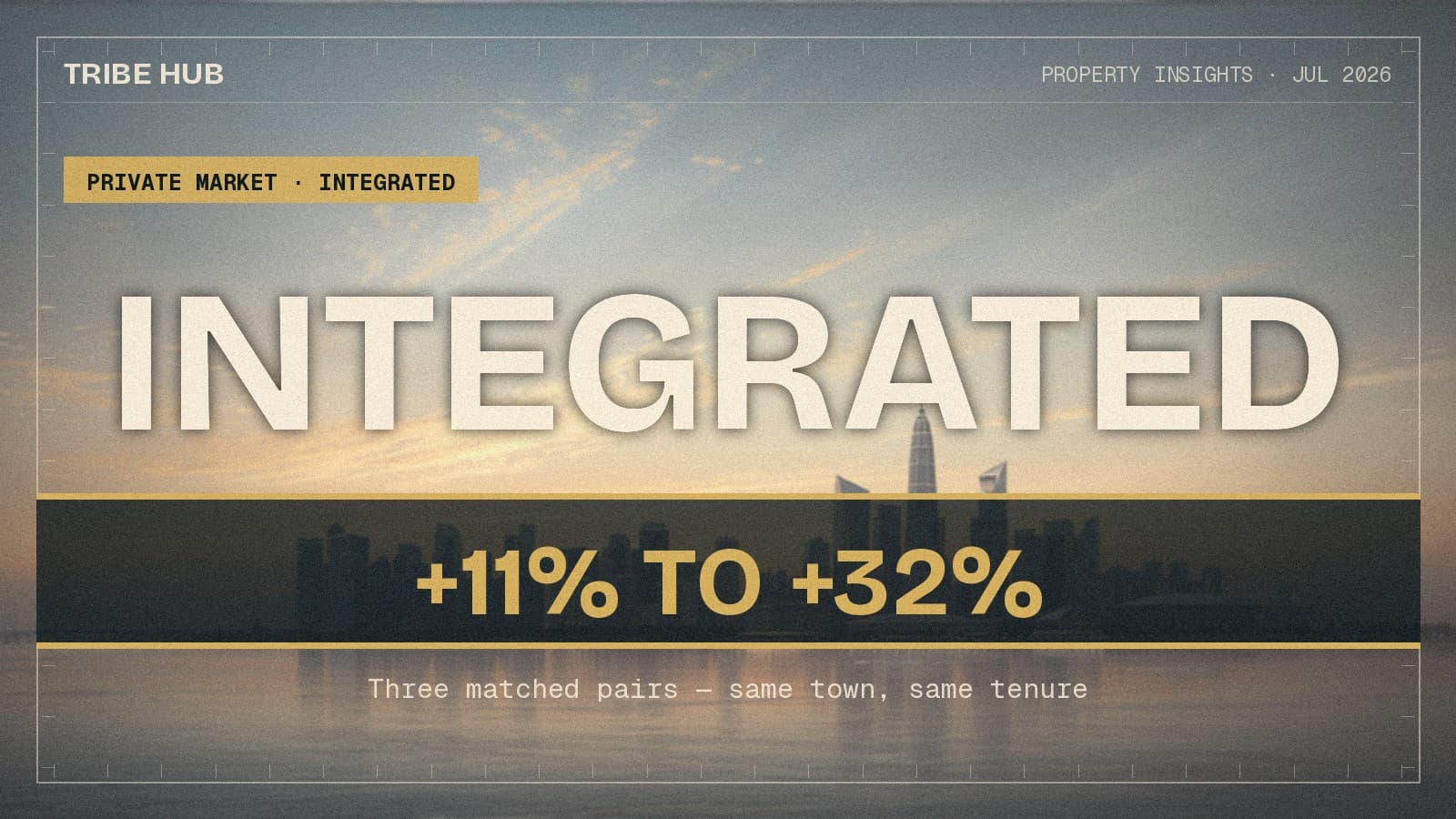
Matched against a same-town, same-vintage, same-tenure neighbour, the mall-and-MRT premium runs from 11% to 32%. The rental yield gap that is supposed to justify it is essentially zero.
By TRIBE Editorial · 31 July 2026 · 8 min read
An integrated development — a condo sitting directly on top of a mall and a transport node — is the easiest thing in Singapore property to want and the hardest to price. Agents quote a rule of thumb of 20 to 25 per cent. Buyers nod, and then pay whatever the launch asks.
The rule of thumb is not useless, but it is unmeasured. The premium is measurable, and the way to measure it is boring: find a condo in the same town, on the same 99-year tenure, finished within a couple of years of the integrated one, and read what both are transacting at now. Do that three times and a consistent picture appears — one that is worse for the premium than the sales pitch, and better than the cynics claim.
Three matched pairs
Each pair below is the same town, the same tenure type, and a TOP year within two years. Figures are the average of URA-recorded transactions over the last 12 months, as published on each project's EdgeProp page, read on 31 July 2026.
| Town | Integrated | Avg PSF | Non-integrated neighbour | Avg PSF | Gap |
|---|---|---|---|---|---|
| Yishun (D27) | North Park Residences — Northpoint City + Yishun interchange, TOP 2018 | S$1,796 | Symphony Suites — TOP 2018 | S$1,359 | +32.2% |
| Punggol (D19) | Watertown — Waterway Point + Punggol interchange, TOP 2017 | S$1,787 | A Treasure Trove — TOP 2015 | S$1,603 | +11.5% |
| Potong Pasir (D13) | The Poiz Residences — The Poiz Centre + Potong Pasir MRT, TOP 2018 | S$2,084 | Sant Ritz — TOP 2016 | S$1,879 | +10.9% |
On a 1,000 sqft unit, that is S$437,000 more in Yishun, S$184,000 more in Punggol, and S$205,000 more in Potong Pasir. The spread between 11% and 32% is the whole story: there is no single integrated premium. There is a premium that depends entirely on what else the town offers.
Why Yishun's gap is three times Punggol's
Yishun's alternative to North Park Residences is a small set of ageing 99-year projects sitting a bus ride from the MRT. Punggol's alternative to Watertown is a wall of newer 99-year stock — A Treasure Trove is 882 units, and it is one of several — much of it walking distance from an LRT stop. The premium is not paid for the mall. It is paid for the absence of a substitute.
That has a practical consequence. In a town with thin, old alternative stock, the integrated project prices like the only modern option, and the gap is wide. In a town where the next comparable is two hundred metres away and five years younger, the gap compresses to roughly ten per cent — which is close to what a straightforward "newer, better-located" condo would command anyway, integrated or not.
The unit-mix trap
Project-average PSF blends unit sizes, and small units always print a higher PSF. Integrated developments skew small — they are built to sell one- and two-bedders to singles and investors who want the mall downstairs.
The Yishun pair shows the effect plainly. North Park Residences' highest recorded transaction is S$1,983 psf on an 883 sqft unit; Symphony Suites' highest is S$1,418 psf on a 1,023 sqft unit. Part of that 32% is the mall, and part of it is simply that one project sells more small apartments than the other.
Compare like bedroom counts, not project averages. If you are buying a three-bedder, pull three-bedder caveats on both sides. The headline gap will shrink, sometimes by a third. Every number in the table above is a project average and carries this caveat — it is a screening tool, not a valuation.
The premium is not repaid in rent
The most common defence of the premium is rental. It does not survive contact with the yield data on the same pages:
| Pair | Integrated yield | Neighbour yield |
|---|---|---|
| North Park Residences / Symphony Suites | 3.9% | 3.9% |
| Watertown / A Treasure Trove | 3.5% | 3.2% |
| The Poiz Residences / Sant Ritz | 3.7% | 3.5% |
Zero, plus 0.3, plus 0.2 percentage points. Integrated units rent faster and rent higher in dollar terms — but you paid more for them in exactly the proportion that the rent is higher, so the yield lands in the same place. Stacked Homes' analysis of twelve integrated developments against their districts reached the same conclusion: no clear pattern of superior yield, with Hillion Residences and The Poiz topping their districts while Wallich Residence and Marina One Residences sat at the bottom of theirs.
Put concretely: the extra S$437,000 for a 1,000 sqft unit in Yishun would need about S$17,000 a year of additional rent to earn the same 3.9%. It earns roughly that. It does not earn more.
What the premium has actually returned
Two findings from the same Stacked Homes study, which compared integrated launches against resale prices in their districts six months before launch:
At launch, the premium is much larger than 20 to 25 per cent. Their measured launch gaps included North Park Residences +66.2%, Pasir Ris 8 +65.7%, Sengkang Grand Residences +59.8%, Hillion Residences +58.9%, Bedok Residences +43.4% and Watertown +35.1%. Thirteen of seventeen projects exceeded the normal new-launch premium for their district.
On resale, the advantage is real but small. Across post-2011 transactions, integrated developments averaged a 16.6% gain when profitable versus 15.0% for non-integrated, and lost 5.7% versus 7.0% when unprofitable.
Read those two together and the shape of the trade is clear. You pay a 35 to 66 per cent premium at launch, most of which is the standard new-launch premium plus the mall; the market later settles that down to the 11 to 32 per cent resale gap in the first table; and what you are left holding is a slightly better upside and a slightly softer downside than the condo down the road. It is a defensive asset, not an outperforming one.
What the pitch leaves out
You are buying a neighbour's amenity, and they aren't paying for it. Every resident within walking distance uses the same mall and the same MRT entrance without the premium. That is a cap on how far the gap can widen.
Retail is a landlord's decision, not yours. The mall's tenant mix is set by its owner, and residents get no vote. Early integrated projects have been criticised for weak retail line-ups.
Crowds are the product. The footfall that makes the mall viable arrives at your lift lobby and your car park ramp. In town centres this is a weekend condition, not an occasional one.
En bloc is materially harder. Commercial strata, civic uses and layered ownership make a collective sale far more complex than at a plain residential site — which matters if your exit thesis for a 99-year lease is redevelopment.
The next one is already priced
The Hougang Central white site was awarded in January 2026 to a consortium of CapitaLand Integrated Commercial Trust, CapitaLand Development and UOL at roughly S$1.5 billion, or about S$1,179 psf ppr — with CICT taking the commercial component and a CLD/UOL joint venture building around 830 homes for sale, with a preview indicated for late 2026 (CapitaLand, EdgeProp).
When it launches, the integrated premium will be quoted as a reason for the price. The correct response is not to reject it. It is to find Hougang's Symphony Suites — the same-tenure, same-vintage condo a few hundred metres away — and measure the gap you are being asked to accept.
The test, in three lines
- Match the comp properly: same town, same tenure, TOP within two or three years. Not the same district — districts mix towns.
- Compare bedroom to bedroom, not project average to project average, or the unit mix will hand you a premium that isn't there.
- Check the yield gap. If it is under half a percentage point, you are buying convenience out of your own pocket. That is a legitimate thing to buy — it is just not an investment case.
Methodology published. No spin.
Sources: Transacted PSF, rental yields, tenure, TOP year and unit counts for all six projects are the last-12-months figures published on each project's EdgeProp page from URA data, read 31 July 2026 (North Park Residences, Symphony Suites, Watertown, A Treasure Trove, The Poiz Residences, Sant Ritz). Project averages blend unit sizes and are screening figures, not valuations. Launch-premium and resale-performance figures are from Stacked Homes, whose underlying dataset predates 2026 — treat the direction as durable and the magnitudes as of their vintage. Hougang Central land price and consortium structure from CapitaLand and EdgeProp. Percentage gaps and dollar figures computed by TRIBE from the cited PSF averages.
Silas Tan is a District Director at Huttons Asia and co-founder of TRIBE. This article is general information, not financial advice. CEA Registration R000303I.
Check how your condo scores
2,357 condos independently scored across 7 weighted factors. No registration required.
Score my resale →Prefer a personal read on your situation? Arrange a consultation →Keep reading

19 September 2026Private Property Market
A 42-Year-Old Block, a Fourth Attempt, and a New Law Worth Two Signatures
18 September 2026Private Property Market
The Cheapest PSF and the Cheapest Apartment Are Two Different Units

17 September 2026Private Property Market
Seven Developers Bid for the Same Site. The Winner Still Paid 11% More Than Anyone Else.

TRIBE Editorial · Reviewed by Silas Tan
Co-Founder, TRIBE · District Director, Huttons Asia · Ex-Mortgage Banker (AVP) · >1,000 families advised · CEA R000303I
This article is for informational purposes only and does not constitute financial or investment advice.