Insights
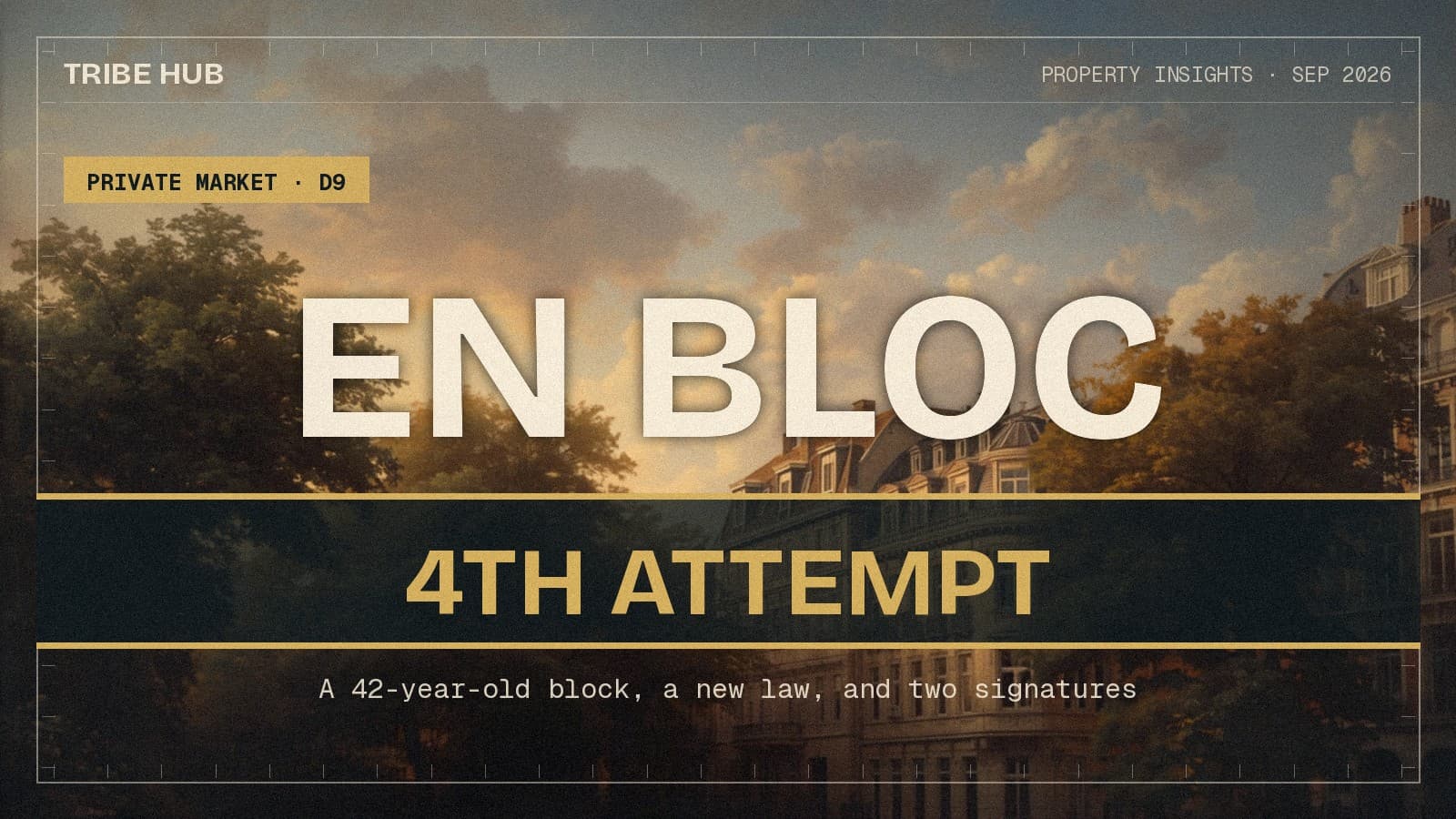
A 42-Year-Old Block, a Fourth Attempt, and a New Law Worth Two Signatures
Trendale Tower is back at S$168 million, the same price that failed in 2023. Parliament cut the en bloc consent bar on 8 September. In an 18-unit block that cut is worth exactly two signatures — and this tender runs under the old rules anyway.
By TRIBE Editorial · 19 September 2026 · 10 min read
Trendale Tower, an 18-unit freehold block at 79 Cairnhill Road completed in 1984, went back on the market this week with a guide price of S$168 million. It is the fourth attempt since 2018, and the price is the same one that failed in 2023.
Eleven days earlier, Parliament passed the Land Titles (Strata) (Amendment) Bill, cutting the collective sale consent threshold to 70% for developments aged 40 to 59. Trendale Tower is 42. The two facts look like they belong in the same sentence. They do not — and working out why is more useful than the headline.
The law arrived, and then stopped at the door
The new tiers are real. From the Minister for Law's Second Reading speech on 8 September, developments aged 40 to 59 move to a 70% consent threshold and those 60 and older to 65%. Everything under 40 stays where it was. We set out the full package, including the three safeguards that run the other way, when the Bill was first introduced in August.
What almost no coverage has carried is the transitional rule, and it is the rule that decides Trendale Tower's tender. The existing framework continues to apply wherever signature collection has already begun. Owners who have signed a Collective Sale Agreement do not find the rules changed under them.
There is an opt-in route for developments aged 40 and above that are mid-collection: convene a general meeting, terminate the existing agreement, and start again under the new framework with seven months from commencement to reach the new threshold. That is a genuine option for a campaign still gathering signatures. It is not an option for a campaign that has finished gathering them, appointed a marketing agent, and launched a tender that closes on 23 October.
So the block the new law was written for is running this attempt under the old law. And the commencement date has not been announced, which means the seven-month clock has not started for anyone.
What 70% means in a block of eighteen
Here is the part that gets lost when a threshold is discussed as a percentage. Consent is measured by share value and by total strata area, not by a show of hands — but Trendale Tower's 18 apartments are, on the published description, uniform, so units and share value move together. Percentages of 18 do not land on whole numbers.
| Age band | Threshold | Owners required | Effective rate |
|---|---|---|---|
| Under 10 years | 90% | 17 of 18 | 94.44% |
| 10 to 39 years | 80% | 15 of 18 | 83.33% |
| 40 to 59 years | 70% | 13 of 18 | 72.22% |
| 60 years and above | 65% | 12 of 18 | 66.67% |
A ten-percentage-point cut in the law is worth two apartments here. And no owner of this block has ever faced an 80% threshold in practice: the real bar has always been 83.33%, because you cannot collect four-fifths of a signature. In a small development every threshold rounds against the sellers, and the smaller the block the larger the penalty — 3.33 points at the 80% tier, 4.44 points at the 90% tier.
That is the reusable point. Read a consent threshold as a count of units, not as a percentage. For a 500-unit development the rounding is noise. For an 18-unit block it is a third of the distance the new law was supposed to close.
The price has not moved in three years
| Attempt | Guide price | Per apartment |
|---|---|---|
| 2018 | S$163.5m | S$9,083,333 |
| 2022 | S$178.0m | S$9,888,889 |
| 2023 | S$168.0m | S$9,333,333 |
| 2026 | S$168.0m | S$9,333,333 |
Three failures and the ask is 2.75% above where it started in 2018 — 0.34% a year, nominal, before any allowance for inflation. It is 5.62% below the 2022 peak ask and exactly level with the 2023 attempt that did not clear.
This matters because the constraint on a collective sale was never only consent. We made that argument in August and this tender is the clean test of it: an owner group that has already agreed to sell, at a price the market has already declined once, is not waiting on Parliament. Lowering the consent bar changes who is allowed to sell. It does not change who wants to buy.
The land rate has three answers
The guide price is reported at about S$2,248 psf per plot ratio, on a 21,709 sq ft site with a gross floor area of approximately 72,691 sq ft, with the figure said to factor in a 7% bonus for balconies.
Run the arithmetic and those numbers do not meet:
- S$168,000,000 ÷ 72,691 sq ft = S$2,311 psf
- S$168,000,000 ÷ (72,691 × 1.07) = S$2,160 psf
- S$2,248 psf implies a GFA of 74,733 sq ft, a figure that appears nowhere
The spread between the outer two is S$151 psf, or 7.0% — about S$11.0 million of implied land value on the stated floor area. We are not calling it an error. "Psf ppr" has no single convention: the denominator can be the base permissible GFA, the base plus bonus, or a negotiated maximum, and a marketing release rarely says which. This is the third denominator problem we have hit in three weeks, after the site-area-times-plot-ratio check that reconciles a collective sale exactly and the maximum-GFA convention that governs state land tenders.
It changes the comparison, which is the only reason it matters. Against the Bukit Timah Road site awarded at S$1,820 psf ppr and the Peck Hay Road site at S$1,865 psf ppr, Trendale reads as +23.5% and +20.5% on the quoted figure — or +18.7% and +15.8% if you strip the balcony bonus to match the state-tender convention. Four to five percentage points of apparent premium sit entirely inside a definition.
The defence is simple: a buyer bids a sum of money, not a psf. S$168 million is the number that either clears or does not. Everything after the division sign is a reporting choice.
The pivot is the buyer, not the price
If the price has not moved in three years, something else has to. The marketing agent's answer is a change of use: URA has indicated it would support an Outline Planning Permission for a Serviced Apartment 2 scheme on the site, subject to approvals.
SA2 is URA's long-stay serviced apartment class, introduced in December 2023, with a three-month minimum stay and the whole development held and managed under single ownership. That last clause is the entire point. A condominium developer buys land, builds, sells strata units and exits. An SA2 owner buys land, builds, and keeps the block for rental income.
Which means the buyer changes. A condo developer prices this site off an achievable launch psf. An income investor prices it off a yield on S$168 million plus construction. Those two buyers can reach very different numbers on the same land, and a block that three developers have passed on is now being shown to a different room — family offices, hospitality operators, private investors. Royal Group's roughly 100-apartment long-stay conversion at 11 Claymore Road, on a site bought for S$75 million, is the nearest live precedent.
Two cautions belong next to that. First, an indication of support for an Outline Planning Permission is not a permission; it is a signal that an application would be entertained. Second, the possibility of stamp duty relief for serviced apartment use is exactly that — a possibility, and the marketing material says so. A residential developer buying this site on conventional terms is looking at the 40% developer rate, of which the 5% portion — S$8.4 million here — is never remitted and falls due within 14 days, with the remaining 35% remitted only against building and selling out within the window. Any different treatment for SA2 is the single largest open variable in the deal, and it is unresolved.
If this one fails too
The same Bill that lowered the consent bar made a fifth attempt materially harder.
The restriction period after a failed sale goes from two years to three. The threshold to requisition a meeting to form a new sale committee rises from 20% by share value or 25% by units to 35% — in an 18-unit block, from 5 owners to 7. Inside the restriction period, a first attempt needs 50% support and any second or subsequent attempt needs the full age-based consent threshold, so 70% just to get started. The signature collection window halves from twelve months to six. And the cap on court-ordered top-ups to an objector rises from 0.25% to 0.5% of that unit's proceeds — here, from about S$23,333 to S$46,667.
Read together, the package is not a loosening. It is a trade: easier to finish, harder to start, and much harder to keep trying.
What an owner should take from this
Roughly one in twenty non-landed private homes in Singapore is now 40 years or older — about 20,000 units across close to 250 developments. If you own in one of them, three things follow from this week.
The threshold you care about is a unit count. Work out the actual number of signatures in your block at 80%, 70% and 65%, and look at the gap. In a large development the new tier moves it meaningfully. In a small one it may move it by two.
Timing against commencement is now a decision, not a detail. A campaign that has begun collecting signatures stays on the old framework unless it terminates its agreement and restarts. That is a real choice with a real cost, and it has a seven-month clock attached to a date the Government has not yet named.
And the bar that has actually been binding is price. Trendale Tower has had 80% of a very small number of owners on side for years. What it has not had is a buyer at S$9.33 million an apartment. No amendment to the Land Titles (Strata) Act changes that number.
Sources: guide price, site area, GFA, unit count, completion year, tender close and the SA2 option from StackedHomes, 17 September 2026; consent thresholds, requisition thresholds, signature window, restriction period, objector top-up limit, transitional arrangements and the ageing-stock figures from the Second Reading Speech of the Land Titles (Strata) (Amendment) Bill 2026 and MinLaw's policy note; SA2 guidelines from URA circular dc23-11. All per-unit, percentage, effective-threshold and psf figures computed by TRIBE from those inputs. Methodology published. No spin.
Check how your condo scores
2,357 condos independently scored across 7 weighted factors. No registration required.
Score my resale →Prefer a personal read on your situation? Arrange a consultation →Keep reading
18 September 2026Private Property Market
The Cheapest PSF and the Cheapest Apartment Are Two Different Units
17 September 2026Private Property Market
Seven Developers Bid for the Same Site. The Winner Still Paid 11% More Than Anyone Else.
17 September 2026Private Property Market
A 12.9% En Bloc Price Cut Costs Each Owner S$363,000. It Buys the Developer No Extra Floor Area at All.

TRIBE Editorial · Reviewed by Silas Tan
Co-Founder, TRIBE · District Director, Huttons Asia · Ex-Mortgage Banker (AVP) · >1,000 families advised · CEA R000303I
This article is for informational purposes only and does not constitute financial or investment advice.