Insights
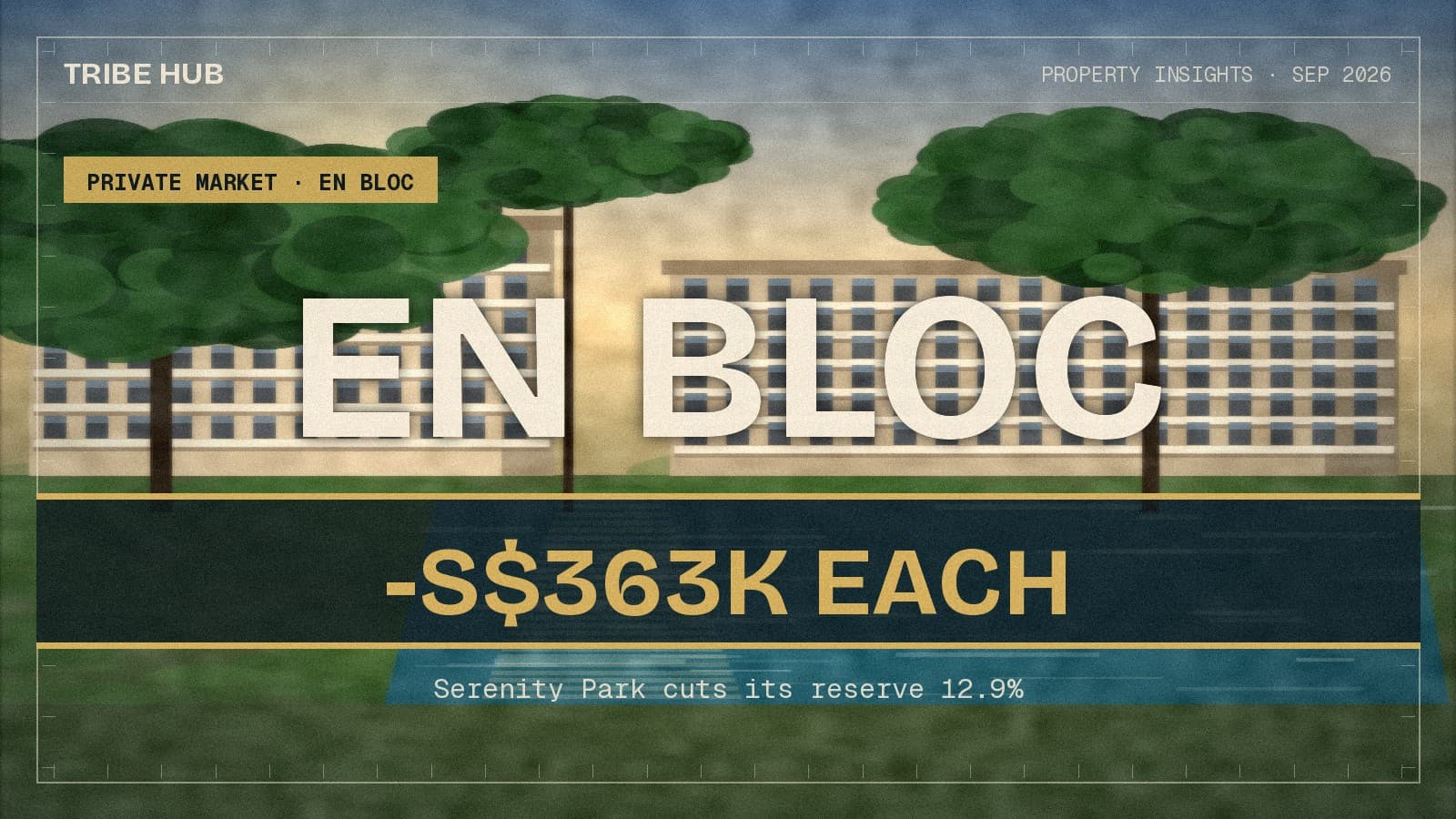
A 12.9% En Bloc Price Cut Costs Each Owner S$363,000. It Buys the Developer No Extra Floor Area at All.
Serenity Park relaunched its collective sale S$65 million lower this week — S$363,000 an owner. The site is already at its full plot ratio under a five-storey cap, so the cut buys a developer no extra floor area at all.
By TRIBE Editorial · 17 September 2026 · 8 min read
Serenity Park, a 179-unit freehold condo off Yio Chu Kang Road, went back on the collective sale market this week at S$440 million, down from the S$505 million it asked in February. The cut is 12.87%. Spread across 179 households it is an average of S$363,128 each, and it is the only lever the sale committee actually controls.
What the cut does not do is change anything about why the first attempt failed. The site is already built to its permitted plot ratio under a five-storey height cap, so a lower price buys a developer no additional floor area whatsoever. The 2026 amendments that lowered en bloc consent thresholds do not reach a condo completed in 1995. And the 40% stamp duty a developer pays on the land is unchanged either way.
The cut, reconciled
Both asking prices reconcile exactly, which is worth doing before trusting any collective sale headline. The site is 248,173 sq ft with a plot ratio of 1.4 under Master Plan 2025, giving 347,442 sq ft of gross floor area. S$505 million over that is S$1,453 psf per plot ratio; S$440 million is S$1,266. Both match the published figures to the dollar.
That check works on any collective sale: site area times plot ratio should reproduce the quoted psf ppr from the quoted total. When it does not, one of the two published figures rests on a different assumption from the other.
Pek Chuan Building, the Lavender Street commercial property relaunched alongside it by the same agent, took a much smaller haircut: S$80 million last October to about S$77 million, down 3.75%, or S$1,115 to S$1,073 psf ppr.
What a developer is actually buying
The standard engine of a collective sale is unused plot ratio: an old, low-density block sits on land zoned for more than it uses, and the developer pays for the gap between what is there and what is allowed.
At Serenity Park there is no such gap. The plot ratio is 1.4, the height limit is five storeys, and the site sits inside a landed enclave in District 28 that will not be rezoned for a buyer's convenience. The permitted 347,442 sq ft is the same whether the site sells for S$505 million or S$440 million.
The marketing estimate of about 380 units at an average 915 sq ft — the Outside Central Region norm for new non-landed homes — comes to 347,700 sq ft, which is the permitted GFA to within a rounding error. So the redevelopment does not add floor area. It re-cuts the same floor area into 2.12 times as many units, dropping the average from roughly 1,941 sq ft of GFA per existing home to 915.
That is a unit-size trade, not an intensification trade. The developer's entire return has to come from the price-per-square-foot gap between a 1995 low-rise apartment and a new compact one, with no extra storeys to sell. It is among the thinnest forms of en bloc arithmetic, and it explains why the reserve moved and the buyer did not.
For owners, the plainest way to read the new number: at S$440 million you are being offered roughly S$1,266 for each square foot of permitted floor area attached to your home. Whoever pays it then has to cover stamp duty, construction, financing, marketing and a margin out of what the same floor area sells for once it has been divided in two.
The tax that sets the floor
A housing developer buying residential land pays 40% ABSD. Five percentage points are non-remittable and due within 14 days of acquisition; the remaining 35% is remitted only if the project is completed and every unit sold within the prescribed period (IRAS).
On S$440 million, the non-remittable 5% alone is S$22 million, paid before a single pile goes in and never recovered. The 35% behind it is not a tax the developer expects to pay — it is a deadline the developer has to price, and on a 380-unit project that clock is what limits how hard the land can be bid. Revisions announced in July 2026 extended the remission timeline for large-scale en bloc redevelopments: they lengthened the clock, they did not cut the rate.
One genuine advantage here runs the other way. Serenity Park is freehold, so there is no lease top-up to buy, and because the development baseline already reflects the permitted envelope, there is little uplift for a land betterment charge to attach to — the same insulation we described at Gilstead Court when the September LBC revision raised non-landed rates 3.4%. A site with no unused plot ratio is a site with nothing much to be charged on.
The relaxation does not reach this building
The 2026 amendments to the collective sale regime lowered the consent threshold to 70% for developments 40 to 59 years old and 65% for those aged 60 and above, and we walked through the mechanics when the Bill was introduced in The En Bloc Bar Just Dropped.
Serenity Park was completed in 1995. At 31 years old it falls outside both new tiers and stays on the 80% standard. The easing is written for the cohort arriving after this one — and that cohort is large: of roughly 3,750 private residential developments in Singapore, more than 1,000 are already at least 30 years old. Its real effect lands over the next decade, not this quarter.
A second change cuts the other way: the window for assembling consent was shortened to six months. A lower bar with half the time to clear it is not unambiguously easier, particularly where a committee has to re-canvass every owner after a price cut.
The base rate for relaunches
A relaunch at a lower number reads like a setback. Historically it is simply the process.
| Project | Concluded | Price | Attempt that closed | Discount to asking |
|---|---|---|---|---|
| Chuan Park | Jul 2022 | S$890m | 4th | −5.11% from S$936m |
| Meyer Park | 2023 | S$392.18m | not stated | not stated |
| Thomson View | Oct 2024 | S$810m | 6th (5 prior failures over 12 years) | −S$108m |
| Loyang Valley | Apr 2026 | S$880m | 3rd, over 4 years | −S$100m |
Those four are close to the entire recent record of large collective sales. There was no large en bloc deal at all in 2025, against 31 deals worth S$8.5 billion in 2017 and 36 worth S$10.3 billion in 2018 (Property Soul). The pattern among those that closed is consistent: three or more attempts, and a nine-figure discount, before a buyer appears — and then Chuan Park needed a High Court ruling after minority objections, while Thomson View's buyers waited another year for acquisition approval.
Against that, Serenity Park is on attempt two with a 12.87% cut. High Point is on its sixth attempt at S$580 million. Gilstead Court is on its fourth at S$198 million. None of that is a distress signal — but the historical shape says the price on a site that eventually sells usually has further to travel than its first cut.
What the cut cannot do
The reserve price is the one variable a sale committee can move, and moving it transfers money from owners to the probability that a deal happens. It cannot change the plot ratio, the height cap, the 5% of land price that ABSD burns on day one, or the six-month consent window.
It also cannot change the number that matters most to the people voting. Private home prices have gone up through 2026, not down; the replacement home did not become 12.87% cheaper because the reserve did. An owner weighing the lower figure should measure it against what it costs to buy back into the same neighbourhood today — not against February's S$505 million, which was never money in anyone's hands.
Serenity Park's private treaty exercise closes at 11am on 30 September. The Pek Chuan Building tender closes on 7 October.
Site areas, plot ratios, reserve prices, unit counts and completion dates as published by the marketing agent and reported on 16 September 2026. Developer ABSD treatment from IRAS. Historical collective sale prices, attempt counts and discounts as compiled by Property Soul, 8 September 2026. All psf ppr figures, percentage changes, per-unit averages and floor-area reconciliations computed, not quoted; per-unit figures are simple averages across 179 units and individual entitlements vary by share value. Methodology published. No spin.
Check how your condo scores
2,357 condos independently scored across 7 weighted factors. No registration required.
Score my resale →Prefer a personal read on your situation? Arrange a consultation →Keep reading
19 September 2026Private Property Market
A 42-Year-Old Block, a Fourth Attempt, and a New Law Worth Two Signatures
18 September 2026Private Property Market
The Cheapest PSF and the Cheapest Apartment Are Two Different Units
17 September 2026Private Property Market
Seven Developers Bid for the Same Site. The Winner Still Paid 11% More Than Anyone Else.

TRIBE Editorial · Reviewed by Silas Tan
Co-Founder, TRIBE · District Director, Huttons Asia · Ex-Mortgage Banker (AVP) · >1,000 families advised · CEA R000303I
This article is for informational purposes only and does not constitute financial or investment advice.