Insights
The Cheapest PSF and the Cheapest Apartment Are Two Different Units
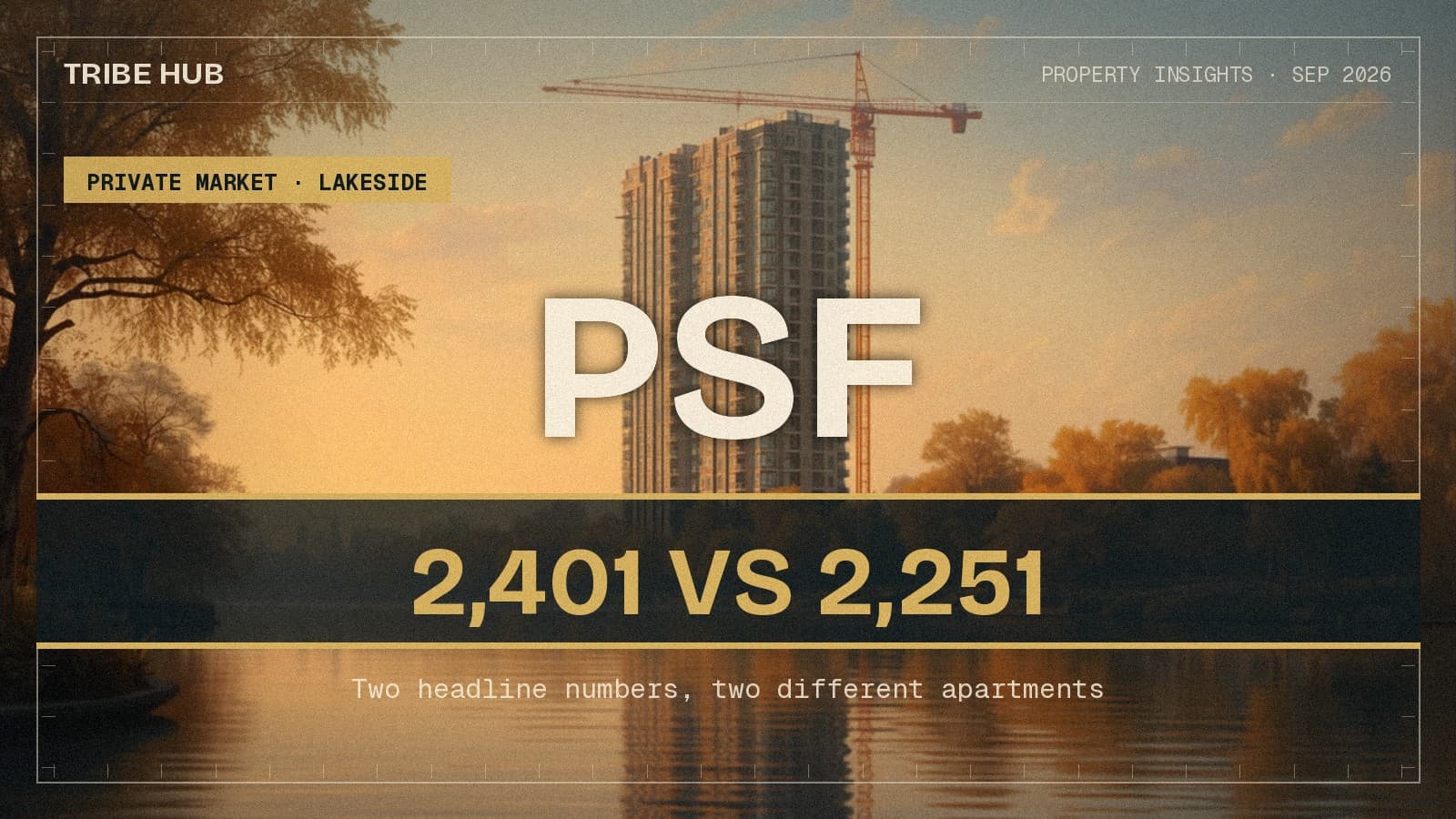
Lucerne Grand previews today from S$2,251 psf and from S$1.498 million. Those two headline numbers belong to two different apartments, and the gap between them is the most useful thing a launch price list will tell you.
By TRIBE Editorial · 18 September 2026 · 8 min read
City Developments previews Lucerne Grand today, a 570-unit leasehold project on Lakeside Drive with bookings opening on 3 October. The coverage carries two numbers: prices from S$2,251 psf, and prices from S$1.498 million (EdgeProp).
Both are accurate. Neither describes the same apartment. The S$1.498 million is a 624 sq ft two-bedroom that works out to S$2,401 psf; the S$2,251 psf belongs to an 883 sq ft three-bedroom costing S$1.988 million. A buyer who reads the two figures as one apartment is looking for a 624 sq ft unit at S$1.40 million that does not exist.
The ladder, as published
| Unit type | From (sq ft) | From (price) | Implied |
|---|---|---|---|
| Two-bedroom | 624 | S$1,498,000 | S$2,401 psf |
| Three-bedroom | 883 | S$1,988,000 | S$2,251 psf |
| Four-bedroom premium | 1,152 | S$2,788,000 | S$2,420 psf |
The psf column is not a straight line. It dips in the middle. The three-bedroom is 6.22% cheaper per square foot than the two-bedroom and 6.97% cheaper than the four-bedroom premium, which inverts the usual expectation that smaller units carry higher psf and larger ones carry lower.
That expectation is usually right, and it is worth being precise about why it fails here. Small units do carry a psf premium, because the fixed content of an apartment — one kitchen, one bathroom, one entrance — is spread over fewer square feet. But at the top of a ladder the premium returns for a different reason: the four-bedroom premium layouts occupy better stacks and higher floors, and the project's largest format runs to 1,432 sq ft. The lowest psf therefore lands in the middle, on the unit type with neither the small-unit loading nor the top-stack loading.
What the marginal square foot costs
The cleanest way to see it is to stop reading the psf column and price the difference instead.
Moving from the entry two-bedroom to the entry three-bedroom costs S$490,000 and buys 259 more square feet. That is S$1,892 per additional square foot — 21% below the S$2,401 psf the buyer is paying for the two-bedroom itself.
Put plainly: at this price list, the extra bedroom is cheaper per square foot than the apartment it is attached to. The same arithmetic run the other way is what makes the three-bedroom's headline psf look like a discount when it is really a blend — a 624 sq ft core at the entry rate plus 259 sq ft at a materially lower one.
This is the check worth carrying to any launch. Take two adjacent price points, divide the price difference by the area difference, and compare that marginal rate to the entry psf. It tells you where a developer wants volume.
Where the land number stops being comparable
The site was awarded to CDL in June 2025 at S$608 million, or S$1,132 psf per plot ratio, topping six bids (EdgeProp).
Set S$1,132 against S$2,401 and land looks like 47% of the price. That ratio is not quite legitimate, and the reason is the denominator. Psf per plot ratio is quoted on gross floor area — every covered square foot in the development, including common corridors, lift lobbies and the 10,764 sq ft retail podium. A selling price is quoted on strata area — what is inside your front door. Strata area is always smaller, so dividing one by the other flatters the land share.
The assumption-free version: S$608 million across 570 homes is S$1,066,667 of land per apartment. Against the S$1.498 million entry two-bedroom that is 71.2% of the price; against the S$2.788 million four-bedroom premium it is 38.3%. Neither figure is the land share of the project — the retail podium earns separately, and construction, financing and stamp duty sit on top — but both are computed from published numbers rather than an assumed efficiency ratio.
Six bids, one gross floor area
There is a free correctness check buried in any multi-bid tender. Divide every bid by its quoted psf per plot ratio and the same gross floor area should fall out.
| Bidder | Bid | psf ppr | Implied GFA |
|---|---|---|---|
| City Developments | S$608.00m | S$1,132 | 537,102 sq ft |
| Frasers Property / Mitsubishi Estate Asia | S$550.56m | S$1,025 | 537,132 sq ft |
| CapitaLand Development / Sing Holdings | S$529.00m | S$985 | 537,056 sq ft |
| Wee Hur | S$503.90m | S$938 | 537,207 sq ft |
| Hong Leong Holdings / TID | S$495.18m | S$922 | 537,072 sq ft |
| Sim Lian | S$488.20m | S$909 | 537,074 sq ft |
All six land within 151 sq ft of each other — 0.03%, which is rounding in the published psf figures. The numbers are internally consistent.
What they are not consistent with is the site's stated zoning. The plot is 145,314 sq ft at a gross plot ratio of 3.6, which multiplies out to 523,130 sq ft. The bids are priced on 537,107 sq ft, 2.67% more.
The gap is not an error. A government land sale tender states a maximum permissible gross floor area directly, and that figure is what bidders price against; the Master Plan plot ratio is the rounded zoning attribute. So the reconciliation rule that works on a collective sale — site area times plot ratio should reproduce the quoted psf ppr — needs a caveat on GLS land: check the bids against each other first, and treat the tender's own GFA as the denominator.
The spread, again
Yesterday we argued that the useful information in a land tender is the spread between the bids, not the winning number. Lakeside Drive says the same thing fifteen months earlier and in the other direction.
CDL bid 10.43% above the second-highest bid and 24.54% above the lowest. The five losing bids span only 12.76% between themselves. One bidder was priced somewhere the other five were not — and the S$57.44 million difference works out to S$100,772 per apartment CDL has to recover out of the price list previewing today.
Whether it did is now partly answerable. At tender, PropNex estimated the future project would average around S$2,400 psf. The published ladder runs S$2,251 to S$2,420. A consultant's forecast made fifteen months before launch landed inside the actual range — worth noting precisely because the same profession's land forecasts have been beaten repeatedly this year.
Against the neighbours
There had been no new condo launch in the Lakeside area since Lake Grande in 2016. The nearest comparisons are The LakeGarden Residences and Sora, carrying median prices of S$2,134 psf and S$2,216 psf respectively as at the tender.
On those medians, Lucerne Grand's three-bedroom at S$2,251 psf is 1.6% above Sora and 5.5% above The LakeGarden Residences; its entry two-bedroom at S$2,401 psf is 8.3% and 12.5% above. We scored Sora separately and it graded C (5.2) on the New Project Scorecard — strong rental record, district-based growth that only just clears 3%, and no MRT within the scoring radius. Lucerne Grand sits directly at Lakeside station, which is the substantive difference between the two sites and the part of the premium that is doing real work.
One housekeeping note for anyone reconciling coverage: the tender-stage plan described 575 units in five 16-storey blocks. The launch describes 570 units in five 17-storey blocks. Small, but it is the kind of drift that makes a per-unit land figure quoted from tender-day reporting slightly wrong by launch day.
The rule
Three checks, none of which need anything beyond the published price list:
- Confirm which apartment each headline belongs to. The lowest price and the lowest psf are rarely the same unit.
- Price the margin, not the average. Divide the price step by the area step between two unit types; compare it to the entry psf.
- Do not divide a land rate by a selling price. One is gross floor area, the other is strata. Use land cost per home instead.
None of that tells you whether Lucerne Grand is worth buying. It tells you what you are actually being quoted — which is the part most price lists are designed to blur.
Check how your condo scores
2,357 condos independently scored across 7 weighted factors. No registration required.
Score my resale →Prefer a personal read on your situation? Arrange a consultation →Keep reading

19 September 2026Private Property Market
A 42-Year-Old Block, a Fourth Attempt, and a New Law Worth Two Signatures

17 September 2026Private Property Market
Seven Developers Bid for the Same Site. The Winner Still Paid 11% More Than Anyone Else.
17 September 2026Private Property Market
A 12.9% En Bloc Price Cut Costs Each Owner S$363,000. It Buys the Developer No Extra Floor Area at All.

TRIBE Editorial · Reviewed by Silas Tan
Co-Founder, TRIBE · District Director, Huttons Asia · Ex-Mortgage Banker (AVP) · >1,000 families advised · CEA R000303I
This article is for informational purposes only and does not constitute financial or investment advice.