Insights
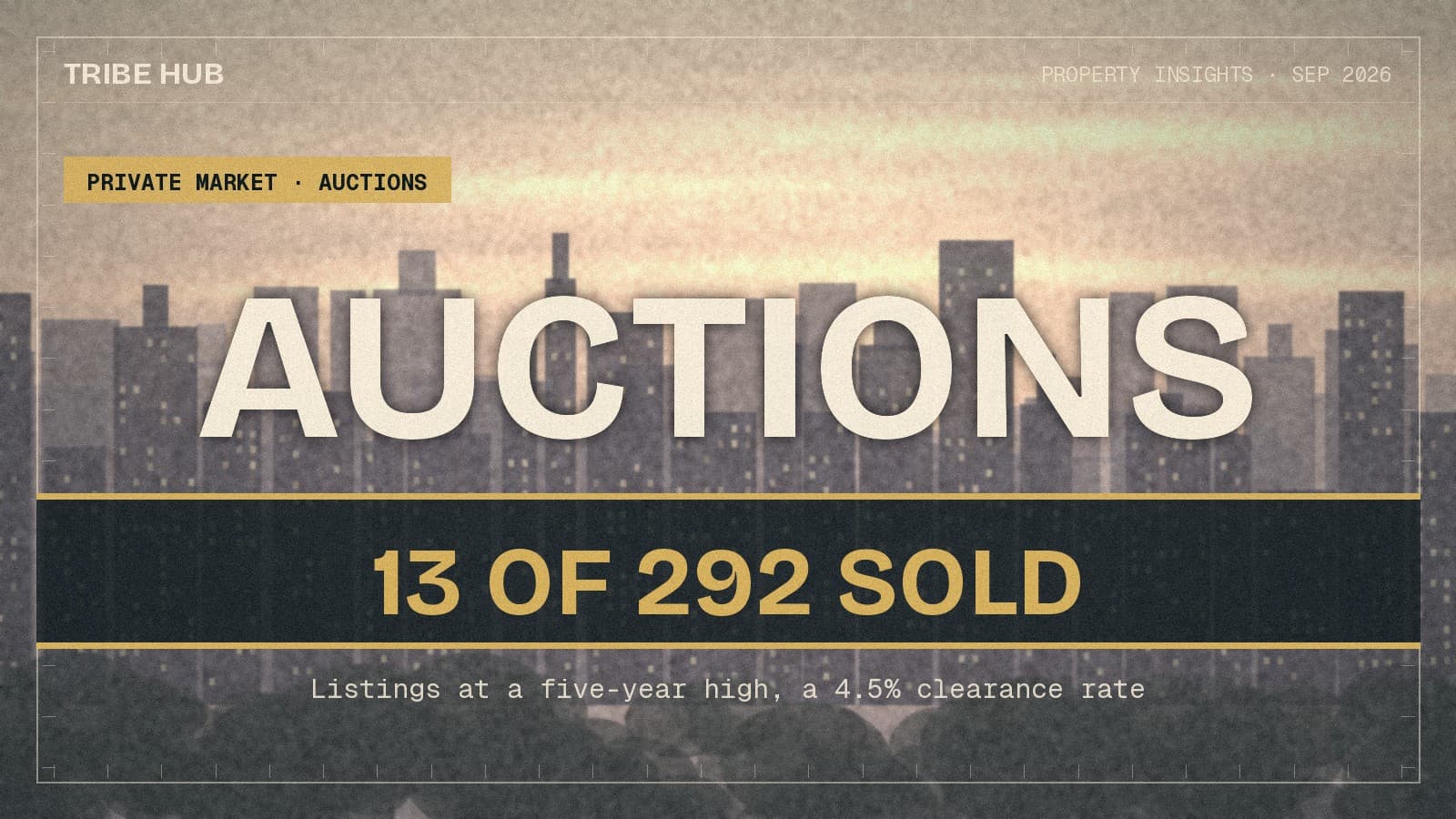
Auction Listings Hit a Five-Year High. One in 22 Sold.
292 properties went to auction in the first half of 2026, the most in five years, and 74% were mortgagee sales. Thirteen of them sold. The listing count is not a distress signal, and the auction room is not a discount channel.
By TRIBE Editorial · 4 September 2026 · 7 min read
Ten apartments at Martin Modern and Wallich Residence go under the hammer on 23 September, guide prices from S$2.238 million to S$6.78 million. They are the leading edge of roughly 80 forfeited properties from Singapore's S$3 billion money laundering case, to be auctioned in phases into mid-2027. It reads like a market under pressure.
The underlying numbers say something more specific. Auction listings in the first half of 2026 hit their highest half-yearly level in five years — and thirteen properties sold. Out of 292. The auction room in Singapore is not where distressed stock gets cleared at a discount; it is where a price gets tested in public, and 95% of the time the sale happens somewhere else.
The headline number and the number that matters
ETC's half-year auction review, published 27 July, counts 292 listings in 1H2026 — up 12.3% on the previous half and 8.6% year-on-year, the most since the first half of 2021. Of those, 216 were mortgagee sales, meaning a lender rather than the owner put the property up.
Thirteen sold, for a combined S$27.67 million. That is a success rate of 4.45%, and an average of S$2.13 million per lot that found a buyer. Knight Frank counted five sales in 1Q2026 at a 3.4% success rate, up from 3.0% in 4Q2025, and holds a full-year projection of around 5%.
Put plainly: about one listing in 22 sells under the hammer. The other 279 were withdrawn, passed in below reserve, or — most commonly — sold afterwards by private treaty at a negotiated price.
This is the single most misread statistic in the auction coverage. A rising listing count gets reported as rising distress. But listings measure how many properties were put up, and in a market where 95% do not clear on the day, that is closer to a measure of marketing activity than of forced liquidation.
Why the mortgagee share is rising while the total barely moves
The composition tells a better story than the total.
| 1H2026 listings by seller | Count | Share |
|---|---|---|
| Mortgagee sales | 216 | 74.0% |
| Owner sales | 53 | 18.2% |
| Sheriff's, trustee's, MCST, liquidator, receiver's, estate | 23 | 7.9% |
| Total | 292 | 100% |
ETC's head of auction and sales, Joy Tan, attributes the mortgagee share to tighter financing conditions — but the second half of her explanation is the load-bearing part: owner-sale listings are declining because the resale market is healthy, which lets borrowers under strain sell on the open market before a foreclosure ever happens.
That matters arithmetically. The mortgagee share is a ratio, and its denominator is shrinking. A falling owner-sale count pushes the mortgagee percentage up even if the absolute number of foreclosures is flat. "74% mortgagee" is therefore partly a statement about how few owners now need an auctioneer — not only about how many are being foreclosed on.
Tan's own summary is that this reflects "a market that remains selective rather than a signal of distress." The data supports that reading better than the headline does.
Industrial is where the movement is
Residential remained the largest slice at 144 listings, or 49.3% of the total. The real change was elsewhere.
| Asset type | 1H2025 | 2H2025 | 1H2026 | Change vs 2H2025 |
|---|---|---|---|---|
| Industrial | 61 | 58 | 87 | +50.0% |
| Retail | 63 | 52 | 46 | −11.5% |
| Residential | — | — | 144 | — |
Industrial listings rose 50% against the previous half, driven — per ETC — by B1 and B2 strata factories with short tenures, many with fewer than 30 years left on the lease. That is a lease-decay story, not a credit story: a strata factory with 25 years remaining is a wasting asset that becomes progressively harder to finance, and owners run out of exit options before they run out of money.
Retail moved the other way, down 27% from 1H2025, on healthy occupancy and quick absorption of vacant units.
What you are actually committing to at the fall of the hammer
For anyone reading the September and October catalogues as a bargain hunt, three mechanics decide whether that is realistic.
The contract is unconditional. A successful bid at auction is a binding sale on the spot, with the deposit payable immediately. There is no financing condition, no cooling-off period and no walking away to renegotiate. Your loan approval, your cash for the deposit and your legal review of the title all have to be finished before you raise your hand — which is precisely why the crowd is thin and the success rate is 4.5%.
A mortgagee sale is sold as-is. The lender selling under its power of sale is not the person who lived there. It gives no warranties on condition, no undertaking about outstanding maintenance or property tax, and often cannot guarantee vacant possession. Any repair bill, arrears or sitting occupant is the buyer's problem after completion.
The reserve is not the guide price. Published guide prices open the bidding; the reserve is set by the lender, typically at or near a valuation that recovers the outstanding debt. A lender is under a duty to obtain a proper price, not a fast one — which is why so many lots pass in rather than clear at a discount. The 279 unsold lots in 1H2026 are the evidence.
Weighed together, the discount most buyers expect is really compensation for risks the auction format transfers to them: no due-diligence window, no financing out, no warranties. Sometimes that trade is worth it. It is not free money, and the clearance data says the market prices it about right.
What to watch in the second half
Two things will inflate the 2H2026 and 2027 listing counts for reasons unrelated to household stress. The forfeited money-laundering portfolio — over 1,000 luxury items and roughly 80 properties, with Deloitte appointed to realise them and SRI, Edmund Tie and Knight Frank handling the auctions — is a court-driven disposal programme, not a wave of defaults. And industrial strata stock will keep arriving as short leases run down.
ETC expects 2H2026 sales value to track 1H2026's modest pace. If it does, the pattern holds: more listings, roughly the same handful of sales, and a market clearing quietly by private treaty while the auction room does the price discovery in public.
Read the success rate before the listing count. It is the number that tells you whether anyone is actually being forced to sell.
Working through your own numbers? WhatsApp us: wa.me/6569012192
Listing, composition and sales figures from ETC's 1H2026 auction review (27 July 2026); success-rate figures from Knight Frank's 1Q2026 auction commentary. Total 1H2026 transaction value includes one estimated valuation where the final price was unavailable at publication. Methodology published. No spin.
Condos in this article

Check how your condo scores
2,350 condos independently scored across 7 weighted factors. No registration required.
Score my resale →Prefer a personal read on your situation? Arrange a consultation →Keep reading
12 October 2026Private Property Market
Five Foreigners Were Approved to Buy a Good Class Bungalow in a Decade. None Since 2021.

11 October 2026Private Property Market
One S$70 Million Deal Decides Whether the Shophouse Quarter Was Up or Down
10 October 2026Private Property Market
A Record S$42.4 Billion. A Quarter of It Was the Government Selling Land.
Next step

TRIBE Editorial · Reviewed by Silas Tan
Co-Founder, TRIBE · District Director, Huttons Asia · Ex-Mortgage Banker (AVP) · >1,000 families advised · CEA R000303I
How TRIBE scores and checks its analysis
Spotted an error, or a figure that has moved since publication? Tell us and we will correct it.
This article is for informational purposes only and does not constitute financial or investment advice.