Insights
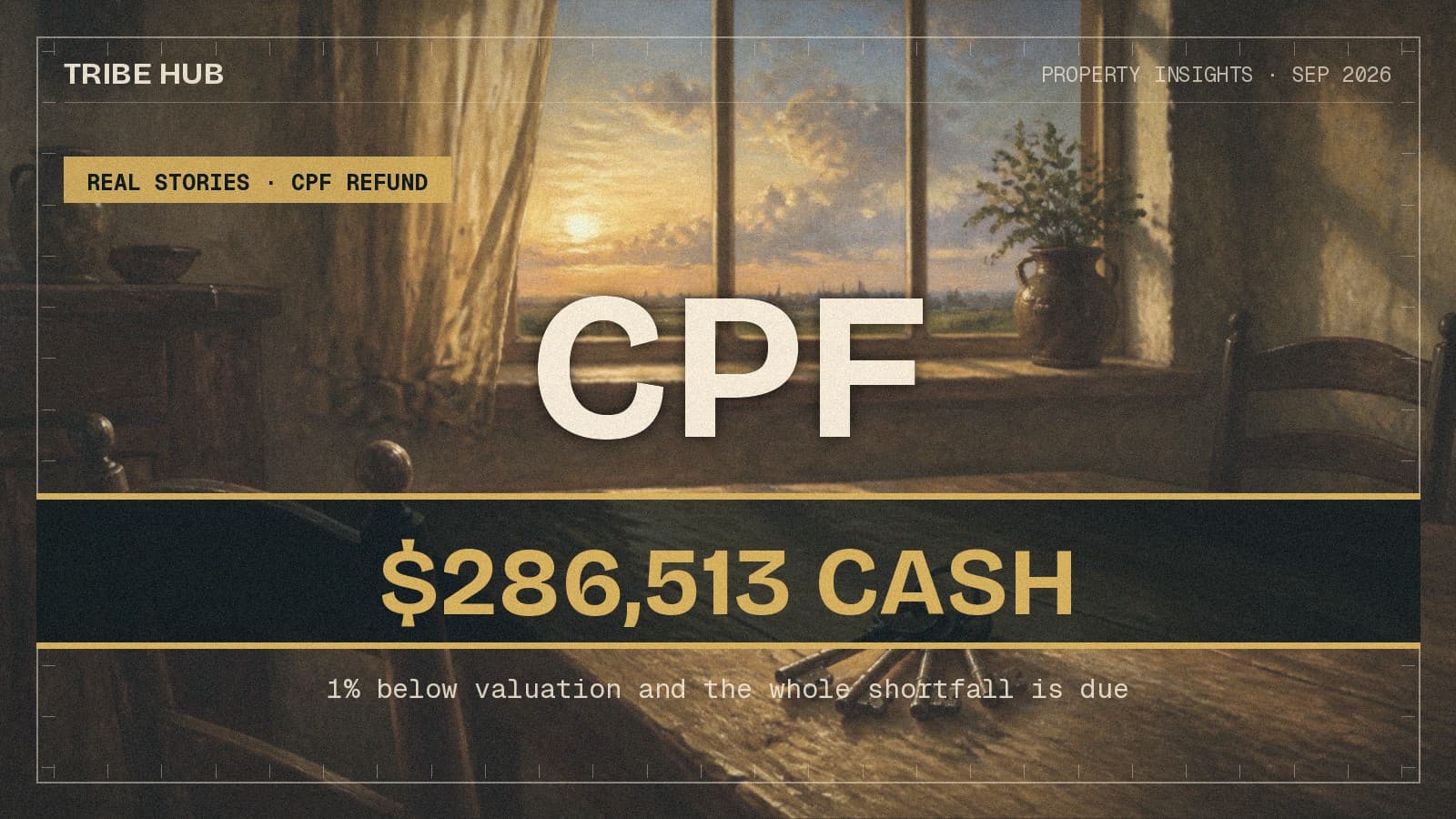
Sell One Per Cent Below Valuation, Owe $286,000 in Cash
Sell at market value and CPF absorbs whatever the sale cannot refund. Sell a single dollar below it and the entire shortfall becomes payable in cash. We ran one 2013 condo purchase through both outcomes.
By TRIBE Editorial · 27 September 2026 · 8 min read
Most sellers understand that a discount costs them the discount. Take $13,000 off the asking price and you are $13,000 worse off. It is the one piece of property arithmetic that feels safe to do in your head.
For a seller with a CPF refund shortfall, it is wrong by a factor of twenty. The same $13,200 concession below valuation, in the case below, converts a bill of nothing into a bill of $286,513 in cash, due on completion. Not a smaller cheque. Cash out of the bank.
This is a composite. The couple are illustrative, the rules and rates are real, and every figure below is computed from the stated assumptions rather than drawn from a client file.
The rule, in CPF's words
When you sell a property you used CPF to buy, your Ordinary Account is owed back the principal you withdrew plus the accrued interest it would have earned at the OA rate had you left it there. That refund ranks after your outstanding housing loan is discharged.
Often the sale cannot cover both. CPF's published position on what happens then turns on one condition:
"If the selling price after paying your outstanding housing loan is not enough to cover the required CPF refund, you do not need to top up the shortfall in cash if you have sold the property at market value."
And the other side of it:
"If your property sells below market value, you will need to top up the shortfall in cash."
Read those two sentences together and the structure is not a slope. It is a cliff, and the cliff sits at the valuation line. At market value the shortfall is simply a smaller credit to your OA. One dollar below, the shortfall — all of it, not the part caused by the discount — becomes a cash obligation.
The case
Wei Han and Adeline bought a 99-year condominium in January 2013 for $1,240,000, close to that cycle's top. The numbers from there are mechanical.
| Item | Amount |
|---|---|
| Purchase price, Jan 2013 | $1,240,000 |
| Loan at 80% LTV | $992,000 |
| Cash downpayment (5% minimum) | $62,000 |
| CPF downpayment | $186,000 |
| Instalment, 2.00% over 30 years | $3,667/month |
CPF serviced the instalment throughout — straightforward for a dual-income couple at that instalment size, and the default most buyers fall into because it costs nothing today.
Thirteen years and nine months later, in September 2026:
| Item | Amount |
|---|---|
| Outstanding loan (165 payments made) | $610,003 |
| CPF principal withdrawn | $790,993 |
| Accrued interest at 2.5% | $192,317 |
| CPF refund owed | $983,311 |
| Current valuation | $1,320,000 |
The accrued interest is not a penalty and it is not lost money — it is the return the OA would have made, and it goes back into their own account. We have traced that distinction in full elsewhere. The relevant point here is only its size: $192,317, which is most of the reason the refund owed exceeds what the sale can produce.
Their CPF principal is 63.8% of the purchase price, comfortably inside the Valuation Limit, so no CPF usage cap is in play. They have held for 13.7 years, so there is no seller's stamp duty.
Note what the valuation says about the deal itself. $1,320,000 against $1,240,000 is a 6.5% nominal gain over 13.75 years — 0.46% a year. This is a project that went nowhere, which is exactly the profile in which refund shortfalls appear.
Both outcomes
Sold at the $1,320,000 valuation. Proceeds after discharging the loan are $709,997. The refund owed is $983,311, so CPF is credited $709,997 and falls $273,313 short. Wei Han and Adeline receive no cash at all — every dollar goes to the bank and then to their own CPF accounts — and they owe nothing further. The shortfall is absorbed.
Sold 1% below, at $1,306,800. Proceeds after the loan are $696,797. The shortfall becomes $286,513, and because the sale was below market value, that figure is payable in cash on completion.
| Price | vs valuation | Proceeds after loan | Shortfall | Cash top-up required |
|---|---|---|---|---|
| $1,320,000 | at valuation | $709,997 | $273,313 | $0 |
| $1,306,800 | −1% (−$13,200) | $696,797 | $286,513 | $286,513 |
| $1,293,600 | −2% (−$26,400) | $683,597 | $299,713 | $299,713 |
| $1,280,400 | −3% (−$39,600) | $670,397 | $312,913 | $312,913 |
| $1,254,000 | −5% (−$66,000) | $643,997 | $339,313 | $339,313 |
The first row and the second row are separated by $13,200 of price and $286,513 of cash. Every row after that adds only the discount itself — the discontinuity is entirely in the first step across the line.
Why sellers walk into this
Nobody discounts below valuation for fun. The offers that cross the line arrive with reasons attached, and all of them sound like good housekeeping at the time.
The fast close. A buyer who can complete in eight weeks, at 2% under, when you have already committed to your next purchase. The discount looks like the price of certainty, and the certainty is real. The cash bill is not on the comparison sheet.
The stale listing. Four months, few viewings, an agent suggesting a trim to "test the market". A trim of $20,000 on $1.3m is a rounding error in the conversation and a six-figure event at completion.
The valuation nobody checked. For a private sale, market value is a valuer's number, not the asking price you chose. A seller who has assumed their $1.3m listing is market value can accept $1.29m believing they are still at or above it. Valuation arriving after you have already committed is a familiar failure mode on the buying side; it cuts the same way on the selling side.
The option fee. CPF treats cash received from the buyer as part of the selling price: "any option monies (such as an option fee or option exercise fee) that you received from the buyer in cash is considered part of the selling price" and must be refunded. A 1% option fee on this property is $13,200 — money that has already been spent on the next deposit by completion, and is still owed to the OA.
What to do about it
The practical rule is short. If your CPF refund exceeds your expected proceeds after the loan, do not go below valuation. Not by a little, not for a fast close, not to unstick a quiet listing. Above the line the shortfall costs nothing in cash; below it, the whole thing is due.
Three steps make that decision possible rather than theoretical.
- Get the refund figure before you price the flat, not after you accept an offer. It sits on the CPF Home Ownership Dashboard, as principal plus accrued interest, updated. Subtract your outstanding loan from your realistic sale price and compare. If the refund is larger, you are a shortfall seller and the valuation line is the most important number in your transaction.
- Establish market value independently. A formal valuation costs a few hundred dollars and tells you where the cliff actually is. Guessing at it is what turns a small concession into a large one.
- If the offer is below valuation and you need the sale, ask for the arithmetic in writing. Your conveyancing lawyer computes the completion account, and CPF confirms the required refund. Both numbers exist before you sign anything.
One honest caveat. The two CPF passages quoted above are the published rule, and they are also the rule as implemented in our own decoupling engine, which prices part-share transfers at market value for exactly this reason. What neither we nor CPF's public pages can tell you is how a specific transaction will be assessed — whether a particular price is treated as market value is a determination CPF makes on the facts. That is a further argument for asking in advance rather than discovering it on the completion statement.
The arithmetic most sellers do in their heads works on every property except the one where CPF is owed more than the sale can pay. On that one, the discount is not the cost. The line is.
Composite case. Loan amortisation computed at 2.00% over 30 years on an $992,000 facility, 165 payments to September 2026. CPF accrued interest computed by compounding each outflow — the $186,000 downpayment and 165 monthly instalments — at the Ordinary Account rate of 2.5% per annum to September 2026. Refund and top-up rules per CPF Board as cited. Confirm your own refund figure on the CPF Home Ownership Dashboard; this is general information, not advice on your transaction.
Check how your condo scores
2,357 condos independently scored across 7 weighted factors. No registration required.
Score my resale →Prefer a personal read on your situation? Arrange a consultation →Keep reading

19 September 2026Real Stories
They Held It 50-50 to Keep Their Options Open. Two Children Now Own a Quarter of the Home.
29 August 2026Real Stories
Sell the Condo, Buy the Flat, Skip the 15-Month Exile: One Couple's Right-Sizing, End to End

26 August 2026Real Stories
One Name on the Flat, One Name Kept Free. What the Plan Actually Costs.

TRIBE Editorial · Reviewed by Silas Tan
Co-Founder, TRIBE · District Director, Huttons Asia · Ex-Mortgage Banker (AVP) · >1,000 families advised · CEA R000303I
How TRIBE scores and checks its analysis
Spotted an error, or a figure that has moved since publication? Tell us and we will correct it.
This article is for informational purposes only and does not constitute financial or investment advice.