Insights
The Valuation Arrives After You Commit. That Is the Design.
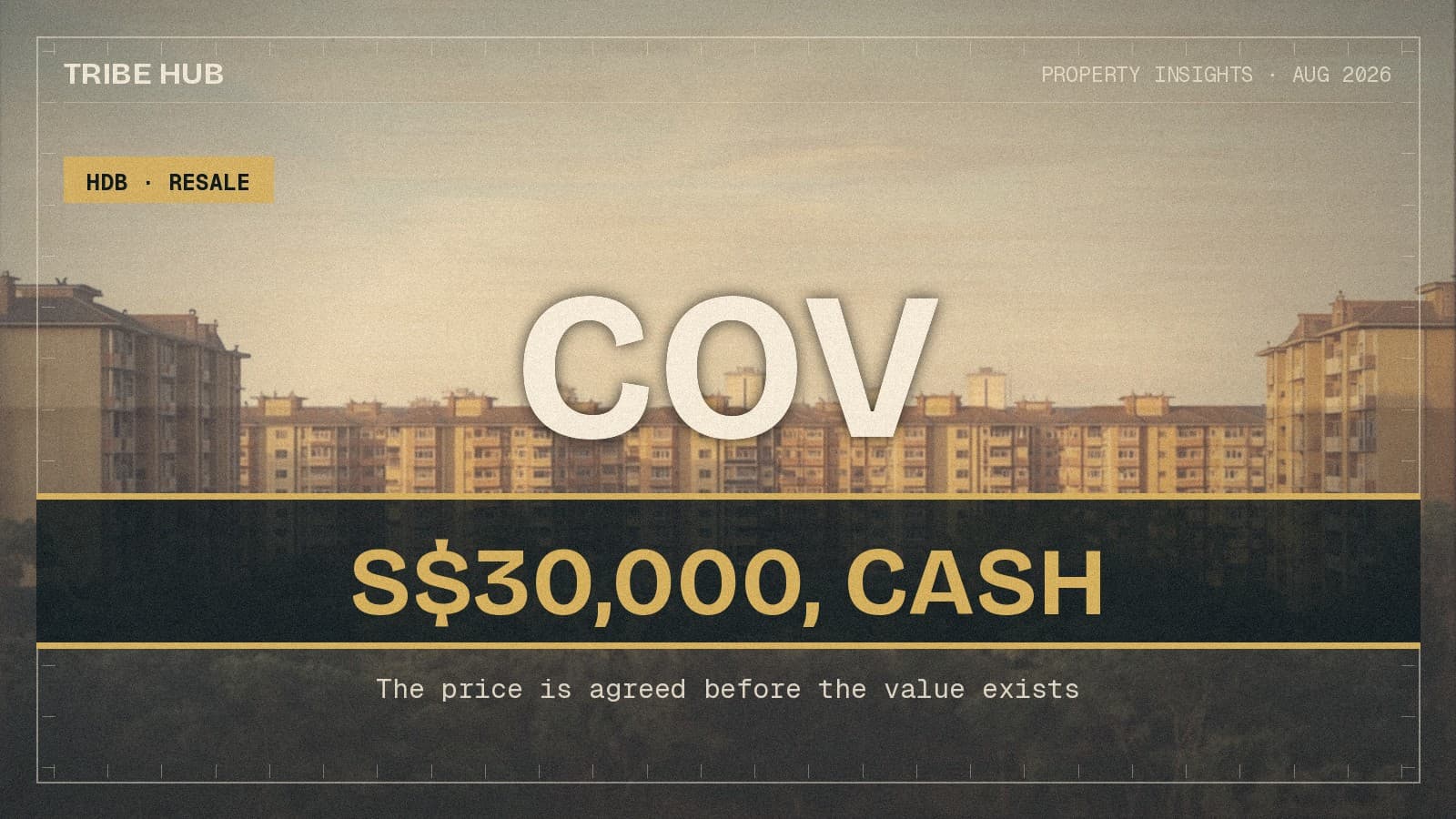
Since March 2014, an HDB resale price is agreed first and HDB's valuation lands days later — and every dollar of price above that valuation can only be paid in cash. The state's own numbers: 18% of buyers since February 2023 paid the gap, the median buyer paid S$0, and walking away costs at most S$1,000.
By TRIBE Editorial · 26 August 2026 · 7 min read
Most buyers of an HDB resale flat negotiate the price believing the valuation is somewhere in the background, anchoring the number. It is not. Under the process that has applied since March 2014, the price comes first, in writing, before any valuation of that flat exists — and if the valuation then comes in below what you agreed, the difference leaves your bank account as cash. Not CPF, not loan. Cash.
This is not a loophole. It is the deliberate design of the system, and it has one escape hatch that most buyers never price in: an option fee capped at S$1,000.
The 2014 re-sequencing
Before March 2014, an HDB resale negotiation started from a valuation report and haggled over the premium above it — the cash-over-valuation, or COV, was the headline number, published quarterly by town and flat type. In a rising market, that meant every negotiation began at the last high-water mark and bid up from there.
On 10 March 2014, the sequence was reversed: HDB would accept a valuation request only after a buyer had been granted an Option to Purchase, the option window was stretched from 14 to 21 days to make room for it, and the COV data series was withdrawn entirely. Buyers and sellers now negotiate on recent transacted prices, and the valuation arrives afterwards, privately, for each deal.
Twelve years on, the consequence is unchanged: you commit to a price before anyone tells you what the flat is worth on paper.
What actually happens inside the 21 days
The mechanics are precise, and they are all on HDB's own pages:
- The seller grants you an Option to Purchase. The 21-calendar-day option period starts on the Option Date, and the price in that OTP is fixed.
- By the next working day, you (or your salesperson) must submit a Request for Value with a scanned copy of the OTP's first page, and pay a S$120 processing fee.
- The outcome is typically available within 10 working days — roughly two calendar weeks of your 21-day window.
- The result stands for 3 months, and it "will determine the value that will form the basis for your CPF usage and/or the reference for the housing loan amount from HDB or the financial institution", in HDB's words.
That last line is the whole game. Your loan — HDB or bank — is sized against the lower of the price and the valuation, and so is your CPF. Whatever sits above the valuation is outside both, which is why COV is cash-only.
Then you choose: exercise the option, or let it lapse. Walk away and you forfeit the option fee — which, by rule, is between S$1 and S$1,000 — plus the S$120 you paid HDB. As MND put it to Parliament, "buyers can decide whether to exercise the OTP for the resale transaction depending on the valuation and any COV payable". The system assumes you know you can leave. Many buyers do not.
The state's own numbers
Because the data series was withdrawn in 2014, there is no published COV index. What exists is a series of parliamentary answers, and they are worth reading precisely:
| Period | Share of resale buyers who paid any COV |
|---|---|
| 2020 | ~20% |
| 2021 | 36% |
| 2022 | 29% |
| Feb 2023 onwards | ~18% |
The 2021–2023 figures are from MND's March 2024 oral answer; the 2020 figure from the November 2022 written answer above. Two details matter more than the headline: the median COV across all buyers is S$0 — most people pay nothing — and in 2022 the 75th-percentile COV by flat type ran from S$5,000 to S$38,000. COV is not a broad market tax. It is a concentrated one, paid by a minority of buyers, mostly in the places where prices are moving faster than the caveats that valuers rely on.
What a S$30,000 gap actually does
Take a four-room flat in a mature town agreed at S$680,000 — right around the 2Q2026 caveat-based average of S$679,570 — financed with an HDB loan at 75% loan-to-value. The only variable is the valuation.
| Valuation S$680,000 | Valuation S$650,000 | |
|---|---|---|
| HDB loan (75% of the lower figure) | S$510,000 | S$487,500 |
| Total buyer funds before BSD | S$170,000 | S$192,500 |
| Payable with CPF and grants | S$170,000 | S$162,500 |
| Hard cash minimum | S$0 | S$30,000 |
An HDB loan famously requires no minimum cash — the downpayment can be fully CPF and grants. A S$30,000 valuation gap overrides that: the loan shrinks by S$22,500, total upfront funds rise by the same, and S$30,000 of the stack becomes cash-only. Grants do not help here either; they are CPF-side money and cannot touch the above-valuation slice. With a bank loan the same S$30,000 stacks on top of the 5% minimum cash component that already applies.
Note the asymmetry. If the valuation had come in at S$710,000, nothing improves — the loan and CPF are still keyed to the S$680,000 price, because the rules take the lower of the two. A high valuation gives you nothing; a low one costs you dollar for dollar, in the scarcest kind of money you have.
Why this matters more in a falling market than you'd think
The Resale Price Index fell 0.3% in 2Q2026, its second straight quarterly decline, and 15 of 26 towns recorded price contractions. Intuitively that should make COV rarer — valuations are set off recent caveats, and when agreed prices stop outrunning them, the gap closes. Market-wide, that is broadly what the 36% → 29% → 18% sequence shows.
But 2026 is a two-speed market. The same quarter that took the index down produced a record 491 million-dollar resale transactions, with Toa Payoh, Queenstown and the Central Area printing million-dollar median prices for four-room flats. Wherever record prices are being set, the agreed price is by definition ahead of the transaction history that valuers work from — which is exactly the condition that produces a gap. The buyers most exposed to COV in 2026 are not stretching into a hot market; they are paying record prices in a cooling one, where the valuation has the least reason to follow.
The practical read
Three things follow from the mechanics. First, before you sign an OTP, pull the recent transacted prices for the block and its neighbours — that is the evidence base the valuer will use, and if your agreed price sits meaningfully above it, budget the difference in cash. Second, hold that buffer in cash until the Request for Value outcome lands, not committed elsewhere. Third, remember the exit: if the valuation surprises you, the cost of walking is capped at S$1,120 all-in. Against a S$30,000 cash call you had not planned for, that option — in both senses — is the cheapest insurance in the entire transaction.
Sources: HDB, Request for Value; MND oral answer to Parliament, 6 March 2024; MND written answer to Parliament, 28 November 2022; CEA practice circular PC 04-14, 12 March 2014; EdgeProp, 24 July 2026. Loan figures computed at HDB's 3% assessment floor and 75% LTV; worked example assumes an HDB concessionary loan and no other constraints.
This article is general information, not financial advice. Confirm the current rules with HDB and your financier before committing to a purchase.
Know what you can afford
Loan, stamp duty, CPF, and monthly repayments — work out your real budget before you commit. No registration required.
Plan my purchase →Prefer a personal read on your situation? Arrange a consultation →Keep reading

TRIBE Editorial · Reviewed by Silas Tan
Co-Founder, TRIBE · District Director, Huttons Asia · Ex-Mortgage Banker (AVP) · >1,000 families advised · CEA R000303I
How TRIBE scores and checks its analysis
Spotted an error, or a figure that has moved since publication? Tell us and we will correct it.
This article is for informational purposes only and does not constitute financial or investment advice.