Insights
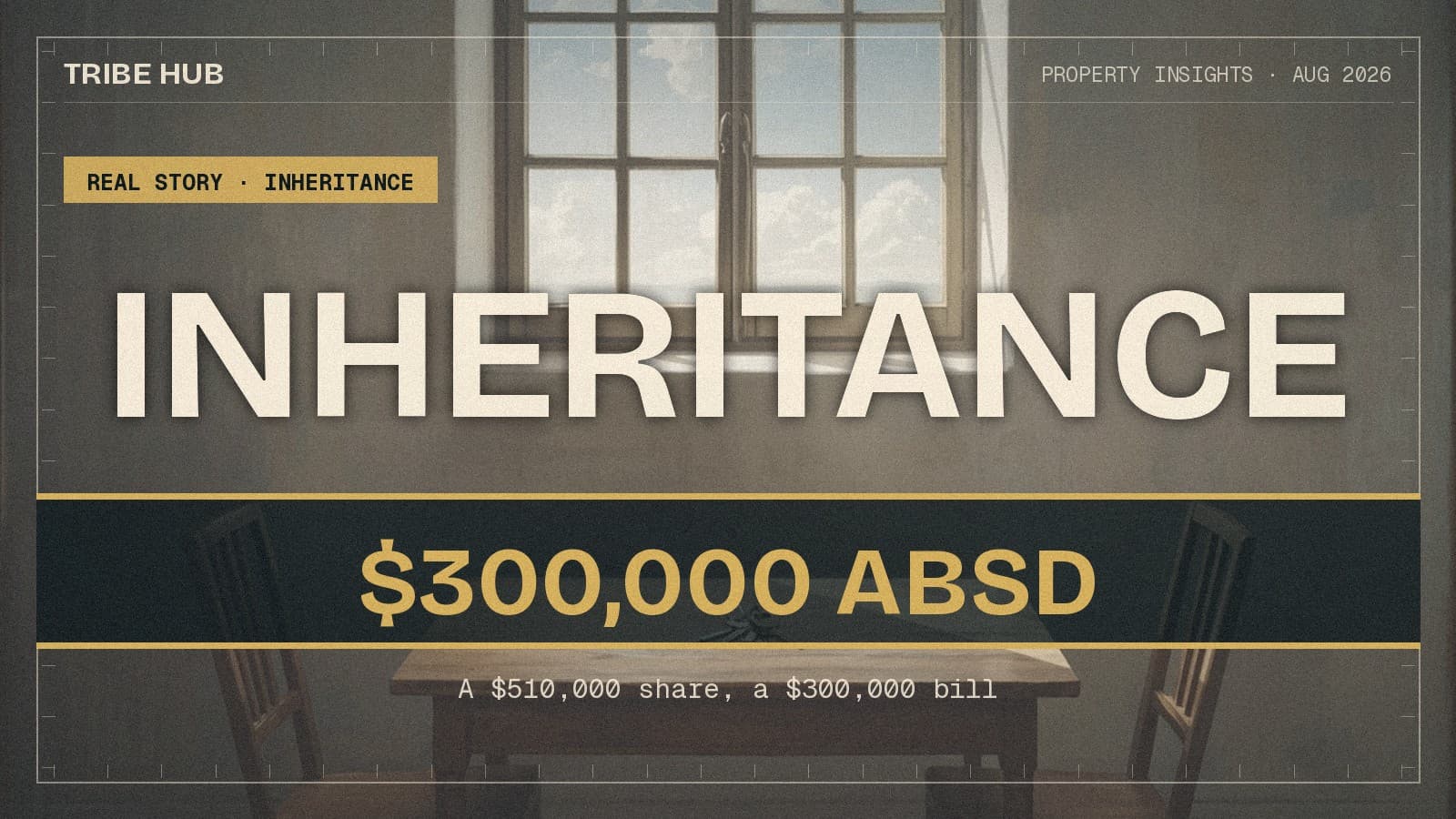
He Inherited Half a Flat. The Bill Arrived Two Years Later, and It Was $300,000.
Inheriting a property costs nothing in stamp duty. What it costs is your first-property status — and for one sibling planning a $1.5 million purchase, a $510,000 inherited share triggered $300,000 of ABSD on the way in.
By TRIBE Editorial · 17 August 2026 · 7 min read
Nobody plans an inheritance around stamp duty. When a parent dies, the flat is the last thing anyone wants to be analytical about, and the paperwork moves at the pace of grief and probate rather than of tax planning. Which is precisely why the expensive decisions get made by default — quietly, in the months when no one is looking at the numbers.
The household below is an illustrative composite: invented people, stated assumptions, computed math. The rules and the figures are real. The names are not.
The estate
Mdm Chua dies in early 2026, leaving a four-room flat in Toa Payoh. She bought it in 2011 with a CPF Housing Grant. Her will splits the flat equally between her two children.
Serene, 44. Owns a condominium in Bukit Timah jointly with her husband. Two school-age children. Not planning to move.
Marcus, 39. Rents in Tiong Bahru. Owns nothing. Has been saving for six years and intends to buy a $1.5 million two-bedroom next year.
The Q2 2026 median for a four-room flat in Toa Payoh was $1.02 million — the town was one of three, alongside the Central Area and Queenstown, where the four-room median crossed seven figures that quarter. So each sibling's half-share is worth roughly $510,000.
Neither of them pays a cent of stamp duty to receive it. Property that passes by will, under the Intestate Succession Act, or under Muslim inheritance law is not a purchase, and no buyer's stamp duty or ABSD is charged on the transfer (IRAS).
That is the sentence everybody hears. The one that matters comes next.
Serene's problem is loud
Serene owns private property. You cannot hold an HDB flat and private residential property concurrently unless you meet a narrow exception — and the exception turns on when the flat was bought. Flats purchased before 30 August 2010 without a housing grant can, in defined circumstances, be retained by a beneficiary who owns private property. Mdm Chua bought in 2011, with a grant. The exception does not reach her estate.
So Serene has six months from the inheritance to dispose of one or the other — her share of the flat, or the condominium. HDB can grant an extension on reasonable grounds, and failing to act can end in compulsory acquisition of the flat.
This is the loud problem, and loud problems get solved. There is a deadline, there is a letter, there is a lawyer. Serene will sell her share. Nobody misses this one.
Marcus's problem is silent
Marcus's half-share triggers no duty, no letter, and no deadline. It also quietly ends his status as a first-time buyer.
For ABSD purposes, your property count is not a count of what you bought. It includes anything acquired by inheritance, gift, release, settlement, declaration of trust or exchange. A half-share counts. Marcus went from owning nothing to owning residential property on the day the estate was distributed, and nothing in the process announced it.
Here is what that does to the purchase he has been saving six years for. He is a Singapore Citizen; the tiers are 0% on a first property, 20% on a second, 30% on a third or subsequent.
| $1.5m purchase | Before the inheritance | After |
|---|---|---|
| Buyer's Stamp Duty | $44,600 | $44,600 |
| ABSD | $0 (first property) | $300,000 (second property) |
| Total duty on stamping | $44,600 | $344,600 |
A $510,000 inherited share has cost him $300,000 in cash at the point of purchase — 59% of what the share is worth, payable in full within 14 days of exercising the option, and not fundable by CPF or by loan. Marcus did not buy anything, did not sign anything, and did not do anything wrong. He simply appeared in a will.
What the options actually are
There are ways through, and every one of them lives before the estate is distributed, not after. This is the part worth reading twice.
Sell the flat as part of the estate. If the executor sells before distributing, the beneficiaries receive cash rather than property. Marcus's count never moves. This is the cleanest route and it requires only that someone raises it at the right moment. On the SSD question, the holding period is measured from Mdm Chua's acquisition date, not from the date of death. She bought in 2011 — well outside any SSD window — so a sale attracts no Seller's Stamp Duty. Had she bought within the last four years, that would not be true, and it is one of the few places where the deceased's purchase date reaches forward into the beneficiaries' costs. Our full walkthrough of the duties sits here.
Vary the distribution by agreement. Beneficiaries can enter a deed of family arrangement redistributing the estate — Serene takes the flat, Marcus takes a larger share of the cash and CPF monies. Executed properly, and within the estate, this can keep Marcus off the title entirely. It has to be documented and it has to be done for the right reasons; it is not a device to be improvised after the fact.
Sell his share to Serene afterwards. This is the route people default to, and it is the expensive one. Once the shares are distributed, a transfer between siblings for consideration is a purchase. Serene would pay BSD of $9,900 on the $510,000 share, plus ABSD at her own rate — $102,000 at the second-property tier, $153,000 at the third — and Marcus's count only resets once the disposal completes. Two duty events instead of none.
Just wait. Marcus can dispose of his share and buy afterwards. If he sells before he purchases, his count is back to zero and there is no ABSD. If he buys first intending to sell the share later, he pays the $300,000 upfront, and the married-couple remission that helps some upgraders does not apply to him — he is single, and the remission is for a matrimonial home. The buy-first-or-sell-first sequencing problem is the same one upgraders face, with the same answer: the order is worth more than the timing.
The thing to take from this
The disposal deadline is the rule everyone knows, because it comes with a letter and a clock. The property count is the rule that costs more, because it comes with neither.
If you are named in a will that includes residential property, and you have any intention of buying in the next few years, the question to ask is not "what will I inherit?" It is "what will this do to my property count, and can it be settled inside the estate rather than after it?" That question has a good answer while the estate is open and an expensive one once it is closed.
It is an awkward conversation to have while a family is grieving. It is a $300,000 conversation.
Illustrative composite. The people are invented; the rules, rates and computations are not. Figures assume a Singapore Citizen buyer, a $1.02 million flat valuation (HDB Q2 2026 median for a four-room in Toa Payoh), a $510,000 half-share and a $1.5 million next purchase. BSD and ABSD computed from the rates current as at 27 April 2023. Estate and inheritance matters are legal questions — this is analysis of the duty arithmetic, not legal advice. Take the specifics to a probate lawyer before the estate is distributed, which is the only point at which most of these options exist.
Methodology published. No spin.
Check how your condo scores
2,352 condos independently scored across 7 weighted factors. No registration required.
Score my resale →Prefer a personal read on your situation? Arrange a consultation →Keep reading
27 September 2026Real Stories
Sell One Per Cent Below Valuation, Owe $286,000 in Cash
19 September 2026Real Stories
They Held It 50-50 to Keep Their Options Open. Two Children Now Own a Quarter of the Home.
29 August 2026Real Stories
Sell the Condo, Buy the Flat, Skip the 15-Month Exile: One Couple's Right-Sizing, End to End

TRIBE Editorial · Reviewed by Silas Tan
Co-Founder, TRIBE · District Director, Huttons Asia · Ex-Mortgage Banker (AVP) · >1,000 families advised · CEA R000303I
How TRIBE scores and checks its analysis
Spotted an error, or a figure that has moved since publication? Tell us and we will correct it.
This article is for informational purposes only and does not constitute financial or investment advice.