Insights
Buy First or Sell First? The Upgrader Mistake That Costs $360,000
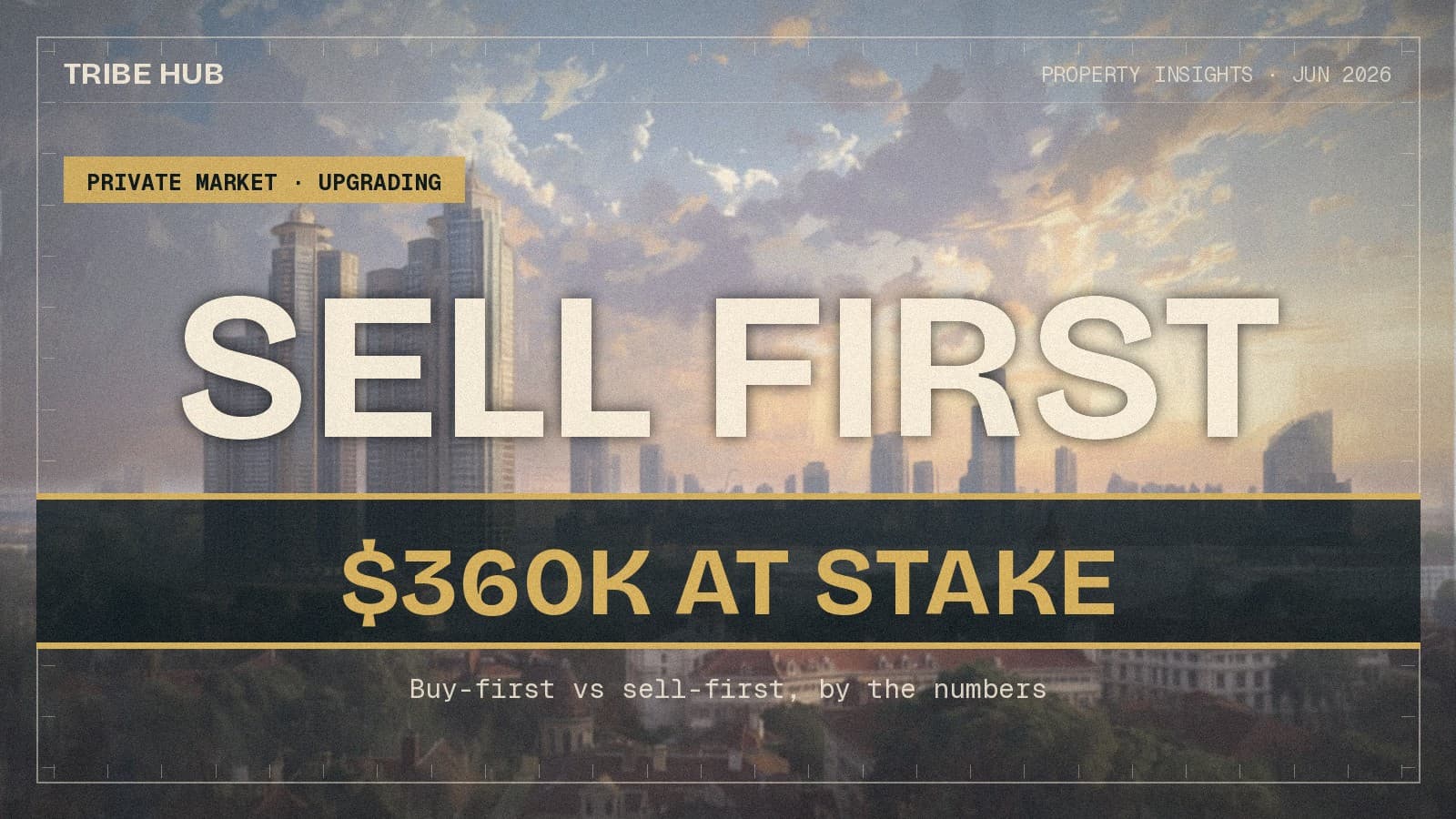
The most expensive decision an HDB upgrader makes isn't which condo — it's the order. Buy before you sell and you trigger 20% ABSD plus a brutal loan haircut. We work the numbers on a $1.8M upgrade.
By TRIBE Editorial · 24 June 2026 · 5 min read
The single most expensive choice an HDB upgrader makes is not the condo, the district, or the rate. It's the sequence — whether you buy the new place before selling the flat, or the other way around. Get the order wrong and you can hand the government $360,000 you'll spend months trying to claw back, and shrink your loan by half a million dollars at the same time. The unit you bought doesn't change. The order you bought it in does. Here is exactly what's at stake, on a worked $1.8M upgrade.
Two separate penalties, often confused
Buying before selling triggers two distinct rules that catch people out because they sound similar but key off different things.
The first is Additional Buyer's Stamp Duty (ABSD), which keys off how many properties you own. The moment you exercise the option on the condo while still owning your HDB flat, you are buying a second property — and a Singapore Citizen pays 20% ABSD on it, on top of the normal Buyer's Stamp Duty (IRAS). On an $1,800,000 condo that's $360,000, due in cash or CPF within 14 days of purchase.
The second is the Loan-to-Value (LTV) limit, which keys off how many housing loans you have outstanding. If your HDB still carries a loan when you take the condo mortgage, the condo is your second housing loan — and MAS caps that at 45% LTV, not the 75% a first loan enjoys (MAS via theloanconnection). Sell first (and clear the HDB loan) and the condo becomes a first loan again, back at 75%.
You can trip one without the other — but buy-first with an outstanding HDB loan trips both.
What the order does to the money
Take a couple upgrading to an $1,800,000 condo. Compare the two sequences side by side:
| Sell first | Buy first (HDB still owned + loaned) | |
|---|---|---|
| ABSD | $0 | $360,000 |
| Max loan (LTV) | 75% = $1,350,000 | 45% = $810,000 |
| Downpayment required | 25% = $450,000 | 55% = $990,000 |
| Minimum in cash | 5% = $90,000 | 25% = $450,000 |
Selling first, the condo is a normal first purchase: 75% loan, a $450,000 downpayment of which only $90,000 must be cash, and no ABSD. Buying first, you must produce a $990,000 downpayment — $540,000 more — because your loan is capped at 45%, and find the $360,000 ABSD on top. The same household that comfortably upgrades by selling first may not have anywhere near the $1.4 million of cash and CPF that buying first demands upfront.
The escape hatch — and how people fall out of it
There is a legitimate way to buy first: the married-couple ABSD remission. A married couple with at least one Singapore Citizen who buys a second residential property can claim a full refund of the ABSD — provided they sell their first matrimonial home within 6 months of buying the second (for a completed/resale purchase), and meet the other conditions (IRAS). Used deliberately, it lets you secure the unit you want and reclaim the $360,000 later.
The trap is treating the refund as automatic. The remission is only as safe as your ability to sell the flat inside six months — and that's exactly the part you don't fully control. Price the flat too high in a softening market (the HDB Resale Price Index actually dipped 0.1% in Q1 2026, its first fall since 2019) and the months slide by (HDB via 99.co). Miss the window and the $360,000 is forfeited — or you panic-sell the flat at a discount to beat the clock, which can cost tens of thousands of its own. Either way, the "refundable" ABSD stops being refundable.
And the remission only ever covers the ABSD. The 45% LTV cap stays for as long as the HDB loan is outstanding — there's no refund for the smaller loan and the bigger cash downpayment it forces.
So what's the right order?
For most upgraders, sell first is the cleaner, cheaper default. You crystallise your HDB proceeds, know exactly what you can spend, avoid ABSD entirely, and borrow at 75%. The cost is logistical: a gap between moving out and moving in, usually bridged by temporary rental or a short-term bridging loan (typically up to 6 months at around 5–6% p.a.) (SingSaver). That inconvenience is real, but it's measured in thousands — not the hundreds of thousands that the wrong sequence puts at risk.
Buy first makes sense only when you genuinely cannot find a replacement home in a sell-first timeline, you have the $1.4 million of liquid cash and CPF to fund ABSD plus the 45%-LTV downpayment upfront, and you are highly confident of selling the flat well within six months. That's a narrow set of households — typically cash-rich, buying a specific scarce unit. For everyone else, the sequence is the decision, and selling first is how you keep the $360,000.
The condo you want will, in almost every case, have a comparable unit available after you've sold. The $360,000 will not come back if you miss the window. Pick the order with that asymmetry in mind.
General information only, not financial or tax advice. ABSD (20% for a Singapore Citizen's second residential property), the married-couple remission and its 6-month condition, BSD, and the 75%/45% LTV limits and 5%/25% minimum-cash rules are MAS/IRAS requirements current as at June 2026 and subject to conditions and change — verify your own position with IRAS, MAS, your bank and a conveyancing lawyer (IRAS ABSD, downpayment/LTV guide). Figures computed for the stated assumptions ($1,800,000 purchase).
Silas Tan is a District Director at Huttons Asia and co-founder of TRIBE. CEA Registration R000303I. Methodology published. No spin.
Check how your condo scores
2,352 condos independently scored across 7 weighted factors. No registration required.
Score my resale →Prefer a personal read on your situation? Arrange a consultation →Keep reading
9 October 2026Private Property Market
The Last Auction Cleared 15%. The Next One Is Guided 21% Above the Only Matching Sale.
6 October 2026Private Property Market
The 70% En Bloc Band Holds 223 Developments. The Published Count Is Four.
5 October 2026Private Property Market
Lucerne Grand Sold 61%. Buyers Bought the Smallest Version of Everything.

TRIBE Editorial · Reviewed by Silas Tan
Co-Founder, TRIBE · District Director, Huttons Asia · Ex-Mortgage Banker (AVP) · >1,000 families advised · CEA R000303I
How TRIBE scores and checks its analysis
Spotted an error, or a figure that has moved since publication? Tell us and we will correct it.
This article is for informational purposes only and does not constitute financial or investment advice.