Insights
The Best Resale Grades Are in the Suburbs, Not the Prime Districts
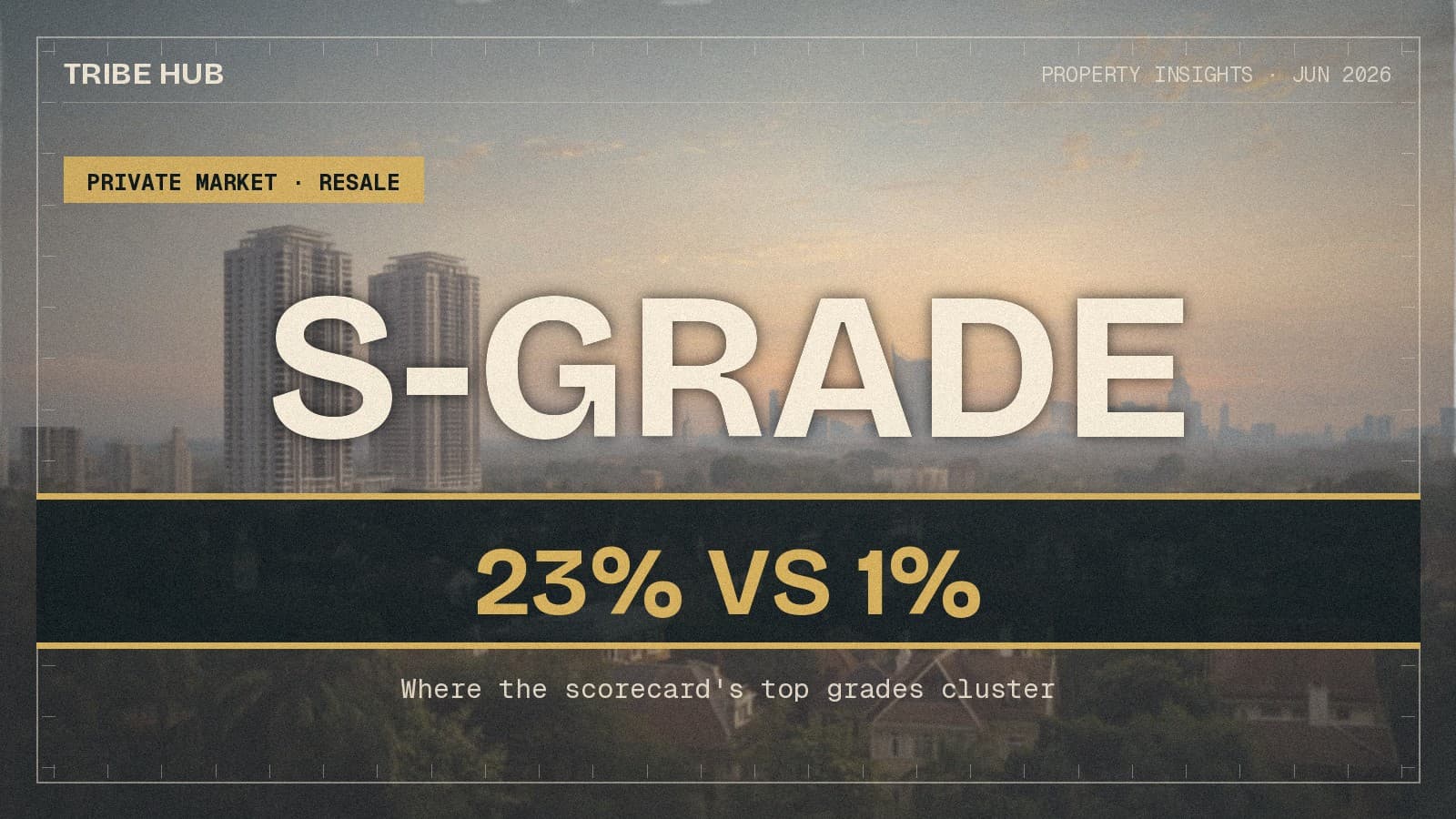
We graded all 2,357 resale condos on the same scorecard. Almost a quarter of suburban projects earn the top S grade — against just 1% in the prime central districts. The reason isn't snobbery. It's yield.
By TRIBE Editorial · 21 June 2026 · 6 min read
Ask most buyers where Singapore's best condos are and they'll point at the prime districts — the freehold blocks of Districts 9, 10 and 11, the addresses with the Orchard postcode and the brand-name developer. Run all 2,357 resale projects through the same scorecard, though, and the grades land somewhere else entirely. The top S grade is roughly 23 times more common in the suburbs than in the prime core. That isn't a typo, and it isn't an opinion. It's what the data does when you stop pricing prestige and start pricing fundamentals.
We graded every resale condo on the Resale Project Scorecard (RPS) — 236,000-plus URA REALIS transactions across seven weighted factors: secondary-market strength (25%), primary-school catchment (20%), project size (16%), MRT access (13%), tenure (10%), rental yield (10%) and future-transformation upside (6%). Each project gets one score and a letter grade from S to D. Of 2,357 projects, 218 earn an S — about one in eleven. Here's where they sit.
The grades cluster in the Outside Central Region
Split the island into the three planning regions URA uses — the Core Central Region (the prime districts plus the city), the Rest of Central Region (the city fringe), and the Outside Central Region (the suburbs) — and the S grades fall almost entirely into the last one.
| Region | S-grades | Projects | S-rate | Median score |
|---|---|---|---|---|
| Core Central (CCR) | 4 | 659 | 1% | 5.40 |
| Rest of Central (RCR) | 81 | 1,133 | 7% | 6.08 |
| Outside Central (OCR) | 133 | 577 | 23% | 6.48 |
The Outside Central Region holds 133 of the 218 S grades despite having the fewest projects of the three. The prime Core Central Region — the most expensive land in the country — produces four. The median suburban project (6.48) outscores the median prime-district project (5.40) by more than a full point, and the single highest-scoring prime-district resale condo, Viva in District 11 at 7.73, would not crack the top tier of the suburban table. The best-graded pure private resale condos on the whole island are The Centris (9.30) and Caspian (9.08), both 99-year projects in Jurong, District 22.
It's not snobbery. It's the rent
The temptation is to read this as the scorecard punishing prestige. It isn't. The RPS doesn't know or care what a postcode signals — it measures whether a project does the things that make a resale condo a good long-run asset. And on the single factor that separates the regions most sharply, the prime districts are genuinely weak: income.
Average the rental-yield sub-score across each region and the gap is stark. Prime central projects score 2.90 out of 10 on yield; the suburbs score 4.88. This is the prestige-tax in its rawest form — buyers pay so much for prime freehold land that the rent can't keep pace, so the yield is thin and the scorecard marks it down. It's the same pattern we found project by project in our Novena and Newton review, where even the district's best condos cleared barely 2.3–2.9% yields. The prime core does win one factor cleanly — MRT access, scoring 8.10 against the suburbs' 6.71, because the city is denser with stations — but a stronger train line doesn't offset a structurally weaker income return when the scorecard weights total-market performance and yield together at 35%.
The suburbs win the rest. Mature OCR estates pair active resale markets with the things families actually buy on — a primary school within 1km, a large project with deep liquidity, and an MRT within walking distance — and they do it at price points where the rent still pencils out. That combination is what the top grades are made of.
The district map, and the freehold myth
Inside the suburbs, a few districts do the heavy lifting. District 19 — Hougang, Sengkang, Punggol and Serangoon — alone holds 50 S-grades, the most of any district in Singapore. By concentration rather than count, District 22 (Jurong) is the densest: 45% of its ranked projects are S grade. District 27 (Sembawang and Yishun) runs at 32%, District 18 (Tampines and Pasir Ris) at 30%, and District 23 (Bukit Batok, Bukit Panjang and Choa Chu Kang) at 24%. By average score, District 22 leads the island at 7.25, ahead of District 18 (6.91) and District 20 (6.85).
The other myth the data dismantles is freehold. If durable tenure were the deciding factor, the S grades would skew freehold — they don't. Two-thirds of all S-graded projects are 99-year leasehold; only about a third are freehold or 999-year. Tenure is worth 10% of the score, and the scorecard treats a 99-year lease with 80-plus years left as carrying no near-term decay concern. A well-located leasehold project near schools and an MRT, earning a real yield, out-grades a freehold block that does none of those things. Land tenure matters, but it is one factor among seven, not the whole game.
What this does — and doesn't — mean
Two honest caveats. First, a grade is not a price forecast and the scorecard is not a verdict on where you should live — a prime address still costs more, still carries the freehold land and the prestige, and may still suit a buyer who values those things over yield and liquidity. The RPS measures fundamentals, not aspirations. Second, the ranked universe includes a small number of executive condominiums alongside private projects; several of the very highest individual scores are ECs, and the regional and district patterns above hold whether or not you include them — the top pure private condos (The Centris, Caspian, The Woodleigh Residences) are suburban too.
The takeaway for a buyer is simpler than the map looks. If you're optimising for the things a scorecard can measure — total returns, a real rental yield, schools, liquidity and a walkable MRT — the evidence says you'll find more of them per dollar in a mature suburban estate than in the prime core. The prime districts sell something the scorecard doesn't grade. Just don't confuse the two, and don't assume the expensive postcode is the better asset until you've priced the rent it actually earns.
See where every project lands at tribesg.com/rps.
Sources: TRIBE Resale Project Scorecard (236,000+ URA REALIS transactions; 2,357 ranked resale projects, scores and grades as at June 2026). Region definitions follow URA's CCR/RCR/OCR market segments. Scores and grades are model outputs, not investment advice.
Silas Tan is a District Director at Huttons Asia and co-founder of TRIBE. He built the Resale Project Scorecard (RPS) using 236,000+ URA REALIS transactions. This article is for informational purposes and does not constitute financial or investment advice. CEA Registration R000303I.
Check how your condo scores
2,357 condos independently scored across 7 weighted factors. No registration required.
Score my resale →Prefer a personal read on your situation? Arrange a consultation →Keep reading

19 September 2026Private Property Market
A 42-Year-Old Block, a Fourth Attempt, and a New Law Worth Two Signatures
18 September 2026Private Property Market
The Cheapest PSF and the Cheapest Apartment Are Two Different Units

17 September 2026Private Property Market
Seven Developers Bid for the Same Site. The Winner Still Paid 11% More Than Anyone Else.

TRIBE Editorial · Reviewed by Silas Tan
Co-Founder, TRIBE · District Director, Huttons Asia · Ex-Mortgage Banker (AVP) · >1,000 families advised · CEA R000303I
This article is for informational purposes only and does not constitute financial or investment advice.