Insights
Gross Yield vs Net Yield: What Actually Lands in Your Pocket
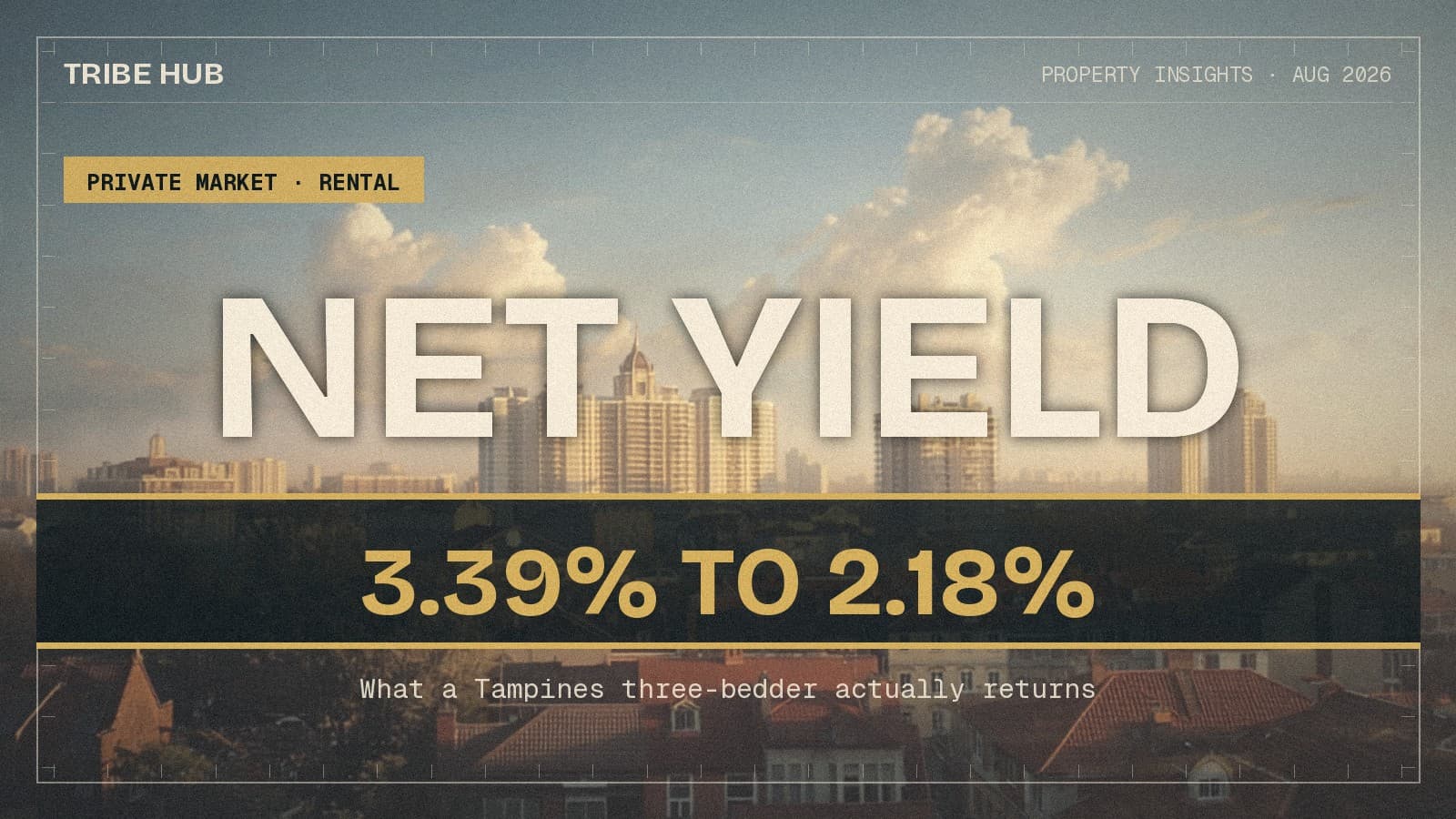
On a real Tampines three-bedder renting at S$4,458 a month, the quoted gross yield is 3.39%. After property tax, MCST, vacancy, insurance, repairs and the agent's fee, 2.18% is left — and income tax has not been paid yet.
By TRIBE Editorial · 3 August 2026 · 9 min read
Every listing portal, every project page and every agent's pitch quotes a rental yield, and almost all of them quote the same one: annual rent divided by price. On a Singapore condo that number usually lands between 3% and 4%, which sounds respectable next to a fixed deposit.
It is also the only yield figure that involves none of the costs of being a landlord. Run the same property through what it actually costs to own and rent out, and roughly a third of the rent disappears before income tax is assessed. Here is that arithmetic, on a real project, with every input sourced.
The property
Treasure at Tampines, District 18, 99-year leasehold from 2018, TOP 2023, 2,203 units. The three-bedroom cohort of 900 to 1,000 sqft transacted at an average of S$1,577,000 (S$1,715 psf) across 15 sales, and rented at an average of S$4,458 a month across 6 leases, per project data compiled from URA records at sg-propertydata. EdgeProp's project-level figures for the same development read S$1,798 psf average sale and a stated 3.6% yield (EdgeProp).
Annual rent of S$53,496 on a price of S$1,577,000 gives a gross yield of 3.39%. That is the number that gets quoted.
What comes out of it
Property tax — the largest single deduction
The Annual Value is IRAS's estimate of the gross annual rent the property would command, excluding furniture, furnishings and maintenance fees, pegged to market rents of comparable properties and reviewed annually (gov.sg). Stripping an assumed S$400 a month of maintenance from the contractual rent gives a working AV of S$48,700. Your actual AV will differ; it is set by IRAS, not by your lease.
The non-owner-occupier bands have not moved since 1 January 2024:
| Annual Value | Rate |
|---|---|
| First S$30,000 | 12% |
| Next S$15,000 | 20% |
| Next S$15,000 | 28% |
| Above S$60,000 | 36% |
On an AV of S$48,700 that is S$7,636 a year.
The same AV under the owner-occupier bands would be S$1,642 — and 2026 brings a one-off rebate of 10%, capped at S$500, for owner-occupied private homes, bringing it to about S$1,478 (MOF, 28 November 2025). The rebate is owner-occupied only. Renting the same flat out costs about five times the property tax, and the relief does not apply to you.
Vacancy
URA's completed private residential vacancy rate reached 6.4% at the end of 2Q2026, up from 6.2%; by segment, CCR 8.3%, RCR 6.1% and OCR 5.6% (URA, 24 July 2026). Tampines is OCR, so 5.6% is the honest haircut — about three weeks of empty unit a year, or S$2,996. Note the counter-intuitive shape of that data: the mass market lets faster than the prime districts do.
The rest
MCST fees. No government body surveys these. Industry guides cluster around S$300 to S$700 a month for mainstream condos, with mass-market projects billed at roughly S$70 to S$80 per share value per quarter. Assume S$400 a month, or S$4,800 a year, and adjust to your own notice.
Leasing commission. CEA fixes nothing: "commission rate is in fact negotiable," and the agency "does not fix commission rates or provide commission guidelines" (CEA). Market practice on a rent above the industry threshold is one month for a two-year lease, half a month for one year — which amortises to the same 4.2% of gross rent a year either way. That is S$2,229. (Note the thresholds themselves are disputed: PropertyGuru's guide uses S$3,500 a month as the line below which tenants pay their own agent, while the SEAA best-practice guideline effective 1 July 2024 uses S$6,000.)
Insurance. A condo landlord's contents and liability policy runs from roughly S$297 a year for a 100 sqm unit (MoneySmart). Structural fire cover on a strata unit is normally arranged by the MCST and already inside the maintenance fee.
Repairs. Assume S$1,200 a year. There is no published Singapore rule of thumb, and the imported "1% to 2% of property value" convention is not a Singapore figure. Most tenancy agreements make the tenant liable for the first slice of each repair — commonly around S$150 per item — with the landlord carrying replacements of big-ticket appliances.
Rental stamp duty is not your cost. It runs at 0.4% of total rent for leases of four years or less, and is customarily paid by the tenant (IRAS). It does not touch your yield.
Gross to net
| Line | Amount | % of gross rent |
|---|---|---|
| Gross annual rent | S$53,496 | 100.0% |
| Less vacancy at OCR 5.6% | −S$2,996 | 5.6% |
| Effective gross rent | S$50,500 | 94.4% |
| Property tax | −S$7,636 | 14.3% |
| MCST | −S$4,800 | 9.0% |
| Leasing commission, amortised | −S$2,229 | 4.2% |
| Insurance | −S$297 | 0.6% |
| Repairs allowance | −S$1,200 | 2.2% |
| Net operating income | S$34,339 | 64.2% |
Gross yield 3.39%. Net yield 2.18%. The gap is 1.21 percentage points, and it is not a rounding error — 35.8% of the rent never reaches the owner.
Then income tax
Net rental income is taxable. IRAS offers two routes, and the choice is worth real money (IRAS Quick Guide for e-Filers, YA2026):
- Deemed expenses: 15% of gross rent, pre-filled on the online form, plus mortgage interest on top.
- Actual expenses: property tax, mortgage interest, fire insurance, repairs and maintenance, itemised.
On these numbers the deemed route allows S$7,575. The actual costs are S$16,162 — 32.0% of effective gross rent. Claiming actuals is worth more than double.
There is a catch IRAS states plainly: "If you have more than one tenanted residential property and opt to claim actual rental expenses on any one tenanted residential property, you will need to apply this treatment consistently to all your tenanted residential properties." You cannot mix and match across a portfolio.
Taxable rental income on the actuals route is S$34,339. At an 11.5% marginal rate that is S$3,949 of tax, leaving S$30,390 — an after-tax net yield of 1.93%. At a 15% marginal rate it is 1.85%.
One more distinction that costs people money: only mortgage interest is deductible, never principal. And leasing commission is deductible for subsequent tenants but not for securing the first one, which IRAS treats as a pre-letting cost.
What leverage does
Everything above is an unlevered figure — it measures the asset, not your position. Borrow, and the answer changes in both directions.
Take 75% financing, S$1,182,750 over 30 years. Package rates in July 2026 ran from about 1.297% to 2.380% on floating and 1.350% to 3.300% on fixed (Redbrick); assume 1.4%. That is a monthly instalment of S$4,025 and first-year interest of S$16,354.
Net operating income of S$34,339 less that interest leaves S$17,985 of economic return on cash of S$442,700 — the 25% equity plus S$48,450 of Buyer's Stamp Duty. That is 4.06%, comfortably above the 2.18% unlevered figure, because a 1.4% cost of debt sits well under a 2.18% asset yield. Leverage is currently accretive. It is accretive by a margin that a rising SORA can close.
Two hard qualifications:
Cash flow is negative. The full instalment of S$48,305 a year exceeds net operating income by S$13,966. Most of that gap is principal repayment — equity you are buying, not money you are losing — but it is still cash leaving your account monthly, before any income tax on the rent.
If this is a second property, ABSD reframes everything. At 20% for a Singapore citizen's second residential purchase, that is S$315,400 of non-recoverable duty. Cash in rises to S$758,100 and the same S$17,985 return falls to 2.37%. The duty is not an investment; it is a toll.
The three numbers to hold
Gross yield is a screening tool. Use it to shortlist, never to decide. It is comparable across projects precisely because it ignores everything specific to yours.
Net operating income is the asset's real return. On mainstream Singapore condo stock, expect to keep somewhere near two-thirds of gross rent before income tax. If your own working assumes 85%, you have forgotten property tax or vacancy or both.
Cash-on-cash is your position's return, and it depends on your loan, your marginal tax rate, and whether you paid ABSD. Two people can own identical units in the same stack and earn returns two percentage points apart.
None of this argues against owning rental property in Singapore. It argues against pricing it off the wrong number. A 3.39% yield and a 1.93% yield support very different decisions, and only one of them is what actually lands in your pocket.
Methodology published. No spin.
Sources and assumptions: Sale and rental cohort figures for Treasure at Tampines three-bedroom units of 900–1,000 sqft from sg-propertydata, with project-level figures cross-checked against EdgeProp; both derive from URA records and are averages of small cohorts, not valuations. Non-owner-occupier and owner-occupier property tax bands and the Annual Value definition from gov.sg; the 2026 owner-occupier rebate from MOF. Vacancy rates from URA's 2Q2026 release. Commission negotiability from CEA; market-practice commission structures and the S$3,500 threshold from PropertyGuru. Insurance premium from MoneySmart. Rental stamp duty from IRAS. Deemed and actual rental expense treatment, and the consistency rule, from the IRAS Quick Guide for e-Filers YA2026, correct as at 27 April 2026. Mortgage package rate ranges from Redbrick, July 2026. Assumptions stated in the text and set by TRIBE, not by any source: Annual Value of S$48,700, MCST of S$400 a month, a S$1,200 annual repairs allowance, a 1.4% mortgage rate, a 30-year tenure and an 11.5% marginal income tax rate. All yields, tax amounts, amortisation and cash figures computed by TRIBE from those inputs. MCST fee ranges are from industry guides; no government survey of Singapore condo maintenance fees exists.
Silas Tan is a District Director at Huttons Asia and co-founder of TRIBE. This article is general information, not financial, tax or legal advice. CEA Registration R000303I.
Check how your condo scores
2,357 condos independently scored across 7 weighted factors. No registration required.
Score my resale →Prefer a personal read on your situation? Arrange a consultation →Keep reading

19 September 2026Private Property Market
A 42-Year-Old Block, a Fourth Attempt, and a New Law Worth Two Signatures
18 September 2026Private Property Market
The Cheapest PSF and the Cheapest Apartment Are Two Different Units

17 September 2026Private Property Market
Seven Developers Bid for the Same Site. The Winner Still Paid 11% More Than Anyone Else.

TRIBE Editorial · Reviewed by Silas Tan
Co-Founder, TRIBE · District Director, Huttons Asia · Ex-Mortgage Banker (AVP) · >1,000 families advised · CEA R000303I
This article is for informational purposes only and does not constitute financial or investment advice.