Insights
Stamp Duty End to End: BSD, ABSD and SSD on One Timeline
Singapore charges three separate stamp duties on one home, and they fire at three different moments. Laid on a single timeline — day 0, day 14, month 6, year 4 — they read as one tax with a four-year tail.
By TRIBE Editorial · 9 August 2026 · 8 min read
Singapore charges three separate stamp duties on one home. Most buyers meet them one at a time and out of order — Buyer's Stamp Duty as a line on the lawyer's bill, Additional Buyer's Stamp Duty as a shock in the same week, Seller's Stamp Duty two years later as the reason they cannot sell. Individually each looks like a rate. Put on one timeline they are a single tax with a four-year tail, and the tail is the part that decides whether a purchase works.
Here is the whole thing on one line, with every figure computed on a S$1,800,000 residential purchase. Methodology published. No spin.
The timeline
Four dates matter, and only one of them is the day you pay.
- Day 0 — the Option to Purchase is exercised, or the Sale and Purchase Agreement is signed. BSD and ABSD both accrue here, and the SSD clock starts ticking here too. Not on completion. Not at TOP.
- Day 14 — the stamping deadline. Thirty days if the document was executed outside Singapore.
- Month 6 — the married-couple ABSD remission window closes. Non-extendable.
- Year 4 — the SSD tail runs out. Under the schedule that has applied since 4 July 2025.
Everything below hangs off those four points.
Day 0: BSD is marginal, not flat
The most common arithmetic error in Singapore property is multiplying the whole price by one rate. Buyer's Stamp Duty is tiered like income tax — each slice of the price is charged at its own rate (IRAS). On residential property the tiers have been 1% / 2% / 3% / 4% / 5% / 6% since 15 February 2023.
On S$1,800,000 the working is:
| Slice | Rate | Duty |
|---|---|---|
| First S$180,000 | 1% | S$1,800 |
| Next S$180,000 | 2% | S$3,600 |
| Next S$640,000 | 3% | S$19,200 |
| Next S$500,000 | 4% | S$20,000 |
| Next S$300,000 (to S$1,800,000) | 5% | S$15,000 |
| Total | S$59,600 |
Which is 3.31% of the price, not 5%. The effective rate climbs slowly and never reaches the headline:
| Price | BSD | Effective rate |
|---|---|---|
| S$800,000 | S$18,600 | 2.33% |
| S$1,000,000 | S$24,600 | 2.46% |
| S$1,500,000 | S$44,600 | 2.97% |
| S$1,800,000 | S$59,600 | 3.31% |
| S$2,000,000 | S$69,600 | 3.48% |
| S$3,000,000 | S$119,600 | 3.99% |
| S$4,000,000 | S$179,600 | 4.49% |
One rule catches buyers of an unusually cheap unit: BSD is assessed on the higher of purchase price or market value. Negotiate S$1.75m on a unit IRAS values at S$1.8m and you are stamped on S$1.8m.
Day 0: ABSD is a tax on who you are
Additional Buyer's Stamp Duty is flat, sits on top of BSD, and is set entirely by nationality and how many residential properties you already own. The rates have held since 27 April 2023 (IRAS), with no change in Budget 2026. On the same S$1,800,000:
| Buyer profile | Rate | ABSD |
|---|---|---|
| Singapore Citizen, 1st property | 0% | — |
| Singapore Citizen, 2nd | 20% | S$360,000 |
| Singapore Citizen, 3rd+ | 30% | S$540,000 |
| Permanent Resident, 1st | 5% | S$90,000 |
| Permanent Resident, 2nd | 30% | S$540,000 |
| Permanent Resident, 3rd+ | 35% | S$630,000 |
| Foreigner, any | 60% | S$1,080,000 |
| Entity or trust | 65% | S$1,170,000 |
Note the scale. A citizen's second property carries six times the BSD in ABSD. That single line is why decoupling exists as an industry.
Two mechanics do more damage than the rates. First, the joint-purchase rule: when two or more people buy together, ABSD is charged at the highest rate applying to any one of them, on the entire price — never apportioned by share. A citizen first-timer buying with a foreigner spouse does not pay a blended rate; the whole property is stamped at 60%. Second, nationals of the United States, and nationals or PRs of Iceland, Liechtenstein, Norway and Switzerland, are accorded Singapore Citizen treatment under the relevant free trade agreements — which is a remission, not a lower rate, and it must be claimed.
Day 14: the deadline nobody diarises
Stamp duty is payable within 14 days of the document being signed in Singapore, or 30 days if signed overseas. Miss it and IRAS's penalty is not a token: for documents stamped within three months of the deadline, the penalty is the higher of S$10 or the duty payable; beyond three months, the higher of S$25 or four times the duty.
On our S$1,800,000 second property, day-0 duty is BSD S$59,600 plus ABSD S$360,000 = S$419,600. The four-times ceiling on that is S$1,678,400. Conveyancing lawyers stamp on time as a matter of routine, which is precisely why this rarely bites — but it is the reason you should never sign an OTP on a property you are not funded to stamp.
Month 6: the remission clock
The married-couple ABSD remission is the single most valuable date on the timeline, and the one most often mishandled. Where a married couple with at least one Singapore Citizen spouse buys a second home jointly, in both names only, the ABSD is refunded if they sell their first residential property within six months of the purchase date — or, for an uncompleted property, within six months of TOP or CSC, whichever is earlier. The refund must then be applied for within six months of the sale.
Three things to hold onto. The window is not extendable, for any reason including a buyer who fails to complete. The ABSD is still payable upfront at stamping — the remission is a refund, not a waiver, so the S$360,000 leaves your account regardless. And neither spouse may have bought any other residential property in the interim.
That is a S$360,000 bet on a sale completing inside six months, in a market where private resale volumes ran 3,813 transactions in 2Q2026 (URA) — healthy, but not a guarantee for any one unit.
Years 0–4: SSD, and why it now bites harder
Seller's Stamp Duty was extended on 4 July 2025 from a three-year window to four, with every tier raised by four percentage points (MAS). Anything bought on or after that date sits on the new schedule:
| Sold within | Rate | On a S$1,800,000 sale |
|---|---|---|
| 1 year | 16% | S$288,000 |
| More than 1, up to 2 years | 12% | S$216,000 |
| More than 2, up to 3 years | 8% | S$144,000 |
| More than 3, up to 4 years | 4% | S$72,000 |
| More than 4 years | 0% | — |
Two details decide real cases. The bands run on calendar anniversaries, not day counts, and a disposal landing exactly on an anniversary falls into the lower band — IRAS's own worked example has a 7 July 2025 purchase sold on 7 July 2029 paying nothing. And the clock starts at OTP exercise, not completion, which means a building-under-construction purchase burns most of its SSD tail during the build. Buy a unit completing in year four and you are close to free on day one of ownership; buy completed stock and the full four years sit ahead of you.
HDB owners are largely insulated, not exempt: the five-year Minimum Occupation Period outlasts the four-year SSD window, so by the time a flat can legally be sold the tail has expired.
The whole timeline, on one purchase
A Singapore Citizen couple, buying a S$1,800,000 second property, and exiting in year two at the same price:
| Moment | Duty |
|---|---|
| Day 0 — BSD | S$59,600 |
| Day 0 — ABSD (2nd property) | S$360,000 |
| Year 2 — SSD at 12% | S$216,000 |
| Total | S$635,600 |
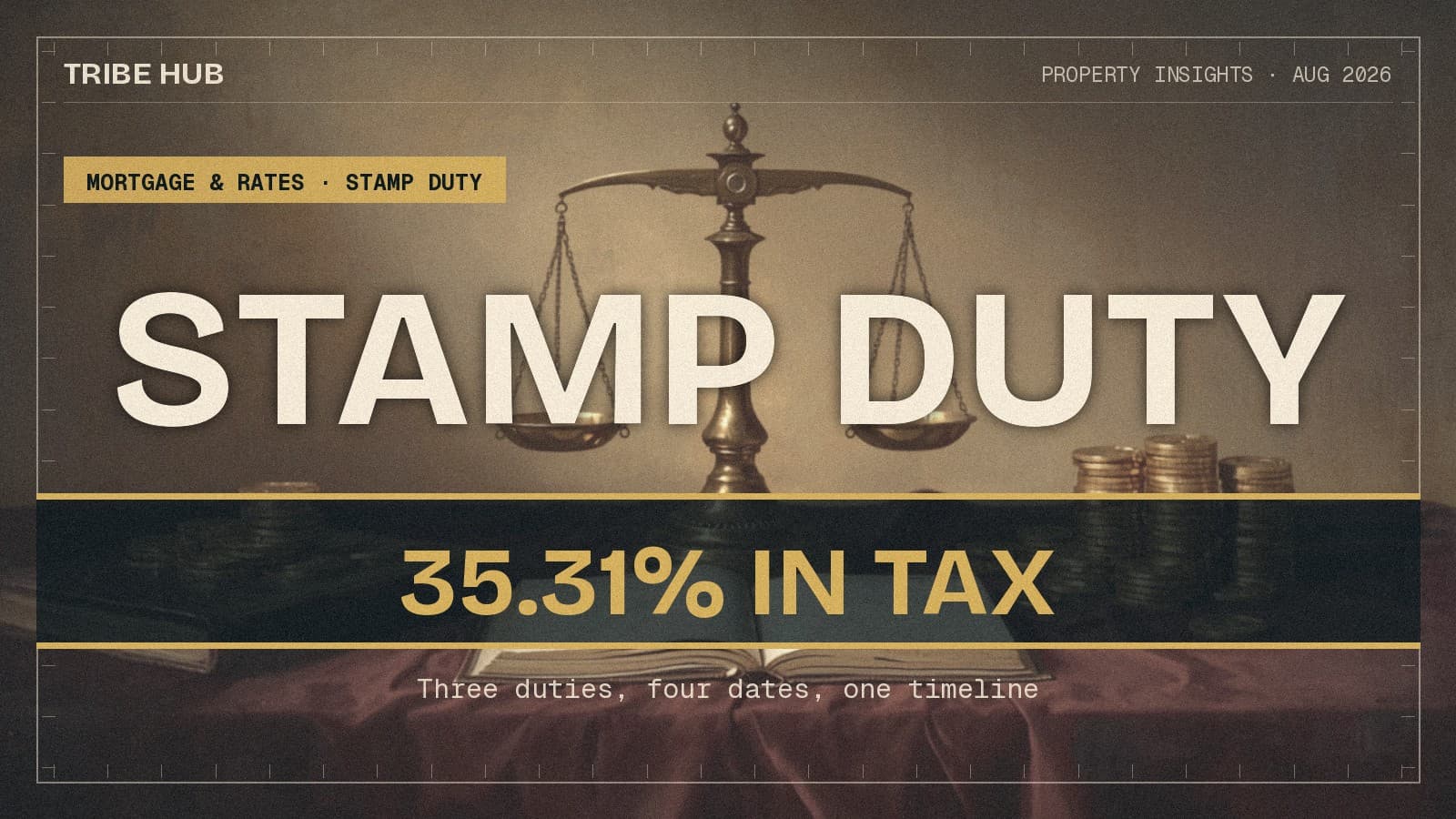
That is 35.31% of the purchase price paid in tax on a flat market — before agent commissions, legal fees or a cent of financing cost. The same couple as first-timers, holding past year four, would pay S$59,600 and nothing else: 3.31%.
Nothing about the property changed between those two numbers. What changed was the profile at day 0, whose names were on the deed, whether the first home sold inside six months, and how long they held. Those are the four levers, they sit on four dates, and every one of them is decided before you sign.
Assumptions stated: S$1,800,000 residential purchase; BSD on the residential tiers effective 15 February 2023; ABSD on the rates effective 27 April 2023; SSD on the schedule for purchases made on or after 4 July 2025; exit modelled at the same price, so no gain or loss is included. Duty is assessed on the higher of price and market value and rounded down to the nearest dollar. Figures exclude legal fees, agent commissions, property tax and financing costs. Remissions are never netted into the headline figures above — they are refunds, applied for and granted after the fact, subject to IRAS conditions. This is general information, not tax or financial advice; confirm your own position with IRAS or your conveyancing lawyer before transacting. Compute your exact position with the TRIBE stamp duty calculators.
Know what you can afford
Loan, stamp duty, CPF, and monthly repayments — work out your real budget before you commit. No registration required.
Plan my purchase →Prefer a personal read on your situation? Arrange a consultation →Keep reading

4 October 2026Mortgage & Rates
Floating Only Wins Now If SORA Falls. Here Is the Breakeven.
30 September 2026Mortgage & Rates
The Fed Hiked for the First Time in Three Years. Singapore's Floating Rate Moved Four Basis Points.
23 September 2026Mortgage & Rates
The HDB Loan Lends You 11% More. The Bank Loan Costs 45% Less.

TRIBE Editorial · Reviewed by Silas Tan
Co-Founder, TRIBE · District Director, Huttons Asia · Ex-Mortgage Banker (AVP) · >1,000 families advised · CEA R000303I
How TRIBE scores and checks its analysis
Spotted an error, or a figure that has moved since publication? Tell us and we will correct it.
This article is for informational purposes only and does not constitute financial or investment advice.