Insights
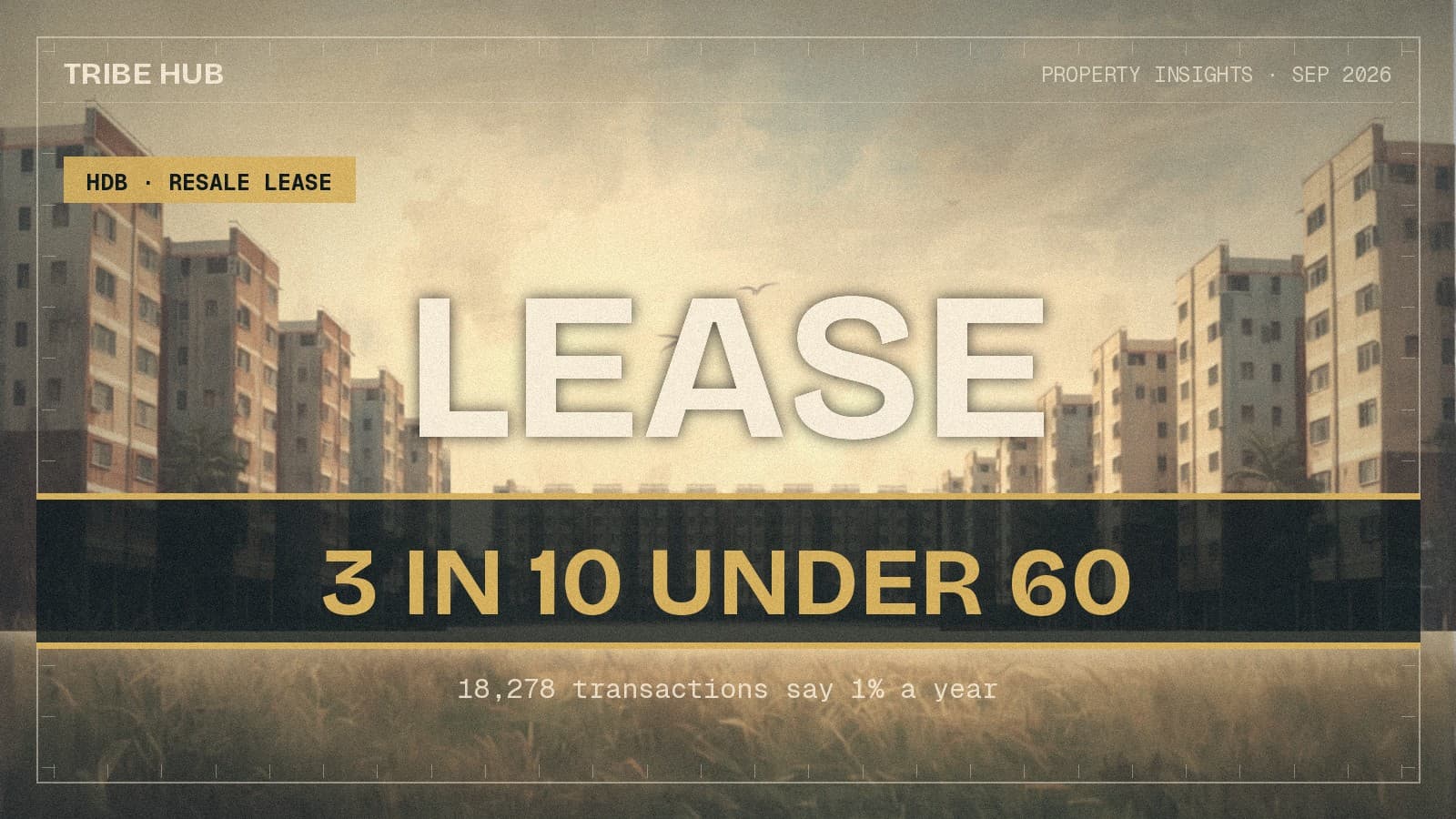
Three in Ten Resale Flats Now Have Under 60 Years Left
Across 18,278 HDB resale transactions this year, the market prices remaining lease at almost exactly 1% of PSF per year. That is a steeper discount than the standard valuation table predicts, and it is now being applied to 29% of everything that sells.
By TRIBE Editorial · 13 September 2026 · 8 min read
In July we published the theory of lease decay — Bala's Table, the standard valuation curve, which says a 99-year lease holds most of its value for the first decade and then bends downward. This is the other half of that piece: what the HDB resale market actually pays, measured across every transaction it has recorded this year.
The answer is close to a straight line, and it is steeper than the table.
The measurement
HDB publishes every resale transaction, with the remaining lease stated to the month, on data.gov.sg. We took the 71,195 transactions from January 2024 to 12 September 2026 and fitted the log of price per square foot against remaining lease, with fixed effects for town and controls for storey height and floor area.
The town controls matter more than anything else here. Short-lease flats are not randomly distributed — they cluster in Bedok, Ang Mo Kio, Toa Payoh and the older central estates, which are also the estates that carry a location premium. Compare raw medians by lease band and the two effects partly cancel: four-room flats with under 50 years left show a median of S$572 psf, higher than the S$536 psf of flats with 60 to 65 years left. Read without the controls, lease decay looks like it barely exists.
With the controls in, it is clean, stable, and close to linear in percentage terms.
| Flat type and year | Discount per year of lease | Observations | R-squared |
|---|---|---|---|
| 4-room, 2026 | 0.99% | 8,053 | 0.876 |
| 4-room, 2025 | 0.91% | 10,843 | 0.859 |
| 4-room, 2024 | 0.88% | 11,988 | 0.844 |
| 3-room, 2026 | 1.15% | 4,243 | 0.815 |
| 5-room, 2026 | 1.14% | 4,287 | 0.836 |
| 3/4/5-room pooled, 2026 | 1.09% | 16,583 | 0.825 |
A usable rule falls out of that: every year of lease is worth about 1% of the flat, and the rate has drifted slightly upward over three years rather than down.
Where it disagrees with the table
Bala's Table is the reference valuers and banks use for leasehold land. It is a smooth curve — value holds near par at the top, then falls away faster as the lease shortens. The resale market's own curve is a constant percentage per year, which compounds. The two shapes cross early, then diverge.
| Years of lease left | Bala's Table | HDB resale market, fitted | Market is |
|---|---|---|---|
| 95 | 0.985 | 0.961 | 2.4% lower |
| 85 | 0.957 | 0.871 | 9.0% lower |
| 75 | 0.920 | 0.789 | 14.2% lower |
| 65 | 0.870 | 0.715 | 17.8% lower |
| 60 | 0.838 | 0.681 | 18.8% lower |
| 55 | 0.802 | 0.648 | 19.2% lower |
| 50 | 0.762 | 0.617 | 19.1% lower |
Both columns are fractions of a fresh 99-year lease. At 60 years remaining, the table says a flat should hold 83.8% of its fresh-99 value. The market pays 68.1%.
Two caveats before anyone treats that gap as a trading signal.
First, this is a cross-section, not the path of one flat over time. A flat with 90 years left is a recent build; a flat with 55 years left was completed in the early 1980s. The coefficient therefore carries building age, layout, lift access and renovation cycle along with the lease itself. Some of that 1% a year is the concrete depreciating, not the lease.
Second, Bala's Table was built for leasehold land, where the holder can rebuild at the end. It was never a model of HDB flat pricing, and it contains no term for the financing rules that attach to a short lease. Those rules are most of the rest of the gap.
Why the market's discount is steeper
A shortening lease does not only reduce the years of use. It removes buyers.
CPF savings can be used only on a property with at least 20 years of remaining lease. Above that floor, how much can be used depends on whether the lease covers the youngest buyer to age 95 — full usage if it does, a pro-rated share if it does not. CPF states plainly that the 20-year floor is deliberate, and it applies even where the lease would comfortably outlast the buyer.
The practical consequence: a 35-year-old and a 55-year-old looking at the same flat with 58 years left face different effective prices, because they can bring different amounts of CPF to it. We worked that crossover in The 95 Rule, Worked. Every year the lease runs down, the set of buyers who can pay without a larger cash component narrows. A discount that compounds at a constant rate is what a shrinking buyer pool looks like once it is priced.
The short-lease share is still climbing
| Year | Transactions | Under 60 years left | Share |
|---|---|---|---|
| 2024 | 27,832 | 6,686 | 24.0% |
| 2025 | 25,085 | 7,088 | 28.3% |
| 2026 to 12 September | 18,278 | 5,282 | 28.9% |
August 2026 on its own: 727 of 2,521 transactions, or 28.8%. Flats with under 50 years left are 6.7% of this year's volume.
This is the arithmetic of a building programme that peaked in the 1970s and 1980s working through the resale market, and it does not reverse. Stock that is short-lease today only gets shorter.
Where it concentrates, by 2026 transaction count: Bedok 634, Tampines 455, Ang Mo Kio 444, Yishun 385, Geylang 317, Bukit Merah 312, Toa Payoh 307. Median prices inside that sub-60-year segment run from S$370,000 in Toa Payoh to S$575,000 in Tampines — the location premium is alive and well inside the short-lease pool.
Nor is it only a cheap-flat story. Of the 1,364 flats that sold for at least S$1,000,000 this year, 109 had under 60 years of lease left — 8.0% of them, concentrated in Geylang, Marine Parade, Tampines and Bedok. Buyers are paying seven figures for assets with a defined end date. That decision deserves the arithmetic rather than the assumption.
What to do with the number
For a seller of an older flat, the discount is already in your price. The question is whether the comparables you are being shown come from blocks with a similar lease, not merely the same town. Ten years of lease difference is worth roughly 10% of PSF — larger than most of the adjustments that actually get discussed at the kitchen table.
For a buyer, 1% a year is a test, not a target. Run it against the specific unit: if a short-lease flat is being marketed at a discount shallower than the curve implies once you have matched town, floor and size, the lease is not being priced, and you are the one who pays for that on exit.
For anyone holding a flat as the retirement asset, the number that matters is not today's discount but the one that will apply when you sell. At 1% a year, waiting a decade costs about a tenth of the flat before the market moves at all.
Figures computed from HDB's resale flat transaction dataset published on data.gov.sg, covering January 2024 to 12 September 2026 (71,195 transactions). Discount rates are ordinary-least-squares coefficients on log price per square foot with town fixed effects and controls for storey and floor area; they describe a cross-section of different flats, not the path of any single flat over time. Bala's Table figures are the standard five-year breakpoints, linearly interpolated — the same implementation used in our Resale Project Scorecard. CPF rules as stated on cpf.gov.sg at 13 September 2026. Methodology published. No spin.
Know what you can afford
Loan, stamp duty, CPF, and monthly repayments — work out your real budget before you commit. No registration required.
Plan my purchase →Prefer a personal read on your situation? Arrange a consultation →Keep reading

TRIBE Editorial · Reviewed by Silas Tan
Co-Founder, TRIBE · District Director, Huttons Asia · Ex-Mortgage Banker (AVP) · >1,000 families advised · CEA R000303I
This article is for informational purposes only and does not constitute financial or investment advice.