Insights
Lease Decay, Properly: What 99 Years Is Worth at 60 Years Left
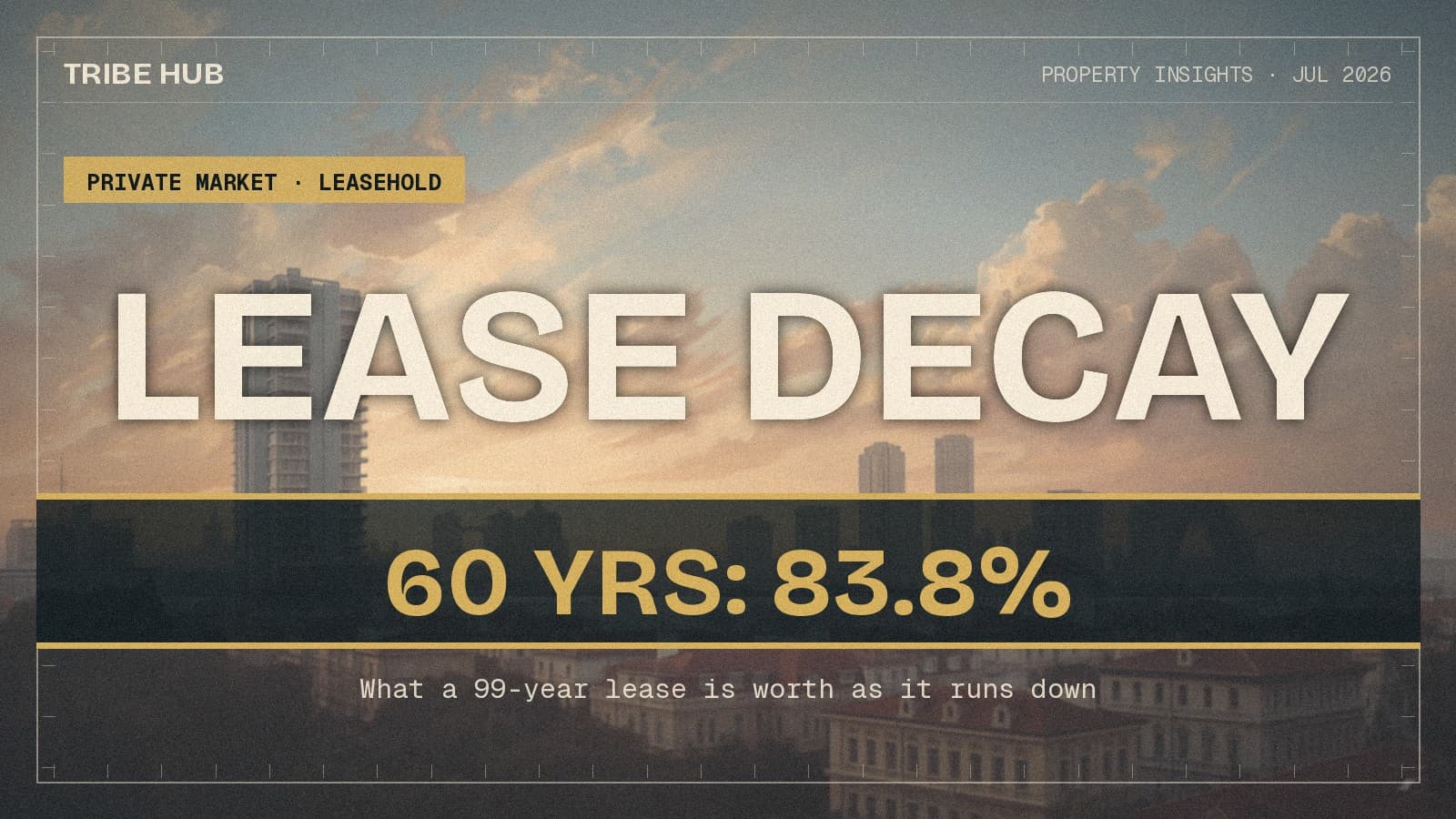
A 99-year lease does not lose value in a straight line. It barely moves for the first decade, then bends downward and keeps accelerating. We walk the standard valuation curve — Bala's Table — and price a real ageing leasehold to show where the drop actually bites.
By TRIBE Editorial · 24 July 2026 · 7 min read
Every leasehold home in Singapore is a wasting asset — the lease runs down to zero, and so, eventually, does the value. That much everyone knows. What most buyers get wrong is the shape of the decline. They picture a 99-year lease losing value evenly, a little each year, like a car. It does not. For the first ten or fifteen years a fresh lease barely moves. Then the curve bends, and each subsequent decade costs more than the last. The 60-year mark is roughly where the bend becomes impossible to ignore — and it is exactly where a lot of otherwise sensible resale stock sits. Here is the curve, the arithmetic behind it, and what it means for your exit. Methodology published. No spin.
The curve has a name
The industry does not guess at lease decay. It reads off a standard reference — Bala's Table, the leasehold-valuation curve used by professional valuers to express what a lease is worth as a percentage of the same property on a fresh 99-year lease. It is the same table our own scorecard uses. The canonical points:
| Years left | % of fresh-99 value | Years left | % of fresh-99 value |
|---|---|---|---|
| 99 | 100.0% | 50 | 76.2% |
| 90 | 97.2% | 40 | 66.7% |
| 80 | 94.0% | 30 | 55.3% |
| 70 | 89.7% | 20 | 42.0% |
| 60 | 83.8% | 10 | 27.5% |
Read down the left column and the pattern is obvious once you see it. Drop from 90 to 80 years and you lose about 3.3 percentage points of value. Drop from 60 to 50 — the same ten years — and you lose about 9.1 points. From 50 to 40, about 12.5 points. The lease loses value faster the less of it there is.
Why it is not a straight line
The intuition is simpler than the table looks. A lease is worth the stream of use it still buys you, and each future year is discounted back to today. When you hold 90 years, the years you are "losing" at the far end are so distant they are worth almost nothing in present-value terms — shaving one off barely registers. When you hold 30 years, the years at the end are close, valuable, and every one you lose is a real bite out of what remains.
Put differently: divide the value factor by the years left and you get how much each remaining year is "worth." At 90 years left, each year of lease carries about 1.08% of fresh-99 value. At 60 years, about 1.40%. At 30 years, about 1.84%. The scarcer the lease, the more each remaining year is worth — which is exactly why losing them hurts more as you go.
This is the number that matters for your exit. Lease decay is a headwind your resale price has to overcome before it can show any gain:
| Ten-year hold | Value lost to decay alone | Market must appreciate just to break even |
|---|---|---|
| 90 → 80 years | 3.3% | ~0.34% a year |
| 60 → 50 years | 9.1% | ~1.00% a year |
| 50 → 40 years | 12.5% | ~1.33% a year |
At the young end of a lease, a flat market still leaves you roughly whole. At 60 years left, the market has to deliver about 1% a year of pure appreciation just to stand still — and anything less means you sell for less than the decay-adjusted value you bought at, even in nominal terms.
Pricing a real one
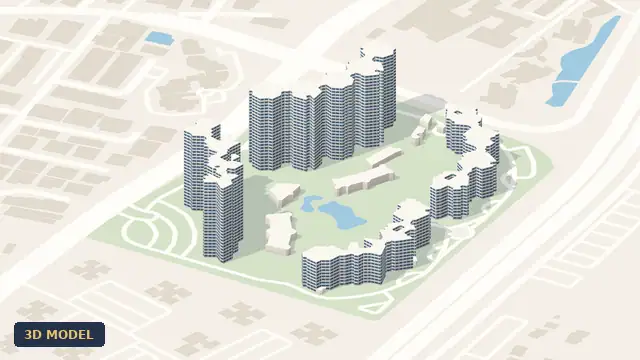
Consider Mandarin Gardens in District 15 — a large, well-located East Coast development on a 99-year lease that commenced in 1982, which leaves it with roughly 55 years remaining in 2026. (It is, not coincidentally, exploring a collective sale — the classic escape hatch for a leasehold estate feeling the pull of the curve.) At 55 years left, Bala's Table puts it at about 80.2% of fresh-99 value.
Now take a hypothetical ageing leasehold sitting right on the headline 60-year mark, trading at S$1,150 psf. The 60-year factor is 0.838, so the lease-adjusted value — what you would pay for the identical unit on a fresh 99-year lease — works out to S$1,372 psf. That S$222 gap is the price of the 39 years of lease already burned off. It is not a discount you are "getting"; it is value that has already left the building. Hold that unit ten years to the 50-year mark and, market aside, another 9% leaves with it.
The penalty most buyers miss: CPF
Lease decay does not only compress your resale price. Past a certain point it compresses how you can pay — which shrinks your buyer pool when you come to sell. Since May 2019, you can use your CPF in full only if the property's remaining lease covers the youngest buyer to age 95. If it does not, CPF usage is pro-rated, and if the remaining lease is under 20 years, CPF cannot be used at all.
The arithmetic is unforgiving at the old end of the curve. At 60 years left, a buyer whose younger half is 35 just clears it (35 + 60 = 95). A 30-year-old does not — the lease covers them only to 90 — so their CPF is pro-rated. CPF's own worked example: two 25-year-olds buying a 65-year-lease flat can use up to about 90% of the price from CPF, not the full amount. The younger your future buyer, the harder this bites — which means an ageing lease quietly rules out exactly the young upgraders who would otherwise bid your unit up.
What this means for your exit
None of this makes ageing leasehold a mistake. If you buy at the right decay-adjusted price and you never sell, lease decay is close to irrelevant — you consume the use you paid for. The trouble is buyers who pay a fresh-lease price for an old lease, or who plan a 10-year hold-and-flip on a unit already past 60 years and are surprised when a flat market hands them a loss.
Three practical rules fall out of the curve. First, judge the price against the decay-adjusted value, not the raw PSF — a S$1,150 psf unit at 60 years is not "cheap" versus S$1,372 psf new; it is priced for its lease. Second, the shorter the lease, the shorter your realistic hold — every extra year you own accelerates the drag. Third, think about your exit buyer's financing, not just yours — CPF pro-ration at the far end of the lease thins the crowd that can pay you.
The lease is a clock. It runs slowly at first and then, from about the 60-year mark, faster and faster. Buy knowing what time it is.
Sources: Leasehold value factors per Bala's Table, the standard valuation reference (the same curve used in TRIBE's Resale Project Scorecard). Mandarin Gardens tenure (99 years from 1982, District 15) per EdgeProp. CPF usage and the 95-age lease-coverage rule per CPF Board, in force since May 2019. Value-per-year, decade-erosion and break-even figures computed by TRIBE from Bala's Table; the S$1,150 psf unit is an illustrative worked example. CPF, HDB and valuation rules are set by CPF Board, HDB and IRAS and can change — verify current terms before committing.
Silas Tan is a District Director at Huttons Asia and co-founder of TRIBE. This article is for informational purposes and does not constitute financial or investment advice. CEA Registration R000303I.
Condos in this article
Check how your condo scores
2,350 condos independently scored across 7 weighted factors. No registration required.
Score my resale →Prefer a personal read on your situation? Arrange a consultation →Keep reading

22 October 2026Private Property Market
One-Bedders Yield More. In the Same Building, They Appreciate Half as Fast.

21 October 2026Private Property Market
The Primary School Premium Is Negative Until You Hold the District Still

20 October 2026Private Property Market
Three Factors Are 29% of Our Scorecard and 1% of the Difference
Next step

TRIBE Editorial · Reviewed by Silas Tan
Co-Founder, TRIBE · District Director, Huttons Asia · Ex-Mortgage Banker (AVP) · >1,000 families advised · CEA R000303I
How TRIBE scores and checks its analysis
Spotted an error, or a figure that has moved since publication? Tell us and we will correct it.
This article is for informational purposes only and does not constitute financial or investment advice.