Insights
They Qualified on Paper. They Failed the Cash Test.
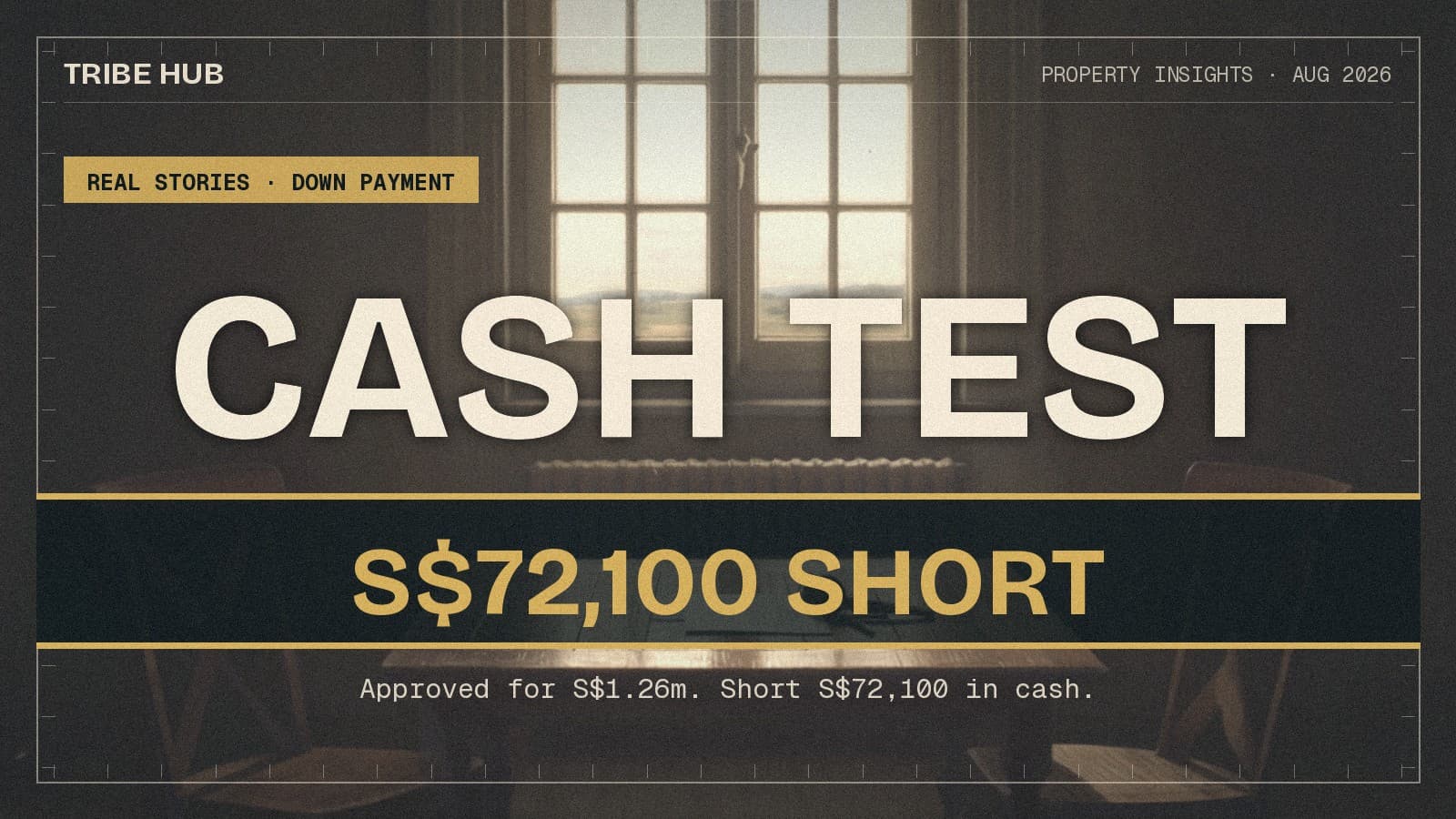
A composite couple earning S$13,500 a month were approved for a S$1.26m loan on a S$1.68m condo, with S$310,000 sitting in CPF. They still could not complete — because S$167,100 of that purchase had to be cash, and they had S$95,000.
By TRIBE Editorial · 11 August 2026 · 6 min read
Wei Jie and Serene had an approval letter for S$1,260,000. Their banker had run the stress test, cleared the TDSR with room to spare, and told them they could shop up to about S$1.68 million. They found the flat, negotiated it, and put down the option fee. Six weeks later they walked away and forfeited it.
Nothing about their income failed. What failed was the shape of their money. They had S$310,000 in CPF and S$95,000 in cash, and the purchase demanded S$167,100 in cash specifically — not savings, not CPF, cash. The gap was S$72,100 and no amount of CPF could close it.
Wei Jie and Serene are an illustrative composite, not clients. The assumptions are stated below and every figure is computed, not estimated.
The approval measures the wrong thing
A loan approval answers one question: can you service the monthly repayment under a stress rate. It says nothing about whether you can assemble the money to get to the closing table.
On a S$1,260,000 loan over 28 years, the numbers are comfortable. Wei Jie is 37 and earns S$7,500; Serene is 35 and earns S$6,000. Weighted by income, their average age is 36.1, which leaves 28 years of tenure before the loan would run past 65 and drag the LTV down from 75% to 55%.
| Test | Monthly repayment | Share of S$13,500 income |
|---|---|---|
| At the 4% stress floor | S$6,240 | 46.2% |
| At an actual 1.40% fixed rate | S$4,535 | 33.6% |
The TDSR ceiling is 55%. They cleared it at 46.2% on the stress rate, which is the test that binds. On the rate they would actually pay, the loan consumes a third of their income. By every measure the bank applies, this was an easy approval.
Where the 25% actually comes from
The part nobody sequences is the down payment, and it is not one number. At 75% LTV the remaining 25% splits into two tranches with different rules:
- 5% of the price must be cash. Not CPF. This is a floor, and it cannot be substituted.
- 20% of the price may be cash or CPF Ordinary Account, in any mix.
On S$1,680,000 that is S$84,000 of hard cash and S$336,000 that CPF is allowed to cover. Wei Jie and Serene read that second line and stopped reading. They had S$310,000 in CPF, which felt like enough.
It was S$26,000 short. The 20% tranche does not shrink to fit your CPF balance — whatever CPF cannot cover spills into cash.
The bill nobody sequences
Then there is stamp duty. Buyer's Stamp Duty on S$1,680,000 works out to S$53,600 across the marginal bands — 1% on the first S$180,000, 2% on the next S$180,000, 3% on the next S$640,000, 4% on the next S$500,000, and 5% on the S$180,000 above S$1.5 million. As Singapore Citizens buying their first property, they owed no ABSD.
BSD falls due within 14 days of exercising the option. CPF reimbursement for a completed property arrives afterwards, on application — which makes it a cash outlay at the moment it is owed, whatever it becomes later. Here is the whole requirement, in the order it actually lands:
| Item | Amount | Payable from |
|---|---|---|
| Option fee (1%) | S$16,800 | Cash only |
| Exercise of option (4%) | S$67,200 | Cash only |
| Balance down payment (20%) | S$336,000 | CPF OA or cash |
| — met from CPF OA | (S$310,000) | CPF OA |
| — spill into cash | S$26,000 | Cash |
| Buyer's Stamp Duty | S$53,600 | Cash, reimbursable later |
| Legal fees and valuation | ~S$3,500 | Cash |
| Total cash required | S$167,100 |
Against S$95,000 on hand, they were S$72,100 short. Their CPF was not idle or mismanaged — it was simply the wrong instrument for three of the four lines above.
What they could actually have bought
Run the same constraint the other way. Hold the CPF balance at S$310,000 and the cash at S$95,000, and solve for the highest price where the cash requirement still lands at or under S$95,000.
The answer is about S$1,188,000. At that price the 5% cash floor is S$59,400, CPF covers the entire 20% tranche of S$237,600 with room left over, and BSD drops to roughly S$28,400. The cash column balances almost exactly.
The distance between S$1.68 million and S$1.19 million is not a financing problem. It is a S$492,000 gap between what a bank will lend against your income and what your balance sheet can complete. Those are different questions, and only one of them gets answered by an approval letter.
What actually fixes it
Three things, in order of how much they move the number.
Price the cash column before you shortlist. The cash requirement is roughly 5% of price, plus BSD, plus whatever the 20% tranche exceeds your CPF OA, plus a few thousand in fees. That arithmetic takes two minutes and it should precede the property search, not follow it.
Check the CPF balance against the 20% tranche, not against the total. A CPF balance that looks large in isolation can still fall short of 20% of an ambitious price, and every dollar of that shortfall converts into cash at the worst moment.
Treat BSD as cash even though it is reimbursable. Reimbursement is a later event. Completion is not.
None of this is exotic, and none of it is a rule the couple could have negotiated around. The 5% cash floor is a floor. The stamp duty is due when it is due. The only variable they controlled was the price they went looking at — and they set that from an approval letter that was never measuring their ability to complete.
Composite profile. Assumptions: Singapore Citizen couple, first residential property, no outstanding housing loan, 75% LTV, 28-year tenure, S$13,500 combined monthly income, S$310,000 combined CPF Ordinary Account, S$95,000 cash. Stress-test repayment computed at the 4% medium-term rate floor; actual repayment at a 1.40% fixed package. BSD computed from the IRAS residential tiers in force. Legal and valuation costs are indicative. Figures exclude renovation, furnishing and moving costs.
Methodology published. No spin.
Check how your condo scores
2,352 condos independently scored across 7 weighted factors. No registration required.
Score my resale →Prefer a personal read on your situation? Arrange a consultation →Keep reading
27 September 2026Real Stories
Sell One Per Cent Below Valuation, Owe $286,000 in Cash
19 September 2026Real Stories
They Held It 50-50 to Keep Their Options Open. Two Children Now Own a Quarter of the Home.
29 August 2026Real Stories
Sell the Condo, Buy the Flat, Skip the 15-Month Exile: One Couple's Right-Sizing, End to End

TRIBE Editorial · Reviewed by Silas Tan
Co-Founder, TRIBE · District Director, Huttons Asia · Ex-Mortgage Banker (AVP) · >1,000 families advised · CEA R000303I
How TRIBE scores and checks its analysis
Spotted an error, or a figure that has moved since publication? Tell us and we will correct it.
This article is for informational purposes only and does not constitute financial or investment advice.