Insights
A Shorter Wait Isn't Convenience. It Moves Your Whole Timeline 21 Months Forward.
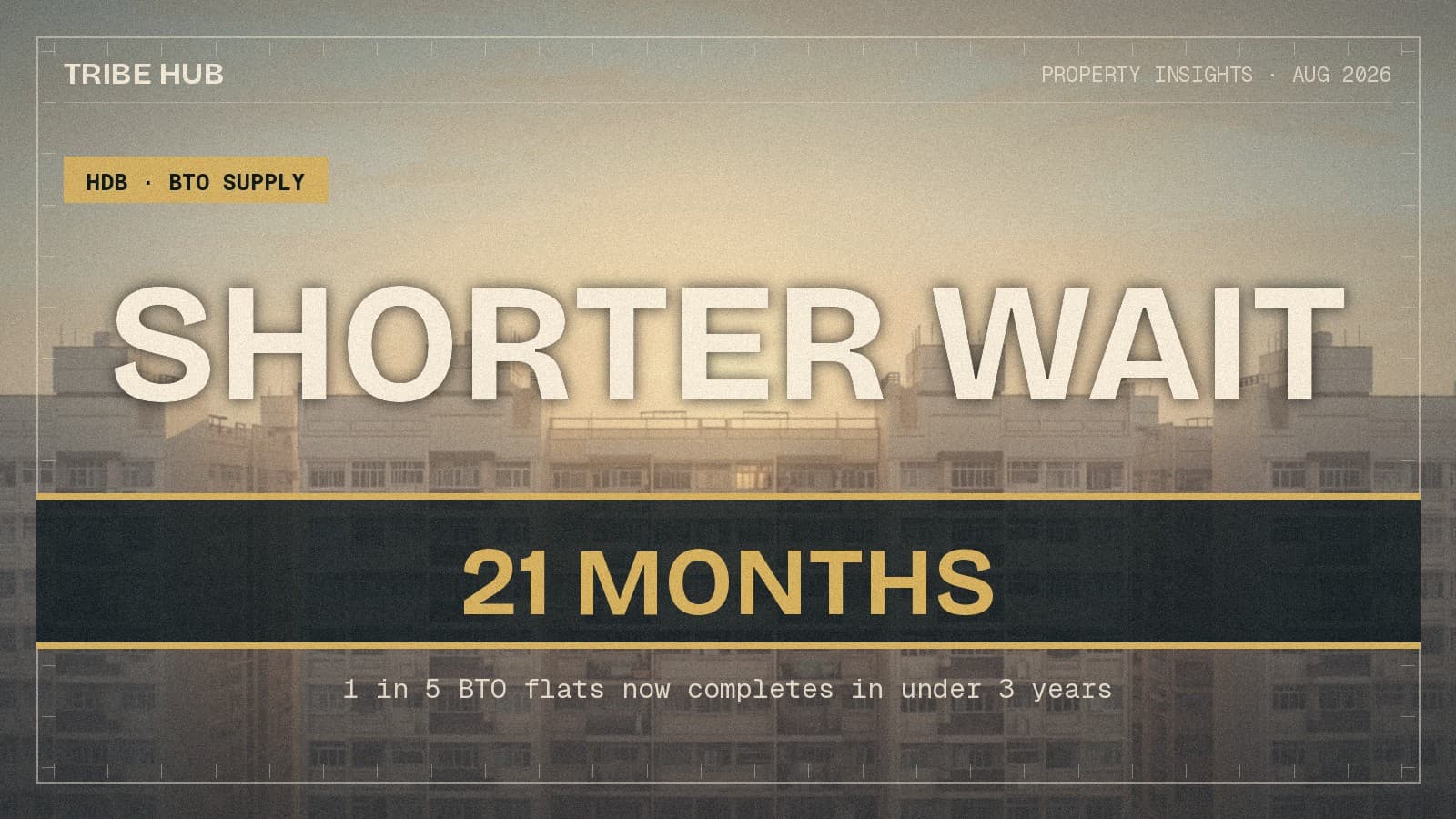
One in five BTO flats launched in 2026 completes in under three years. Buyers treat that as a lifestyle perk. It is really a 21-month shift in when you reach MOP, when you can sell, and when you can upgrade.
By TRIBE Editorial · 15 August 2026 · 7 min read
Waiting time is the most consequential variable in a BTO application and the one buyers weigh least carefully. Price gets compared to the decimal. Location gets argued over for weeks. The completion date gets read once, filed under "inconvenient", and forgotten.
That is backwards. The wait is not a delay bolted onto the front of ownership. It sits ahead of every other date that matters — key collection, the Minimum Occupation Period, the first day you may sell, the day you can move up. Shorten it by 21 months and all of those move 21 months closer.
What a Shorter Waiting Time flat actually is
A Shorter Waiting Time (SWT) flat is an ordinary BTO flat launched later in its own construction cycle. HDB starts building ahead of the sales exercise rather than after it, so by the time the flat is balloted, a good deal of the work is already done. Buyers collect keys in under three years instead of the four-plus that a standard BTO has typically required.
Nothing else about the flat differs. Same Standard, Plus or Prime classification and its attached restrictions, same grants, same 5-year MOP measured from key collection, same lease. What is compressed is only the gap between signing up and moving in.
They are no longer a rounding error
HDB will launch about 19,600 BTO flats in 2026 across three exercises — February, June and October — keeping it on track for roughly 55,000 flats between 2025 and 2027. More than 4,000 of the 2026 flats are SWT, or about one in five.
That is a step change. A few years ago the annual count sat below 2,000. It passed 4,000 in 2025, and roughly 8,000 more are expected across 2026 and 2027 against a 12,000-flat target for the 2025–27 window.
The February 2026 exercise shows the mix in practice: about 1,300 SWT flats inside a launch of 4,692, or 28% of that exercise. Flats have been spread across Ang Mo Kio, Bukit Merah, Sembawang, Toa Payoh, Tampines, Woodlands and Yishun. The June exercise offered 6,952 flats across seven projects. October is the year's last.
The 21-month arithmetic
Here is the part that does not appear in any launch brochure. The MOP does not start when you apply. It starts when you collect keys. So the waiting time and the MOP stack, and the stack is what governs when you are free to move.
| Route | Wait | + MOP (60 months) | Total to resale eligibility |
|---|---|---|---|
| Standard BTO (~4.5 yrs) | 54 months | 114 months | 9.5 years |
| Typical BTO (~4 yrs) | 48 months | 108 months | 9.0 years |
| SWT flat (under 3 yrs) | 33 months | 93 months | 7.8 years |
| Fastest SWT (~2.5 yrs) | 30 months | 90 months | 7.5 years |
Against a 54-month standard project, an SWT flat at 33 months reaches resale eligibility 21 months earlier — one year and nine months. For a couple applying at 29, that is the difference between being free to sell at 38 and at 40. If a second child, a school posting or an upgrade is anywhere in the plan, 21 months is not a detail.
The same shift applies to every downstream date: when you may rent out the whole flat, when you may buy private property without disposing of the flat, when the lease decay clock has run a little less far at the point you exit.
What the extra wait costs in cash
While you wait, you live somewhere, and that somewhere usually costs money — rent, or a contribution at home, or an existing mortgage you are still servicing.
Whatever that figure is, the extra months of a standard BTO multiply it:
| Monthly housing cost while waiting | 12 months | 18 months | 21 months | 24 months |
|---|---|---|---|---|
| $900 | $10,800 | $16,200 | $18,900 | $21,600 |
| $1,600 | $19,200 | $28,800 | $33,600 | $38,400 |
| $2,500 | $30,000 | $45,000 | $52,500 | $60,000 |
| $3,200 | $38,400 | $57,600 | $67,200 | $76,800 |
A couple renting a modest whole flat at $2,500 while waiting spends $52,500 over the 21-month difference. That money buys nothing and leaves no asset behind. It is worth setting against whatever price gap exists between the SWT project and the standard one you were also considering — a comparison that rarely gets made, because the two sit in different columns of the brochure.
Note the direction of the effect, though. This is money not spent, not money earned. It does not appear in any valuation and it will not show up when you sell. It shows up in how much you have when you get there.
What you give up
The case is not one-sided, and two things genuinely cut the other way.
Choice narrows sharply. SWT flats are roughly a fifth of supply and are not evenly spread. In any given exercise a buyer with a fixed town in mind may find no SWT option at all, or one project with a single flat type. A shorter wait is only worth having if it is attached to somewhere you actually want to live for at least the following five years — and the MOP means you are committed to precisely that.
Pricing is set project by project. HDB prices each launch against its own market valuation with subsidies applied, so the price of an SWT flat is a function of its location and attributes, not a published discount or premium for the wait. Read the indicative price range in the launch annex for the specific project rather than assuming the shorter wait is free or that it is paid for. We put the three routes into a flat side by side, with prices from HDB's own launch documents, in BTO, SBF or Resale in 2026.
There is also a limit to what supply can fix. More SWT flats mean shorter waits for the buyers who get them; they do not change how many applicants chase each unit in a popular town.
How to use this in October
Treat the completion date as a headline number, not a footnote. Concretely, for the October exercise:
- Write down the completion date for each project you are considering, and add 60 months. That second date — not the price — is when you regain flexibility.
- Multiply the difference in waiting months by what your housing costs you today. That is the real, if invisible, cost of the longer wait.
- Only then compare indicative prices, and ask whether the gap is larger or smaller than the figure you just calculated.
- Apply the location test last and hardest. An SWT flat in the wrong town locks you in sooner, not later — the compressed timeline works against you if you did not want to be there.
The shorter wait is not simply a nicer version of the same product. It is a different position on the clock, and the clock is the thing most buyers never price.
Supply figures are HDB's published 2026 programme: about 19,600 BTO flats across February, June and October exercises, of which more than 4,000 are Shorter Waiting Time flats. Waiting times shown are illustrative of the standard and SWT bands rather than any specific project — check the actual estimated completion date in each launch's annex. MOP is 5 years from key collection for the flat types discussed; Plus and Prime flats carry additional restrictions beyond the MOP.
Know what you can afford
Loan, stamp duty, CPF, and monthly repayments — work out your real budget before you commit. No registration required.
Plan my purchase →Prefer a personal read on your situation? Arrange a consultation →Keep reading


TRIBE Editorial · Reviewed by Silas Tan
Co-Founder, TRIBE · District Director, Huttons Asia · Ex-Mortgage Banker (AVP) · >1,000 families advised · CEA R000303I
How TRIBE scores and checks its analysis
Spotted an error, or a figure that has moved since publication? Tell us and we will correct it.
This article is for informational purposes only and does not constitute financial or investment advice.