Insights
Your Loan Costs 1.4%. Your CPF Earns 2.5%. Prepaying Is the Losing Trade.
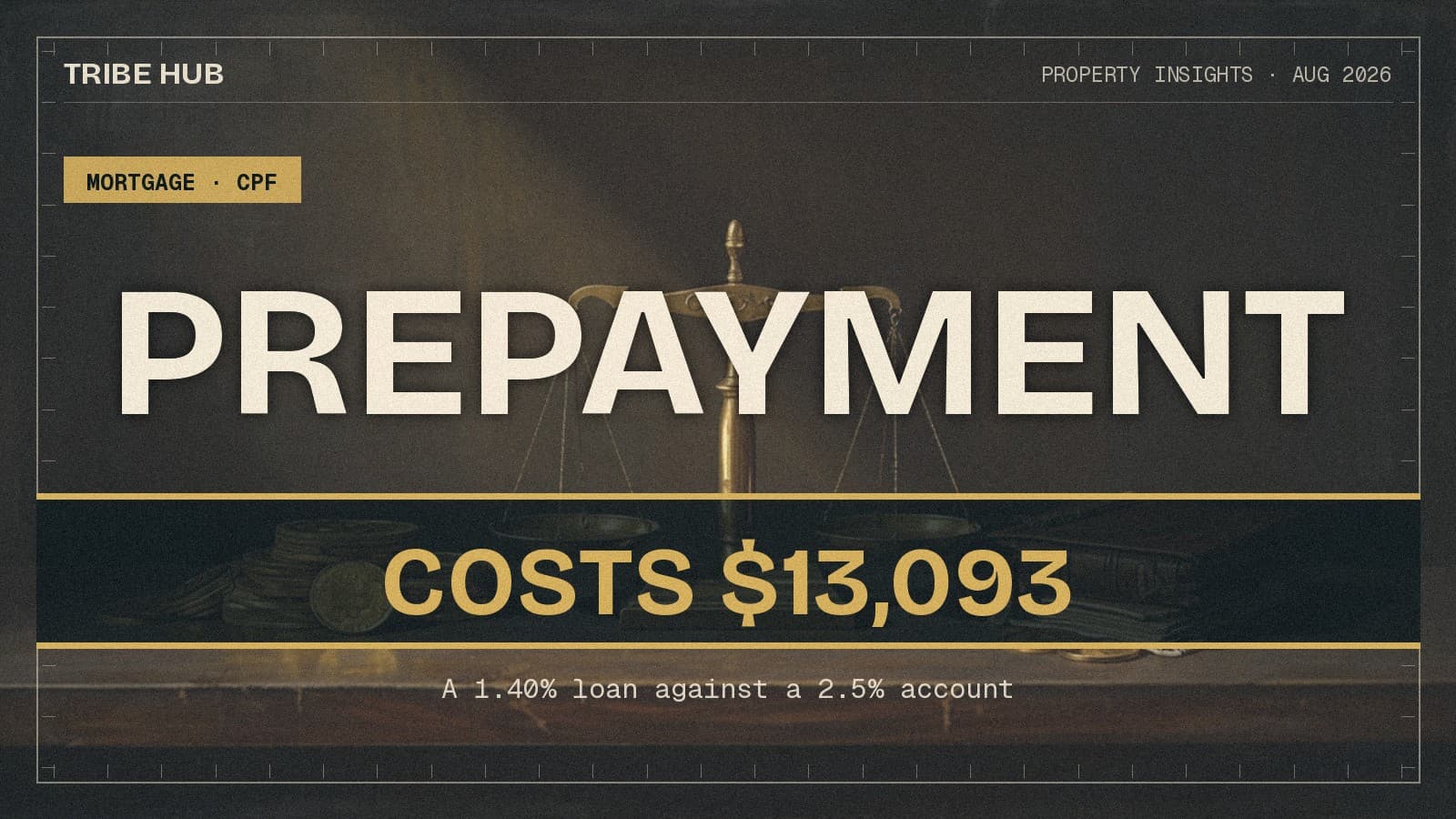
Paying down the mortgage feels like the responsible move. On a 1.40% bank loan funded from CPF OA at 2.5%, $100,000 of prepayment costs you $13,093 over ten years. On an HDB loan at 2.60%, the same move earns you money.
By TRIBE Editorial · 15 August 2026 · 7 min read
Clearing debt early is the one piece of personal finance advice nobody argues with. It is also, for a large number of Singaporean homeowners right now, arithmetically wrong.
The reason is a gap that has opened between two rates. Your CPF Ordinary Account pays a legislated floor of 2.5%. A bank home loan in August 2026 costs somewhere around 1.4%. Money that moves from the first to the second is money that stops earning 2.5% in order to stop costing 1.4% — a losing trade of about 1.1% a year, repeated for as long as you would have held the loan.
The two rates that decide it
From 1 July to 30 September 2026, CPF confirmed the Ordinary Account rate stays at its 2.5% floor, because the pegged rate remains below it. The HDB concessionary loan rate, fixed at 0.1% above the OA rate, stays at 2.60%.
Bank rates sit well beneath both. 3M compounded SORA has been hovering near 1.1%, and advertised packages in August 2026 run from roughly 1.3% floating to about 1.4–1.5% fixed. We worked through the fixed-versus-floating choice at those levels in a separate piece; what matters here is only the level, not the flavour.
So the ranking is unusual, and it is the whole story:
| Where the money sits | Rate (Q3 2026) |
|---|---|
| CPF Ordinary Account | 2.50% |
| HDB concessionary loan | 2.60% |
| Bank home loan (typical fixed) | ~1.40% |
For most of the last two decades the mortgage was the most expensive money in a household's balance sheet. In 2026 it is frequently the cheapest.
What prepaying buys you
Take a $600,000 outstanding loan with 20 years to run at 1.40% fixed, and a $100,000 lump sum sitting in CPF OA.
Prepay the $100,000 and the numbers look genuinely good in isolation. The monthly instalment falls from $2,868 to $2,390 — a saving of $478 a month. Total interest over the remaining 20 years drops from $88,263 to $73,552. You have saved $14,710 in interest.
That figure is real. It is also only one side of the ledger, and it is the smaller side.
What prepaying costs you
The $100,000 did not appear from nowhere. It was compounding at 2.5% inside your OA, and it stops the moment it leaves. So the honest comparison is not "interest saved versus zero" — it is "interest saved versus interest forgone."
Left alone, $100,000 in OA grows at 2.5%. Used to prepay, it kills off debt that was compounding at only 1.40%. Line the two up:
| Years | $100,000 left in OA @ 2.5% | Debt avoided @ 1.40% | Net position |
|---|---|---|---|
| 5 | $113,141 | $107,199 | +$5,942 |
| 10 | $128,008 | $114,916 | +$13,093 |
| 15 | $144,830 | $123,188 | +$21,642 |
| 20 | $163,862 | $132,056 | +$31,805 |
The positive numbers are what you keep by not prepaying. Ten years on, the household that left the money alone is $13,093 ahead of the one that felt responsible. Twenty years on, $31,805.
For members under 55 the gap is wider still. CPF pays an extra 1% on the first $60,000 of combined balances, capped at $20,000 for the OA. On that slice the effective rate is 3.5%, and the spread against a 1.40% loan is 2.10% a year rather than 1.10%.
The accrued-interest red herring
A common objection: CPF money used for housing must be refunded on sale with accrued interest at 2.5%, so surely prepaying with CPF is doubly punitive?
No. The accrued interest is calculated at exactly the rate the money would have earned had it stayed in the account, and it is refunded into your own OA, not paid to anyone else. It is bookkeeping that restores your retirement balance, not a penalty. We traced a full refund through a real sale in this worked case.
The cost of prepaying is the 1.10% spread and nothing else. That is quite enough.
On an HDB loan, the answer flips
Run the identical exercise against the HDB concessionary rate of 2.60% and the sign reverses.
| Years | $100,000 in OA @ 2.5% | Debt avoided @ 2.60% | Net position |
|---|---|---|---|
| 5 | $113,141 | $113,694 | −$553 |
| 10 | $128,008 | $129,263 | −$1,254 |
| 20 | $163,862 | $167,089 | −$3,227 |
Here the loan costs marginally more than the account earns, so prepaying wins — by 0.1% a year, which on $100,000 over a decade is $1,254. Real, but slight.
This is the part worth internalising. The prepayment question has no general answer. It has two answers, and which one applies depends entirely on which side of 2.5% your loan sits. A bank borrower at 1.40% and an HDB borrower at 2.60% should do opposite things with the same $100,000, and both would be right.
(The related question — whether an HDB borrower should refinance to a bank in the first place — is a different and much less symmetric decision, because the 2.60% rate is one you can never get back. We worked that one through here.)
Cash is a different question
Everything above concerns CPF OA money, where the 2.5% is a legislated floor rather than a market rate. Cash has no such floor.
With 3M SORA near 1.1%, cash sitting in deposits earns something in the same neighbourhood as the loan it would retire. The spread is thin and can go either way, so prepaying with cash is closer to a genuine toss-up — decided by liquidity, lock-in penalties and temperament rather than by arithmetic. The stark version of this trade only exists because CPF's floor holds 2.5% steady while market rates have fallen beneath it.
The reverse trade almost nobody makes
If prepaying moves money the wrong way, the mirror image moves it the right way. CPF allows a voluntary housing refund — putting cash back into your OA to restore savings you previously used for the property, where it resumes earning 2.5%.
For a household holding idle cash and a cheap bank loan, that is the same 1.10% spread captured in the correct direction. It is the trade the arithmetic actually points to, and it is far less popular than prepayment, because it feels like doing nothing about the debt.
When you should prepay anyway
Arithmetic is not the only input, and a 1.10% spread is not large enough to override the following:
- Cashflow strain. If the instalment is genuinely tight, $478 a month of breathing room is worth more than $13,093 of theoretical carry over a decade.
- A rate you cannot hold. The spread depends on your loan staying cheap. If you are on a floating package with no fixed floor, the calculation is a snapshot, not a promise.
- Lock-in penalties. Most packages charge 1.5% on prepayments made inside the lock-in period, which swamps everything discussed here. Check the clause before doing anything.
- You will not otherwise leave it alone. OA money earmarked for a renovation next year is not compounding for ten years, and should not be modelled as if it were.
What should not drive the decision is the feeling that debt is bad. At 1.40%, against an account paying 2.5%, the debt is the cheapest thing you own.
Rates cited are as at Q3 2026: CPF OA 2.5%, HDB concessionary 2.60%, both per CPF's 1 July–30 September 2026 announcement; bank package rates as advertised in August 2026 and subject to change. All loan figures computed on a $600,000 balance with 20 years remaining. Your own numbers depend on your outstanding balance, remaining tenure, package terms and lock-in status — check them before acting.
Know what you can afford
Loan, stamp duty, CPF, and monthly repayments — work out your real budget before you commit. No registration required.
Plan my purchase →Prefer a personal read on your situation? Arrange a consultation →Keep reading
4 October 2026Mortgage & Rates
Floating Only Wins Now If SORA Falls. Here Is the Breakeven.
30 September 2026Mortgage & Rates
The Fed Hiked for the First Time in Three Years. Singapore's Floating Rate Moved Four Basis Points.
23 September 2026Mortgage & Rates
The HDB Loan Lends You 11% More. The Bank Loan Costs 45% Less.

TRIBE Editorial · Reviewed by Silas Tan
Co-Founder, TRIBE · District Director, Huttons Asia · Ex-Mortgage Banker (AVP) · >1,000 families advised · CEA R000303I
How TRIBE scores and checks its analysis
Spotted an error, or a figure that has moved since publication? Tell us and we will correct it.
This article is for informational purposes only and does not constitute financial or investment advice.