Insights
NDR 2026 Housing Changes: More BTO Demand, Softer Resale Pressure and Stronger Interest in Existing ECs
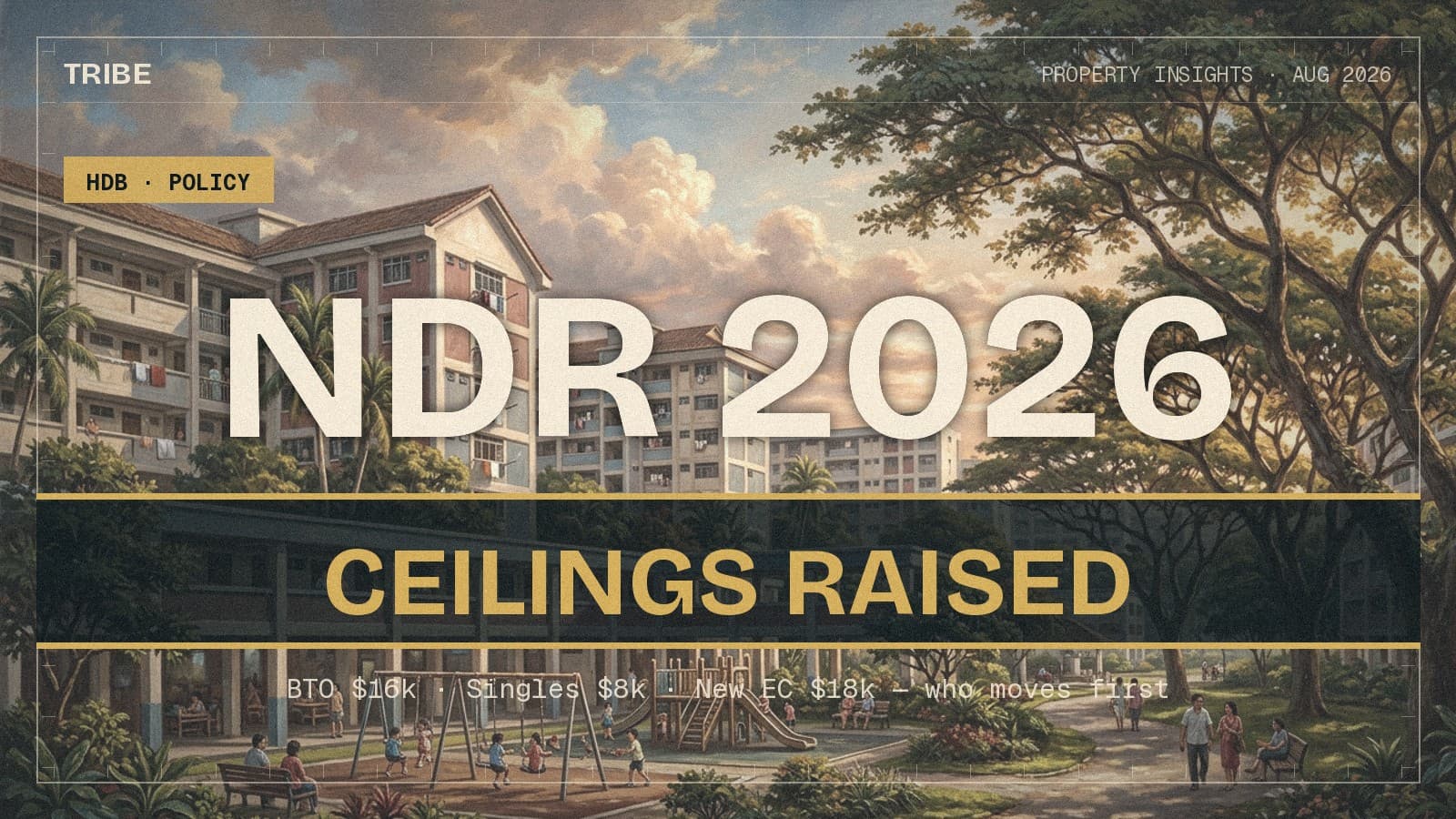
NDR 2026 lifted the BTO family income ceiling to S$16,000, the singles' ceiling to S$8,000 and the new-EC ceiling to S$18,000, with extra ballot chances for families with children. The effects won't land evenly: BTO demand should rise, resale demand softens at the margin, existing ECs may move first — and future ECs may launch at higher prices.
By TRIBE Editorial · 23 August 2026 · 10 min read
Singapore's National Day Rally 2026 introduced several housing measures that will widen access to BTO flats and executive condominiums.
The key changes, as announced at the Rally and detailed by HDB and MND, are:
- BTO family income ceiling increased from S$14,000 to S$16,000
- Singles' HDB income ceiling increased from S$7,000 to S$8,000
- New EC income ceiling increased from S$16,000 to S$18,000
- First-timer families with children will receive an additional ballot chance for every Singapore Citizen child aged 18 and below, from the February 2027 sales exercise
These measures will not affect every housing segment in the same way.
At TRIBE, our view is that the main impact will be felt across three markets:
- Higher demand for BTO flats
- Some softening of demand for HDB resale flats
- Stronger movement in existing EC projects, while future ECs may launch at higher prices
The effects will not happen equally or immediately, but the direction of travel is worth understanding.
1. BTO demand is likely to increase
The most direct impact will be on the BTO market.
By raising the family income ceiling from S$14,000 to S$16,000, more middle-income households will become eligible for new subsidised flats. Some couples who were previously excluded may now be able to apply for a BTO flat and potentially qualify for an HDB loan.
The additional ballot chances for first-timer families with children may also increase demand from this group.
The November 2026 BTO exercise is expected to offer approximately 7,960 flats across projects in Bedok, Geylang, Sembawang, Tengah, Toa Payoh and Yishun.
Analysts quoted by CNA expect the overall application rate to increase from 3.4 in the June 2026 exercise to approximately 3.5–4.0 in November.
Demand is likely to be strongest for projects with:
- Established amenities
- Convenient transport connections
- Good school access
- Attractive future development potential
- A location that is difficult to replicate
Bedok and Toa Payoh are expected to attract particularly strong interest.
However, not every BTO project will benefit equally. A higher income ceiling increases the number of eligible buyers, but it does not make every location equally attractive.
Our view is that applicants should not apply simply because they now qualify. They still need to consider whether the project fits their family plans, waiting period, budget and preferred location.
Likely BTO market effect
| Factor | Likely effect |
|---|---|
| Demand | Increase |
| Competition | Increase, especially for well-located projects |
| Application rates | Likely to rise |
| Prices | BTO prices remain policy-driven, but popular projects may become more competitive at application stage |
2. HDB resale demand may soften, but prices may not fall sharply
The resale HDB market may experience some reduction in demand as more households gain access to BTO flats.
Some buyers who previously had to consider resale flats because they were above the BTO income ceiling may now have another option. They may choose to wait for a new flat instead of purchasing a resale flat immediately.
This could reduce demand from certain segments of the resale market, especially buyers who:
- Are first-timer families
- Can wait several years for their flat
- Do not require a specific location
- Prefer a new flat with a subsidised price
- Are willing to accept the uncertainty of the ballot process
However, we do not expect this to affect all resale flats equally.
Resale flats continue to serve buyers who:
- Need to move in quickly
- Want to live near parents
- Need a specific school location
- Require a larger flat
- Prefer established estates
- Cannot wait for BTO construction
- Are not eligible for the type or location of BTO flat they want
This means the resale market may experience softer demand at the margin, but that does not automatically mean a broad-based decline in resale prices.
The impact will likely depend on the location and type of flat. Resale flats that compete directly with upcoming BTO projects may feel more pressure. Flats in established locations with limited new supply may remain resilient.
Likely HDB resale market effect
| Factor | Likely effect |
|---|---|
| Demand | Some softening, particularly among price-sensitive first-timer buyers |
| Prices | Potentially more stable or slower-growing, rather than an automatic sharp decline |
| Most affected | Flats competing directly with new BTO supply |
| More resilient | Well-located flats offering immediate occupation and established amenities |
The key point is that BTO and resale flats are not perfect substitutes. Buyers who need a home immediately will still have a reason to choose resale.
3. Existing ECs may move more quickly
The EC market requires more careful analysis because the new income ceiling does not apply to every EC unit.
The new S$18,000 income ceiling applies to developments with land-sale tender closing dates from 24 August 2026 onwards.
It does not apply to balance units in existing EC developments — those remain under the S$16,000 ceiling.
This creates a potential difference between existing EC supply and future EC supply.
Buyers who are already eligible under the current S$16,000 ceiling may look harder at existing EC projects before future developments are launched, while households newly eligible in the S$16,000–S$18,000 band will need to wait for projects on land sold from 24 August 2026 onwards. Some buyers may prefer an existing project because it offers:
- A known location
- A clearer construction or completion timeline
- Earlier access to the private market
- A potentially lower price compared with future launches
New EC projects will also operate under tighter conditions. For affected new sites:
- The minimum occupation period increases from five years to 10 years
- Full privatisation moves from 10 years to 15 years
- 90 per cent of units will be reserved for first-timer families during the priority period
- The first-timer priority period increases from one month to two years
- The Deferred Payment Scheme will no longer be available
These changes make future ECs more focused on long-term owner-occupation and less suitable for buyers looking for a shorter-term stepping stone into private property.
This may make selected existing EC projects comparatively more attractive, depending on their pricing, location and remaining occupation period.
Likely existing EC market effect
| Factor | Likely effect |
|---|---|
| Demand | Likely to increase for selected existing ECs and balance units |
| Reason | Existing units keep the current five-year MOP and payment rules, while future sites face tighter conditions and potentially higher prices |
| Buyer behaviour | Some may bring forward their purchase before future EC launches become more expensive or less flexible |
| Most attractive | Projects with good locations, reasonable remaining MOP timelines and competitive prices |
This does not mean every existing EC will automatically rise in value. The project still needs to be suitable, fairly priced and financially manageable.
4. Future ECs may be launched at higher prices
Our view is that future EC prices may come under upward pressure.
Developers understand that the higher income ceiling expands the pool of households eligible to purchase a new EC. If more buyers can qualify, developers may have greater confidence in pricing future projects at a higher level.
This is particularly relevant in land tenders. Developers will assess:
- The number of eligible households
- Recent EC transaction prices
- Available competing projects
- Land acquisition costs
- Construction costs
- Expected demand at launch
If developers bid more aggressively for EC land because they expect stronger demand, the higher land cost will eventually be reflected in launch prices.
In other words, the higher income ceiling may improve access for buyers, but it may also increase the price developers believe the market can support.
This creates an important distinction:
More people may qualify for future ECs, but that does not necessarily mean future ECs will become more affordable.
The combination of a larger eligible buyer pool and higher development costs could result in future EC launches being priced higher than existing comparable projects.
Likely future EC market effect
| Factor | Likely effect |
|---|---|
| Eligible buyer pool | Increase |
| Developer pricing power | Potentially increase |
| Land bids | May become more competitive |
| Launch prices | Likely to face upward pressure |
| Buyer consideration | Compare future launches carefully against existing ECs and private condominiums |
5. The private condominium market may see indirect effects
The impact on the broader private residential market is likely to be more indirect.
Some households who might previously have considered a mass-market private condominium may now choose an EC instead, particularly if they are eligible for the subsidised EC pricing structure and can accept the longer occupation restrictions.
This could redirect some demand away from selected private condominiums.
At the same time, buyers who are above the EC ceiling, unwilling to accept the 10-year MOP or looking for full private ownership may continue to consider private condominiums.
URA's 2Q 2026 data showed that private residential prices increased 0.5 per cent, while the Government continues to maintain a substantial private housing supply pipeline.
The NDR measures alone are unlikely to determine the direction of the entire private property market. Location, interest rates, supply, affordability and buyer sentiment will continue to matter.
Likely private residential market effect
| Factor | Likely effect |
|---|---|
| Demand | Some diversion towards ECs among eligible buyers |
| Impact | More concentrated in mass-market projects competing with ECs |
| Higher-end private market | Likely to be less directly affected |
| Main variables | Mortgage rates, supply, pricing and overall economic conditions |
TRIBE's overall view
NDR 2026 is positive for households that were previously excluded from BTOs or ECs because of the income ceilings.
However, the impact is not simply that "property demand will rise".
The more accurate view is:
- BTO demand is likely to increase
- Some HDB resale demand may soften
- Existing ECs may benefit from stronger buyer interest
- Future EC prices may rise as developers respond to a larger eligible market
- Some private condominium demand may shift towards ECs
The biggest mistake would be to assume that every property will benefit equally from the policy changes.
Buyers still need to compare:
- Existing ECs against future EC launches
- BTO waiting times against resale availability
- Subsidised pricing against actual affordability
- Short-term flexibility against long-term occupation rules
- Project fundamentals against launch-day excitement
The higher income ceiling may create more choices. But it may also create more competition and higher prices.
For buyers, the opportunity is not simply to qualify for a property.
The real opportunity is to understand how the different housing markets are changing — and position themselves before the market fully adjusts.
Sources: Prime Minister's Office, National Day Rally 2026; HDB, "Increase in income ceilings and greater support for families with children"; MND, "Strengthening the Executive Condominium housing scheme and supporting first-time home buyers"; CNA; The Straits Times; URA 2Q 2026 real estate statistics.
This article is for general information only and does not constitute financial, legal or property investment advice. Housing eligibility, EC rules, financing and applicable timelines should be verified with HDB, MND and the relevant professionals before making a decision.
Know what you can afford
Loan, stamp duty, CPF, and monthly repayments — work out your real budget before you commit. No registration required.
Plan my purchase →Prefer a personal read on your situation? Arrange a consultation →Keep reading

TRIBE Editorial · Reviewed by Silas Tan
Co-Founder, TRIBE · District Director, Huttons Asia · Ex-Mortgage Banker (AVP) · >1,000 families advised · CEA R000303I
How TRIBE scores and checks its analysis
Spotted an error, or a figure that has moved since publication? Tell us and we will correct it.
This article is for informational purposes only and does not constitute financial or investment advice.