Insights
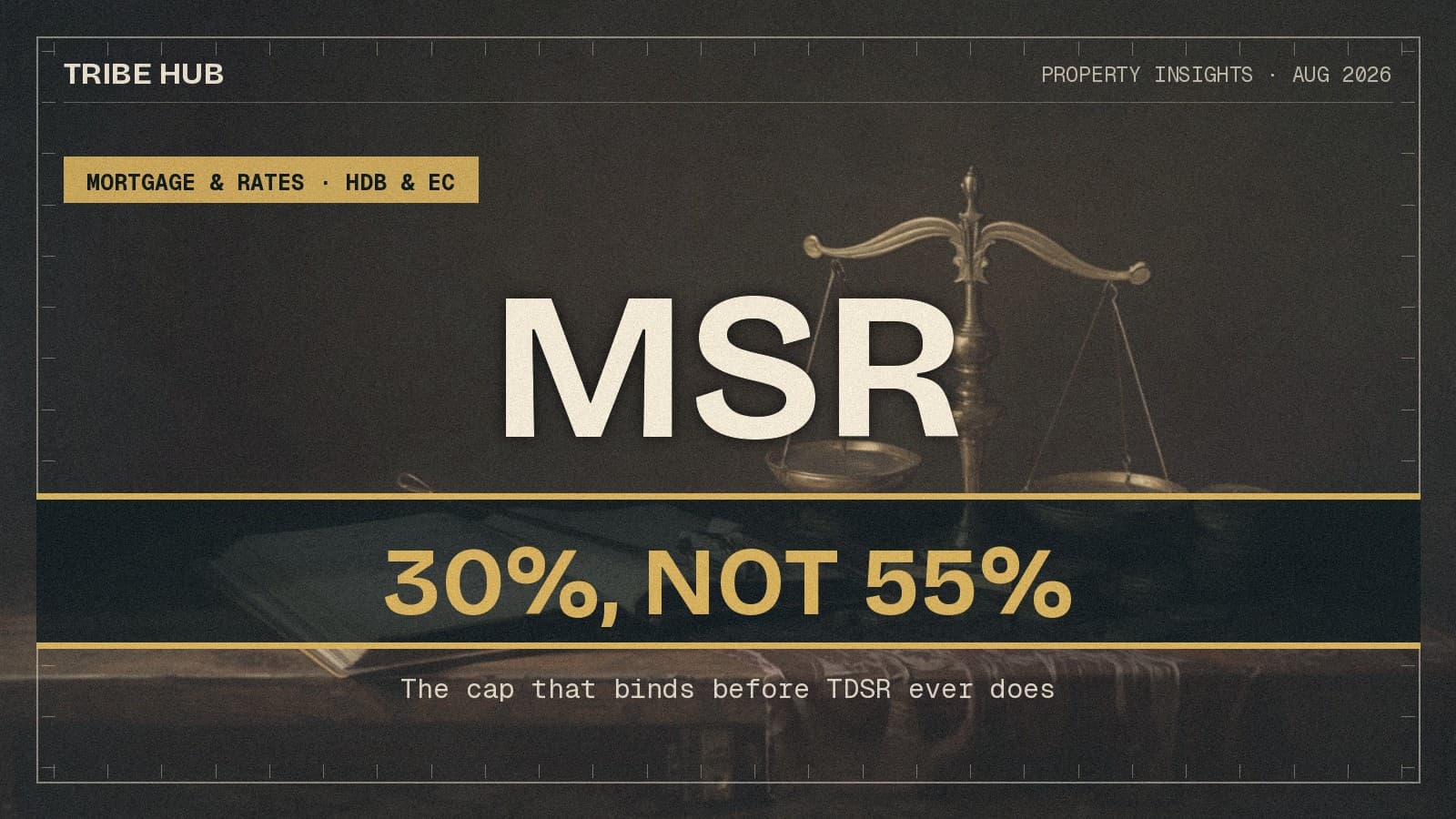
TDSR Isn't What Caps You. MSR Is.
Everyone quotes the 55% TDSR. For an HDB flat or a new EC, a second and much tighter rule sits on top of it — and on a S$8,000 household income it removes 45% of the loan TDSR would have allowed.
By TRIBE Editorial · 23 August 2026 · 8 min read
Ask most buyers what caps their loan and they will say TDSR — 55% of gross income, the rule everyone has heard of. For a private condominium that is correct. For an HDB flat or a new executive condominium bought from a developer, it is the wrong rule. A second, tighter ceiling sits on top of it, and in the ordinary case it is the only one that binds.
The Mortgage Servicing Ratio caps property-loan repayments at 30% of gross monthly income. On a household earning S$8,000 a month, that is the difference between a S$454,686 loan and a S$833,591 one — a 45% reduction in borrowing capacity that has nothing to do with your credit, your savings, or the rate you will actually pay.
What MSR is, precisely
MAS is narrow about the scope. MSR "applies only to housing loans for the purchase of an HDB flat", or an executive condominium whose minimum occupation period has not expired (MAS). Everywhere else — resale condominium, landed, commercial — only TDSR applies.
The test itself is simple:
Monthly repayment instalments for all property loans ÷ gross monthly income ≤ 30%
Three details do most of the damage in practice:
- It counts all your property loans, not just the new one, plus at least 20% of the monthly obligation on any property loan you have guaranteed.
- It is measured on gross income, and variable income is haircut before it counts.
- It is computed at a stress rate, not your contracted rate.
The gap is not small
Here is the same household, S$8,000 combined gross, no other debts, buying a resale flat over a 25-year tenure — the maximum for full loan-to-value on an HDB flat.
| Cap | Monthly ceiling | Assessed at | Maximum loan |
|---|---|---|---|
| TDSR 55%, if it were the only rule | S$4,400 | 4.0% | S$833,591 |
| MSR 30%, HDB concessionary loan | S$2,400 | 3.0% | S$506,103 |
| MSR 30%, bank loan | S$2,400 | 4.0% | S$454,686 |
At 75% LTV those loans support a purchase price of roughly S$674,805 on an HDB loan and S$606,248 on a bank loan. The bank route buys less flat despite the cheaper headline rate, because the assessment floor is a full percentage point higher — 4.0% under MAS's medium-term rate against the 3.0% floor HDB applies to its own concessionary loan.
Across incomes, the MSR ceiling on price looks like this:
| Combined gross | MSR cap | HDB loan (3%) | Max price | Bank loan (4%) | Max price |
|---|---|---|---|---|---|
| S$5,000 | S$1,500 | S$316,315 | S$421,753 | S$284,179 | S$378,905 |
| S$6,000 | S$1,800 | S$379,578 | S$506,103 | S$341,014 | S$454,686 |
| S$8,000 | S$2,400 | S$506,103 | S$674,805 | S$454,686 | S$606,248 |
| S$10,000 | S$3,000 | S$632,629 | S$843,506 | S$568,357 | S$757,810 |
| S$12,000 | S$3,600 | S$759,155 | S$1,012,207 | S$682,029 | S$909,372 |
Figures assume 25 years, 75% LTV and no other debts. Grants, cash and CPF are separate constraints — this table is capacity only.
Your other debts do nothing, until they do everything
This is the part almost nobody gets right, and it has an exact answer.
MSR is 30% of gross income for the property loan alone. Other debts — the car, the personal loan, the credit-card minimum — do not touch it. They enter only the TDSR test, which nets them off a 55% ceiling. So the binding cap is whichever is lower, and the crossover is solvable:
TDSR-after-debts falls below MSR when 0.55 × income − debts < 0.30 × income, i.e. when debts exceed 25% of gross income.
Below that line your debts are completely irrelevant to how much you can borrow. Above it, they bite at full weight. On S$8,000 of income:
| Other monthly debts | MSR cap | TDSR after debts | Binding cap | Max loan |
|---|---|---|---|---|
| S$0 | S$2,400 | S$4,400 | MSR S$2,400 | S$454,686 |
| S$1,000 | S$2,400 | S$3,400 | MSR S$2,400 | S$454,686 |
| S$2,000 | S$2,400 | S$2,400 | MSR S$2,400 | S$454,686 |
| S$2,500 | S$2,400 | S$1,900 | TDSR S$1,900 | S$359,960 |
| S$3,000 | S$2,400 | S$1,400 | TDSR S$1,400 | S$265,233 |
Paying down a S$1,000 car loan before applying, on this income, changes your loan by exactly nothing. Paying down a S$2,500 one changes it by S$94,726. The advice "clear your debts first" is not wrong so much as unpriced — it is worth something only past 25% of gross.
The same building, two different ceilings
Because MSR lapses once an EC's minimum occupation period expires, the identical property can carry two different financing limits depending on which market you buy it in.
Take a household on S$12,000 combined gross, 30-year tenure, assessed at the 4% floor:
| Route | Rule that binds | Monthly ceiling | Maximum loan | Price at 75% LTV |
|---|---|---|---|---|
| New EC from the developer | MSR 30% | S$3,600 | S$754,060 | S$1,005,414 |
| Resale EC, MOP expired | TDSR 55% | S$6,600 | S$1,382,444 | S$1,843,259 |
Same buyers, same block, 83% more loan on the resale side. This is worth holding next to the 2026 EC rules, which extend the MOP to ten years for EC land parcels tendered from 8 May 2026 — a longer MOP is also a longer period during which the MSR cap follows the building.
It also produces an awkward arithmetic at the top of the EC market. The EC household income ceiling is S$16,000. Run MSR at that ceiling on a 30-year tenure and the maximum financeable price is about S$1,340,552. A S$1.4m new EC needs roughly S$16,710 a month to clear MSR — more than the scheme's own eligibility limit allows you to earn. Above a certain price, the two rules cannot both be satisfied, and the gap has to be closed with cash or CPF, not loan.
You are assessed at a rate you will not pay
None of the loans above are computed at a market rate. MAS requires banks to assess residential property loans at a medium-term floor of 4.0%; HDB assesses eligibility for its concessionary loan at 3.0%, a floor introduced in September 2022. Actual pricing in August 2026 is nowhere near either — fixed packages have been quoted from around 1.4%, and the HDB concessionary rate is 2.6%.
The consequence is that the household above, borrowing its MSR maximum, does not spend 30% of income on the mortgage:
| Loan | Rate actually paid | Instalment | Share of gross |
|---|---|---|---|
| S$506,103 (HDB) | 2.60% | S$2,296 | 28.7% |
| S$454,686 (bank) | 1.40% | S$1,797 | 22.5% |
Which is the rule working as designed — the buffer is the point. But it also means falling rates do not enlarge what you can borrow on a flat, a mechanism we have covered in why lower rates don't increase borrowing power.
Variable income is haircut before any of this runs
Commission, bonus and self-employed income are recognised at 70% of value. A borrower on S$5,000 fixed plus S$36,000 a year variable does not present S$8,000 of income — they present S$7,100. That is S$270 a month off the MSR cap and S$51,152 off the loan, before a single other rule is applied. Our piece on the self-employed income haircut works through the documentation side of it.
What to actually do with this
If you are buying an HDB flat or a new EC, stop computing 55% of your income. Compute 30%, apply the haircut to any variable portion, and only then check whether your other debts exceed a quarter of gross — because that is the sole condition under which they change the answer.
Both of TRIBE's planners run the same law: the resale HDB purchase planner and the new EC purchase planner take the lower of the two caps and show you which one bound.
Assumptions: 75% LTV, 25-year tenure on HDB, 30-year on EC, no other property loans, income-weighted average age within the tenure limits. Regulatory parameters from MAS as at August 2026. Every figure computed, none estimated. Methodology published. No spin.
Know what you can afford
Loan, stamp duty, CPF, and monthly repayments — work out your real budget before you commit. No registration required.
Plan my purchase →Prefer a personal read on your situation? Arrange a consultation →Keep reading

4 October 2026Mortgage & Rates
Floating Only Wins Now If SORA Falls. Here Is the Breakeven.

30 September 2026Mortgage & Rates
The Fed Hiked for the First Time in Three Years. Singapore's Floating Rate Moved Four Basis Points.
23 September 2026Mortgage & Rates
The HDB Loan Lends You 11% More. The Bank Loan Costs 45% Less.

TRIBE Editorial · Reviewed by Silas Tan
Co-Founder, TRIBE · District Director, Huttons Asia · Ex-Mortgage Banker (AVP) · >1,000 families advised · CEA R000303I
How TRIBE scores and checks its analysis
Spotted an error, or a figure that has moved since publication? Tell us and we will correct it.
This article is for informational purposes only and does not constitute financial or investment advice.