Insights
Landed Carried the Headline. Non-Landed Fell.
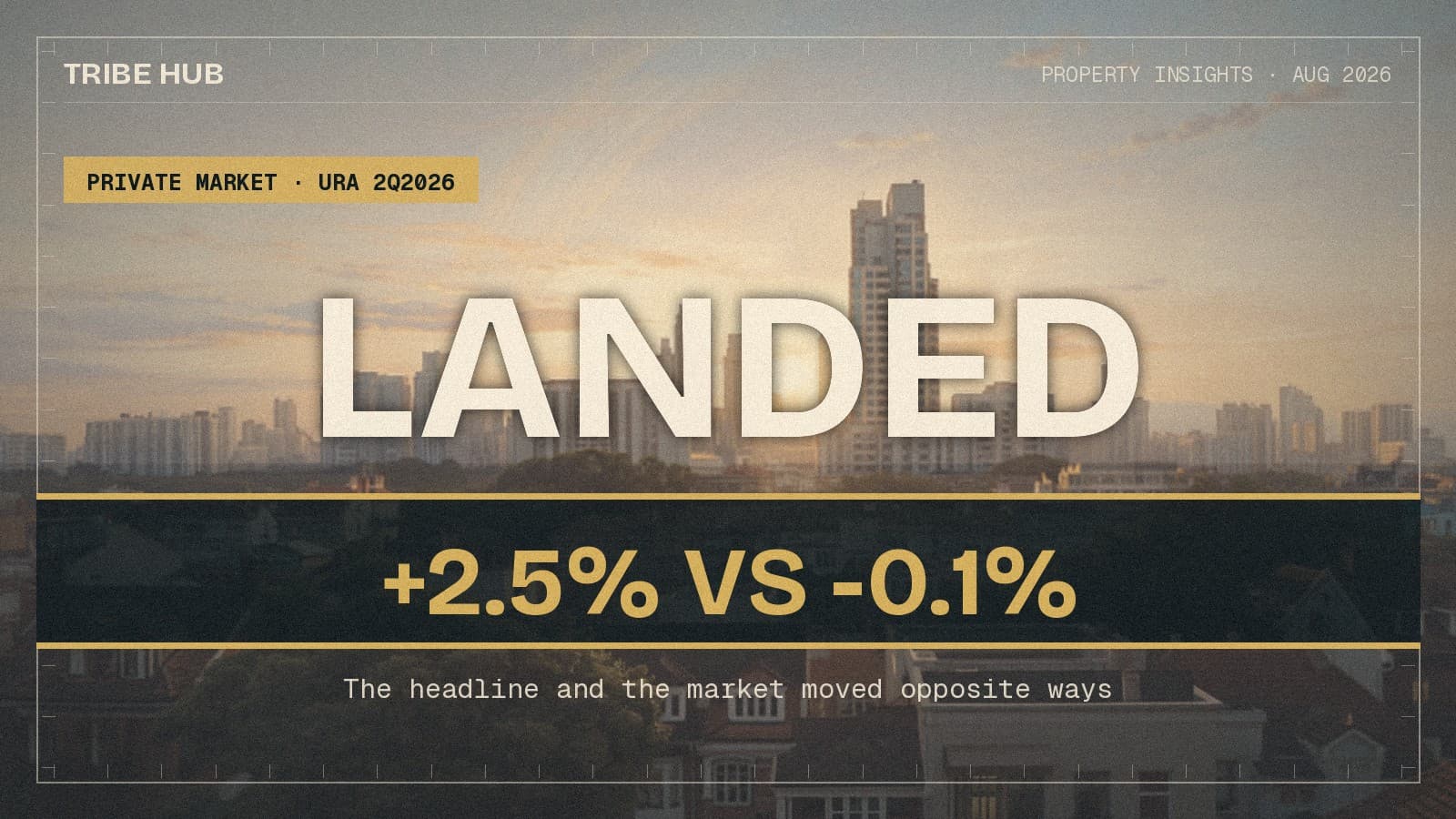
URA's Q2 2026 index rose 0.5%. The whole increase is landed housing, up 2.5%. Non-landed — where almost every private buyer actually transacts — slipped 0.1%. The headline describes a market most buyers cannot legally enter.
By TRIBE Editorial · 23 August 2026 · 5 min read
Singapore's private residential price index rose 0.5% in the second quarter of 2026. That is the number that travelled. It is also, on its own, close to useless — because the index is a blend of two markets that moved in opposite directions, and the one doing all the lifting is the one almost nobody in the market is shopping in.
Landed housing rose 2.5% in the quarter. Non-landed — condominiums and apartments, the segment that carries the overwhelming majority of private transactions — fell 0.1%. Both figures come from the same URA release as the 0.5%. Only one of them describes the market a buyer is standing in.
What the index actually did
All three series below are URA's, published through SINGSTAT with a 1Q2009 = 100 base (data.gov.sg). We read the levels directly and computed the changes rather than quoting a summary of them.
| Series | 1Q2026 | 2Q2026 | q/q | y/y |
|---|---|---|---|---|
| All private residential | 218.3 | 219.4 | +0.5% | +2.9% |
| Landed | 252.1 | 258.4 | +2.5% | +7.0% |
| Non-landed | 210.8 | 210.6 | −0.1% | +1.8% |
The quarter before ran the other way. In 1Q2026 non-landed rose 1.3% while landed fell 0.4%, and the aggregate printed +0.9%. Two consecutive quarters, two headline increases, two completely different engines. URA's own release describes the same split (URA).
The blend is doing the work
The aggregate index is not an average of the two sub-indices. It is weighted by transacted value, which is why a segment with far fewer sales can still move it.
You can solve for the weight the aggregate implied this quarter. If landed moved +2.50%, non-landed −0.09%, and the total +0.50%, then landed must have carried about 23% of the weight and non-landed about 77%. Nearly a quarter of the headline's sensitivity sits in the smaller, thinner half of the market.
That is not a criticism of the index — value-weighting is the correct construction, and URA is explicit that the series uses stratified hedonic regression with five-quarter value weights. It is a reason to stop treating one number as a description of one market.
Landed is the noisiest series URA publishes
Over the last forty-one quarters, the standard deviation of quarter-on-quarter moves is:
- Landed: 2.36 percentage points
- Non-landed: 1.58 percentage points
- Aggregate: 1.47 percentage points
Landed is roughly 1.5× as volatile as non-landed, with a quarterly range running from −3.6% to +6.7% against non-landed's −1.2% to +5.3%. Its last eight quarters, in order from most recent: +2.5, −0.4, +3.4, +1.4, +2.2, +0.4, −0.1, −3.4.
A series that swings between −3.4% and +3.4% inside two years does not turn a single +2.5% quarter into a trend. It is a small number of expensive, heterogeneous transactions — no two landed houses are the same asset — running through a regression that has fewer comparables to work with. Read it across years, not quarters.
Most buyers cannot act on the number anyway
The segment carrying the headline is legally closed to a large share of the buying pool. Under the Residential Property Act, a foreign person must obtain approval from the Singapore Land Authority to buy a landed home; approval is case-by-case, with published guidance pointing to at least five years of permanent residence and an exceptional economic contribution to Singapore (SLA). Good Class Bungalow areas are closed to permanent residents and foreigners outright.
Non-landed carries no such gate. So the +0.5% is, for most people reading it, a statement about a market they cannot enter, blended with a −0.1% about the market they can.
What a condo buyer should take from the quarter
Three things, none of them dramatic.
The condo market has gone sideways, not down. Non-landed is up 1.8% over the year and has now fallen in two of the last five quarters (−0.1% this quarter, −0.2% in 4Q2025). That is a plateau with noise in it, not a correction. Anyone waiting for a break in prices is, on this data, waiting.
The flat market did the same thing. HDB's resale index also edged lower in 2Q2026 — we covered the second consecutive quarterly dip separately. Both of the markets an ordinary upgrader stands between paused in the same quarter, which is a much less alarming picture than one falling while the other runs.
Stop pricing your own decision off the aggregate. If you are buying a three-bedroom in the suburbs, the relevant series is non-landed, and the relevant number is −0.1%, not +0.5%. If you are selling one, the same applies in reverse. The gap between the two is 2.6 percentage points in a single quarter — larger than the entire annual move most people are trying to forecast.
The honest caveat
A quarter is a quarter. Non-landed at −0.1% is a rounding distance from flat, and it would be as wrong to call that a decline as it is to call +0.5% a recovery. The point is not that the market fell. It is that the headline and the market are two different measurements, and the difference between them this quarter was larger than the headline itself.
The 2H2026 supply pipeline and the direction of new launches will settle which reading holds. Until then: check which index you are actually in.
Sources: URA private residential property price index via SINGSTAT (data.gov.sg, data to 2Q2026, last updated 24 July 2026); URA media release; Singapore Land Authority on foreign ownership. All percentage changes computed from the published index levels. Methodology published. No spin.
Check how your condo scores
2,352 condos independently scored across 7 weighted factors. No registration required.
Score my resale →Prefer a personal read on your situation? Arrange a consultation →Keep reading
6 October 2026Private Property Market
The 70% En Bloc Band Holds 223 Developments. The Published Count Is Four.
5 October 2026Private Property Market
Lucerne Grand Sold 61%. Buyers Bought the Smallest Version of Everything.

3 October 2026Private Property Market
The Rules Were Meant to Cool EC Land Bids. The First Site Under Them Set a Record.

TRIBE Editorial · Reviewed by Silas Tan
Co-Founder, TRIBE · District Director, Huttons Asia · Ex-Mortgage Banker (AVP) · >1,000 families advised · CEA R000303I
How TRIBE scores and checks its analysis
Spotted an error, or a figure that has moved since publication? Tell us and we will correct it.
This article is for informational purposes only and does not constitute financial or investment advice.