Insights
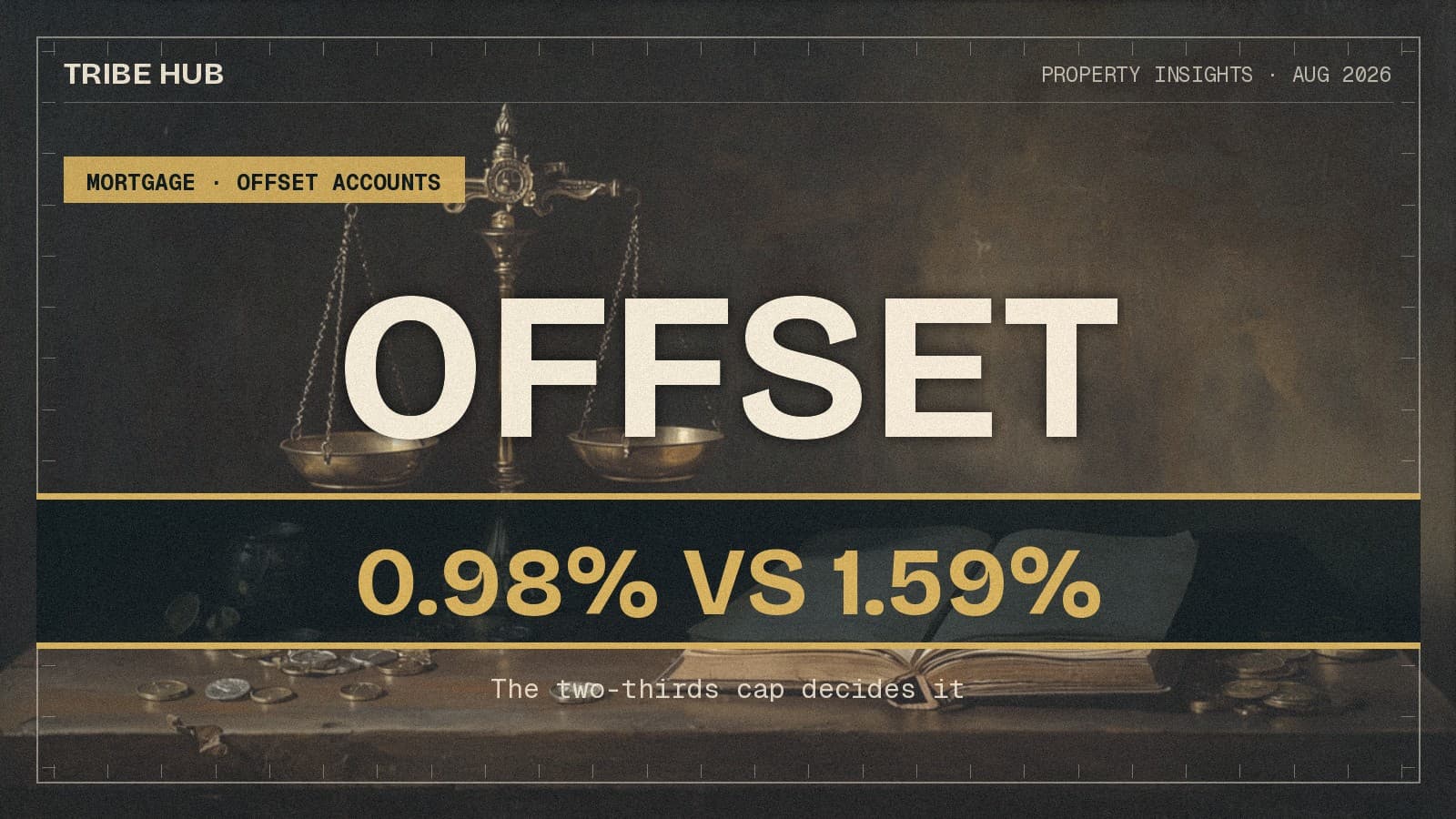
The Interest Offset Account Pays 0.98%. A Six-Month T-Bill Pays 1.59%.
Offset accounts are sold as the clever way to hold cash against your mortgage. At August 2026 rates the arithmetic has inverted — the break-even mortgage rate is 2.26%, and no bank package in Singapore is anywhere near it.
By TRIBE Editorial · 17 August 2026 · 8 min read
An interest offset account is the most quietly admired feature in Singapore mortgage lending. Park cash in a linked deposit account, the bank stops charging you interest on an equivalent slice of the loan, and you keep every dollar liquid. No lock-in, no auction, no forms. It sounds like a free lunch, and for most of the last three years it very nearly was.
At August 2026 rates it is not. The product has not changed — the rate environment moved underneath it, and the arithmetic now points the other way. Worked properly, an offset account on a 1.35% mortgage returns 0.98% on your deposit. A six-month Singapore T-bill returned 1.59% at the 4 August auction. That gap is not a rounding error, and nobody selling you the feature is going to open with it.
How the offsetting actually works
Two lenders in Singapore offer this selectively — Standard Chartered, through MortgageOne, and HSBC. Citibank runs a related structure that pays half the housing loan rate on linked deposits.
The mechanic that decides everything is the cap. In MortgageOne's case, only two-thirds of your deposit earns the mortgage rate. The remaining third sits at the ordinary deposit rate, currently 0.25%. The qualifying two-thirds is also capped at the outstanding loan, so there is no benefit to depositing more than you owe.
So the headline is "earn your mortgage rate on your savings," and the reality is a blended figure:
Blended yield = (⅔ × mortgage rate) + (⅓ × 0.25%)
On a 1.35% loan that comes to 0.98%. That number is fixed regardless of how much you deposit — the cap is proportional, so scale does not rescue it.
The worked case
Take a $750,000 loan over 25 years at 1.35%, which is roughly where the sharpest floating packages sit in August 2026. The instalment is $2,947, and the first month's interest component is $844.
| Deposit | Qualifying ⅔ | Month-1 offset | Interest still paid | Effective loan rate |
|---|---|---|---|---|
| $150,000 | $100,000 | $123 | $721 | 1.15% |
| $300,000 | $200,000 | $246 | $598 | 0.96% |
| $500,000 | $333,333 | $410 | $434 | 0.69% |
| $750,000 | $500,000 | $615 | $229 | 0.37% |
Read down the right-hand column and the feature looks superb. Half a million on deposit cuts the effective rate on a $750,000 loan from 1.35% to 0.69% — a halving. That is the number the brochure leads with, and it is not wrong.
It is just the wrong frame. You are not choosing between "offset" and "no offset." You are choosing where to park cash you already hold. So the question is not what the loan rate falls to. It is what that cash earned.
The comparison nobody runs
Same deposits, one year, against the risk-free alternatives available right now — the 6-month T-bill at its 4 August cut-off yield of 1.59%, and the August 2026 Savings Bond at 1.46% in year one.
| Deposit | Offset earns | T-bill at 1.59% | You gave up |
|---|---|---|---|
| $150,000 | $1,475 | $2,385 | $910 |
| $300,000 | $2,950 | $4,770 | $1,820 |
| $500,000 | $4,917 | $7,950 | $3,033 |
| $750,000 | $7,375 | $11,925 | $4,550 |
Half a million in an offset account against a 1.35% mortgage costs you about $3,000 a year versus rolling T-bills. Against the Savings Bond it is roughly $2,400 in year one, and the SSB steps up from there — its ten-year average is 2.06%.
The break-even, and why it matters
Set the blended offset yield equal to the T-bill and solve for the mortgage rate. The offset only wins when your loan rate exceeds:
2.26% — versus the 1.59% T-bill 2.07% — versus the 1.46% first-year SSB
That is the whole article in two lines. The two-thirds cap means an offset account is structurally worth about 67% of your mortgage rate, so your mortgage has to be substantially more expensive than the risk-free rate before parking cash against it beats simply buying the risk-free asset.
Through 2023 and 2024, with mortgages at 3.5–4% and T-bills drifting down from their peak, that condition held comfortably. In August 2026, with packages starting from 1.32% and the cheapest fixed rates around 1.45%, no Singapore bank package clears 2.26%. The condition has not narrowed. It has stopped being satisfied at all.
There is one exception, and it is a pointed one. The HDB concessionary loan is still 2.60% — the only widely held Singapore mortgage above the break-even. It is also the one product to which an offset account cannot be attached: MortgageOne applies to private property mortgages, not HDB bank loans, and certainly not to the HDB loan itself. The single case where the maths would work is the single case the product excludes.
So what are you actually buying?
If the yield case is gone, the honest framing is that the spread is a price, and what it buys is optionality. Three things, specifically.
Instant reversibility. A prepayment is easy to make and hard to undo. Taking that money back out means a home equity term loan — weeks of processing, LTV limits, TDSR assessment on whatever your income looks like then, and a second loan on a different lock-in cycle. An offset withdrawal is a bank transfer. For a self-employed borrower, or anyone whose income assessment might not survive a fresh underwrite, that difference is worth real money. We covered how banks assess income here.
No maturity ladder. A T-bill locks funds for six months and forces a reinvestment decision at every auction, at whatever yield the market hands you. The offset has neither lock-in nor reinvestment risk. If your liquid pot is genuinely emergency money that might be called next Tuesday, the T-bill is the wrong instrument regardless of its yield.
Amortisation, not interest. This is the subtlest one and it gets overstated. Because the instalment is fixed, offset interest does not land in your account — it converts into principal reduction. In the $300,000 case, month-one principal repayment rises from $2,103 to $2,349. Over a full tenure that shortens the loan. It is a real effect, but it is not free extra return; it is the same 0.98%, delivered as debt reduction rather than cash. Do not count it twice.
Price those three against roughly $3,000 a year on a $500,000 balance and decide. For a household holding six months of expenses that must stay instantly callable, the offset is defensible. For someone parking a property sale proceeds cheque for eighteen months while they look for the next purchase, it is defensible for a different reason — the money needs to be movable on a week's notice. For a borrower holding $500,000 of genuinely idle capital with no near-term claim on it, paying $3,000 a year for liquidity they will not use is simply a bad trade.
The rule of thumb, updated
The old rule — "if you have spare cash and a mortgage, an offset account is a no-brainer" — was written for a 4% world. In a 1.35% world it needs replacing:
- Mortgage above ~2.3%: the offset beats risk-free paper on yield. Use it.
- Mortgage below ~2.3%: the offset loses on yield. Use it only for the tranche of cash that must stay instantly liquid, and put the rest in T-bills or an SSB.
- Any rate: never deposit more than your outstanding loan. Beyond the cap you are earning 0.25%.
None of this makes the offset account a bad product. It makes it a liquidity product that spent three years being mistaken for a yield product, because at 4% it happened to be both. Rates fell, and only one of those two things survived. Know which one you are buying.
Rates cited are as at August 2026: 6-month T-bill cut-off yield 1.59% (4 August 2026 auction), August 2026 SSB 1.46% year-one / 2.06% ten-year average, HDB concessionary rate 2.60%, floating packages from 1.32%. All loan figures computed on a $750,000 principal over 25 years. Verify live rates before acting — the break-even moves with them, and it is the break-even that decides this, not the brochure.
Methodology published. No spin.
Know what you can afford
Loan, stamp duty, CPF, and monthly repayments — work out your real budget before you commit. No registration required.
Plan my purchase →Prefer a personal read on your situation? Arrange a consultation →Keep reading

4 October 2026Mortgage & Rates
Floating Only Wins Now If SORA Falls. Here Is the Breakeven.

30 September 2026Mortgage & Rates
The Fed Hiked for the First Time in Three Years. Singapore's Floating Rate Moved Four Basis Points.
23 September 2026Mortgage & Rates
The HDB Loan Lends You 11% More. The Bank Loan Costs 45% Less.

TRIBE Editorial · Reviewed by Silas Tan
Co-Founder, TRIBE · District Director, Huttons Asia · Ex-Mortgage Banker (AVP) · >1,000 families advised · CEA R000303I
How TRIBE scores and checks its analysis
Spotted an error, or a figure that has moved since publication? Tell us and we will correct it.
This article is for informational purposes only and does not constitute financial or investment advice.