Insights
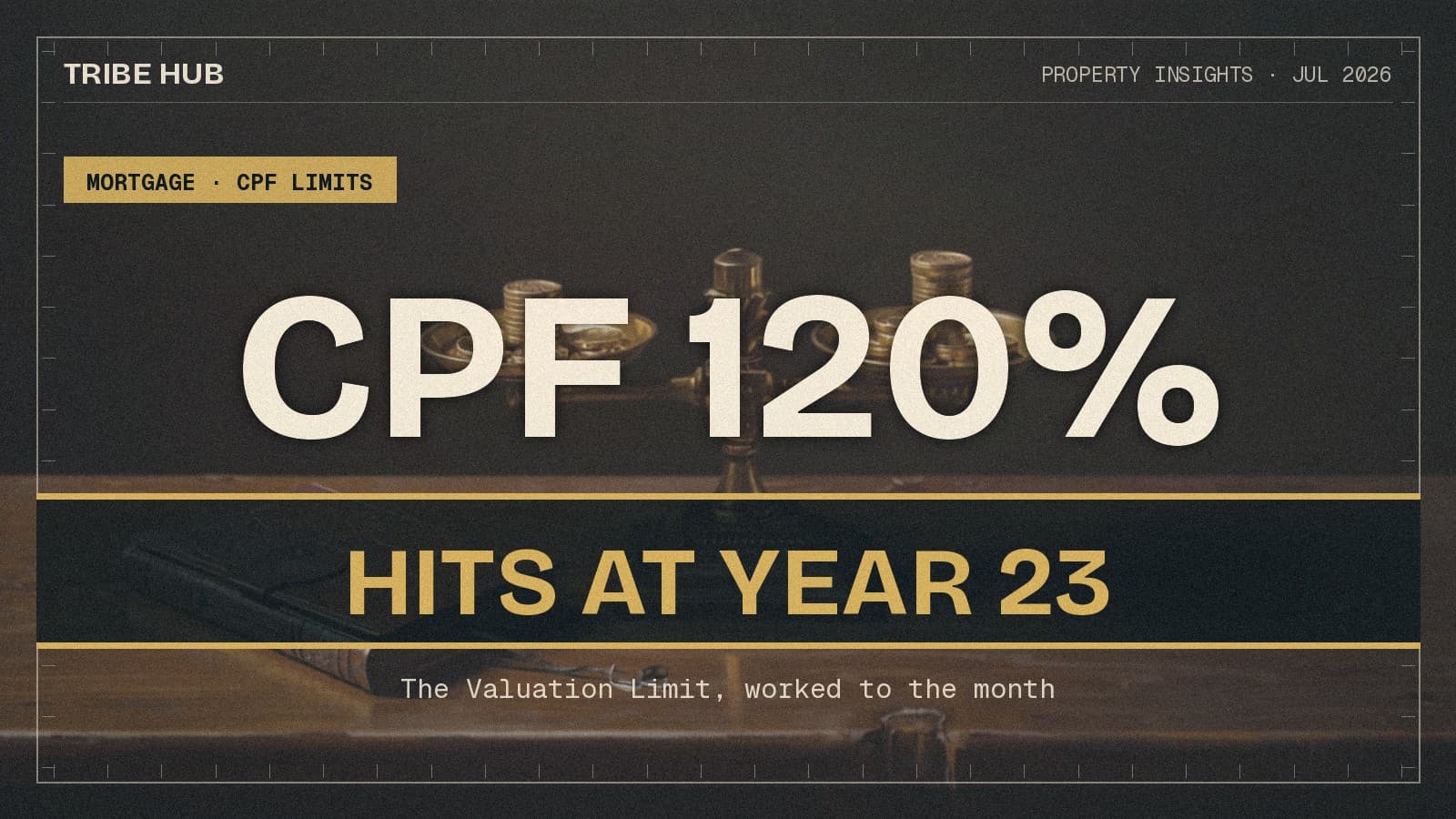
CPF's 120% Ceiling: The Limit Nobody Plans For
Your CPF cannot pay for a private property forever. On a S$1.8m purchase with a 30-year loan, the first ceiling arrives in year 23 and the hard one in year 29 — and the second only exists if you have set aside your Basic Retirement Sum.
By TRIBE Editorial · 31 July 2026 · 8 min read
Most buyers understand that CPF has rules about how much of a property it will pay for. Very few can say what the limit is, and almost nobody can say when it arrives. The answer, on an ordinary private purchase with an ordinary 30-year loan, is somewhere around your sixtieth birthday — and it arrives as a monthly cash bill you did not budget for.
Two numbers govern it. The Valuation Limit is the lower of the purchase price or the property's valuation at the time of purchase. The Withdrawal Limit is 120% of that, and reaching it requires you to have set aside your Basic Retirement Sum. Past the Withdrawal Limit, CPF stops paying for that property altogether (CPF).
What actually consumes the limit
This is where most people misjudge the timing. The Valuation Limit is not a cap on your downpayment. It is a running total of every dollar of Ordinary Account money that leaves your CPF for this property:
- the portion of the downpayment paid from OA;
- Buyer's Stamp Duty, legal fees and related costs paid from OA;
- every monthly instalment, in full — principal and interest alike.
The instalment line is the one that catches people. A loan repayment is a CPF withdrawal, and the interest half of it counts against the ceiling exactly like the principal half. That is why the limit binds twenty-odd years in rather than never.
Accrued interest — the 2.5% a year that CPF notionally charges on what you took out — is a separate matter. CPF describes it in the context of what you must refund on sale, not as a withdrawal (CPF). It does not consume your Valuation Limit, but it does quietly consume your sale proceeds — a separate problem covered in our piece on the accrued-interest cash shock.
The worked case: S$1.8m, 75% LTV, 30 years
A private condo at S$1,800,000, valuation equal to price, so the Valuation Limit is S$1,800,000 and the 120% Withdrawal Limit is S$2,160,000. Loan of S$1,350,000 at 75% LTV. Of the 25% not borrowed, at least 5% must be cash under MAS rules; assume the remaining 20% comes from OA.
| Item | Amount |
|---|---|
| Downpayment from OA (20%) | S$360,000 |
| Buyer's Stamp Duty | S$59,600 |
| Legal and related costs (assumed) | S$3,000 |
| CPF used on completion day | S$422,600 |
| Headroom remaining to the Valuation Limit | S$1,377,400 |
| Monthly instalment at 2.0% over 30 years | S$4,990 |
At S$4,990 a month, that S$1,377,400 of headroom lasts 277 months — year 23 of a 30-year loan. If you bought at 40, the Valuation Limit hits at 63.
What happens next depends entirely on one test.
If you cannot set aside the Basic Retirement Sum: CPF stops. From month 277 to the end of the loan, the instalment is cash. That is 84 payments totalling S$419,148, starting in the decade when most people's earned income is falling rather than rising.
If you can set aside the BRS: you get another 20% of the Valuation Limit — S$360,000 of further CPF usage — which carries you to month 349, or year 29 of a 30-year loan. The last twelve months, about S$59,878, are cash. The ceiling still exists. It just arrives eleven months before the loan ends instead of seven years before.
When it bites, across four cases
Same purchase, same 20% CPF downpayment and duties, different loan terms. Computed on a full amortisation schedule:
| Rate | Tenure | Monthly | Valuation Limit reached | 120% Withdrawal Limit reached |
|---|---|---|---|---|
| 1.5% | 30 years | S$4,659 | Year 24.7 | Not reached in tenure |
| 2.0% | 30 years | S$4,990 | Year 23.1 | Year 29.1 |
| 2.0% | 25 years | S$5,722 | Year 20.1 | Not reached in tenure |
| 3.0% | 30 years | S$5,692 | Year 20.2 | Year 25.5 |
Two readings matter. A higher rate brings the ceiling forward, because you are withdrawing more OA per month for the same debt — an underappreciated second cost of a rate rise. And a shorter tenure hits the Valuation Limit sooner but never reaches the 120% ceiling, because the loan ends first. Faster amortisation is the cleaner way to stay inside the limits, not the slower one.
The Basic Retirement Sum gate, precisely
To use CPF beyond the Valuation Limit, each owner drawing on CPF must set aside their own Basic Retirement Sum — CPF's wording is "respective BRS". It is not halved between a couple; two owners means two full sums (CPF).
The sum rises about 3.5% a year by published schedule:
| Turning 55 in | Basic Retirement Sum | Full Retirement Sum |
|---|---|---|
| 2025 | S$106,500 | S$213,000 |
| 2026 | S$110,200 | S$220,400 |
| 2027 | S$114,100 | S$228,200 |
Source: CPF. For members already 55 and above, the BRS is half the Full Retirement Sum for their cohort and is fixed for life.
Do not confuse this with the property pledge, which lets you meet the Full Retirement Sum partly with property if your lease runs to age 95. That is a retirement-payout mechanism. It has nothing to do with unlocking the last 20% of your housing limit.
The lease-to-95 rule does not rescue you
A common and expensive misreading: because the 2019 changes relaxed CPF housing rules for properties whose lease covers the owner to age 95, buyers assume a freehold or fresh 99-year condo escapes the ceilings. It does not.
These are two independent mechanisms, and it is worth being exact:
- If the remaining lease does not cover the youngest CPF-using owner to 95, CPF usage is cut to a percentage of the Valuation Limit, scaled by age and remaining lease — and no CPF at all where the remaining lease is 20 years or less.
- If the lease does cover the owner to 95 — which a fresh 99-year lease does for anyone under about 44, and freehold does for everyone — you get the full 100% of the Valuation Limit, extendable to 120% on the BRS test.
The lease test decides whether you get to 100%. It does not remove the 120% ceiling. A 40-year-old buying freehold in 2026 is in exactly the same position as the worked example above (CPF Housing Scheme terms and conditions).
What to do about it
Know your own date. Divide your remaining Valuation Limit headroom by your monthly instalment. That number, in months, is when your housing cash-flow changes. It is arithmetic, not a forecast.
Treat the BRS as a housing input, not just a retirement one. For a long-tenure loan on a large quantum, whether your OA and SA hold the BRS at 55 decides whether your sixties are funded by CPF or by cash.
Watch what refinancing does. Refinancing to a longer tenure lowers the monthly instalment and delays the Valuation Limit — but stretches total OA withdrawal and makes the 120% ceiling more likely to bind. Shortening does the reverse.
Assume the ceiling exists. OA earns 2.5% and the CPF Ordinary Account rate has not moved off that floor (CPF). Using every available dollar of it against the house is a decision to fund the tail end of the loan from somewhere else. Most people make that decision without noticing they made it.
Methodology published. No spin.
Sources: Valuation Limit, the 120% Withdrawal Limit and the "respective BRS" condition from CPF and the CPF Housing Scheme terms and conditions, which also set out the lease-based pro-rating for properties not covering the owner to 95. Retirement sums from CPF. OA interest rate from CPF. Accrued-interest treatment from CPF; CPF describes accrued interest as a refund obligation on sale rather than a withdrawal, so it is treated here as not consuming the Valuation Limit. Buyer's Stamp Duty computed on the current residential tiers; all instalment, timing and cash figures computed by TRIBE on a full amortisation schedule for the stated assumptions — a S$1,800,000 purchase at 75% LTV with the 20% non-cash portion paid from the Ordinary Account, and S$3,000 of assumed legal costs. Your own valuation, CPF balances and loan terms will move these dates.
Silas Tan is a District Director at Huttons Asia and co-founder of TRIBE. This article is general information, not financial, tax or legal advice. CEA Registration R000303I.
Know what you can afford
Loan, stamp duty, CPF, and monthly repayments — work out your real budget before you commit. No registration required.
Plan my purchase →Prefer a personal read on your situation? Arrange a consultation →Keep reading
18 September 2026Mortgage & Rates
The Fed Just Hiked. The Price of Certainty on a Singapore Mortgage Is One Basis Point.

16 September 2026Mortgage & Rates
Your Mortgage Costs 1.40%. The Loan for Your Kitchen Costs 5.96%.
3 September 2026Mortgage & Rates
Your CPF Special Account Pays 4% Because of a Decision Made Every September. This Year's Hasn't Come.

TRIBE Editorial · Reviewed by Silas Tan
Co-Founder, TRIBE · District Director, Huttons Asia · Ex-Mortgage Banker (AVP) · >1,000 families advised · CEA R000303I
This article is for informational purposes only and does not constitute financial or investment advice.