Insights
The Fed Just Hiked. The Price of Certainty on a Singapore Mortgage Is One Basis Point.
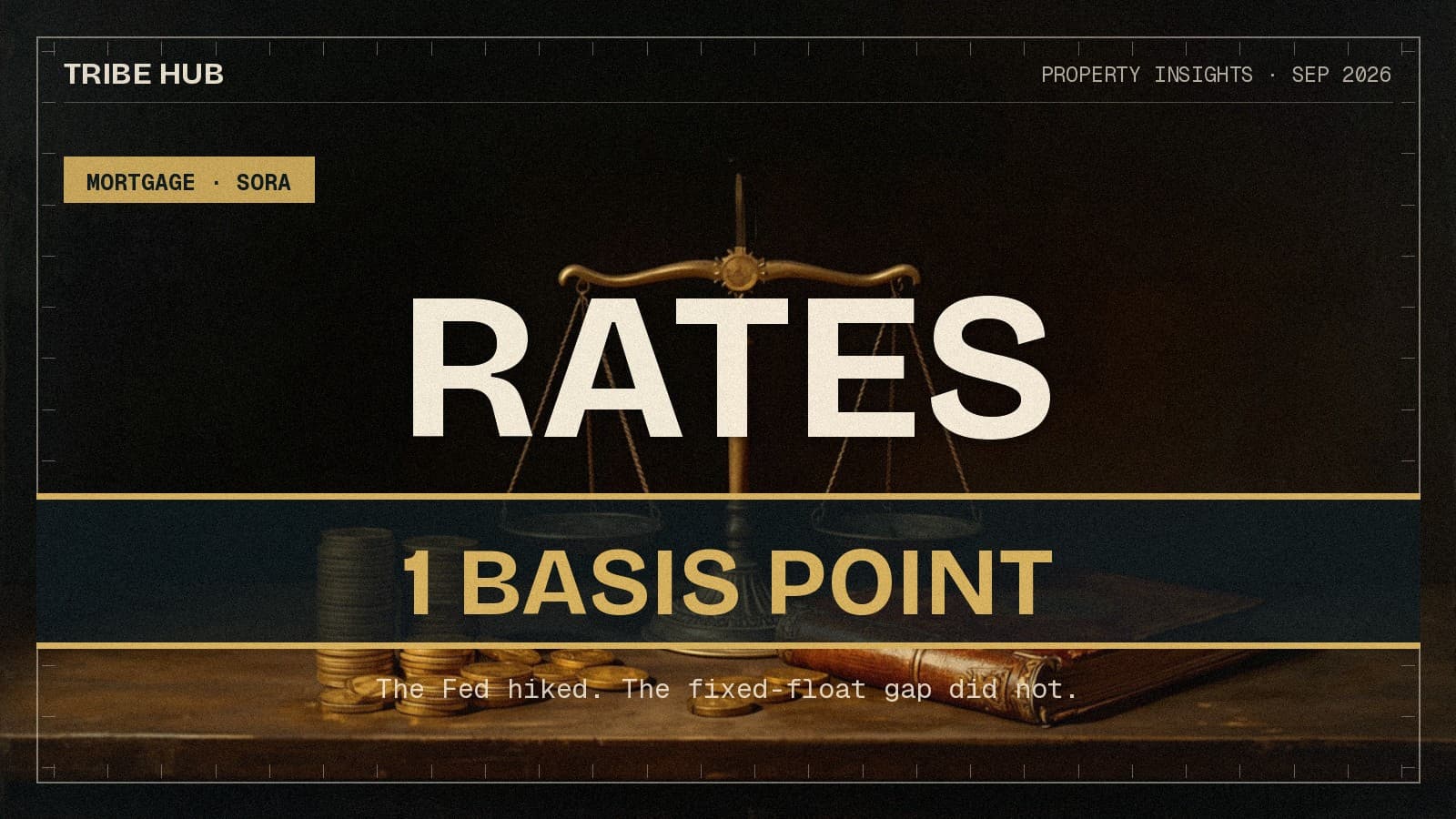
In June the cheapest fixed rate sat 13 basis points above the cheapest float. It now sits one basis point above — S$4.66 a month on a S$1 million loan. The gap closed because the float rose, not because fixed fell.
By TRIBE Editorial · 18 September 2026 · 7 min read
The Federal Open Market Committee raised its target range by a quarter point to 3.75% to 4.00% on 16 September, its first increase since 2023 (Federal Reserve). Markets had been positioned for a cut.
For a Singapore borrower the Fed is not the number that matters, and it never was. The number that matters is the gap between the cheapest fixed rate and the cheapest floating rate, and that gap has quietly done something more interesting than the Fed did. In June it was 13 basis points. It is now one.
The premium collapsed, and not the way anyone wanted
In June we asked whether a 1.40% fixed was worth paying for over a 1.27% float — a 13 basis point certainty premium, roughly S$60 a month on a S$1 million loan.
Three months on, the fixed rate has not moved. HSBC and Citi both quote 1.40% on a two-year fixed package for a completed private condo. What moved is the float: Maybank's leading package is 3-month compounded SORA plus 0.20%, and with 3M SORA at 1.19% that package now reads 1.39% (PropertyNet.SG, 4 September).
The premium fell 92%, from 13 basis points to one. It fell because the floating rate rose 12 basis points, not because fixed rates got cheaper. That distinction is the whole article. A certainty premium that narrows because the certain option got cheaper is good news. One that narrows because the uncertain option got more expensive is the market telling you what it thinks happens next.
What one basis point buys
On a S$1,000,000 loan over 25 years:
- Fixed at 1.40%: S$3,953 a month
- Floating at 1.39%: S$3,948 a month
The difference is S$4.66 a month, or S$112 across a two-year lock-in. That is the cash cost of removing SORA from your life for 24 months.
The benchmark is still catching up to itself
The more useful figure on the board is not 1.19%. It is that 1-month compounded SORA is 1.30% — above the 3-month, and the ladder has inverted.
We walked through this mechanism in August: compounded SORA is calculated in arrears, so the 3-month figure is an average of the past ninety days of overnight rates. If overnight SORA simply stays where it is, the 3-month benchmark rises to meet it. Nothing new has to happen in the market for that to occur — it is arithmetic about the past, not a forecast.
So the 1.39% floating rate is already stale in a specific, measurable way.
| Scenario | 3M SORA | All-in float | Monthly | Versus fixed, over 24 months |
|---|---|---|---|---|
| Today | 1.19% | 1.39% | S$3,948 | −S$112 |
| 3M merely catches up to today's 1M | 1.30% | 1.50% | S$3,999 | +S$1,124 |
| UOB's end-2026 forecast | 1.39% | 1.59% | S$4,042 | +S$2,142 |
| Plus a further 16bp of pass-through | 1.55% | 1.75% | S$4,118 | +S$3,968 |
The second row is the one to sit with. It requires no new Fed move, no new market view, and no forecast being right — only that the overnight rate stops falling. On that row the float costs S$1,124 more than the fixed package over the lock-in, against the S$112 it currently saves.
What the one basis point does not price
A fixed package is not simply a rate. It is a rate plus a two-year lock-in, and most carry a prepayment penalty of around 1.5% of the outstanding loan — S$15,000 on S$1 million.
That number dwarfs everything above. The 1 basis point saving on the float is S$112 over two years; the penalty for breaking a fixed package early is 134 times that. So the honest framing of today's board is not "certainty costs one basis point". It is: the rate is now effectively free, and what you are actually paying is optionality. Anyone who might sell inside two years, or who expects to refinance, is trading something that does not show up in the 1 basis point at all.
Conversely, a borrower who is staying put is being offered two years of insulation for S$112, in a month when the Fed has just moved against consensus and its own projections point to the possibility of another increase this year.
HDB borrowers have the same trade, and a bigger one behind it
The pattern repeats on HDB financing: HSBC's two-year fixed at 1.45% against UOB's floating at 1.44% — again a single basis point.
Behind both sits the comparison that matters more. The HDB concessionary loan is 2.60%, unchanged. On a S$500,000 loan over 25 years that is S$2,268 a month, against S$1,988 on a bank fixed package at 1.45% — a difference of S$280 a month, or about S$3,360 a year.
That gap is large enough that it dominates the fixed-versus-floating question entirely for HDB buyers. It also cuts both ways, and we have covered why dropping the HDB loan is not a one-way decision: the concessionary loan can be re-entered only once, and never after you have taken a bank loan on the same flat.
The Fed is not your lender
It is worth being exact about the causal chain, because the coverage this week will not be.
MAS does not set an interest rate. It runs monetary policy through the exchange rate, and SGD interest rates are the residual — set by the interbank market, influenced by global rates, but not announced by anybody. That is why the federal funds midpoint of 3.875% sits 2.69 percentage points above 3-month SORA at 1.19%. There is no mechanism that closes that gap, and no reason to expect a 25 basis point Fed move to arrive as 25 basis points here.
What travels is expectation, and it travels early. In August we noted that OCBC and UOB had already raised fixed rates in a month when the Fed did nothing, and argued that waiting for the 16 September meeting was waiting for information the SGD swap curve had already priced. The meeting has now happened, it surprised to the upside, and the local fixed board is unchanged at 1.40%. The repricing came first; the announcement confirmed it.
The practical consequence is that "wait and see what the Fed does" was never a strategy for a Singapore mortgage, and is less of one now. The information a borrower can actually act on is on the board today: a one basis point spread, an inverted SORA ladder that mechanically lifts the float, and a lock-in whose real cost is flexibility rather than rate.
Rates quoted are indicative for a S$1 million loan as at early September and move without notice; verify with your bank before committing. We are not licensed financial advisers, and nothing here is a recommendation to take a particular package.
Working through your own numbers? WhatsApp us: wa.me/6569012192
Know what you can afford
Loan, stamp duty, CPF, and monthly repayments — work out your real budget before you commit. No registration required.
Plan my purchase →Prefer a personal read on your situation? Arrange a consultation →Keep reading

16 September 2026Mortgage & Rates
Your Mortgage Costs 1.40%. The Loan for Your Kitchen Costs 5.96%.

3 September 2026Mortgage & Rates
Your CPF Special Account Pays 4% Because of a Decision Made Every September. This Year's Hasn't Come.
2 September 2026Mortgage & Rates
The Second Name on Your Loan Buys Years, Not Just Income — and MAS Charges You for Them

TRIBE Editorial · Reviewed by Silas Tan
Co-Founder, TRIBE · District Director, Huttons Asia · Ex-Mortgage Banker (AVP) · >1,000 families advised · CEA R000303I
This article is for informational purposes only and does not constitute financial or investment advice.