Insights
The Rooms Coliwoo Owns Are Its Emptiest. That Is the Business Model, Not a Fault.
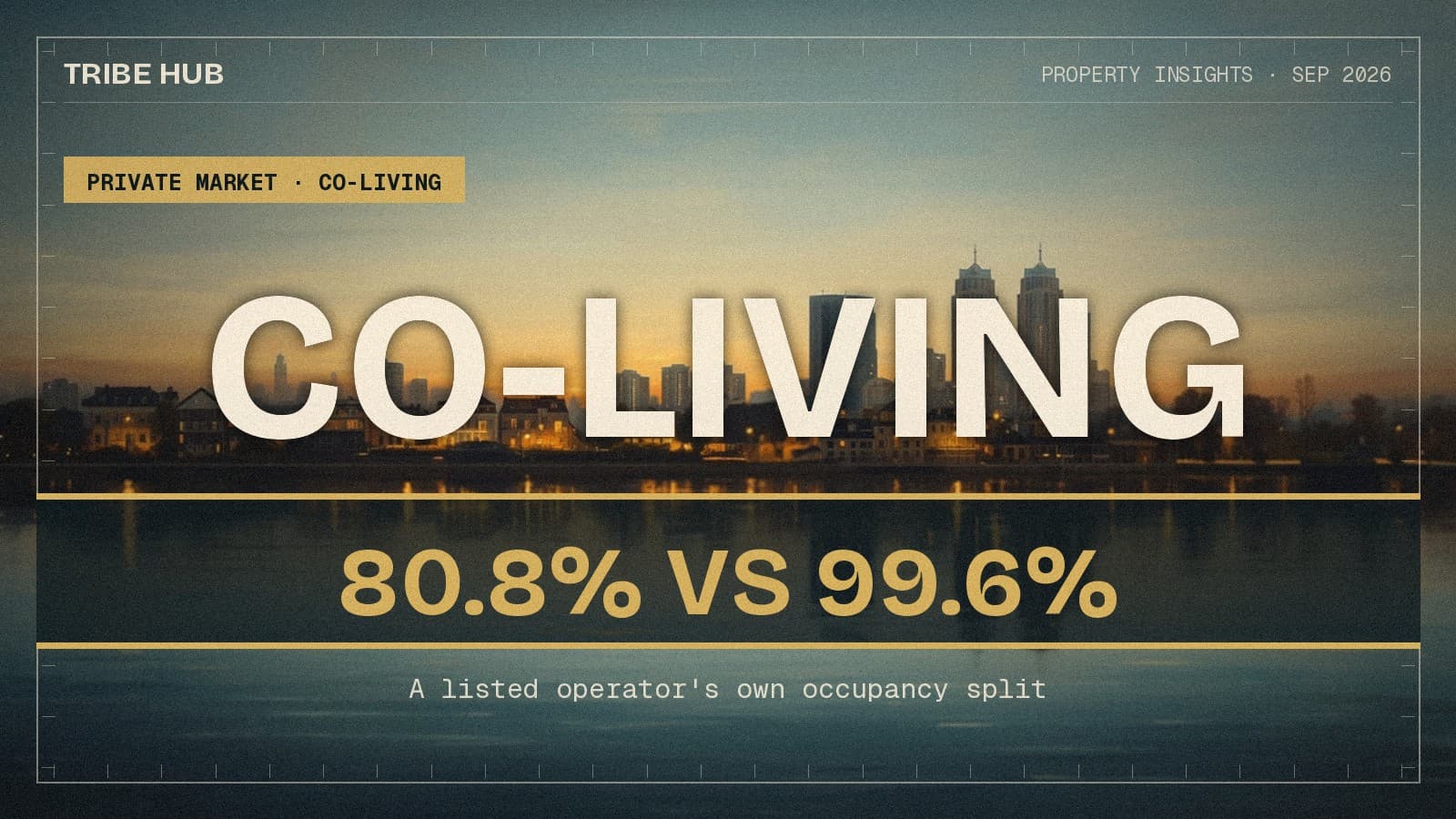
A listed co-living operator publishes occupancy three ways: leased rooms 95%, managed rooms 99.6%, owned rooms 80.8%. The ladder runs inverse to ownership — and the company is selling buildings to keep the operating contract.
By TRIBE Editorial · 20 September 2026 · 7 min read
On 18 September the Singapore Land Authority awarded the 362 Holland Road state property to Trans-Orient Services, which will run it as a co-living residence. Records indicate Trans-Orient is a Singapore-registered automotive repair and maintenance company. The previous tenant, which won the same site in 2017 and ran it as a 37-room student hostel, was Cogent — a logistics firm.
Neither winner is a property company. That is not an oversight in a price-quality tender; it is the point. What the state is buying is an operating proposal, and what co-living sells is an operation. The clearest evidence for that sits in the accounts of the one Singapore co-living operator that now has to publish them.
The occupancy ladder runs the wrong way
Coliwoo Holdings reported average portfolio occupancy of 93.7% for the quarter ended 30 June 2026, across 28 Singapore properties and 3,568 rooms. The useful part of the disclosure is that it splits three ways by how the room is held: 1,907 leased rooms, 1,136 owned, 525 managed.
| Held as | Rooms | Share of portfolio | Occupancy |
|---|---|---|---|
| Managed | 525 | 14.7% | 99.6% |
| Leased | 1,907 | 53.5% | 95.0% |
| Owned | 1,136 | 31.8% | 80.8% |
The rooms the company owns outright are its emptiest by a wide margin — 18.8 percentage points below the rooms it merely manages for somebody else. Read that ladder from the top and it inverts the intuition most property buyers carry: the deeper your claim on the asset, the worse the asset performs.
Two honest caveats before anyone over-reads it. The owned bucket is dragged down by the 212-room Coliwoo Midtown, which only opened in March and was still ramping; by July its occupancy had reached nearly 90%, and stripping it out lifts the whole portfolio to 96%. And 1,021 of the 3,568 rooms — 28.6% — were under renovation during the quarter. So 80.8% is a snapshot of a portfolio mid-works, not a steady state.
But the caveats cut both ways, because they are themselves the argument. Renovation risk, lease-up risk and vacancy during ramp are exactly what an owner absorbs and a manager does not.
The number that does not reconcile
One thing worth flagging, because it changes what "93.7%" means. Weight the three segment rates by the stated room counts and you get 91.16%, not 93.7% — a gap of 2.54 percentage points. The headline is therefore not a room-weighted average of the three figures beneath it.
There is nothing improper in that. The likely explanations are ordinary: segment rates averaged per property rather than per room, or an occupancy denominator that excludes rooms out of service for renovation. Both are standard practice. The reason to say it out loud is that it points the same direction as everything else here — a portfolio occupancy rate is an operating measure, computed on rooms available to let, not a measure of how much of the property you own is earning.
The company is acting on its own numbers
If the operating platform is where the return sits, you would expect the operator to shed buildings and keep contracts. That is precisely what it is doing.
In early August, Coliwoo agreed to sell Coliwoo Midtown at 141 Middle Road to CapitaLand Ascott Trust for S$134 million — and to lease it back for ten years, with completion expected in 4Q2026. A sale-and-leaseback converts an owned asset into a leased one. It moves the building off the balance sheet and keeps the operating income. The company has also said it is pursuing markets outside Singapore through "asset-light structures such as master leases, management contracts and joint ventures."
A sale-and-leaseback is also a financing decision — it raises cash, and a company scaling from 3,568 rooms toward a stated 4,000 by end-2026 and 10,000 by 2030 needs cash. We are not claiming the transaction proves ownership is a bad trade. We are pointing out that the direction of travel, the disclosed occupancy ladder and the overseas strategy all say the same thing, and they were published independently of each other.
What this is worth to a landlord
Co-living is small. Cushman & Wakefield put professionally managed operational supply at roughly 10,000 rooms — around 6% of the combined private non-landed and HDB rental stock of some 190,000 units at end-2025. On those stated figures the ratio works out at 5.3%. Either way, this is not yet competition for the average landlord with one unit.
It is, however, the first published benchmark. And the benchmark says something uncomfortable: the professionals who do this at scale, with a brand, a maintenance team, a booking platform and 24 properties' worth of demand data, are systematically moving out of the half of the trade that an individual landlord is entirely composed of.
Three things follow, and none of them is "sell your condo."
- Separate the two returns before you judge yours. Rent minus costs, divided by price, is an ownership return. It is not the same business as operating a building, and comparing your yield to a co-living operator's occupancy compares nothing at all.
- Occupancy is not a yield. 99.6% occupancy on a managed room says the manager is good at filling rooms. It says nothing about what the owner of that room earned after financing, tax and capital expenditure.
- You cannot copy the model on one unit. The spread between whole-unit rent and room-by-room rent is real, but reaching it requires planning consent, an occupancy allowance, a maintenance function and a leasing operation. Splitting a condo unit into rooms without them is not the co-living trade; it is a tenancy-cap problem waiting to happen. Our note on the eight-tenant occupancy cap covers where that line sits.
Back to Holland Road
The 362 Holland Road site runs to 24,594 sq ft with a gross floor area of around 7,375 sq ft, and the master lease is three years with two options to renew for three more each. In 2017 Cogent won it with a bid rent of S$32,362 a month, running 37 rooms — S$874.65 per room per month to the state, or S$4.39 per sq ft of GFA per month.
One reconciliation note, in the same spirit as the segment occupancy above: 7,375 sq ft of GFA across 37 rooms implies 199 sq ft per room including every corridor, lounge, pantry and laundry. That is tight enough that the published GFA and the historical room count are unlikely to describe the same envelope, and we have not assumed they do.
What survives the caveats is the shape of the deal. The state is not selling land here. It is renting a building, on a short lease with renewal options, to whoever presents the best operating case — and twice now that has been a company whose day job is something else entirely. The building is the easy part. Filling it, for six years, at a rent that clears S$32,362 a month plus the cost of running it, is the business.
Figures in this article are as published by the sources linked above and by EdgeProp Singapore. Stock and supply estimates are Cushman & Wakefield's, published June 2026. Methodology published. No spin.
Check how your condo scores
2,357 condos independently scored across 7 weighted factors. No registration required.
Score my resale →Prefer a personal read on your situation? Arrange a consultation →Keep reading

19 September 2026Private Property Market
A 42-Year-Old Block, a Fourth Attempt, and a New Law Worth Two Signatures
18 September 2026Private Property Market
The Cheapest PSF and the Cheapest Apartment Are Two Different Units

17 September 2026Private Property Market
Seven Developers Bid for the Same Site. The Winner Still Paid 11% More Than Anyone Else.

TRIBE Editorial · Reviewed by Silas Tan
Co-Founder, TRIBE · District Director, Huttons Asia · Ex-Mortgage Banker (AVP) · >1,000 families advised · CEA R000303I
This article is for informational purposes only and does not constitute financial or investment advice.