Insights
MOP, Properly: The Five Years, What Resets It, and What It Blocks
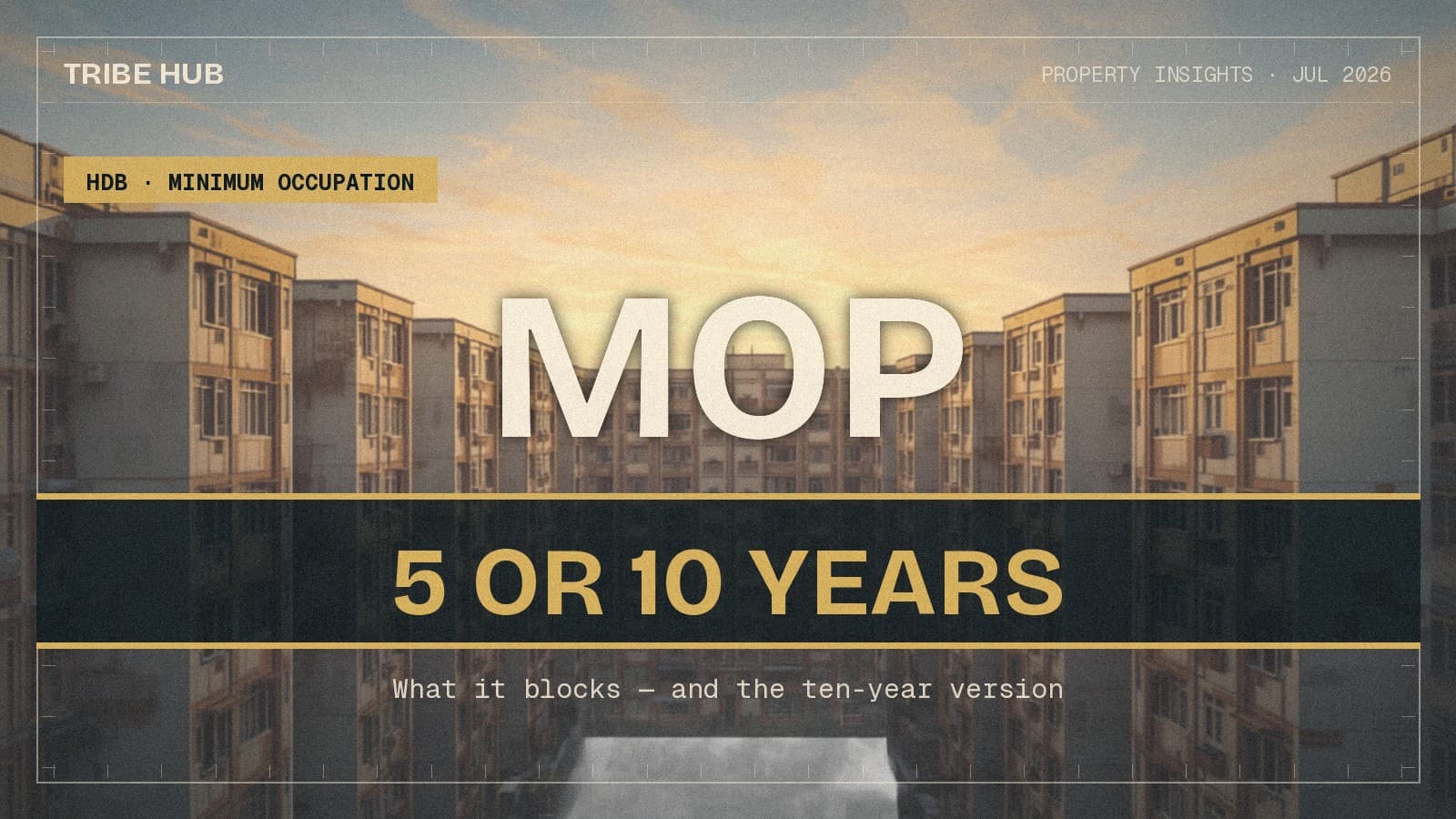
Most owners treat MOP as five years on a calendar, then freedom. It is neither a calendar nor freedom: it counts occupation, not time, and for Plus and Prime flats it runs ten years and never fully lifts. Here is what it really blocks.
By TRIBE Editorial · 27 July 2026 · 6 min read
Almost every HDB owner can tell you their flat has a five-year Minimum Occupation Period. Far fewer can tell you when it actually started, what quietly pauses it, or which of their plans it blocks in the meantime. MOP is not a countdown on a calendar and it is not a simple "wait five years then you are free." It is a set of conditions measured in occupation, not time — and for the new Plus and Prime flats it runs ten years and never fully lifts. Here is what MOP really is, worked through properly. Methodology published. No spin.
The five years is occupation, not ownership
The clock starts on the day you collect your keys and take physical possession — not the day you signed, booked, or paid. From there, MOP counts the time you and the listed occupiers actually live in the flat. That distinction is the whole point: the law counts nights spent in the home, not months on the calendar.
So the "five years" is really "five years of occupation." Own the flat but not occupy it, and those months do not count — the finish line simply moves. This is why two neighbours who bought on the same day can reach MOP months apart.
What resets or pauses the clock
Because MOP tracks occupation, anything that takes you out of the flat stops the clock from advancing. The common ones: a period where the whole flat sits un-occupied by the owners, or an approved absence such as a long overseas posting. Those stretches are excluded from the count, so the MOP end-date is pushed back by however long you were away.
Renting out the whole flat does not count as occupation either — and in any case it is not allowed during MOP (more below). Room rental, once you qualify for it, is different: you are still living there, so the clock keeps running. The mental model to keep is simple — if you are not living in it, it is not counting.
The three doors MOP holds shut
During the MOP, three things are off the table:
- You cannot sell. The flat cannot be sold on the open market; a purported sale inside MOP is void. You also cannot transfer or give up your interest to sidestep this.
- You cannot rent out the whole flat. Subletting the entire unit is barred for the full period. You may rent out spare bedrooms only after you have physically occupied the flat for at least three years, if the flat is 3-room or larger and you have HDB's approval — the owner must still live there.
- You cannot own private property. For the whole MOP, you and every owner (and essential occupiers who used a grant or subsidy) cannot buy, acquire, or hold any interest in private residential property — local or overseas. That includes condominiums, landed homes, and even an overseas holiday flat.
Breach any of these and the consequences are not a fine to shrug off: HDB can compulsorily acquire the flat, typically at a price well below market, and pursue prosecution.
The day MOP ends, three doors open
Clear the MOP and the same three doors swing open. You can sell on the open resale market. You can rent out the whole flat. And you can buy private property — subject to the usual Additional Buyer's Stamp Duty and financing rules, which are a separate matter from MOP. For a standard flat, that is genuinely the finish line: the restrictions fall away and the flat behaves like an ordinary resale asset.
That "then you are free" ending is true for standard flats. It is not true for the new ones.
Plus and Prime: the ten-year version that never fully lifts
Under the framework that replaced the old mature/non-mature split, new flats launched from October 2024 are sorted into Standard, Plus and Prime. Plus and Prime flats — the better-located, more heavily subsidised ones — carry a different, heavier set of strings:
- A ten-year MOP, double the standard five.
- A subsidy clawback on resale. When you eventually sell, HDB takes back a fixed percentage of the resale price — around 6% for Plus and 9% for Prime. It is a flat percentage with no taper: sell in year 11 and you pay the same rate as in year 30. On a S$800,000 resale that is S$48,000 back to HDB for a Plus flat, and S$72,000 for a Prime flat — deducted from your proceeds, not your original subsidy.
- No whole-flat rental, ever. Even after the ten-year MOP, Plus and Prime owners can never sublet the entire flat. Room rental only, for the life of ownership.
- The resale market stays gated. The income ceiling — S$14,000 (or S$21,000 for extended and multi-generation families) — continues to apply to the buyers you can sell to, unlike a standard flat where that restriction disappears on resale.
The trade is explicit: Plus and Prime buyers get a deeper discount on a better location up front, and in return the flat is less liquid, less rentable, and hands part of any gain back to HDB for as long as they own it.
What it means for planning
Two practical reads. If you are timing an upgrade, the number that matters is not "five years from signing" but the occupation-based end-date — check it, because vacancy or an overseas stint may have quietly moved it, and an early sale is void, not merely penalised. And if you are choosing between a Standard flat and a Plus or Prime one, price the strings, not just the discount: the ten-year lock, the permanent whole-flat rental ban, and a subsidy clawback that on a typical resale runs into the tens of thousands are real, quantifiable costs — weigh them against the upfront saving before the location wins the argument for you.
MOP rewards owners who read it as a set of conditions rather than a date. Know when yours actually ends, know which doors it holds shut, and — if the flat is Plus or Prime — know that some of those doors never fully open again. Methodology published. No spin.
Sources: Standard MOP rules — five-year period, occupation-based counting, the bar on selling, whole-flat subletting and holding private property during MOP, and the three-year room-rental threshold — per HDB and PropertyGuru's MOP guide. Plus/Prime framework — ten-year MOP, 6%/9% subsidy clawback on resale price, permanent whole-flat rental ban, and the resale income ceiling — per PropertyNet.SG and Stacked Homes. Clawback amounts computed by TRIBE on an illustrative S$800,000 resale price at the stated 6% and 9% rates. MOP, clawback rates and Plus/Prime eligibility are set by HDB and can change — confirm your flat's classification and end-date with HDB before acting.
Silas Tan is a District Director at Huttons Asia and co-founder of TRIBE. This article is for informational purposes and does not constitute financial or investment advice. CEA Registration R000303I.
Know what you can afford
Loan, stamp duty, CPF, and monthly repayments — work out your real budget before you commit. No registration required.
Plan my purchase →Prefer a personal read on your situation? Arrange a consultation →Keep reading

TRIBE Editorial · Reviewed by Silas Tan
Co-Founder, TRIBE · District Director, Huttons Asia · Ex-Mortgage Banker (AVP) · >1,000 families advised · CEA R000303I
This article is for informational purposes only and does not constitute financial or investment advice.