Insights
Honest Insights On Midtown Bay
Midtown Bay grades B (5.6) on the New Project Scorecard — GuocoLand's 219-unit luxury tower inside the integrated Guoco Midtown at Bugis. Launched in 2019, it sold slowly through COVID and is down to its last 70 units, from S$2,838 psf.
By TRIBE Editorial · 8 July 2026 · 10 min read
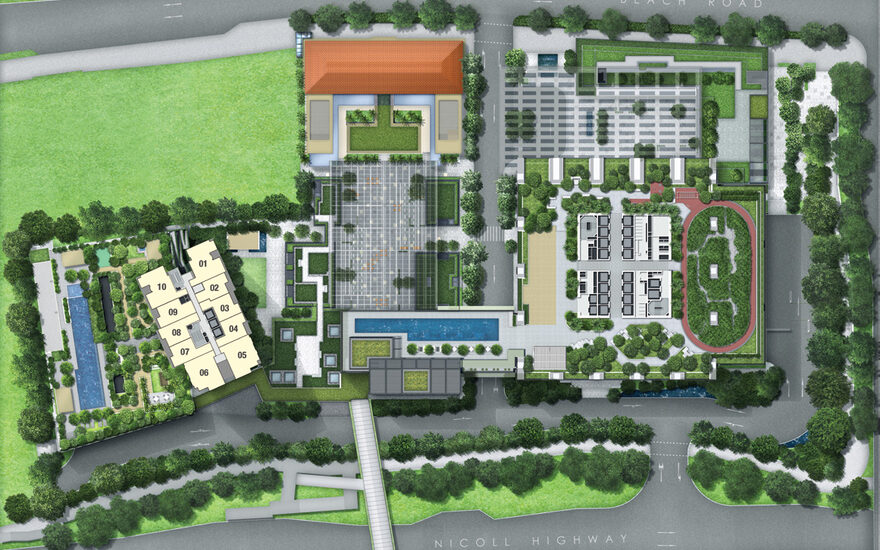
Midtown Bay is a 219-unit, 99-year leasehold luxury tower on Beach Road at Bugis in District 7 — the residential piece of GuocoLand's roughly S$2.4 billion integrated Guoco Midtown development, wrapped around a Grade A office tower, a retail and F&B village and a sheltered link straight into Bugis MRT on the Downtown and East-West Lines, completed in 2024. It grades a B (5.6) on our New Project Scorecard (NPS). Its story is the opposite of a launch-weekend sprint: a shoebox-heavy, luxury-priced tower that opened in October 2019, months before COVID, sold to about 55% by 2023, and is roughly 68% sold today — down to its last 70 units. This is an honest look at what the B rests on, why the price barely moves the growth model, and what those final units are actually worth. Methodology published. No spin.
The NPS grades a project's district-level fundamentals over a 10-year window — capital appreciation, rental growth, schools, MRT access and project size — from real URA transacted data. It is backward-looking by design: it reflects the district's history, lifted for the project's own size, transport and schools, not a forecast. For the holding period, we use the published NPS calculator: fair value is the transacted PSF, the project grows at its modelled rate, and we report the years needed to clear a 3% annual return — gross of stamp duty, financing and selling costs.
The scorecard: what a B actually says
Midtown Bay's 5.6 is a study in a strong location half pulled down by two real gaps.
| NPS factor | Score /10 | What it reflects |
|---|---|---|
| Project Size | 8.0 | 219 units — mid-sized, with a full facilities deck |
| MRT Proximity | 7.0 | A ~0.5km sheltered walk to Bugis MRT (Downtown + East-West Lines) |
| Rental Growth | 6.6 | District 7 rents grew ~6.5%/yr over the decade — strong |
| Capital Appreciation | 5.0 | 1km resale grew ~2.4%/yr; lifted +0.68 for size and transport → ~3.1%/yr |
| School | 2.5 | No primary school within 1km |
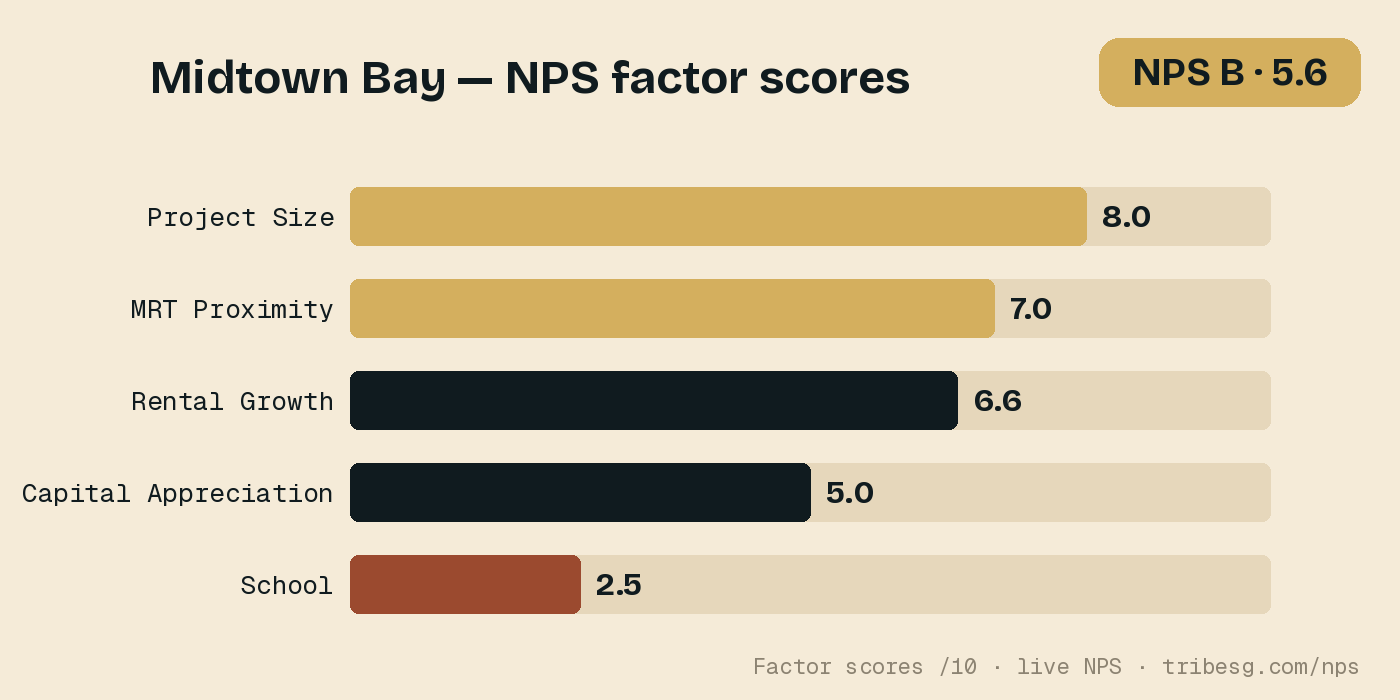
The top of the card is the location. A 219-unit tower scores a solid 8.0 on size, the transport factor is a strong 7.0 for a sheltered walk into a two-line interchange, and rent is the genuine strength: District 7 rents grew about 6.5% a year over the decade, among the healthier bands in the country, powered by the CBD-fringe tenant pool that an integrated, office-anchored address is built to capture. Where the grade comes down is the other half. There is no primary school within a kilometre, which drops the school factor to 2.5 — not unusual for a city-centre address, but a real gap for family demand. And capital appreciation is only moderate: resale homes within 1km grew about 2.4% a year over the decade, the familiar prime and city-fringe underperformance, and even after the model's +0.68 lift for the project's scale and transport, projected growth runs to about 3.1% a year — clearing the 3% bar, but only just. That thin margin is the number that matters most for this project, and the holding section shows why.
The luxury shoebox that took the slow road
Midtown Bay was built for investors, and its unit mix says so: nearly half the project — 107 of 219 units — are one-bedders from about 409 sqft, with the balance in two-bedroom and duplex formats. Launched in October 2019 at over S$3,000 psf, it met the pandemic within months and sold at a trickle rather than a rush — about 55% by September 2023 and 59% by early 2024, at a launch-to-date average of S$3,068 psf. Individual small units have set headline highs along the way (a 484 sqft one-bedder hit S$4,190 psf in 2024), but those are shoebox records, not the book average. By the developer's June 2026 balance, 70 units remain, spread across three very different formats:
| Type | Units left | ~Size | Price from | PSF from |
|---|---|---|---|---|
| 1 Bedroom | 37 | ~484 sqft | S$1.49m | S$3,350 |
| 2 Bedroom | 29 | ~732 sqft | S$2.47m | S$2,838 |
| 3 Bedroom Duplex | 4 | ~1,324 sqft | S$5.05m | S$3,816 |
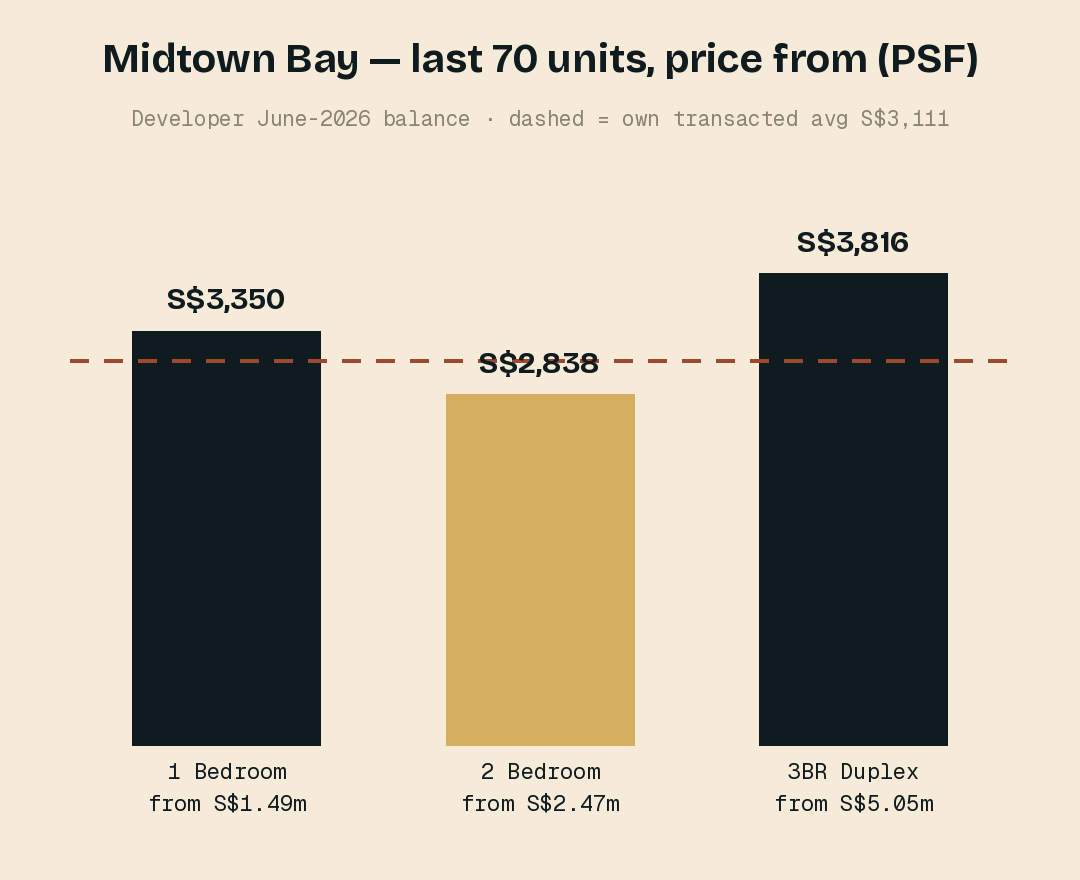
Against the project's own transacted record — a trailing-year average of about S$3,111 psf (EdgeProp) — the three remaining formats read very differently. The one-bedders, from about S$3,350 psf, carry the small-format premium and sit above the project average; the two-bedders, from about S$2,838 psf, are the relative value of what is left; and the four remaining three-bedroom duplexes, from about S$3,816 psf, are the trophy tail, well above the average. One honest caveat on that average: because roughly half the project is high-PSF one-bedders, the blended S$3,111 figure is pulled upward, so the two-bedroom's lower PSF is partly a format effect rather than a pure discount. Even allowing for that, the two-bedder is the stack priced closest to sensible.
The second benchmark: priced with its sister, not the street
The clearest read on Midtown Bay's price is against the Beach Road and Bugis set — and it splits neatly by vintage.
| Comparable | What it is | Indicative PSF |
|---|---|---|
| Midtown Bay | 99-yr, integrated, 2019 launch | ~S$3,111 (own average) |
| Midtown Modern | 99-yr, GuocoLand, 2021 launch | ~S$3,017 (resale) |
| Aurea | 99-yr, Golden Mile / Beach Rd, 2025 launch | ~S$3,005 (launch) |
| Duo Residences | 99-yr, Bugis, resale | ~S$2,273 |
| City Gate | 99-yr, Beach Road, resale | ~S$2,116 |
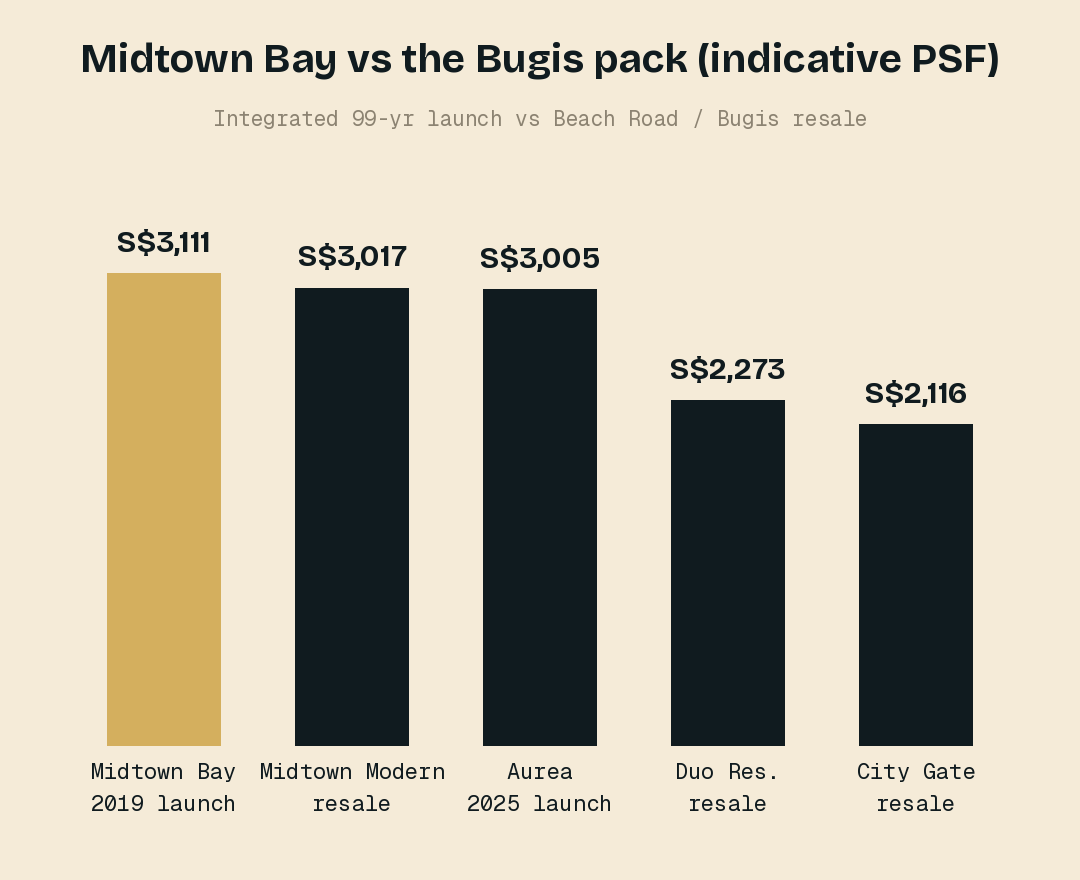
Midtown Bay's ~S$3,111 psf runs almost exactly level with its next-door sister Midtown Modern (~S$3,017) and the new Aurea launch on the old Golden Mile site (~S$3,005) — the current pricing for a fresh-lease, integrated Beach Road address. Where the gap opens is against the older 99-year resale on the same stretch: Duo Residences trades near S$2,273 psf and City Gate near S$2,116, so Midtown Bay runs roughly 37% to 47% above them. That difference is what the integration, the direct-MRT link and the near-new lease command. On a like-for-like, new-and-integrated basis Midtown Bay is not expensive; measured against what a buyer could pay for an older leasehold home in the same postcode, it is a full price — and the growth model in the next section is measured on that full price.
How long you'd likely hold
Using the NPS calculator's model — ~3.1% expected growth, a 3% target — here is the estimated holding period for each remaining stack, on price growth alone and with the area's ~3.5% rental yield added.
| Available stack | PSF | Hold (price only) | Hold (with rent) |
|---|---|---|---|
| 1 Bedroom · ~484 sqft | S$3,350 | >10 yrs | 4–6 yrs |
| 2 Bedroom · ~732 sqft | S$2,838 | 3–5 yrs | 3–5 yrs |
| 3 Bedroom Duplex · ~1,324 sqft | S$3,816 | Doesn't reach 3% | 6–10 yrs |
This is the table that makes the case. Because the modelled ~3.1% growth barely clears the 3% target, price growth alone does very little heavy lifting — and the outcome is decided almost entirely by your entry PSF. The two-bedroom, priced below the blended average, is the one stack that clears comfortably on price alone, in the three-to-five-year tier. The one-bedder, at its small-format premium, is a very long hold on price growth — the thin 0.1-point margin over 3% cannot overcome the premium in any sensible horizon — and only the ~3.5% rent brings it back to a four-to-six-year exit. The three-bedroom duplex, at ~S$3,816 psf, does not reach the 3% target on price at all; it is a yield-and-own-stay proposition where rent, not appreciation, carries the return over six-to-ten years. Read plainly: at Midtown Bay the rent does the work, not the growth. Figures are gross of stamp duty, financing and selling costs.
The honest verdict
Midtown Bay is what a B looks like when the address is excellent and the arithmetic is only fair. The integrated Guoco Midtown location, the sheltered walk into a two-line interchange, the 219-unit scale and District 7's ~6.5%-a-year rental growth are all real strengths — this is a purpose-built CBD-fringe rental machine. The honest limits are equally clear: no primary school within a kilometre, and a projected ~3.1% growth that clears the 3% bar by the thinnest of margins, so capital appreciation is not the story. Among the last 70 units, the read is stack-specific — the two-bedder from ~S$2,838 psf is the sensible entry, the one-bedder is priced for its format, and the four duplexes are a rental-and-lifestyle hold rather than a growth buy. For an investor who wants a fresh-lease, MRT-integrated home wired for CBD rental demand and is buying for yield and the address, Midtown Bay is a defensible B. For a buyer counting on price growth, the model is honest about how little of it there is.
See the full scorecard and run your own unit price through the holding-period calculator at tribesg.com/nps.
Sources: NPS quality grade, the five factor scores, modelled growth and rental yield per the TRIBE New Project Scorecard (URA Data Service transacted PSF; 1km resale trend lifted for project size and transport; figures as at July 2026). October 2019 launch, the shoebox-heavy unit mix and the slow sell-through (~55% by Sept 2023, ~59% by Jan 2024, launch-to-date average S$3,068 psf) per EdgeProp and EdgeProp / Yahoo Finance; the project's trailing-year ~S$3,111 psf transacted average and ~3.5% gross rental yield per the EdgeProp condo page. The last 70 units and per-format pricing from the developer's June 2026 balance list; availability changes as units sell. Comparable indicative PSF for Midtown Modern, Aurea, Duo Residences and City Gate per EdgeProp / 99.co / SRX transaction data. Scores and holding periods are model outputs, not financial advice.
Silas Tan is a District Director at Huttons Asia and co-founder of TRIBE. He built the New Project Scorecard (NPS) and Resale Project Scorecard (RPS) on URA transacted data. This article is for informational purposes and does not constitute financial or investment advice. CEA Registration R000303I.
Check how your condo scores
2,352 condos independently scored across 7 weighted factors. No registration required.
Score my resale →Prefer a personal read on your situation? Arrange a consultation →Keep reading

TRIBE Editorial · Reviewed by Silas Tan
Co-Founder, TRIBE · District Director, Huttons Asia · Ex-Mortgage Banker (AVP) · >1,000 families advised · CEA R000303I
How TRIBE scores and checks its analysis
Spotted an error, or a figure that has moved since publication? Tell us and we will correct it.
This article is for informational purposes only and does not constitute financial or investment advice.