Insights
Honest Insights On Cape Royale
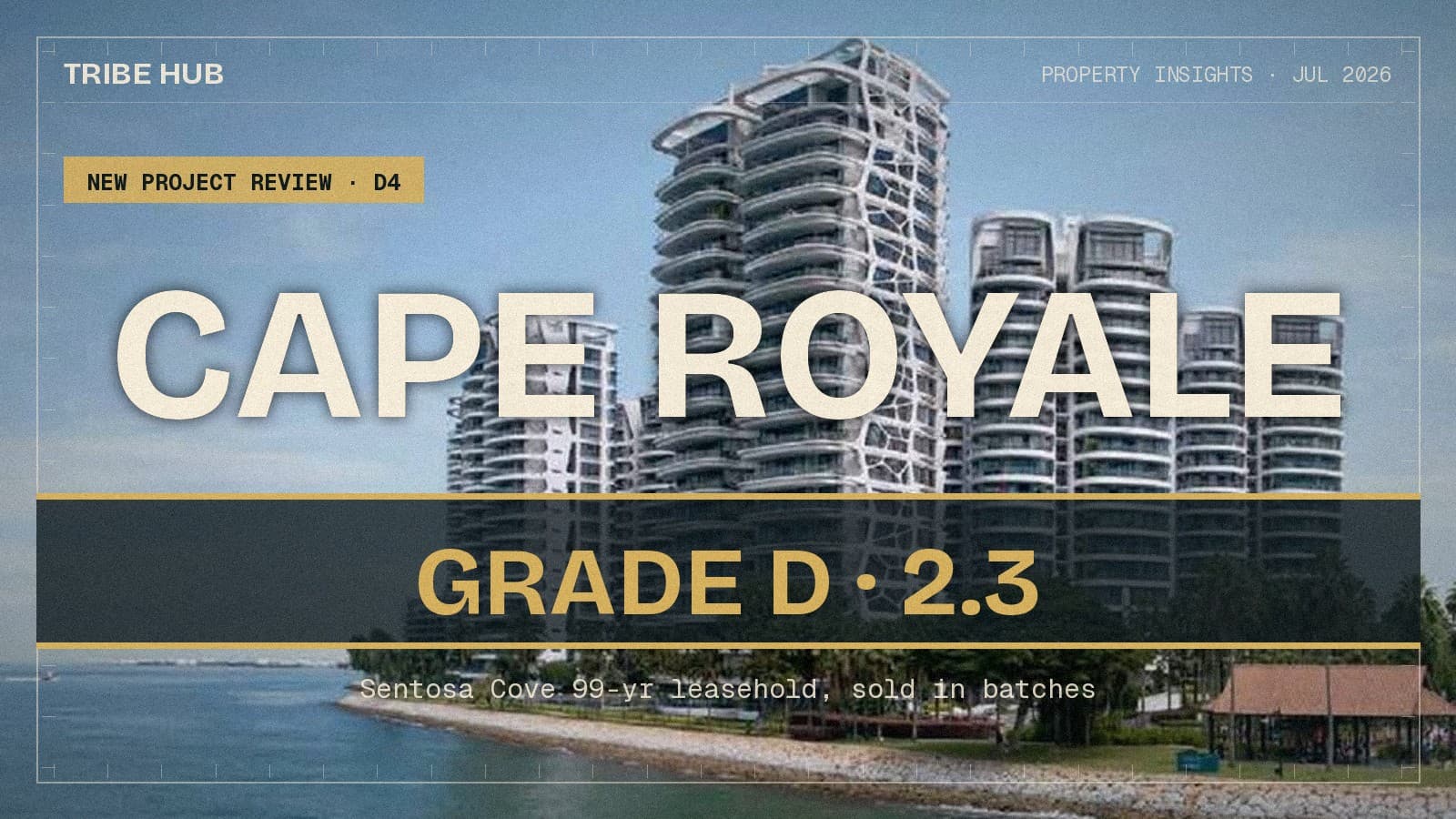
Cape Royale grades D (2.3) on the New Project Scorecard — Ho Bee and IOI's 302-unit, 99-year leasehold in Sentosa Cove, being sold in batches a decade after completion, with three-bedders from about S$1,910 psf against an own resale median near S$2,197.
By TRIBE Editorial · 17 July 2026 · Updated 13 October 2026 · 11 min read
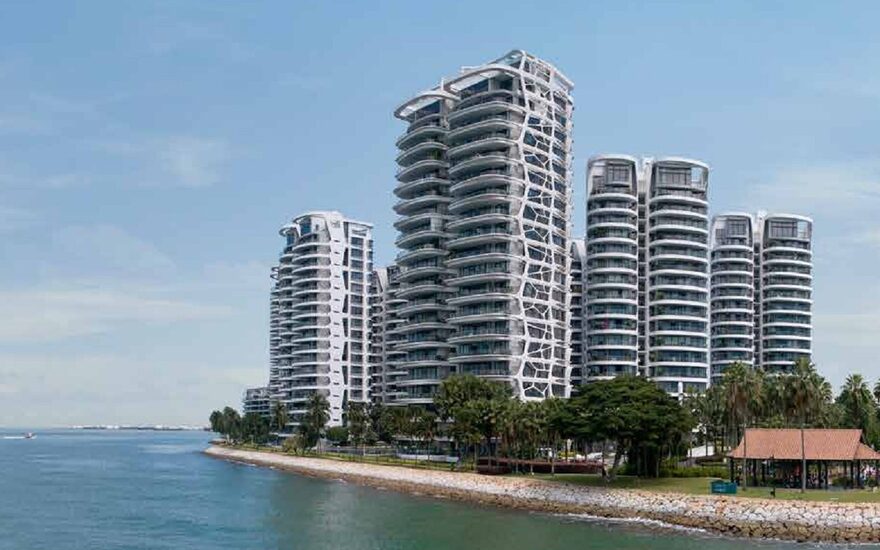
Cape Royale is a 302-unit, 99-year leasehold development in Sentosa Cove, District 4 — eight seafront towers of 16 to 19 storeys by Ho Bee Land and IOI Properties, completed in 2013 and then held back and rented out rather than sold, because prices were weak when it finished. More than a decade on, the developer is releasing the remaining units in batches, and three-bedders are being guided from about S$1,910 psf, or S$3.49 million. It grades a D (2.3) on our New Project Scorecard (NPS) — our lowest published band — and it is the clearest case we have written of a project where the entry price is genuinely cheap and the location's track record is genuinely poor. This is a look at what the D rests on, what "cheap" is actually measured against, and who the honest buyer for it is. Methodology published. No spin.
The NPS grades a project's district-level fundamentals over a 10-year window — capital appreciation, rental growth, schools, MRT access and project size — from real URA transacted data. It is backward-looking by design: it reflects the district's history, lifted or trimmed for the project's own size, transport and schools, not a forecast. Cape Royale has a deep transacted record of its own, so the holding read below anchors on the project's own median rather than a marketing sheet.
The scorecard: what a D actually says
Cape Royale's 2.3 is not a boutique-block quirk or a thin-data artefact. It is a genuinely weak card, carried almost entirely by one factor — sheer scale — while the two that drive returns sit at the floor.
| NPS factor | Score /10 | What it reflects |
|---|---|---|
| Project Size | 8.0 | 302 units across eight towers — a deep, liquid pool by Sentosa Cove standards |
| Rental Growth | 2.6 | District 4 rents grew ~4.1%/yr over the decade — moderate (thin-data estimate) |
| School | 2.5 | No primary school within 1km |
| Capital Appreciation | 0.0 | 1km resale fell ~1.6%/yr over the past decade; trimmed −0.46 for the project's profile |
| MRT Proximity | 0.0 | 5.01km walk to HarbourFront MRT (Exit A) — no rapid transit within walking distance |
The one strength is real but narrow: at 302 units, project size scores 8.0, a deep resale pool for an island where most blocks are small and trade rarely. Everything that matters for returns is at or near zero. MRT proximity scores 0.0 — Sentosa Cove has no MRT; the nearest MRT station on foot, HarbourFront, is a 5.01km walk away on the mainland (measured from the main entrance on Cove Way to Exit A, 13 October 2026), and residents rely on the Sentosa Express and cars. School proximity scores 2.5: there is no primary school within a kilometre. And the decisive one is capital appreciation at 0.0 — resale homes within a kilometre have fallen about 1.6% a year over the past decade on a same-property basis. That is not slow growth; it is a decade of decline. After the model's small downward tilt for the project's own profile, projected growth runs to about −2.1% a year. Rental growth of 2.6 rounds out a card where only the count of units flatters it.
None of this is editorialising. Sentosa Cove is the one enclave in Singapore where the last decade of the private market — cooling measures, the additional buyer's stamp duty on foreigners, and thin resort demand — landed hardest, and the transacted data records it plainly.
The launch: what the leftover stock is asking
Cape Royale never had a conventional launch. It completed in 2013, was rented out through a weak market, and is now being sold down in batches. The developer's remaining stock and the project's own resale record tell two different stories, and the gap between them is the whole point:
| Type | ~Size | Developer from | PSF from | Own resale median (URA) |
|---|---|---|---|---|
| 3 Bedroom | ~1,826–2,508 sqft | S$3.49m | S$1,910 | S$2,197 (107 caveats) |
| 4 Bedroom | ~2,597–3,434 sqft | S$5.24m | S$2,019 | S$2,205 (9 caveats) |
| Penthouse | larger | S$6.23m | S$2,119 | — |
Read those two right-hand columns together. The developer is guiding three-bedders from S$1,910 psf while Cape Royale's own resale units have been changing hands at a median S$2,197 psf across 107 caveats — so the leftover developer stock is being offered about 13% below what the project's secondary market clears, and the four-bedders about 8% below. That is unusual. In most launches the developer sits above resale; here, batch pricing on aged inventory sits beneath it. There were also reported sweeteners in early 2026 — a cash rebate on three-bedders on completion — that widen the effective discount further. The stock is real, the discount is real, and 87 units remained as at mid-June 2026.
The benchmark: the neighbours, adjusted for age
Every comparable here is another 99-year leasehold on the same island, built within a few years of Cape Royale, so there is no clean freehold to distort the picture — and by the harmonisation proxy every one of them (all completed 2009–2013) is on the same pre-2023 area basis, so no GFA restatement separates them either. What does separate them is age: the peers are older, so the model lifts their weathered resale PSF to a like-for-like "as-new" level before comparing.
| Sentosa Cove comparable | Tenure · TOP | Raw resale PSF | As-new (adjusted) PSF |
|---|---|---|---|
| The Residences @ W Sentosa Cove | 99-yr · 2011 | S$1,804 | ~S$2,192 |
| The Oceanfront @ Sentosa Cove | 99-yr · 2010 | S$1,685 | ~S$2,201 |
| The Coast @ Sentosa Cove | 99-yr · 2009 | S$1,526 | ~S$2,192 |
| Marina Collection | 99-yr · 2011 | S$1,495 | ~S$2,201 |
| Turquoise | 99-yr · 2010 | S$1,442 | ~S$2,201 |
Run it through and the pricing verdict is consistent. The peers trade on raw resale at S$1,442–S$1,804 psf; lifted to an as-new basis they cluster around S$2,190–S$2,200 psf — essentially where Cape Royale's own resale median (S$2,197) already sits. So Cape Royale is fairly valued against its neighbours on a like-for-like basis, and the developer's S$1,910 psf entry sits below both that as-new peer cluster and its own resale median. On price, this is the cheapest clean way into new-condition Sentosa Cove stock. The catch is the column you cannot buy your way out of: every one of these blocks carries the same grade D, the same ~3.1% yield, and the same decade of negative capital growth. You are buying a discount into a falling market, not a discount into a rising one.
The Sentosa Cove question: what you are really buying
The bull case is lifestyle and mean-reversion. Cape Royale is genuine waterfront — large units (three-bedders average ~2,500 sqft, four-bedders ~3,400 sqft), a marina-berth address, resort surroundings, and gross rental yields near 3.16%, healthy for prime and higher than most Core Central Region condos manage. Bulls argue Sentosa Cove has already taken its pain — foreigner ABSD, cooling measures, a decade of falling prices — and that entry below resale, in cash-rich hands willing to hold for the lifestyle and the rent, is how you play a bottom.
Two honest counterweights sit against that. First, the discount is a symptom, not just an opportunity: developer stock priced below a project's own resale usually reflects a market clearing aged inventory into thin demand, and the −1.6%/yr decade record says the demand problem is structural, not cyclical. Second, the lease is running — 99 years from April 2010, so about 83 years remain, and lease decay compounds on top of flat-to-negative capital movement rather than being offset by growth. Neither kills the case for a cash buyer who wants the water and the space and will price the hold as income plus enjoyment. Both kill the case for anyone underwriting appreciation.
How long you would likely hold
Seller's stamp duty runs for four years (16%, 12%, 8%, 4%), so no exit before year four is realistic, and the shortest tier we publish is four-to-six years. Using the NPS calculator's model — about −2.1% expected growth, a 3% target — and taking the project's own transacted median as the fair-value anchor, here is the estimated holding period for the remaining stack, on price growth alone.
| Available stack | PSF (developer from) | Hold (price only) |
|---|---|---|
| 3 Bedroom · ~1,826–2,508 sqft | S$1,910 | Doesn't reach 3% |
| 4 Bedroom · ~2,597–3,434 sqft | S$2,019 | Doesn't reach 3% |
Neither stack clears the 3% bar on price alone, and the reason is not the entry price — it is the growth rate. Even buying 13% below the project's own resale median, a modelled −2.1% a year never compounds up to a 3% annualised return; the discount cushions the downside, it does not create an upside. This is the one case where the entry discount is real and still not enough. What carries a Cape Royale hold is not price, it is rent: at a gross yield near 3.16%, an all-cash or lightly-geared buyer can run it as an income-and-lifestyle asset and let the yield do the work the capital value will not. Read this as a use-and-rent hold, not an appreciation hold. Figures are gross of stamp duty, financing and selling costs.
The honest verdict
Cape Royale is what a D looks like when the location, not the building, is the problem. The building is large, waterfront and genuinely discounted — developer stock from S$1,910 psf, about 13% under its own resale median and below the as-new level of every Sentosa Cove neighbour, on units that average 2,500 to 3,400 square feet. The location is the drag: no MRT within 3km, no primary school within 1km, and a same-property resale record that has fallen about 1.6% a year for a decade, which the model carries forward to about −2.1%. That combination has a clear honest buyer and a clear honest non-buyer. For a cash-rich own-stayer who wants the water, the space and the berth, values the ~3.16% yield, and is buying enjoyment plus income rather than capital gain, the discount is genuine and the case is defensible. For anyone underwriting appreciation, or relying on leverage and price growth to make the sums work, the scorecard is unambiguous: this is not that asset, and no entry discount changes it.
See the full scorecard and run your own unit price through the holding-period calculator at tribesg.com/nps.
Sources: NPS quality grade (D, 2.3), the five factor scores, modelled growth (~−2.1%/yr) and gross rental yield (~3.16%) per the TRIBE New Project Scorecard (URA Data Service transacted PSF; 1km same-property resale trend, trimmed for project size, transport and schools; figures as at 17 July 2026). Project facts — 302 units across eight towers, 99-year leasehold commencing 11 April 2010, completed 2013, Sentosa Cove, District 4, by Ho Bee Land and IOI Properties — and the batch-sale history (rented out from 2013 after completion in a weak post-cooling-measure market, released for sale roughly nine years later) per EdgeProp, Ho Bee Land and PropertyGuru. Developer indicative prices (3BR from S$3.49m / S$1,910 psf; 4BR from S$5.24m / S$2,019 psf; penthouse from S$6.23m / S$2,119 psf), 87 units available as at 16 June 2026, and the early-2026 three-bedroom cash-rebate promotion per developer-sale listings. Own resale median PSF by bedroom (3BR S$2,197 across 107 caveats; 4BR S$2,205 across 9) and the Sentosa Cove comparables (The Residences @ W, The Oceanfront, The Coast, Marina Collection, Turquoise) with raw and age-adjusted "as-new" PSF from URA caveats. All comparables are 99-year leasehold completed 2009–2013, so no lease-class or GFA-harmonisation adjustment separates them; the as-new lift is an age-curve restatement per the NPS calculator's published methodology. Scores and holding periods are model outputs, not financial advice.
Silas Tan is a District Director at Huttons Asia and co-founder of TRIBE. He built the New Project Scorecard (NPS) and Resale Project Scorecard (RPS) on URA transacted data. This article is for informational purposes and does not constitute financial or investment advice. CEA Registration R000303I.
Check how your condo scores
2,351 condos independently scored across 7 weighted factors. No registration required.
Score my resale →Prefer a personal read on your situation? Arrange a consultation →Keep reading

Next step

TRIBE Editorial · Reviewed by Silas Tan
Co-Founder, TRIBE · District Director, Huttons Asia · Ex-Mortgage Banker (AVP) · >1,000 families advised · CEA R000303I
How TRIBE scores and checks its analysis
Spotted an error, or a figure that has moved since publication? Tell us and we will correct it.
This article is for informational purposes only and does not constitute financial or investment advice.