Insights
Honest Insights On The Lumos
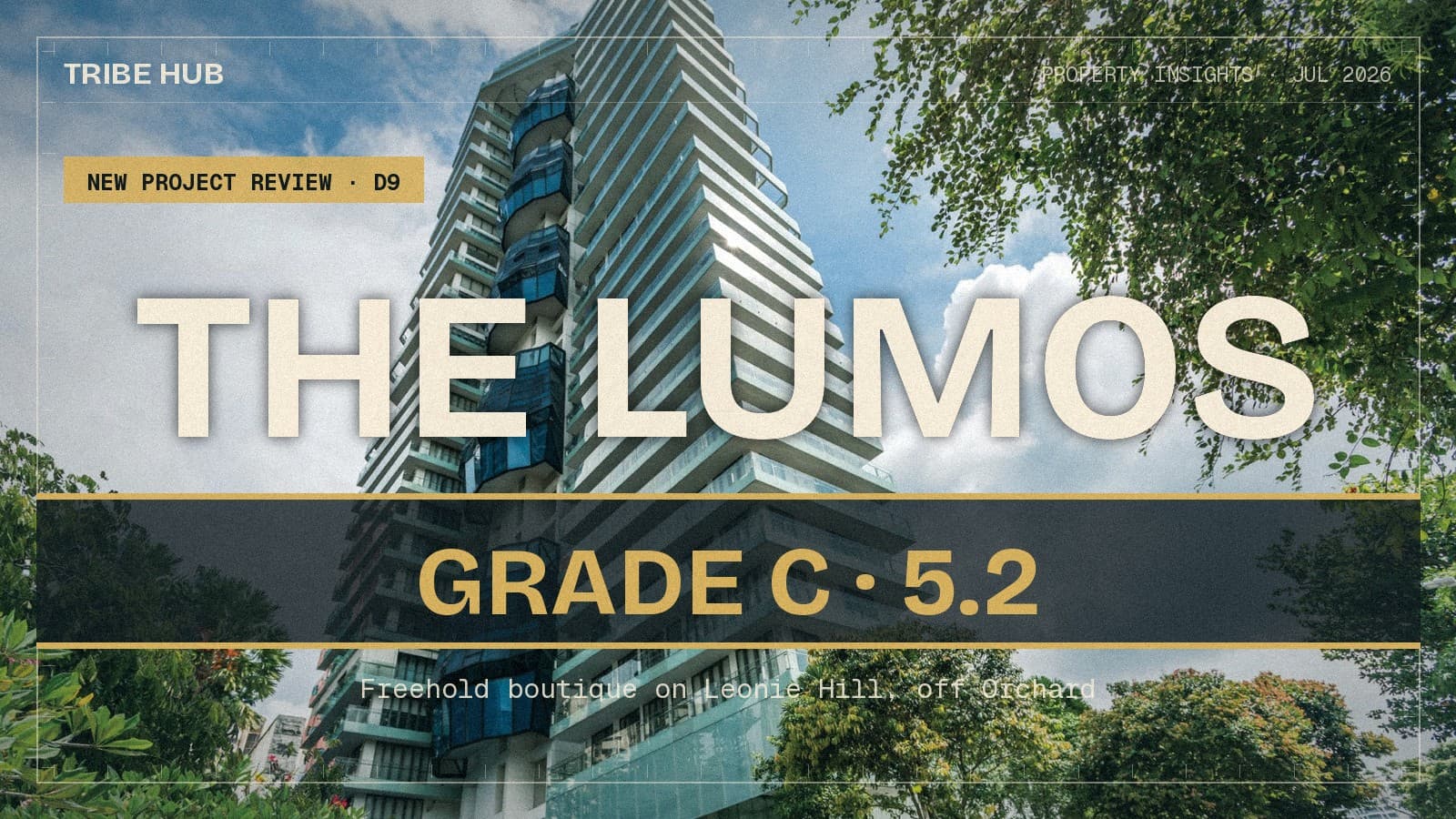
The Lumos grades C (5.2) on the New Project Scorecard — a 53-unit freehold at 9 Leonie Hill in District 9, a short hop from Orchard MRT, with remaining stock asking about S$2,782 psf against an own resale median nearer S$2,308.
By TRIBE Editorial · 17 July 2026 · Updated 13 October 2026 · 11 min read
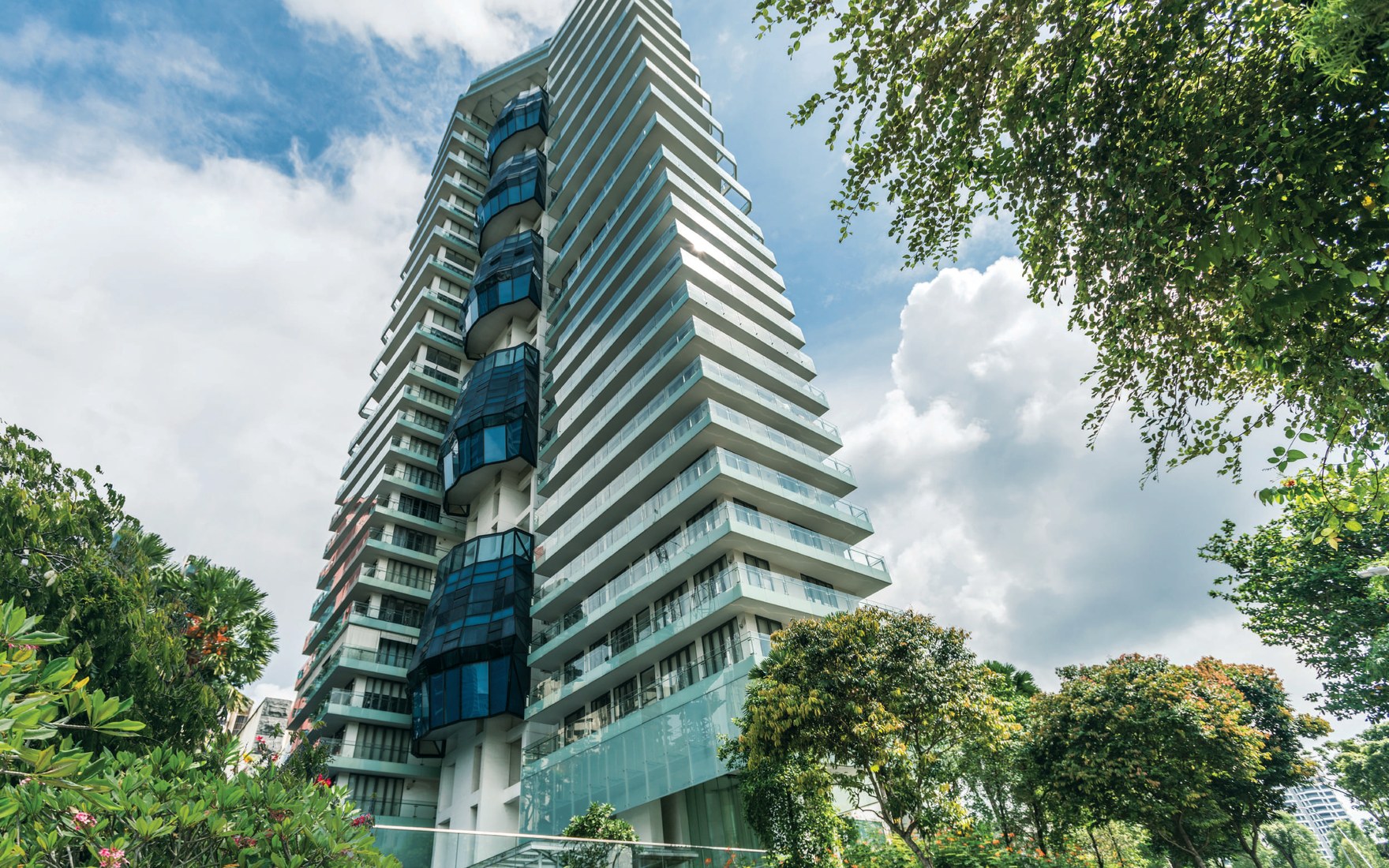
The Lumos is a 53-unit, 36-storey freehold tower at 9 Leonie Hill in District 9 — a boutique Orchard-fringe block by Buildhome, completed back in 2011 and still selling down its final units, with the remaining three-bedders asking about S$2,782 psf and two-bedders nearer S$2,920 psf. It grades a C (5.2) on our New Project Scorecard (NPS), the honest middle of the scale: a freehold title in a blue-chip postcode, walking distance to Orchard MRT, wrapped around a set of numbers that are solid in a couple of places and thin in the ones that decide returns. This is a look at what the C rests on, what the asking price means once you set it against the building's own record, and where the caveats sit. Methodology published. No spin.
The NPS grades a project's district-level fundamentals over a 10-year window — capital appreciation, rental growth, schools, MRT access and project size — from real URA transacted data. It is backward-looking by design: it reflects the district's history, lifted for the project's own size, transport and schools, not a forecast. The Lumos has a transacted record, but a thin one, so the holding read below anchors on that record while flagging just how few caveats sit behind it.
The scorecard: what a C actually says
The Lumos's 5.2 is a genuine middle score — two factors above the line, one at the line, and the factor that matters most for returns sitting below it.
| NPS factor | Score /10 | What it reflects |
|---|---|---|
| MRT Proximity | 7.0 | 0.42km walk to Great World MRT (Exit 4), measured from the Leonie Hill gate |
| School | 6.7 | River Valley Primary School within 1km (0.68km, oversubscribed) |
| Rental Growth | 3.2 | District 9 rents grew ~4.4%/yr over the decade — moderate |
| Project Size | 5.0 | 53 units — a boutique block with a shallow resale pool |
| Capital Appreciation | 4.1 | 1km resale grew ~1.8%/yr over the decade; lifted +0.4 for the project's profile |
The two draws are location and title. MRT scores 7.0 on a 0.42km walk from the Leonie Hill gate to Great World station (Exit 4) on the Thomson-East Coast Line, the nearest station on foot when measured gate to exit on 13 October 2026; Orchard, Somerset and Dhoby Ghaut are all within reach. Schools score 6.7, with River Valley Primary inside the one-kilometre ring. Rental growth is a moderate 3.2 on District 9 rents that grew about 4.4% a year over the decade.
The soft spot is the decisive one. Capital appreciation scores just 4.1: resale homes within a kilometre grew only about 1.8% a year over the past decade on a same-property basis, and even after the model's tilt for the project's freehold title, transport and schools, projected growth runs to about 2.25% a year — below the 3% bar. And project size scores 5.0: 53 units is exclusive, but it means a shallow resale pool, few comparable trades to set your price, and thin liquidity when you exit. The freehold is the reassurance; the sub-3% growth is the problem the freehold does not solve.
The launch: what the leftover stock is asking, against its own record
The Lumos is fourteen years past completion, so the honest benchmark is not a developer brochure — it is the project's own transacted history. The two sit uncomfortably far apart:
| Type | Asking PSF (current) | Own resale median (URA) | Spread |
|---|---|---|---|
| 3 Bedroom | S$2,782 | S$2,308 (3 caveats) | +20.5% |
| 4 Bedroom | S$2,859 | S$2,323 (7 caveats) | +23.1% |
The remaining stock — the larger three-bedroom duplexes and four-bedders, with two two-bedders around S$2,920 psf — is asking roughly 20% more than the project's own units have actually resold for. Two caveats on that comparison, both of which cut toward caution rather than away from it. First, the resale medians are desperately thin — three caveats behind the three-bedroom figure, seven behind the four-bedroom — so they are indicative, not gospel. Second, the record that does exist is not flattering: EdgeProp has reported a three-bedder at The Lumos reselling at a roughly S$1.86 million loss. A freehold Orchard-fringe address that produces million-dollar resale losses is telling you something the sticker price is not. The building's own high-water mark, incidentally, was about S$3,984 psf back in 2007, at launch — a level it has not revisited since.
The benchmark: the freehold neighbours, on the same basis
The comparison here is unusually clean. Every relevant neighbour is freehold, so there is no lease decay to adjust for on either side; and by the harmonisation proxy (planning permission before 22 January 2023, which the calculator flags via a TOP on or after 2026), The Lumos and all its comparables are pre-2023, non-harmonised stock — the same larger, air-con-ledge-inclusive area basis — so their raw PSF already compares like-for-like. No lift, no restatement.
| Freehold comparable | TOP · distance | Raw resale PSF |
|---|---|---|
| Park Nova | 2024 · 0.88km | S$4,786 |
| Twentyone Angullia Park | 2014 · 0.57km | S$3,460 |
| Grange 1866 | 2025 · 0.36km | S$3,049 |
| 120 Grange | 2023 · 0.73km | S$2,822 |
| The Iveria | 2024 · 0.84km | S$2,595 |
Against the street, The Lumos's S$2,782 psf ask is defensible — mid-pack, below branded Park Nova and Grange 1866, roughly level with 120 Grange, a touch above The Iveria. But note what those neighbours are: almost all completed between 2023 and 2025. The Lumos is asking newer-freehold money for a 2011 building. On the model's own logic, the fair-value anchor is not the glossier neighbour — it is the project's own median (about S$2,308), and against that anchor the asking price is a stretch, which is exactly what the holding read below reflects. The freehold neighbours tell you the ceiling the address can support; the project's own record tells you what this building actually delivers, and they are S$400–500 psf apart.
The Orchard-fringe question: what you are really buying
The bull case is durable and simple: freehold, in District 9, a short hop from Orchard MRT. That is a permanent title in one of Singapore's most liquid prime rental catchments, in a boutique block for buyers who value privacy over facilities, in a stretch of River Valley that the URA Master Plan continues to rejuvenate. For an own-stayer who wants a freehold Orchard address and intends to keep it for a decade or more, none of the return maths below may be the point.
Two honest counterweights for everyone else. First, income does not carry it: gross rental yields here run only about 2.7% on the scorecard, and EdgeProp marks them nearer 1.7% — well under the cost of debt, so a geared buyer is funding negative carry from day one. Second, liquidity is thin: 53 units means a handful of resales set the price, and when the tape includes a S$1.86 million loss, a future seller inherits that comparable. Freehold protects you from lease decay; it does not protect you from a slow market and a shallow float.
How long you would likely hold
Seller's stamp duty runs for four years (16%, 12%, 8%, 4%), so no exit before year four is realistic, and the shortest tier we publish is four-to-six years. Using the NPS calculator's model — about 2.25% expected growth, a 3% target — and taking the project's own transacted median as the fair-value anchor, here is the estimated holding period for the remaining stack, on price growth alone.
| Available stack | PSF (current asking) | Hold (price only) |
|---|---|---|
| 3 Bedroom · ~1,755–2,496 sqft | S$2,782 | Doesn't reach 3% |
| 4 Bedroom · ~2,433 sqft | S$2,859 | Doesn't reach 3% |
Neither stack clears the 3% bar on price, and this time the entry premium is only half the reason. The deeper issue is that modelled growth itself, at about 2.25% a year, sits below 3% — so even a buyer entering at the project's own median, with no premium at all, would not clear the bar on price alone. The ~20% asking premium simply turns a near-miss into a clear one, saddling the early years with a negative return while the price grinds back toward fair value. And because the yield is thin — 2.7% at best, likely lower — rent does not rescue the hold either. This is a freehold you buy for the title and the address, holding long and expecting the return to come from the land under it over a full cycle, not from the price over the next few years. Figures are gross of stamp duty, financing and selling costs.
The honest verdict
The Lumos is what a C looks like when the address is better than the arithmetic. The freehold title, the Orchard-fringe location and the River Valley Primary catchment are all real, and for an own-stay buyer who wants a permanent prime address in a boutique block, they may be reason enough. But the numbers ask for discipline the asking price does not offer. Same-property resale here has grown only about 1.8% a year for a decade, the model projects about 2.25% — below the 3% bar on price alone at any entry — the yield runs 1.7% to 2.7% so income will not carry a geared hold, and the remaining stock is asking roughly 20% above what the building's own units have actually resold for, on a tape that already includes a S$1.86 million loss. Against its shinier 2023–2025 freehold neighbours the ask looks mid-pack; against its own record it looks full. For a long-hold own-stayer paying cash and buying the freehold, it is a defensible C. For an investor underwriting price growth or yield, the scorecard says wait for a keener entry or look elsewhere.
See the full scorecard and run your own unit price through the holding-period calculator at tribesg.com/nps.
Sources: NPS quality grade (C, 5.2), the five factor scores, modelled growth (~2.25%/yr) and gross rental yield (~2.7%) per the TRIBE New Project Scorecard (URA Data Service transacted PSF; 1km same-property resale trend lifted for project size, transport and schools; figures as at 17 July 2026). Project facts — 53 units, 36 storeys, freehold, 9 Leonie Hill, District 9, developed by Buildhome Pte Ltd, TOP 2011, nearest MRT Orchard (Thomson-East Coast / North-South lines) — the ~2.7% vs 1.7% rental-yield readings, the highest recorded transaction (~S$3,984 psf, 2007), current for-sale listings (3BR ~S$2,780 psf, 4BR ~S$2,640–3,340 psf, 2BR ~S$2,790–2,920 psf) and the reported three-bedroom resale at a ~S$1.86m loss per EdgeProp and EdgeProp, "Sale of three-bedder at The Lumos results in $1.86 mil loss", corroborated by 99.co and PropertyGuru. Own resale median PSF by bedroom (3BR S$2,308 across 3 caveats; 4BR S$2,323 across 7) and the freehold comparables (Park Nova, Twentyone Angullia Park, Grange 1866, 120 Grange, The Iveria) from URA caveats, last 24 months. All comparables are freehold and pre-2023 (non-harmonised), so no lease-decay or GFA-harmonisation adjustment applies; the model anchors fair value on the project's own transacted median. Primary 1 priority distance is measured door-to-door — confirm any 1km claim on OneMap before relying on it. Scores and holding periods are model outputs, not financial advice.
Silas Tan is a District Director at Huttons Asia and co-founder of TRIBE. He built the New Project Scorecard (NPS) and Resale Project Scorecard (RPS) on URA transacted data. This article is for informational purposes and does not constitute financial or investment advice. CEA Registration R000303I.
Check how your condo scores
2,351 condos independently scored across 7 weighted factors. No registration required.
Score my resale →Prefer a personal read on your situation? Arrange a consultation →Keep reading

Next step

TRIBE Editorial · Reviewed by Silas Tan
Co-Founder, TRIBE · District Director, Huttons Asia · Ex-Mortgage Banker (AVP) · >1,000 families advised · CEA R000303I
How TRIBE scores and checks its analysis
Spotted an error, or a figure that has moved since publication? Tell us and we will correct it.
This article is for informational purposes only and does not constitute financial or investment advice.