Insights
Fewer Launches, Faster Sellouts — Why 2026's New Condos Clear in a Weekend
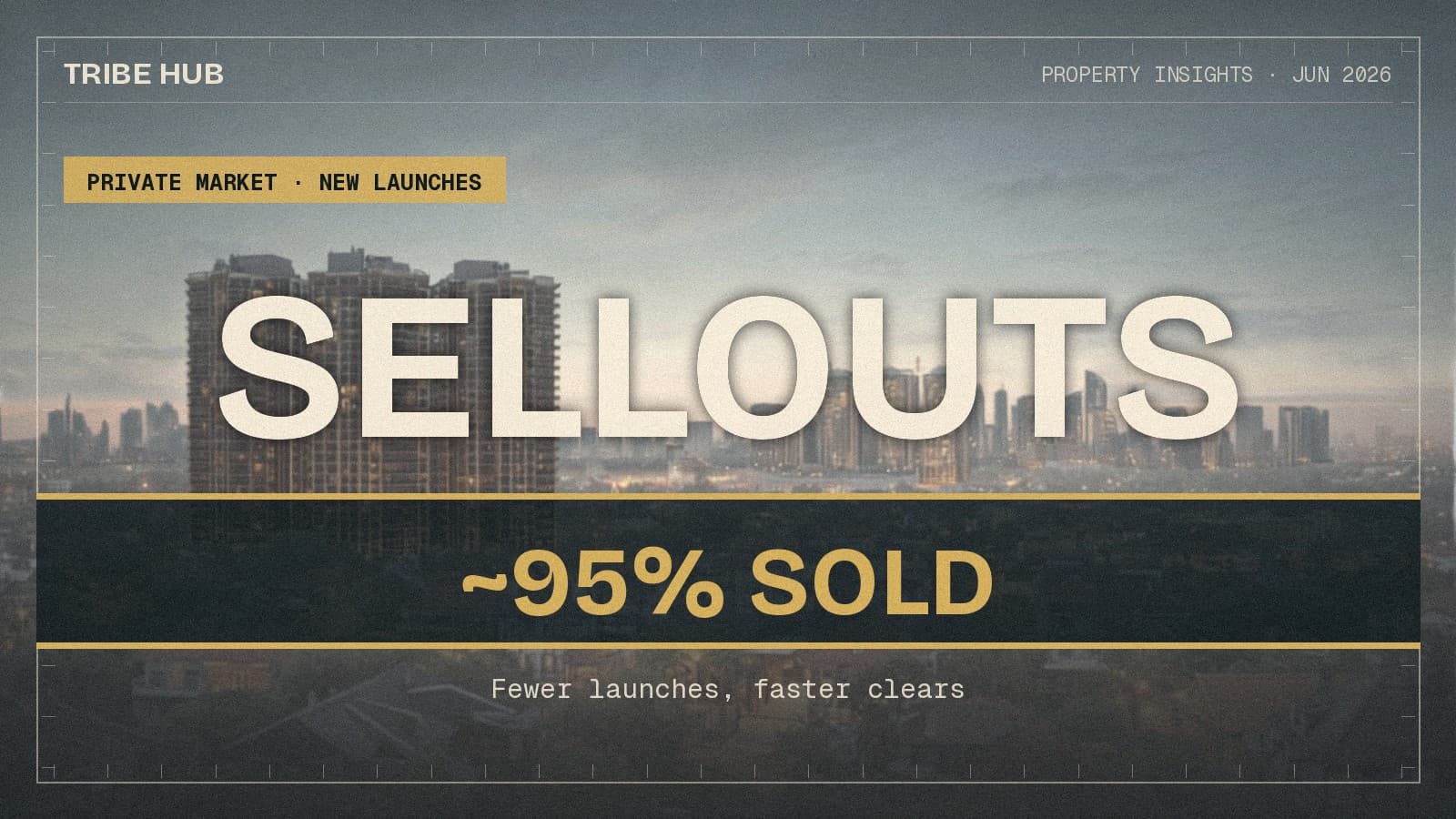
Singapore is launching fewer condos in 2026 — and selling most of them on opening weekend. Tengah Garden Residences moved 853 of 863 units, Pinery 92.5%, River Modern about 90%. The supply crunch isn't a buyer's market at launch. It's a queue.
By TRIBE Editorial · 29 June 2026 · 6 min read
The headline on Singapore's new-launch market in 2026 has been scarcity: fewer projects, a thinner pipeline, a launch calendar that goes quiet for weeks at a time. But scarcity has a second face that the supply numbers hide. When a launch does arrive, buyers are clearing it almost immediately. Tengah Garden Residences sold 853 of its 863 units on opening weekend. Pinery Residences moved 92.5%. River Modern cleared about 90%. The few launches of 2026 aren't sitting in a soft market waiting for buyers — they're selling out before the show-flat carpet wears in.
This is a piece about what take-up rates mean, not a launch advertisement. The point is that "fewer launches" and "weak demand" are not the same thing, and in 2026 they have pulled in opposite directions. The supply crunch is real. It is showing up as a queue at the door, not a discount on the table.
Three launches, three price tiers, one pattern
What makes 2026's sellouts notable isn't a single hot project — it's that the pattern held across completely different products and price points.
At the mass-market end, Tengah Garden Residences — the first private condominium in the new Tengah estate — sold 853 of its 863 units by the close of its launch weekend in late April, at an average of about S$2,120 per square foot. That is close to a 99% take-up and the strongest private launch of the year so far. In the suburban-but-established middle, Pinery Residences in Tampines moved 92.5% of its 588 units at an average of about S$2,546 psf, with its two-bedroom units selling out entirely. And at the city fringe, River Modern in the River Valley area cleared about 90% of its 455 units at an average of roughly S$3,266 psf — a price tier more than half again above Tengah's, with the same near-sellout result.
Put the three together and the math is stark. Across a combined 1,906 units, roughly 1,807 — about 95% — sold at launch. A mass-market project at $2,120 psf, a suburban one at $2,546, and a city-fringe one at $3,266 all met the same wall of ready demand. When absorption looks identical across that wide a price spread, the explanation isn't the individual project. It's the market underneath all three.
Why the few launches clear so fast
Three forces are stacking in the same direction. The first is the supply crunch itself. Singapore launched far fewer units in 2026 than in 2025, and a buyer who has been waiting for the "right" new project has fewer of them to choose from in any given month. Scarcity concentrates demand: when only a handful of launches appear, the buyers who would otherwise have spread across a dozen projects converge on the few that do.
The second is financing. The three-month compounded SORA has spent 2026 near the bottom of its cycle, around 1%, with the cheapest floating home-loan packages well under 2%. Cheap money lowers the monthly cost of a financed purchase and pulls forward buyers who were sitting out the higher-rate years — exactly the kind of demand that shows up as a fast launch-weekend clear.
The third is balance-sheet health. Singaporean households went into 2026 with strong savings and low leverage by historical standards, and the launches that sold out were priced to meet that demand rather than to stretch it — Tengah at $2,120 psf is squarely affordable for the dual-income buyers it targets. A well-located, sensibly priced launch into a supply-starved market with cheap financing is, almost by definition, a fast sellout.
Scarcity doesn't always produce a buyer's market. In 2026 it has produced the opposite at the launch counter — fewer projects, but each one clearing in a weekend.
The number that keeps it honest
One statistic stops this from being a "market is booming" story. Through April, developers sold 3,561 new homes for the year — 12.1% fewer than the 4,050 sold over the same period in 2025. Total volume is down, not up. CBRE projects 7,500 to 8,500 new-home sales for all of 2026, a clear moderation from the 10,815 units sold in 2025 and slightly below the five-year average.
The two facts only look contradictory until you separate them. Take-up rate measures how much of a launch sells; transaction volume measures how many launches there are to sell. In 2026, the rate is high and the volume is low — because there are fewer launches, each selling through quickly. Aggregate sales are softer than last year precisely because the calendar is thinner, not because demand is weak. The sellouts and the year-on-year decline are two readings of the same supply crunch.
What it means if you're buying
For a buyer weighing a new launch, the practical lesson is that the wait-for-a-glut thesis is not playing out at the launch counter. If you have your eye on a specific new project, the evidence of 2026 is that the best units — and at Pinery, an entire bedroom type — can be gone by Sunday evening. A near-sellout launch leaves later buyers choosing from the leftover stack at the developer's price, not negotiating. If a launch genuinely fits, hesitation is the expensive option this year.
For a buyer who can be flexible on age, the same crunch points the other way. The leverage in 2026 is not in the new-launch queue; it is in the resale market, where stock is deeper, the seller is an individual rather than a developer holding firm on a price list, and a patient buyer can transact at valuation. We have argued before that a resale condo's fundamentals often out-score a new launch on the numbers — and in a year when new launches clear at list price in 48 hours, the resale market is where the negotiating room actually sits.
The honest read of mid-2026 is neither boom nor bust. It is a thin pipeline meeting ready demand, producing fast sellouts at the few launches and softer totals across the year. If you want a brand-new unit, move decisively when one that fits appears. If you want room to negotiate, look to resale — that is where this particular market leaves it.
See where every resale project lands on the fundamentals at tribesg.com/rps.
Sources: launch take-up and pricing per EdgeProp, Mothership and Stacked Homes. Year-to-date sales, full-year forecast and launch-supply estimates per CBRE Research. Combined take-up computed from the published per-project figures. SORA levels per MAS. Figures current as at June 2026; this article is informational and not investment advice.
Silas Tan is a District Director at Huttons Asia and co-founder of TRIBE. He built the Resale Project Scorecard (RPS) using 236,000+ URA REALIS transactions. This article is for informational purposes and does not constitute financial or investment advice. CEA Registration R000303I.
Check how your condo scores
2,352 condos independently scored across 7 weighted factors. No registration required.
Score my resale →Prefer a personal read on your situation? Arrange a consultation →Keep reading
6 October 2026Private Property Market
The 70% En Bloc Band Holds 223 Developments. The Published Count Is Four.
5 October 2026Private Property Market
Lucerne Grand Sold 61%. Buyers Bought the Smallest Version of Everything.

3 October 2026Private Property Market
The Rules Were Meant to Cool EC Land Bids. The First Site Under Them Set a Record.

TRIBE Editorial · Reviewed by Silas Tan
Co-Founder, TRIBE · District Director, Huttons Asia · Ex-Mortgage Banker (AVP) · >1,000 families advised · CEA R000303I
How TRIBE scores and checks its analysis
Spotted an error, or a figure that has moved since publication? Tell us and we will correct it.
This article is for informational purposes only and does not constitute financial or investment advice.