Insights
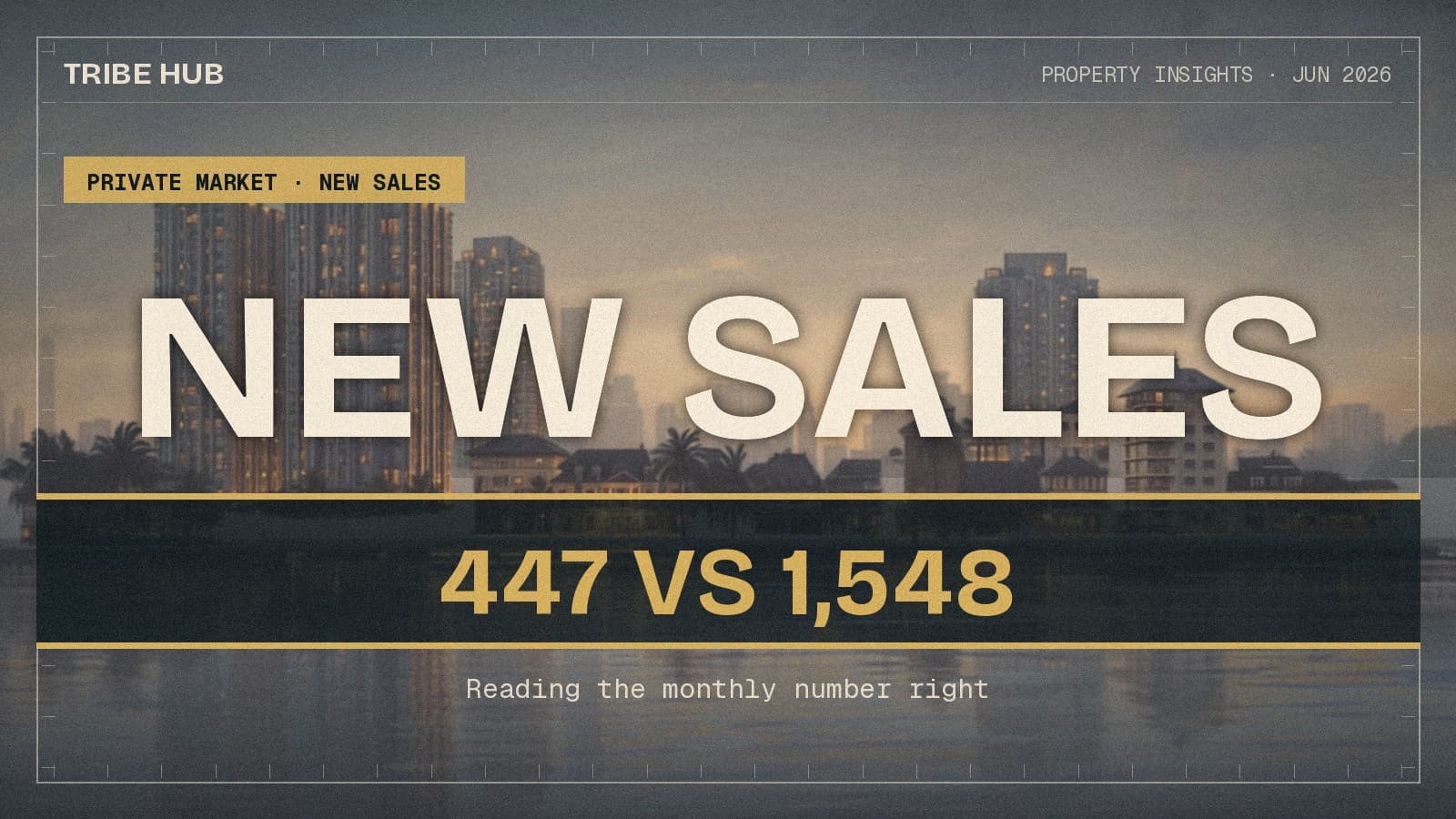
447 Sales in May, 1,548 in April — How to Read the Monthly Developer Number
Developers sold 447 new private homes in May, down 71% from April — a three-month low, and the headlines called it cooling demand. The number is real. The reading is wrong: in a thin-launch year, the monthly figure tracks the launch calendar, not buyer appetite.
By TRIBE Editorial · 26 June 2026 · 5 min read
Developers sold 447 new private homes in May 2026, excluding executive condominiums — down from 1,548 in April, a fall of about 71% in a single month and the lowest monthly tally in three months. The headline writes itself: demand is cooling. The number is real, and the headline is wrong. In a year with almost nothing launching, the monthly developer-sales figure measures the launch calendar, not buyer appetite — and when product actually came to market, it sold.
This is the most misread statistic in Singapore property, so it's worth being precise about what it is and what it isn't.
What the number actually measures
URA's monthly developers' sales survey counts one thing: the number of brand-new units that developers sold in the primary market that month — units in new launches and unsold inventory in still-selling projects. It excludes executive condominiums in the headline figure, and it excludes the entire resale market, which is where most homes actually change hands. In Q1 2026, resale made up about 60% of all private residential transactions. So the monthly developer number is a slice of a slice: new-build sales only, and primary-market only.
That matters because the slice it measures is the one most dependent on supply. A developer can only sell what it has launched. If a big project opens its showflat in a given month, that single launch can account for half the month's sales; if nothing launches, the figure collapses to whatever trickles out of existing projects. The number doesn't move with how many buyers are in the market — it moves with how many units were put in front of them.
Why 2026 makes the swing extreme
Singapore is in a deliberately thin launch year. The 2026 calendar carries roughly 17 new private projects and about 8,100 units — down around 30% from the ~23 projects and 11,000-plus units of 2025. With launches that sparse, the monthly series becomes a step function: a tall month when a project debuts, a quiet month when none does.
That is exactly the April-to-May story. April carried launch activity; May did not, so sales dropped to 447. Read as a trend, that looks like a buyers' strike. Read correctly, it's an empty showflat calendar. The quarterly frame makes the point: developers sold 2,013 new units in Q1 2026 — an average of about 670 a month — but that quarter was itself down 40% year-on-year, in lockstep with launches, which fell 41%. Fewer projects launched, fewer units sold, and the two moved together. The constraint is supply, not demand.
The tell: when something launched, it sold
The cleanest evidence that demand is intact is what happens on the rare weekend a project does open. Hudson Place Residences, in the one-north precinct (District 5), moved 201 of its 327 launched units — about 61% — on opening weekend, at an average of roughly $2,458 psf. That is not the take-up of a market that has run out of buyers. It is consistent with the rule of thumb the data has settled into this cycle: a launch priced within about 3% of nearby resale comparables clears 40% to 65% of its units on the first weekend. Buyers are present, and they are choosy — they show up for correctly priced product and sit out the rest.
So the picture isn't a demand collapse punctuated by one good launch. It's a thin, disciplined market where supply arrives in lumps. The monthly developer figure inherits all that lumpiness and none of the underlying demand signal.
What it means for a buyer
The practical takeaway is to stop treating a single month's developer-sales headline as a market barometer. A weak month tells you few units launched; a strong month tells you a big project opened. Neither tells you where prices are heading or whether now is a good time to buy. If you want a read on demand, look at take-up rates at comparable launches and at resale prices and volumes in your district — the resale market is larger, steadier and far less hostage to one showflat's timing.
This sits inside a market we've described as a measured, waiting-buyer phase, shaped by a thin new-launch pipeline and a record forward supply of land that will only feed launches in years to come. Against that backdrop, the month-to-month developer number will keep swinging by four figures, and the headlines will keep over-reading it. If you're a buyer waiting for "the market to crack," a quiet sales month is not your signal — it's a quiet showflat. Price the home against its resale comparables, watch how similar launches actually sell, and let the monthly noise be noise.
See where every resale project lands on the fundamentals at tribesg.com/rps.
Sources: URA, Release of 1st Quarter 2026 real estate statistics (24 April 2026); URA Developers' Sales survey (monthly developer sales, ex-EC); launch-volume and take-up figures as reported in market coverage of the May 2026 developers' sales data and the Hudson Place Residences launch. Figures as at June 2026 and are illustrative, not advice.
Silas Tan is a District Director at Huttons Asia and co-founder of TRIBE. He built the Resale Project Scorecard (RPS) using 236,000+ URA REALIS transactions. This article is for informational purposes and does not constitute financial or investment advice. CEA Registration R000303I.
Check how your condo scores
2,352 condos independently scored across 7 weighted factors. No registration required.
Score my resale →Prefer a personal read on your situation? Arrange a consultation →Keep reading
6 October 2026Private Property Market
The 70% En Bloc Band Holds 223 Developments. The Published Count Is Four.
5 October 2026Private Property Market
Lucerne Grand Sold 61%. Buyers Bought the Smallest Version of Everything.

3 October 2026Private Property Market
The Rules Were Meant to Cool EC Land Bids. The First Site Under Them Set a Record.

TRIBE Editorial · Reviewed by Silas Tan
Co-Founder, TRIBE · District Director, Huttons Asia · Ex-Mortgage Banker (AVP) · >1,000 families advised · CEA R000303I
How TRIBE scores and checks its analysis
Spotted an error, or a figure that has moved since publication? Tell us and we will correct it.
This article is for informational purposes only and does not constitute financial or investment advice.