Insights
Landed Homes Just Dipped — The One Segment Sitting Out the Rally
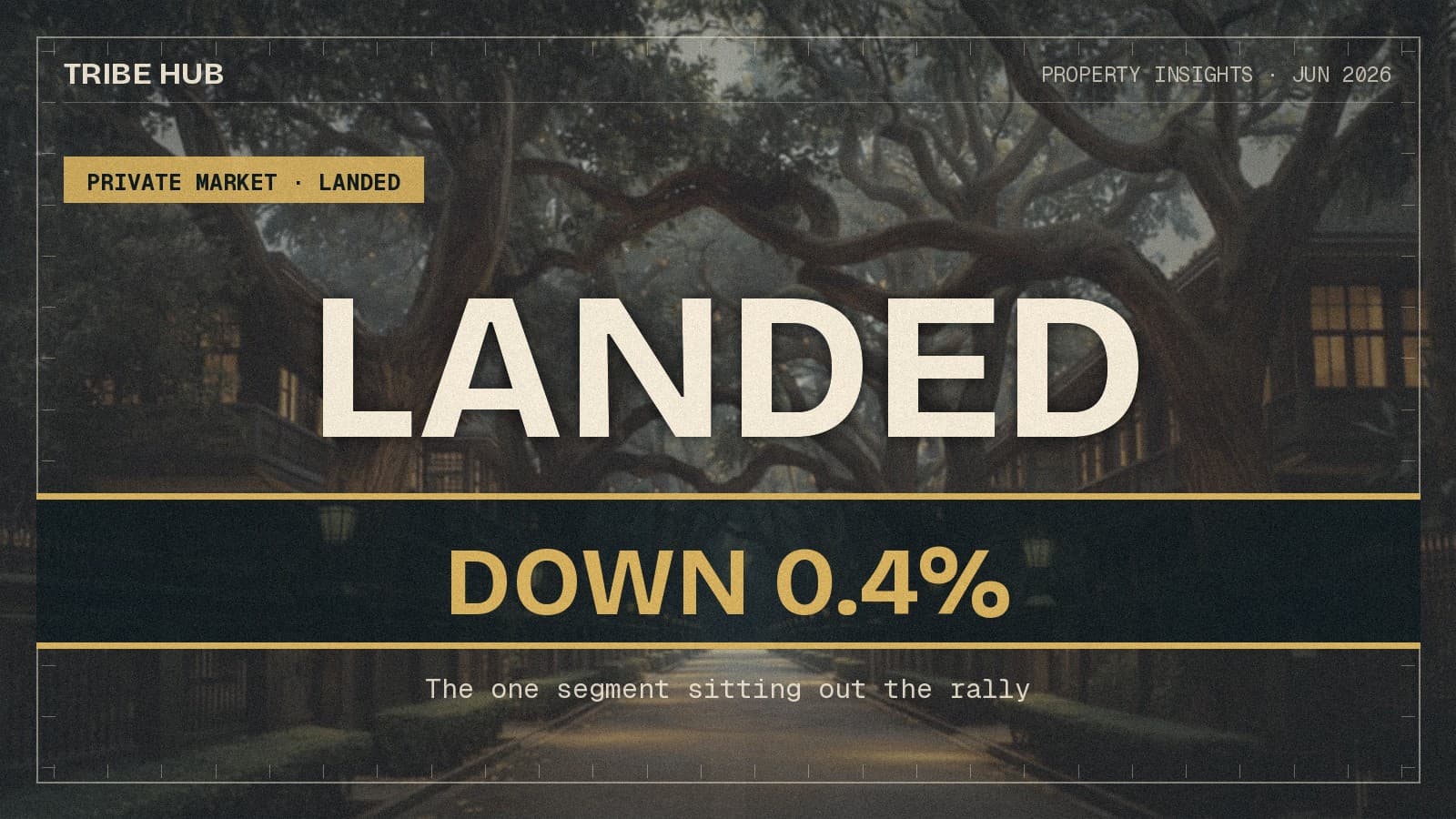
Private home prices rose for a sixth straight quarter in Q1 2026 — but landed houses fell 0.4%, the only segment in reverse. The dip is seasonal, not structural. The more telling number is who has stopped buying landed at all.
By TRIBE Editorial · 25 June 2026 · 7 min read
Singapore's private housing index rose again in the first quarter of 2026 — up 0.9% quarter-on-quarter, a sixth straight quarter of gains. Underneath that headline, one segment moved the other way. Landed homes — terraces, semi-detached houses, bungalows — fell 0.4%, the only part of the market in reverse while non-landed homes climbed 1.3% and the suburbs led at 2.2%. It is the kind of divergence that invites a tidy narrative: the top of the market is cracking. The data says something duller and more useful. The dip is mostly seasonal and base-effect, not structural — and the number that actually matters in the landed report isn't the price line at all.
What the data actually says
The landed price index fell 0.4% in Q1 2026, reversing the 3.4% jump it posted in Q4 2025 — but it remained 6.7% higher than a year earlier, so this is a single soft quarter inside a year of gains, not a trend break. The volume story is sharper than the price one. URA caveats record just 428 landed transactions in the quarter, down 17.9% from the previous quarter and 1.8% lower year-on-year, according to ERA's Q1 2026 landed report. Fewer homes changed hands, and the index drifted with them.
Two things explain most of that drop, and neither is weakness. The first is the base effect: Q4 2025 grew 3.4%, an unusually strong quarter, so a flat-to-soft Q1 reads as a decline off a high mark. The second is the calendar. Chinese New Year fell in February this year, in the middle of the quarter, and landed deals are the most seasonal in the market — they are large-quantum, often chain transactions where a buyer must sell one property before committing to the next. Buyers and sellers routinely defer that complexity past the festive period, which thins out first-quarter activity almost every year. Strip the seasonality and the base, and a 0.4% dip on 428 deals is noise, not signal.
There's even a tell that demand held up where it counts. Of the landed homes that did sell, 57.9% went for more than $5 million, up from 49.7% the quarter before — the mix shifted toward pricier homes, not cheaper ones. The median transacted prices held firm: roughly $4.56 million for a terrace, $6.24 million for a semi-detached, $11.5 million for a detached house, island-wide. This was a quieter quarter, not a discounted one.
The number that matters: who's left buying
Here is the line in the report that does more work than the price index. In Q1 2026, just 2.1% of landed-home buyers came from an HDB address — and across all of 2025, that figure was 0.7%. Either way, it rounds to almost nobody. The classic Singapore aspiration — flat to condo to landed — has, at the landed rung, effectively closed. Landed buying is now overwhelmingly a private-to-private and cash-rich affair, and the reason is arithmetic.
Consider the most accessible entry point on the board: an Outside Central Region terrace, median about $4.44 million. A citizen buying it as a first property pays no Additional Buyer's Stamp Duty, but the Buyer's Stamp Duty alone comes to roughly $213,000. With the 75% loan-to-value cap, the minimum down payment is about $1.14 million in cash and CPF, on top of the stamp duty — before renovation, before furnishing. Step up to a semi-detached at $6.24 million and BSD is about $314,000 with a $1.56 million down payment; a detached at $11.5 million carries roughly $630,000 in BSD and a $2.88 million down payment. That is the quantum wall, and it is why landed is a different market rather than the next rung of the same ladder.
It is also a structurally scarce and protected one. Landed property is the smallest slice of Singapore's housing stock and its supply is essentially fixed — almost no new landed land is released, so the stock barely grows. It is the one residential class generally reserved for citizens: permanent residents need government approval to buy a landed home, and foreigners are barred outright, with Sentosa Cove the lone exception. At the apex sit the Good Class Bungalows — detached houses of at least 1,400 sqm within 39 gazetted areas, mostly in Districts 10 and 11 — where perhaps 30 to 60 homes trade in a whole year at prices from around $10 million into the tens of millions. Finite supply, a citizens-only buyer pool, and a quantum that excludes almost everyone: those are the foundations under the price line, and they don't move on a quarter.
What it means for a buyer
For most buyers, the honest reading is that the Q1 dip changes very little. Do not read −0.4% as a discount window. The report's own framing is that higher-end sellers — larger detached homes, Core Central Region addresses — have begun to relent on asking prices to lock in gains, while owners of smaller, suburban landed homes are holding firm, producing a stand-off rather than a sale. Where prices softened, it was the seller choosing to transact, not the market forcing it.
If you are a condominium owner genuinely weighing the move, the quarter is mildly in your favour: with condo prices up another 1.3%, selling into strength funds a larger landed budget, and the most realistic target remains an OCR terrace in the $4.4–4.6 million band. But plan the chain. Landed purchases hinge on timing the sale of your existing home against the commitment to the next, and mistiming that bridge is where upgraders lose money — a risk we've worked through before. And if you are waiting for landed to fall meaningfully, the structural case argues against you: ERA expects full-year 2026 landed volumes of 1,750 to 1,950 transactions and price growth of 5% to 7%, with the government's plan to grant citizenship to 25,000–30,000 people a year over the next five years adding, at the margin, exactly the high-net-worth buyers this market is reserved for.
The broader market is in a measured, waiting-buyer phase, and the suburbs are doing the heavy lifting on price. Landed sat that quarter out — but it sat it out the way it always does in a Lunar New Year quarter, on thin volume and a high base, not because the floor moved. The segment's real constraints are supply that doesn't grow and a buyer pool that does. Price the quantum, plan the chain, and treat the dip for what it is: a quiet quarter in the one corner of the market that was never going to be cheap.
See where every resale project lands on the fundamentals at tribesg.com/rps.
Sources: URA, Release of 1st Quarter 2026 real estate statistics (24 April 2026); ERA Singapore, 1Q 2026 Landed Report; stamp-duty figures computed on IRAS Buyer's Stamp Duty rates for a Singapore-citizen first property. Figures as at June 2026 and are illustrative, not advice.
Silas Tan is a District Director at Huttons Asia and co-founder of TRIBE. He built the Resale Project Scorecard (RPS) using 236,000+ URA REALIS transactions. This article is for informational purposes and does not constitute financial or investment advice. CEA Registration R000303I.
Check how your condo scores
2,352 condos independently scored across 7 weighted factors. No registration required.
Score my resale →Prefer a personal read on your situation? Arrange a consultation →Keep reading
6 October 2026Private Property Market
The 70% En Bloc Band Holds 223 Developments. The Published Count Is Four.
5 October 2026Private Property Market
Lucerne Grand Sold 61%. Buyers Bought the Smallest Version of Everything.

3 October 2026Private Property Market
The Rules Were Meant to Cool EC Land Bids. The First Site Under Them Set a Record.

TRIBE Editorial · Reviewed by Silas Tan
Co-Founder, TRIBE · District Director, Huttons Asia · Ex-Mortgage Banker (AVP) · >1,000 families advised · CEA R000303I
How TRIBE scores and checks its analysis
Spotted an error, or a figure that has moved since publication? Tell us and we will correct it.
This article is for informational purposes only and does not constitute financial or investment advice.