Insights
One in Three HDB Households Is Now Senior-Led. Here's the Right-Sizing Math.
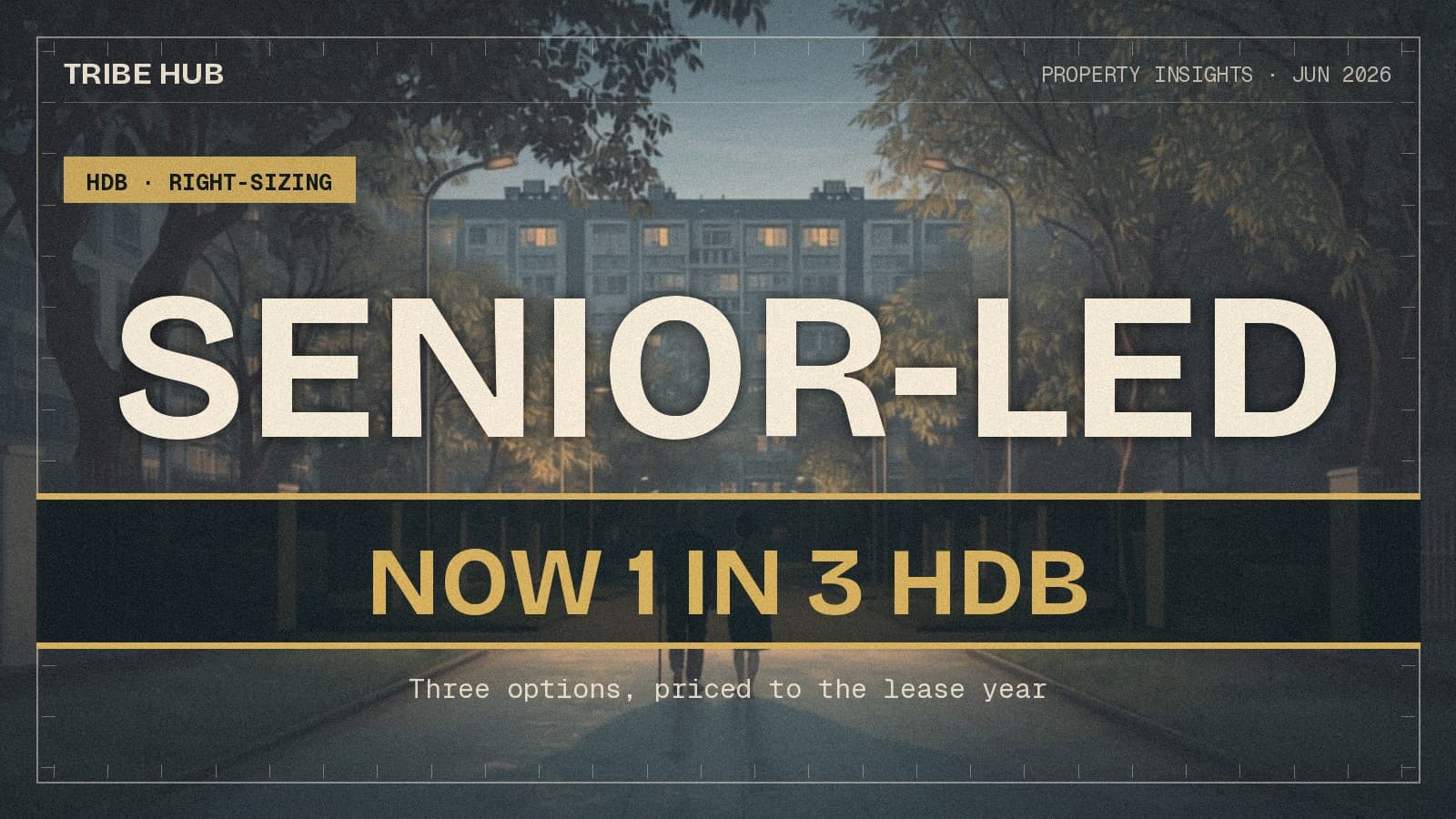
Senior-led households are now close to a third of HDB residents, up from a quarter in 2018. We price the three real options — a Community Care Apartment, a short-lease 2-room Flexi, or staying put — down to the lease year.
By TRIBE Editorial · 17 June 2026 · 7 min read
Singapore's housing stock is ageing alongside its owners. On the latest HDB Sample Household Survey, households where the main occupier is 65 or older now make up close to one in three HDB households — up from roughly one in four in 2018 — and the country is on track to be a super-aged society by 2030, when one resident in four will be 65 or older. That is not an abstract demographic line. It is a very concrete question landing on hundreds of thousands of kitchen tables: do we stay in the flat we raised the family in, or move to something smaller and easier?
There is no single right answer. But there are three real options, and each one carries a different price, a different lease structure, and a different set of strings. This is the math on all three, side by side.
Option 1: The Community Care Apartment
The Community Care Apartment (CCA) is the newest of the three and the most misunderstood. It is a joint MND–MOH–HDB scheme — assisted-living flats with senior-friendly fittings (grab bars, wheelchair-width doors, slip-resistant bathrooms), a 24-hour emergency response system, a community manager, and an Active Ageing Centre next door. Each unit is small by design: 32 square metres of internal floor area.
The pricing has two parts, and missing the second is the classic mistake. The flat itself is priced by lease length — you choose a tenure from 15 to 35 years in five-year steps, as long as it covers you (and your spouse) to age 95. At the first CCA project, Harmony Village @ Bukit Batok, flats ran from about $40,000 for a 15-year lease to $65,000 for a 35-year lease. The next project launches in Bedok later this year.
The second part is the one people forget: a mandatory Basic Service Package, currently $164 a month (or $6,200 every three years), payable for the life of the lease, with a one-year security deposit upfront. That is not optional — every resident subscribes. On top of it sit pay-as-you-use services: social day care at $50 a day, housekeeping at $20 an hour, home-delivered meals at $5–$7, and so on. Over a 20-year stay, the Basic Service Package alone is roughly $39,000 in today's dollars — real money that belongs in the comparison.
Two conditions decide whether a CCA fits. First, you cannot sell it on the open market — if you move out or become ineligible, the flat returns to HDB and you are reimbursed the residual value of the remaining lease on a straight-line basis. There is no capital upside; this is housing-as-consumption, not housing-as-asset. Second, you cannot rent out any part of it, and there is a five-year wait-out before you could buy another subsidised flat. The CCA is for a senior who wants care infrastructure and is comfortable spending down, not preserving, the housing dollar.
Option 2: The short-lease 2-room Flexi
The 2-room Flexi is the more flexible cousin and, for many seniors, the more sensible default. It is a standard small flat — but seniors can buy it on a short lease of 15 to 45 years in five-year steps, again sized to cover them to 95. Because the lease is short, the price is low: you are buying only the years you will use.
The mechanics differ from the CCA in ways that matter. There is no mandatory service package — your only recurring cost is ordinary Service & Conservancy Charges, roughly $45–$70 a month for a 2-room, much of it offset by S&CC rebates. There are no HDB housing loans for short-lease 2-room Flexi flats: payment is made fully in cash or from your CPF Ordinary Account. That is usually a non-issue for a right-sizer, because the whole point is to release cash from a larger flat and buy the small one outright, pocketing the difference.
Crucially, the 2-room Flexi is a normal HDB flat with a normal Minimum Occupation Period. After the MOP it can, subject to the usual rules, be passed on or sold — it is not a one-way return-to-HDB arrangement. For a senior who wants to free up cash and keep some optionality, that distinction from the CCA is the whole ballgame.
Option 3: Staying put
The third option is the one most seniors actually choose, and it is not wrong. Staying in the existing flat costs nothing to execute, keeps the family home, and — if the flat is fully paid — carries only S&CC and utilities. The hidden costs are different in kind: a larger flat is harder to maintain and clean, may have stairs or a layout that ages badly, and ties up equity that could fund retirement.
For stayers, there are two levers worth knowing. The Lease Buyback Scheme lets eligible seniors in 3-room-or-smaller flats sell the tail end of their lease back to HDB for a cash top-up while continuing to live there. And the EASE programme heavily subsidises senior-friendly retrofits — grab bars, ramps, slip-resistant treatment — so a flat that feels unsafe can often be fixed for a few hundred dollars rather than vacated. Staying put plus EASE is, for a healthy senior in a manageable flat, frequently the cheapest and best answer.
So which one?
The honest framing is not "which is best" but "which problem are you solving."
| If your priority is… | The fit is… | Why |
|---|---|---|
| Care and safety infrastructure | Community Care Apartment | Built-in services, 24h response, AAC next door — but you spend down, no resale |
| Releasing cash, keeping optionality | 2-room Flexi (short lease) | Buy only the years you need, no service package, still a sellable HDB flat after MOP |
| Keeping the family home cheaply | Stay put + EASE / Lease Buyback | Lowest cost to execute; retrofit safety instead of moving |
The variable that quietly decides it is care need, not money. A senior who needs daily assistance with washing, dressing or moving around is buying the CCA's service layer, and the $164-a-month package is the point, not the penalty. A senior who is fit and simply over-housed is usually better served by a 2-room Flexi that releases cash without locking away resale value — or by staying put and spending a few hundred dollars on grab bars. Run your own version before you let a showflat decide: price the lease you actually need, add the recurring costs (service package or S&CC) across your real time horizon, and compare that against the cash a right-size would release.
Sources: HDB — Community Care Apartments; HDB — For Our Seniors / EASE; Home & Decor — Harmony Village @ Bukit Batok; HDB Sample Household Survey. Prices and service charges are indicative as at June 2026 and subject to HDB/MOH review.
Silas Tan is a District Director at Huttons Asia and co-founder of TRIBE. He built the Resale Project Scorecard (RPS) using 236,000+ URA REALIS transactions. This article is for informational purposes and does not constitute financial or investment advice. CEA Registration R000303I.
Know what you can afford
Loan, stamp duty, CPF, and monthly repayments — work out your real budget before you commit. No registration required.
Plan my purchase →Prefer a personal read on your situation? Arrange a consultation →Keep reading

TRIBE Editorial · Reviewed by Silas Tan
Co-Founder, TRIBE · District Director, Huttons Asia · Ex-Mortgage Banker (AVP) · >1,000 families advised · CEA R000303I
This article is for informational purposes only and does not constitute financial or investment advice.