Insights
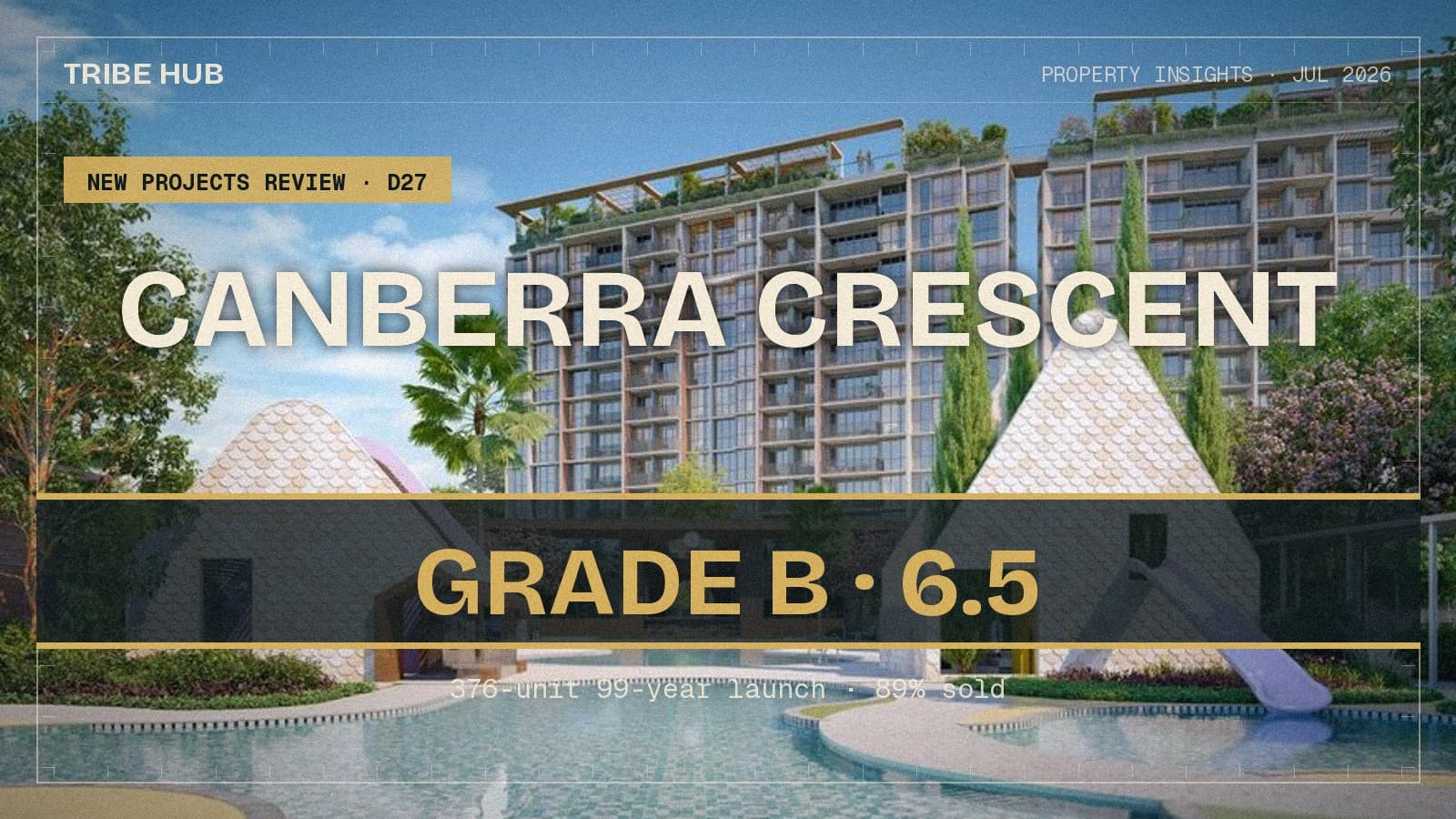
Honest Insights On Canberra Crescent Residences
Canberra Crescent Residences grades A (7.1) on the New Project Scorecard — a 376-unit 99-year leasehold in Sembawang, 89% sold at a ~S$2,000 psf median, with strong rental growth but a 0.77km walk to Canberra MRT.
By TRIBE Editorial · 16 July 2026 · Updated 13 October 2026 · 12 min read
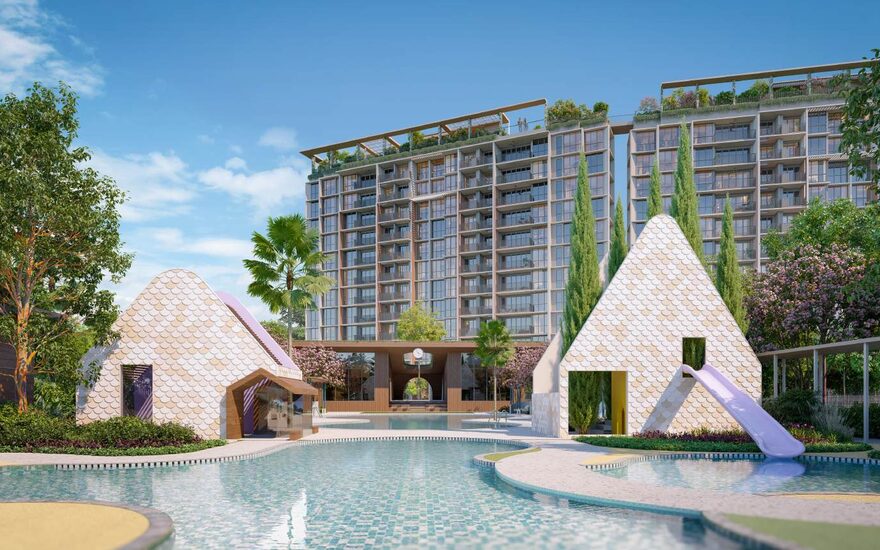
Canberra Crescent Residences is a 376-unit, 99-year leasehold development in District 27 — a mid-sized family project by Kheng Leong and Low Keng Huat in the Sembawang–Canberra growth belt, a 0.77km walk from Canberra MRT on the North-South Line. It grades an A (7.1) on our New Project Scorecard (NPS), and it is one of the better-selling suburban launches of the past year: it opened on 2 August 2025 from S$1,880 psf, took 40% (150 of 376 units) on launch weekend at an average of S$1,974 psf, and was about 89% sold by May 2026. This is a look at what the A rests on, why the grade splits so sharply across its five factors, and what the large-format stock still on the price list actually costs. Methodology published. No spin.
The NPS grades a project's district-level fundamentals over a 10-year window — capital appreciation, rental growth, schools, MRT access and project size — from real URA transacted data. It is backward-looking by design: it reflects the district's history, lifted for the project's own size, transport and schools, not a forecast. With most of the project sold, the holding read below anchors on the project's own transacted median.
The scorecard: an A with a split personality
Canberra Crescent's 7.1 is the average of two very good numbers, two solid ones, and one that is clearly weak. It is worth seeing them separately rather than as a blended grade.
| NPS factor | Score /10 | What it reflects |
|---|---|---|
| Rental Growth | 8.9 | District 27 rents grew ~7.8%/yr over the decade — strong momentum |
| Project Size | 8.0 | 376 units — a healthy, liquid mid-sized development |
| Capital Appreciation | 7.7 | 1km resale grew ~3.7%/yr; lifted +0.35 for size, transport, schools → ~4.0%/yr |
| School | 7.0 | Two primaries within 1km, incl. Wellington Primary (0.82km, heavily oversubscribed) |
| MRT Proximity | 4.0 | A 0.77km walk (about 10 minutes) to Canberra MRT, Exit A — the clear weak factor |
The top of the card is unusually good for an outside-central suburb. Rental growth scores 8.9 — District 27 rents grew about 7.8% a year over the decade, among the strongest in Singapore, helped by the maturing of the Sembawang and Canberra estates and a limited private-rental pool. Project size scores 8.0: at 376 units this is big enough for a liquid resale market and a full facilities deck without being a 1,000-unit mega-launch. Capital appreciation is a respectable 7.7 — same-property resale within a kilometre compounded about 3.7% a year, and after a modest quality tilt the model projects growth of roughly 4.0% a year, above the 3% bar — and schools score 7.0, anchored by a heavily balloted Wellington Primary inside the ring.
Then there is transport. MRT proximity scores 4.0 — a 0.77km walk to Canberra MRT (Exit A), which is about a 10-minute walk, not a doorstep one, and the single honest weakness in the project. Buyers here are trading rapid-transit convenience for space, price and a strong-rental postcode; some will make that trade happily for an own-stay family home, but nobody should pretend the station is at the doorstep. Primary 1 priority is measured door-to-door, so confirm the Wellington catchment on OneMap before relying on the ballot.
Updated 13 October 2026: the walk to Canberra MRT is now measured from the development's gate to the nearest station exit (Exit A): 0.77km, where the earlier version used 1.14km. The MRT score moved from 1.0 to 4.0, the grade from 6.5 to 7.1, a move from B to A, and the modelled growth from about 3.7% to about 4.0% a year; in the holding table below both tiers are unchanged and the entry threshold has been recalculated. Prices and availability remain as at July 2026.
The launch: what is left, and what it costs
Canberra Crescent has sold quickly. After 40% on opening weekend it reached about 89% sold (roughly 338 of 376 units) by late May 2026, with recent buyers transacting near S$1,927 psf. What remains is the large-format tail — the reported balance is concentrated in 3-bedroom premium, 4-bedroom and 5-bedroom stacks — because the one- and two-bedders and compact three-bedders cleared first.
The project's own transacted record, by bedroom:
| Type | ~Size | Median transacted PSF | Caveats |
|---|---|---|---|
| 2 Bedroom | 570–667 sqft | S$2,003 | 91 |
| 3 Bedroom | 872–990 sqft | S$2,005 | 93 |
| 4 Bedroom | 1,173–1,324 sqft | S$1,971 | 39 |
Across more than 220 caveats the project's own median sits right around S$2,000 psf, with the larger formats a touch lower on a PSF basis (the 4-bedders at S$1,971) simply because bigger units carry a lower rate. So the stock still selling — the 4- and 5-bedders — is being released at or a little below the earlier project median, not at a premium to it. On quantum, though, these are the big cheques of the project: a 4-bedroom around 1,200 sqft at ~S$1,971 psf is roughly S$2.37 million, and that is the buyer pool the developer is now working through.
The benchmark: adjusting the Canberra pack
Comparing a new 99-year private condo to the resale around it needs two adjustments, and the article that skips them will mislead. First, lease decay: an older leasehold has fewer years left, so its PSF must be topped back up to a fresh 99-year equivalent via SLA's Leasehold (Bala's) Table. Second, GFA harmonisation: pre-2023 projects still count air-con ledges and void space, so their PSF is understated versus a harmonised new build and must be lifted 6%–8%. The NPS calculator applies both, plus an age restatement to "as-new" terms:
| Comparable | Tenure · what · TOP | Raw resale PSF | As-new (adjusted) PSF | Past growth |
|---|---|---|---|---|
| Parc Canberra | 99-yr EC · 2023 · 0.24km | S$1,103 | S$1,129 | — |
| Provence Residence | 99-yr EC · 2024 · 0.28km | S$1,180 | S$1,180 | — |
| Canberra Residences | 99-yr, ex-EC · 2013 · adjacent | S$1,208 | S$1,782 | 1.8%/yr |
| The Commodore | 99-yr condo · 2024 · 0.91km | S$1,739 | S$1,739 | 3.3%/yr |
| The Brownstone | 99-yr, ex-EC · 2017 · 0.5km | S$1,496 | S$2,004 | 6.8%/yr |
The read is clear once the adjustment is done. Most of the local pack is executive condominiums — Parc Canberra, Provence, and the privatised Canberra Residences and Brownstone — which launch subsidised, carry income ceilings and a five-year minimum occupation period, and so sit structurally below private-condo pricing even after restatement (the two newest ECs land near S$1,130–1,180 as-new). The fair private-condo yardstick is The Commodore, a 2024 completion, at S$1,739 as-new — Canberra Crescent's ~S$2,005 three-bedroom is about 15% above it. The only comp that reaches Canberra Crescent's level is The Brownstone, a strong-performing privatised EC whose as-new restatement lands at S$2,004 — essentially at par, and it got there on a decade of ~6.8%-a-year growth.
In other words, Canberra Crescent is priced at the top of its own neighbourhood — level with the best-performing adjusted comp and a clear premium to every genuine private-condo and EC alternative around it. That top-of-market position is exactly what a buyer is underwriting, and it is the number to be honest with yourself about.
The Sembawang question: what carries this postcode
The bull case is not the building, it is the estate maturing around it. Canberra has added the Canberra MRT station, Canberra Plaza mall, and the Bukit Canberra integrated hub — sports, swimming, a hawker centre and community facilities — inside the last few years, and Sembawang's northern shoreline and park connectors are being progressively opened up. That amenity build-out is a real part of why District 27 rents have compounded near 7.8% a year and why same-property resale has held around 3.7%. For an own-stay family, the combination of space, schools and a genuinely strong rental market is a coherent proposition.
Two honest counterweights. The 0.77km walk to the MRT is not going to change, and in a resale market it is the first thing a future buyer will weigh against the newer, closer stock that the northern GLS pipeline keeps releasing. And this is a 99-year lease, so unlike a freehold the clock is running from day one — the model's ~4.0% projected growth is decent, but it is not a number with a lot of margin above the 3% bar if the estate's rerating slows.
How long you would likely hold
Seller's stamp duty runs for four years (16%, 12%, 8%, 4%), so no exit before year four is realistic, and the shortest tier we publish is four-to-six years. Using the NPS calculator's model — ~4.0% expected growth, a 3% target — and taking the project's own transacted median as the entry, here is the estimated holding period for the stock still selling, on price growth alone.
| Available stack | PSF (median transacted) | Hold (price only) |
|---|---|---|
| 3 Bedroom · 872–990 sqft | S$2,005 | 4–6 yrs |
| 4 Bedroom · 1,173–1,324 sqft | S$1,971 | 4–6 yrs |
Because you enter at the project's own median and modelled growth of ~4.0% clears the 3% bar, both remaining formats sit in the four-to-six-year tier on price alone. But the margin is thinner here than at a higher-growth project, so the entry discipline matters more: pay more than about 6% over the median — roughly S$2,126 psf on a three-bedder — and the hold slips into the six-to-ten-year tier, because there is not much modelled growth above target to absorb an overpayment. The offsetting good news is income: at a ~3.8% gross yield, materially better than most city-fringe launches, rent genuinely helps carry this hold in a way it does not at a 3%-yield prime address — which is the right way to own a project like this, as a space-and-yield family home rather than a pure capital play. Figures are gross of stamp duty, financing and selling costs.
The honest verdict
Canberra Crescent Residences is an A by a narrow margin, 7.1 against a 7.0 line: a project that is very good at some things and clearly weak at one. The strong rental market, the liquid 376-unit size, a respectable resale record and a balloted primary carry the grade; the 0.77km walk to Canberra MRT is the real cost, and no amount of marketing shortens it. On price, the honesty is that this is the top of its neighbourhood — about 15% above the nearest modern private condo and well above the surrounding ECs even after they are adjusted to as-new terms — so a buyer is paying the newest-in-market premium and needs to believe the Sembawang estate keeps maturing to justify it. The redeeming feature is yield: at ~3.8% gross, this is one of the few launches where rent does real work, which makes it a credible own-stay or long-hold family home for someone who values the space, the schools and the rental strength over being next to a train. For a buyer who needs MRT convenience or a short flip, the maths does not favour it.
See the full scorecard and run your own unit price through the holding-period calculator at tribesg.com/nps.
Sources: NPS quality grade (A, 7.1), the five factor scores, modelled growth (~4.0%/yr) and gross rental yield (~3.8%) per the TRIBE New Project Scorecard (URA Data Service transacted PSF; 1km same-property resale trend lifted for project size, transport and schools; figures as at 16 July 2026; MRT walk re-measured gate to station exit and grade updated 13 October 2026). Project facts — 376 units, 99-year leasehold, District 27, Kheng Leong and Low Keng Huat, 0.77km walk to Canberra MRT (Exit A) — and the launch on 2 August 2025 from S$1,880 psf, the 40% (150-unit) launch-weekend take-up at an average of S$1,974 psf, the ~89% sold (~338 of 376) and recent ~S$1,927 psf by May 2026, and the large-format (3BR premium / 4BR / 5BR) balance, per EdgeProp, 99.co and PropertyGuru. Median transacted PSF by bedroom (2BR S$2,003 across 91 caveats; 3BR S$2,005 across 93; 4BR S$1,971 across 39) and the Canberra comparables (Parc Canberra, Provence Residence, Canberra Residences, The Commodore, The Brownstone) from URA caveats, last 24 months; as-new figures apply Bala's Table lease top-up plus +6% (1–2BR) / +8% (3BR+) GFA harmonisation per the NPS calculator's published methodology. Executive-condominium comparables launch subsidised with income ceilings and a five-year MOP, so they sit structurally below private-condo pricing even when adjusted. Primary 1 priority distance is measured door-to-door — confirm any 1km claim on OneMap before relying on it. Prices and take-up move; scores and holding periods are model outputs, not financial advice.
Silas Tan is a District Director at Huttons Asia and co-founder of TRIBE. He built the New Project Scorecard (NPS) and Resale Project Scorecard (RPS) on URA transacted data. This article is for informational purposes and does not constitute financial or investment advice. CEA Registration R000303I.
Check how your condo scores
2,351 condos independently scored across 7 weighted factors. No registration required.
Score my resale →Prefer a personal read on your situation? Arrange a consultation →Keep reading

Next step

TRIBE Editorial · Reviewed by Silas Tan
Co-Founder, TRIBE · District Director, Huttons Asia · Ex-Mortgage Banker (AVP) · >1,000 families advised · CEA R000303I
How TRIBE scores and checks its analysis
Spotted an error, or a figure that has moved since publication? Tell us and we will correct it.
This article is for informational purposes only and does not constitute financial or investment advice.