Insights
HDB Resale Prices Just Stalled for the First Time in 7 Years. The Upgrade Math Moves With Them.
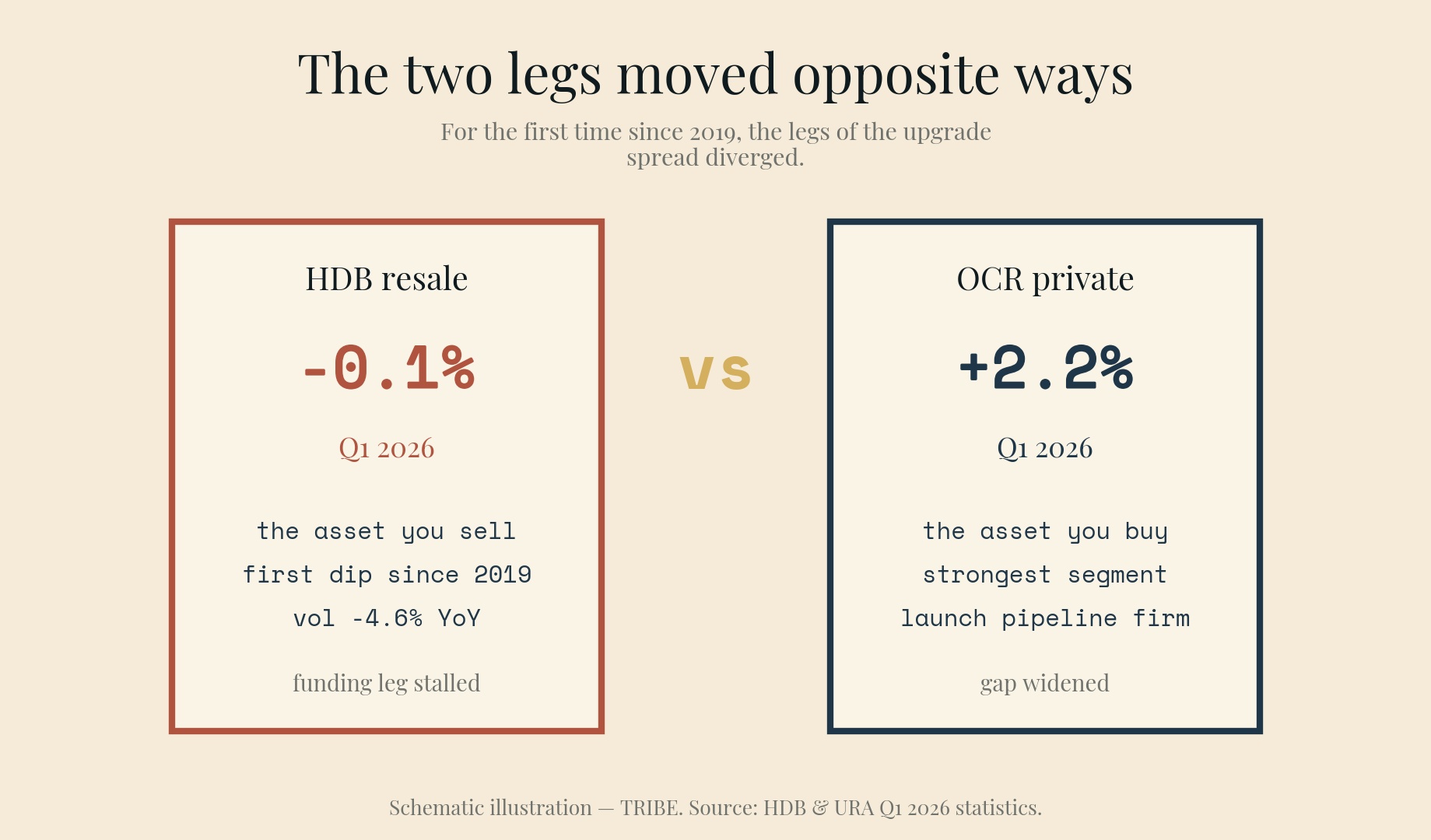
The HDB Resale Price Index slipped 0.1% in Q1 2026 — the first quarterly decline since 2019. In the same quarter, OCR condo prices rose 2.2%. If your upgrade plan assumes your flat keeps appreciating while you wait, the data says stop assuming.
By TRIBE Editorial · 11 June 2026 · 7 min read
For seven years, HDB upgraders have enjoyed a tailwind so steady it stopped feeling like luck: every quarter you waited, your flat was worth more. That run just ended. The HDB Resale Price Index slipped 0.1% in Q1 2026 — the first quarterly decline since Q2 2019.
One-tenth of a percent is not a crash. On its own it's barely a data point. What makes it matter is the other side of the ledger: in the same quarter, private home prices in the Outside Central Region — exactly where most upgraders are headed — rose 2.2%. The gap you have to bridge widened while the asset funding it stood still. That's the story, and it deserves more attention than the headline number is getting.
The deceleration, in three lines
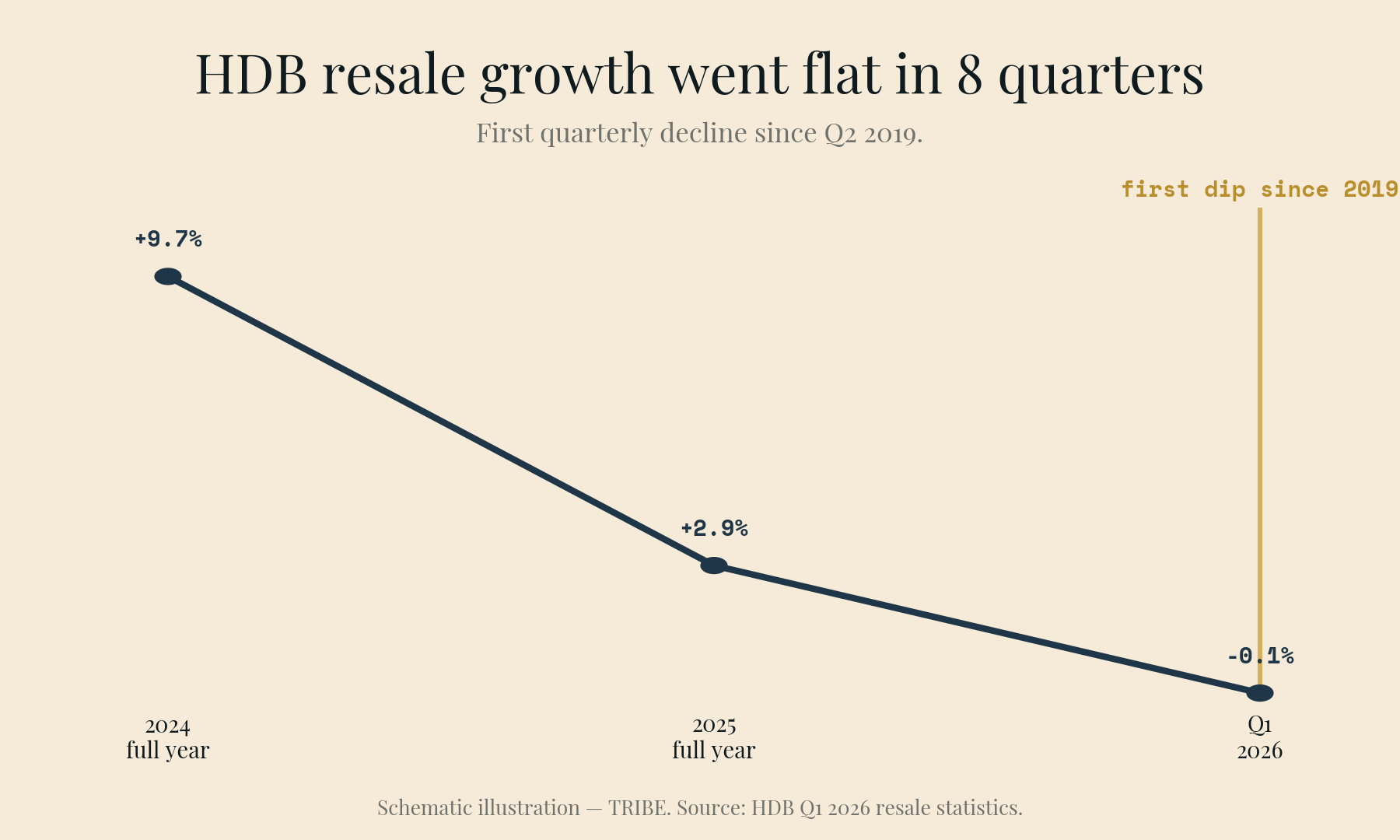
The turn didn't come from nowhere. It's the tail end of a deceleration that's been running for two years:
| Period | HDB resale price growth |
|---|---|
| 2024 (full year) | +9.7% |
| 2025 (full year) | +2.9% |
| Q1 2026 | −0.1% |
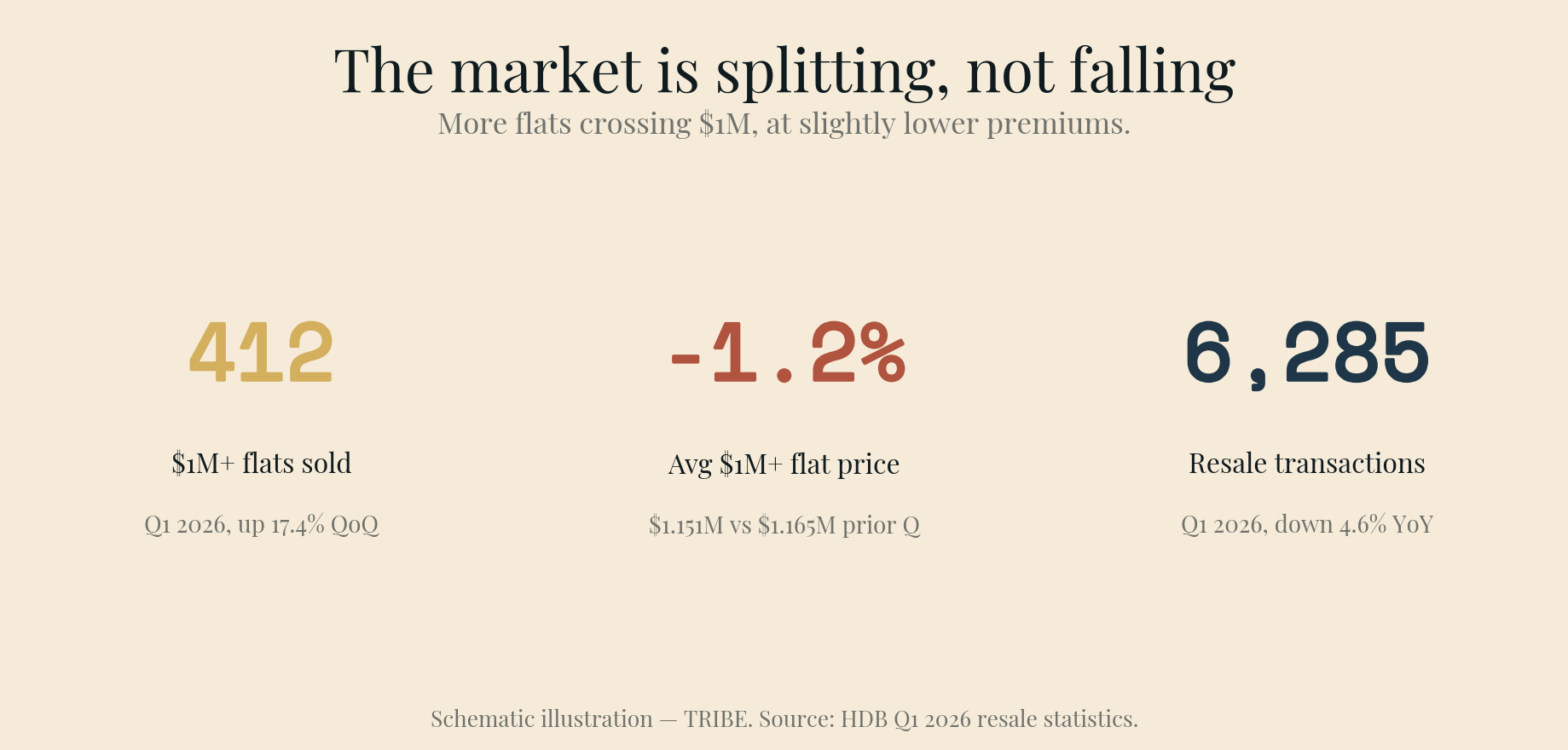
From nearly double-digit annual growth to flat in eight quarters. Transaction volume tells the same story: 6,285 resale flats changed hands in Q1 2026, down 4.6% from the 6,590 in Q1 2025. Monthly flash estimates since then have wobbled around zero — 99.co's tracking puts cumulative resale price movement since May 2025 at roughly +0.2%, which is to say: a year of monthly gains and dips that cancelled each other out.
Why now: the MOP supply wave
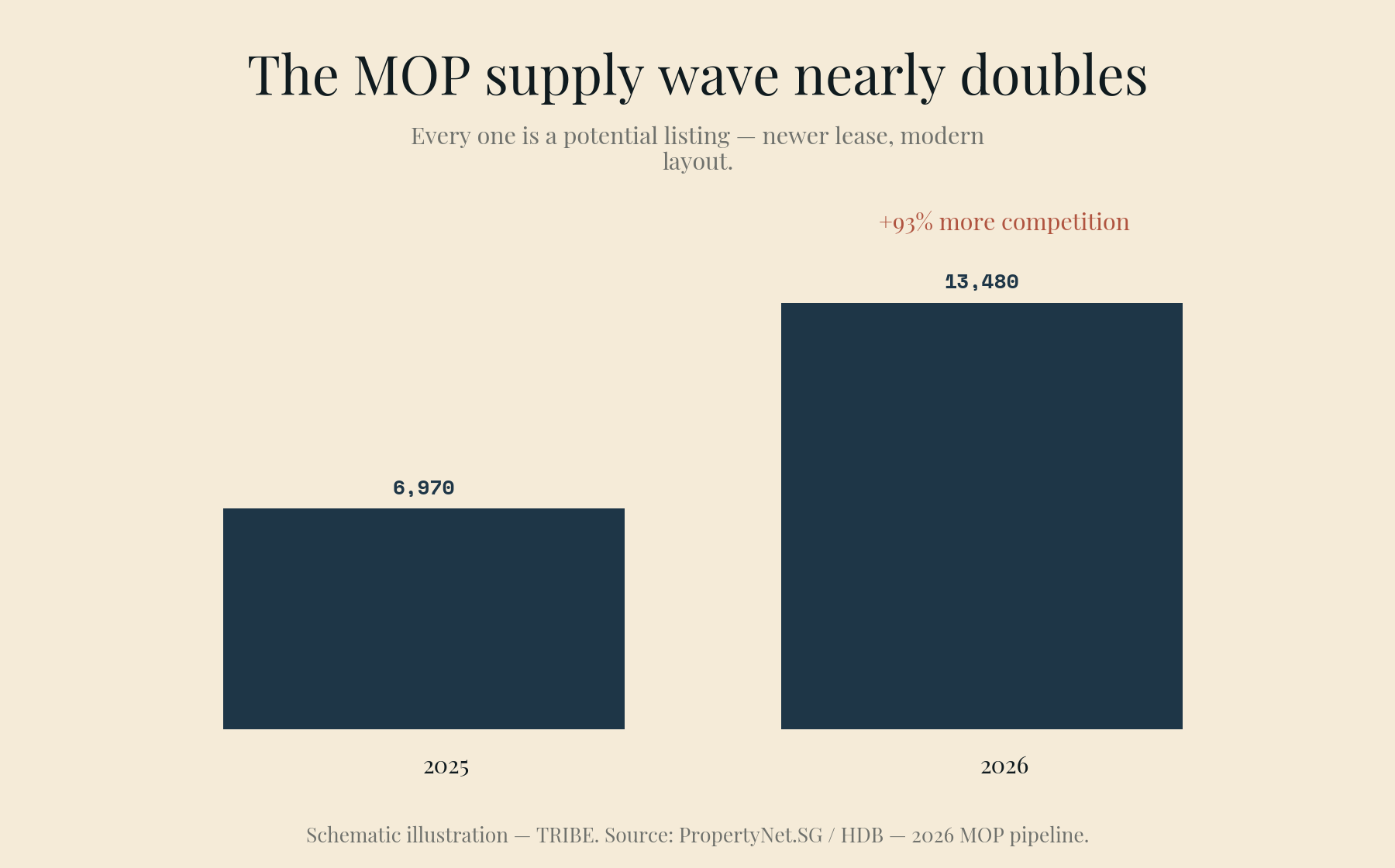
The cleanest explanation is supply. Around 13,480 HDB flats reach their Minimum Occupation Period in 2026 — nearly double the 6,970 that did in 2025. Every one of those is a potential listing, and the newest of them come with 94-plus years of lease remaining, modern layouts, and owners who bought at BTO prices and can afford to negotiate.
If you're selling a 20-year-old flat this year, that's your real competition — not last year's transacted prices in your block. A buyer comparing your unit against a just-MOP'd flat two estates away is comparing lease, layout, and price all at once, and two of those three are working against the older flat.
The market is splitting, not falling
Here's where it gets more interesting than "prices are cooling." The premium segment is doing the opposite. A record 412 flats sold for S$1 million or more in Q1 2026, up 17.4% quarter-on-quarter. Median five-room prices hit S$1.1 million in Toa Payoh, S$1.09 million in Ang Mo Kio, S$1.085 million in Bukit Merah.
But even there, the froth is thinning: the average million-dollar flat transacted at about S$1.151 million in Q1, 1.2% below the previous quarter's S$1.165 million. More flats crossing the line, at slightly lower premiums, concentrated in a handful of mature estates and rare flat types — executive maisonettes, multi-gen units, high-floor DBSS layouts with no real substitutes.
The honest read: if you own a rare configuration in a mature central estate, the record-setting headlines apply to you. If you own a standard four-room in a non-mature town — which is most owners — your relevant market is the one that just went flat, with a record supply wave incoming.
The spread is what you're actually trading
An upgrade is not a sale and a purchase. It's a spread trade: the difference between what your flat fetches and what the condo costs. For seven years both legs rose, and the flat side often rose faster — the spread held steady or narrowed, and waiting was free or even profitable.
Q1 2026 is the first quarter in a long time where the legs moved in opposite directions. The flat side: −0.1%. The OCR private side: +2.2%, the strongest of all market segments, per URA's Q1 statistics. And the forward pipeline leans the same way — ERA counts nearly two-thirds of 2026's upcoming launches in the OCR, with demand explicitly underwritten by HDB upgraders carrying housing equity out of the very towns those projects sit in.
Run the arithmetic on a typical case. A S$700,000 flat funding a S$1.6 million OCR condo leaves a S$900,000 gap. If the flat side stays flat for a year while the condo side repeats anything like Q1's pace, the gap widens by tens of thousands of dollars — silently, without either market doing anything dramatic. The tailwind that used to pay you for waiting is gone; on current data, waiting now has a price.
What this changes in practice
Price your flat against today's market, not your neighbour's 2024 high. The single most expensive mistake sellers make in a flattening market is anchoring on a peak comparable and chasing the market down, listing-extension by listing-extension. The Q1 data is your permission slip to be realistic from day one.
Check what's MOP-ing around you. If your town has a heavy 2026–2027 MOP pipeline, your competition gets worse before it gets better. That argues for selling into this year's still-firm demand rather than after the wave lands.
Don't read this as "panic sell." Prices are flat, not falling — and 2026 forecasts cluster between roughly 0.5% and 5% growth, with most analysts tracking the low end. The point is narrower: the assumption that time is on the seller's side no longer has data behind it. Decisions should be made on the spread, not on momentum that ended two quarters ago.
And keep the two questions separate. Timing — when to sell, whether to sell first or buy first — is one decision. Selection — which condo actually holds its value for the next decade — is the bigger one, and it doesn't get easier because your flat sold well. We've written about the selection problem and what the data rewards separately; everything there applies with more force when the funding leg of your trade has stopped growing.
The bottom line
A 0.1% dip is not the headline. The headline is the crossover: for the first time since 2019, the asset most upgraders are selling went flat in the same quarter the assets they're buying rose 2.2%. Supply data says the flat side stays heavy through 2027. The launch pipeline says the condo side stays firm.
Nobody can tell you the next quarter's print. But the structure of the trade has changed, and structure — not momentum — is what you should be pricing.
If the buying leg is the part you haven't solved yet, every resale condo in Singapore is scored on RPS across seven weighted factors. No registration, no agent call. Just the data.
General information only, not financial or investment advice. Figures are drawn from HDB's Q1 2026 resale statistics, URA's Q1 2026 real estate statistics, and the linked market reports; verify current data against HDB and URA directly before making any commitment.
Know what you can afford
Loan, stamp duty, CPF, and monthly repayments — work out your real budget before you commit. No registration required.
Plan my purchase →Prefer a personal read on your situation? Arrange a consultation →Keep reading

TRIBE Editorial · Reviewed by Silas Tan
Co-Founder, TRIBE · District Director, Huttons Asia · Ex-Mortgage Banker (AVP) · >1,000 families advised · CEA R000303I
This article is for informational purposes only and does not constitute financial or investment advice.