Insights
From Bay Windows to Queen Beds: How Singapore Condo Layouts Got Honest
A 2008 three-bedder and a 2024 one of the same quoted size don't hold the same furniture. Fifteen years of floor-area rule changes — bay windows, planters, aircon ledges — quietly rebuilt what 'saleable area' means.
By TRIBE Editorial · 16 June 2026 · 7 min read
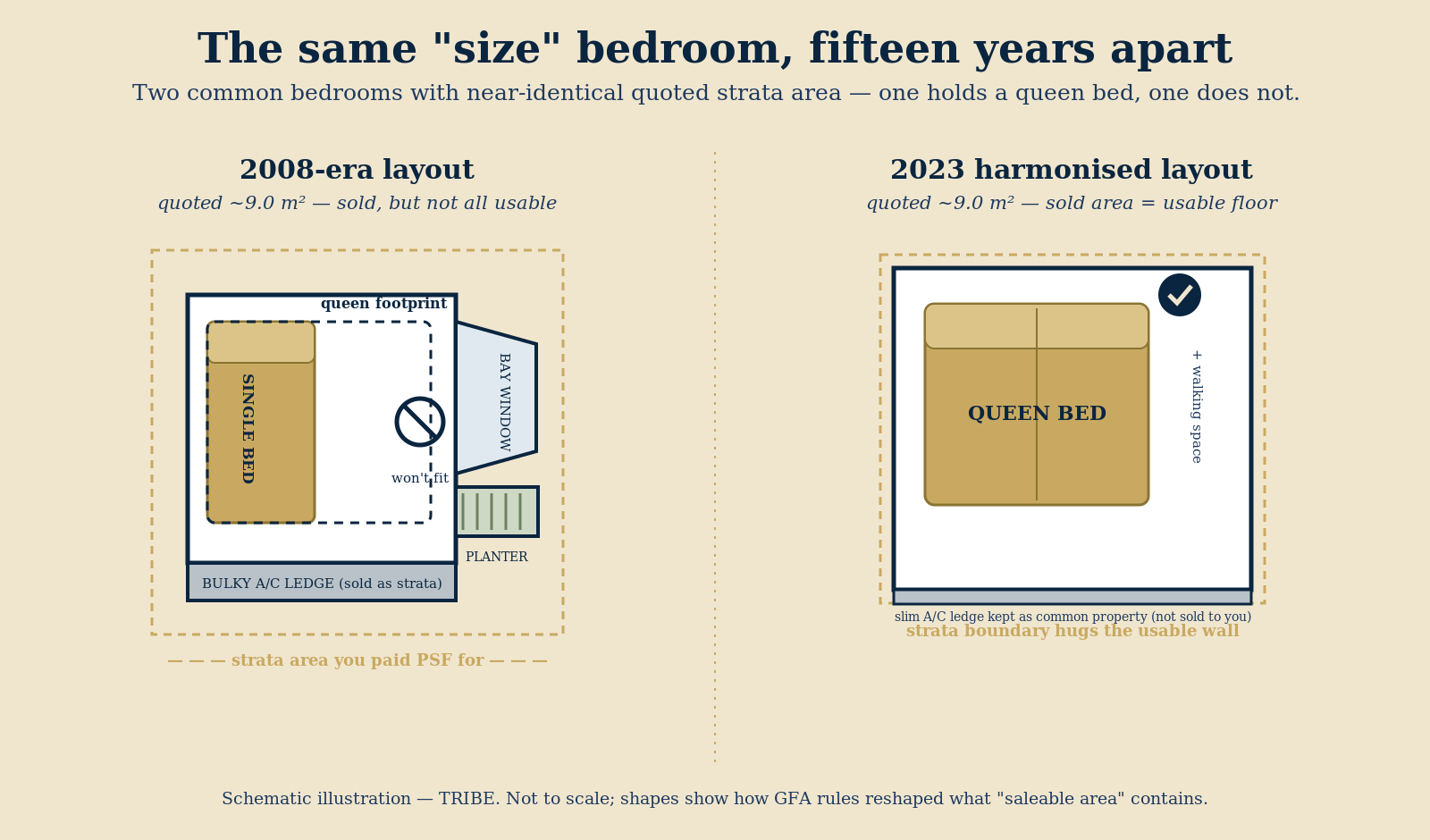
Stand in the common bedroom of a 2008-vintage condo and try to fit a queen bed. In a lot of them, you can't — not without blocking the door or losing the wardrobe wall. Do the same in a unit completed after 2023 and the bed usually drops in with room to walk around it. The quoted size on the two units can be near-identical. What changed isn't the number on the price list. It's fifteen years of quiet rule changes to how floor area is defined — and what developers were allowed to sell you as part of it.
This is one of the least-discussed forces in the resale market: the layout you're buying is a fossil of the rules in force when the project was designed. Here's how those rules evolved, and what it means when you compare an older unit to a newer one.
The age of the "free" add-on
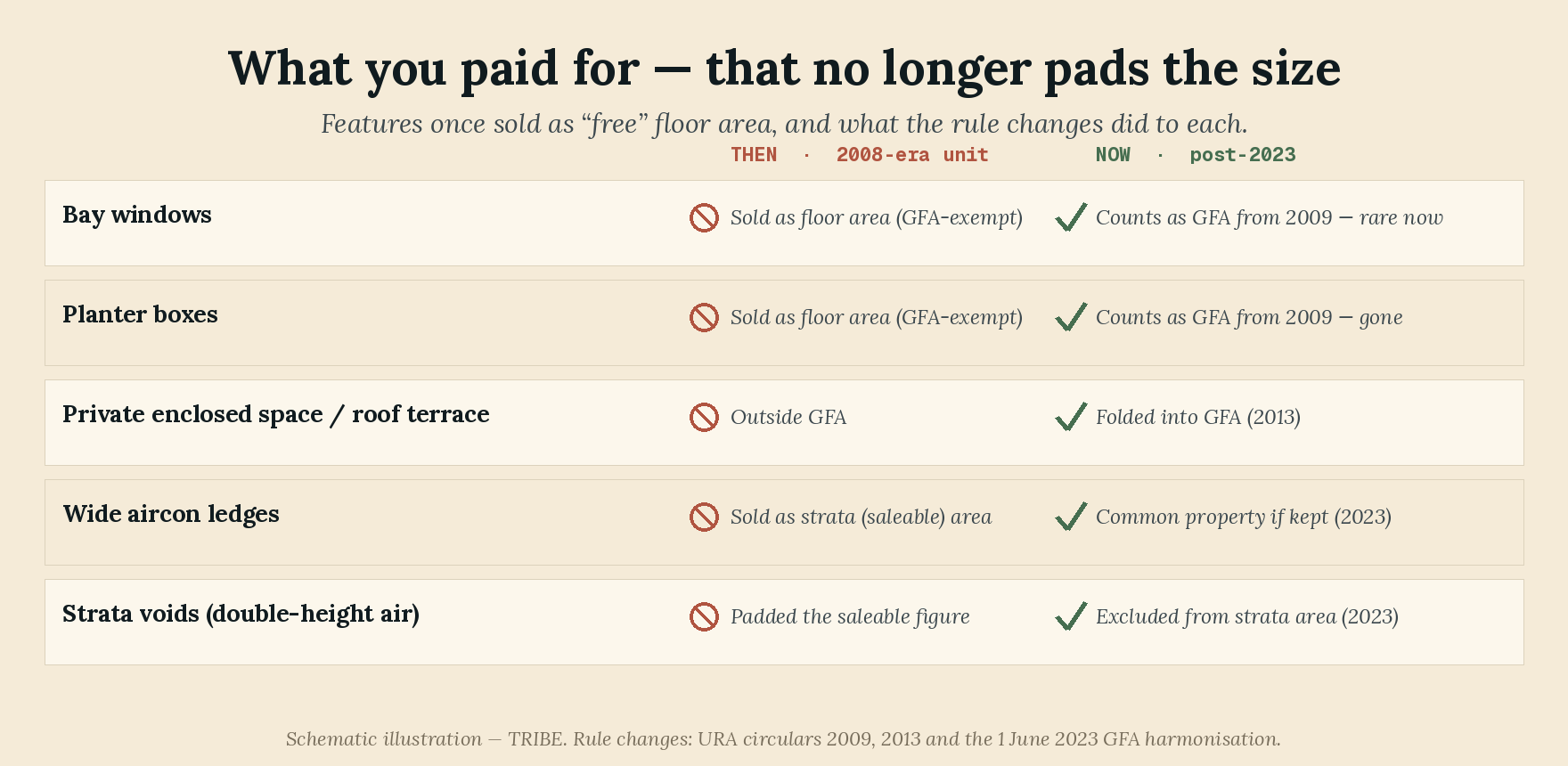
For years, the way Singapore measured a building's bulk — its Gross Floor Area, or GFA — left several features out of the count. Bay windows were treated as raised window ledges, not floor. Planter boxes were meant to green up a home. Private enclosed spaces, roof terraces and deep air-conditioner ledges sat outside the GFA tally too.
The problem was the incentive that created. A developer pays development charges and uses up plot ratio on GFA. Anything exempt from GFA was, in effect, free area — buildable at no GFA cost, and then sold to buyers as part of the unit's strata (saleable) area. So projects of that era are full of them: the bay window you can't put a wardrobe against, the planter you can't stand in, the wide aircon ledge outside the window, all quietly inflating the square footage on the price list.
The cost landed on the buyer twice. You paid the per-square-foot price on space you couldn't fully use — and because a chunk of the quoted "size" was protrusions and ledges, the genuinely usable rectangle of each room shrank. That's why so many common bedrooms from this period top out at a single or super-single bed. The area was real on paper. It just wasn't where you needed it.
Three rule changes closed the loophole
URA reeled these features back in three moves, each one pulling a once-exempt feature into GFA — and quietly removing the reason to build it.
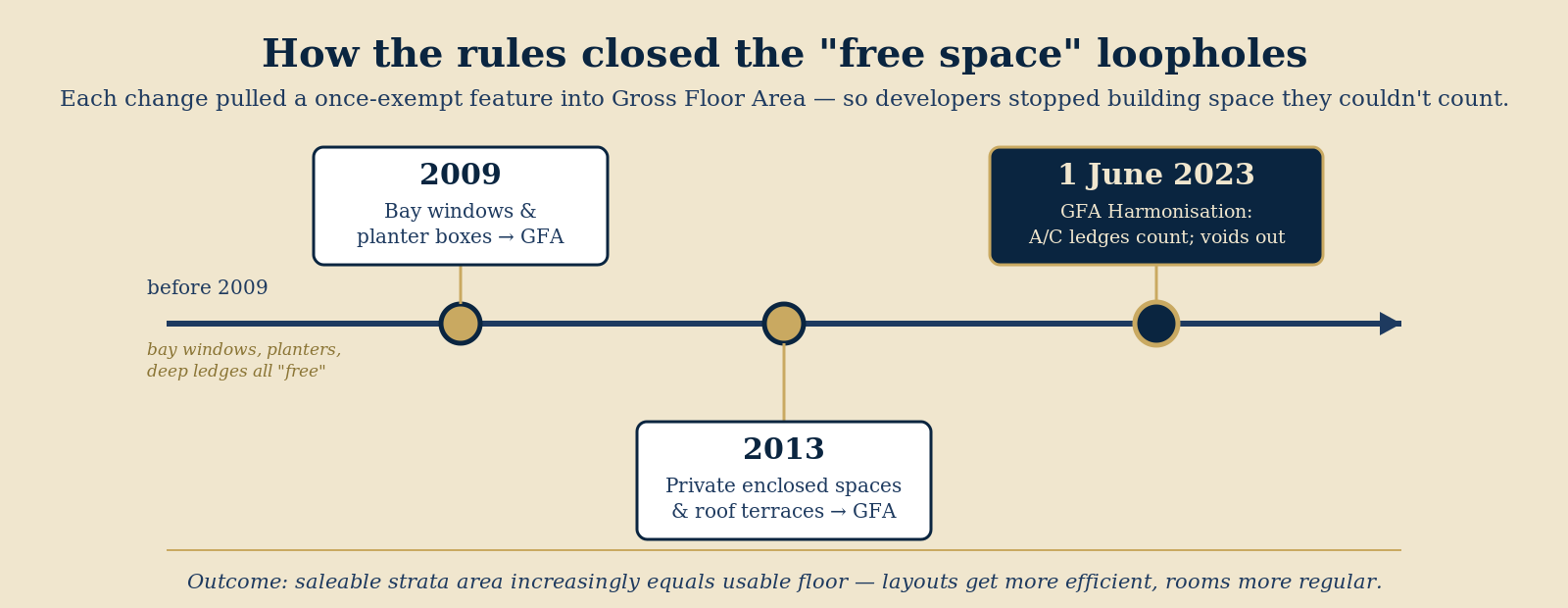
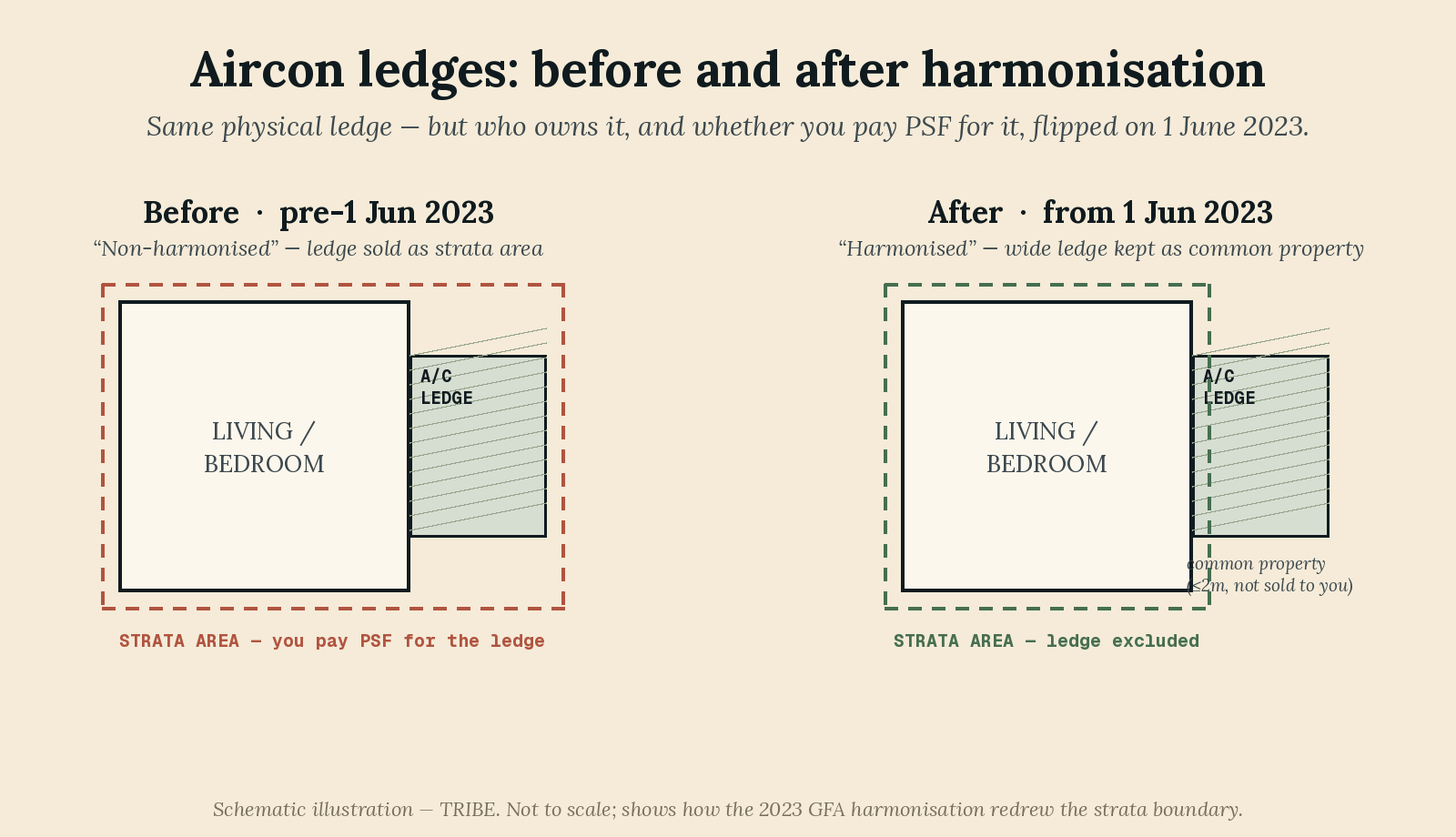
From 2009, bay windows and planter boxes lost their GFA exemption: plans submitted after the cutoff had to count them as floor area, so developers stopped designing them in. Around 2013, URA folded private enclosed spaces and private roof terraces into GFA too, closing the next set of gaps.
The big one came on 1 June 2023, when URA, the Building and Construction Authority, the Singapore Land Authority and the Civil Defence Force harmonised their definitions of floor area. Two changes matter for layouts. Aircon ledges that are part of a strata unit — exclusive to your apartment — now count as GFA; a developer that wants to keep a ledge GFA-exempt has to leave it as common property, capped at 2 metres wide. And strata void area (the empty volume above a double-height living room) was taken out of the strata-area count, so it can no longer pad the saleable figure either.
The cumulative effect is simple to state: the saleable area a developer reports increasingly equals the usable, enclosed floor you actually get. Once the free add-ons stopped being free, they largely stopped being built — and layouts squared off in response. Bay windows vanished. Aircon ledges slimmed down or moved to common property. Common bedrooms became regular rectangles, which is exactly the shape a queen bed needs.
What this means when you compare an old unit to a new one
The practical upshot is a warning about a comparison almost every buyer makes: putting two units of the "same size" side by side.
They're rarely the same. A 950 sq ft three-bedder from 2008 can carry several dozen square feet of bay windows, planters and aircon ledge that a 950 sq ft unit from 2024 simply doesn't have. On paper they match. In the rooms, the newer one has meaningfully more floor you can furnish. Efficiency rose even when the headline size didn't — which is why a brand-new unit often "lives bigger" than an older one of identical quoted area, and why per-square-foot comparisons across eras quietly mislead.
A few things to carry into a viewing:
- Run the queen-bed test in the common bedroom, not the master. Master bedrooms have almost always worked. The common room is where the older rules show up — a bay window or a fat ledge on one wall is the usual reason a queen won't sit with a walkway.
- Read the floor plan for protrusions, not just the number. Hatched strips along the external walls — bay windows, planters, aircon ledges — are area you're paying for but can't fully use. Count them before you compare PSF.
- Don't treat older layouts as worthless. A bay window throws in light and a ledge for plants; a balcony earns its keep for ventilation and a morning coffee. The point isn't that these are bad — it's that you should know you're paying floor-area price for semi-usable space, and price the unit accordingly.
None of this makes a harmonised layout automatically the better buy. Location, lease, quantum and the building itself still dominate the decision, and some buyers genuinely prefer the airier, balcony-and-bay-window feel of an older unit. What the rule changes did was narrow the gap between what you're sold and what you can use. For a generation of resale stock, that gap is real, it's measurable on the floor plan, and it's hiding inside two identical-looking size figures.
For real-world photo examples of how these layouts differ in the flesh, StackedHomes' visual guide to condo layouts is a good walk-through. The diagrams above are our own schematics, drawn to make the trade explicit.
Sources: URA circular on bay window and planter box GFA exemptions (2009); URA circular on the harmonisation of floor area definitions, effective 1 June 2023; 99.co on the floor-area rule changes. Diagrams are TRIBE schematics, not to scale.
Silas Tan is a District Director at Huttons Asia and co-founder of TRIBE. He built the Resale Project Scorecard (RPS) using 236,000+ URA REALIS transactions. This article is for informational purposes and does not constitute financial or investment advice. CEA Registration R000303I.
Check how your condo scores
2,357 condos independently scored across 7 weighted factors. No registration required.
Score my resale →Prefer a personal read on your situation? Arrange a consultation →Keep reading

19 September 2026Private Property Market
A 42-Year-Old Block, a Fourth Attempt, and a New Law Worth Two Signatures
18 September 2026Private Property Market
The Cheapest PSF and the Cheapest Apartment Are Two Different Units

17 September 2026Private Property Market
Seven Developers Bid for the Same Site. The Winner Still Paid 11% More Than Anyone Else.

TRIBE Editorial · Reviewed by Silas Tan
Co-Founder, TRIBE · District Director, Huttons Asia · Ex-Mortgage Banker (AVP) · >1,000 families advised · CEA R000303I
This article is for informational purposes only and does not constitute financial or investment advice.