Insights
Your HDB "Made $300k" — But Only $156k Is Actually Cash
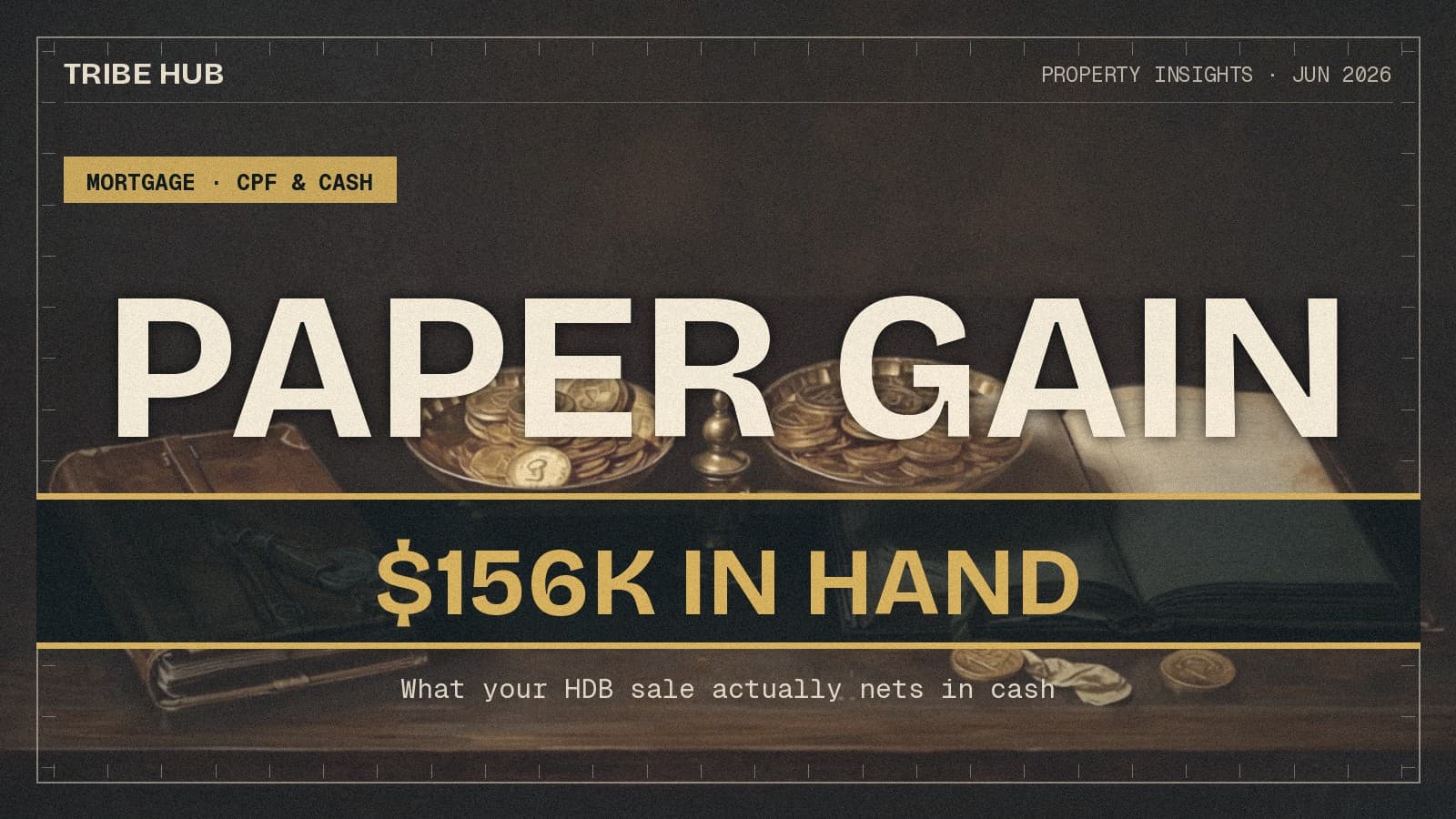
Sell your flat for $300k more than you paid and it feels like $300k in the bank. After the loan, the mandatory CPF refund and the agent's cut, the cash that actually lands can be barely half that. The mistake is budgeting the condo off the wrong number.
By TRIBE Editorial · 24 June 2026 · 5 min read
You bought your flat for $350,000 and you're selling it for $650,000. So you made $300,000 — and it's tempting to plan the condo around having that $300,000 to deploy. This is the most common budgeting mistake we see HDB upgraders make, and it isn't a small one. By the time the sale completes, the amount that actually lands in your bank account as spendable cash can be barely half the paper gain. The rest is real — but it's locked inside your CPF, not sitting in your wallet. Confusing the two is how upgraders over-commit on a condo and then scramble for cash at completion.
Where the $300,000 goes
The "gain" is the sale price minus what you paid. The cash is the sale price minus everything that has to be paid out of the sale first. Three deductions stand between them, and two of them surprise people.
| From the $650,000 sale | Amount |
|---|---|
| Outstanding HDB loan repaid | −$180,000 |
| CPF refund (principal + accrued interest) | −$300,000 |
| Agent commission (2% + 9% GST) | −$14,170 |
| Cash in hand | ≈ $155,830 |
The outstanding loan, everyone expects. The two that catch upgraders are the CPF refund and the way accrued interest inflates it.
The CPF refund is mandatory — and it grows every year
Every dollar of CPF you used to buy the flat must go back into your CPF when you sell — not into your pocket (CPF). And you don't just refund what you took out. You also refund the accrued interest: the 2.5% per year your CPF would have earned had the money stayed in your Ordinary Account, compounded for every year you owned the flat (CPF accrued interest explainer).
In the example, $230,000 of CPF principal plus $70,000 of accrued interest means $300,000 must be returned. The longer you've held the flat, the larger that interest figure — on a flat owned 15-plus years it can run into six figures on its own. This is not a loss; the money is yours and lands back in your OA, where it can fund the next home's downpayment. But it is not cash, and it cannot pay for things CPF can't — which is the trap.
Why the distinction wrecks condo budgets
When you buy the condo, some costs must be paid in cash and cannot be touched by CPF:
- The minimum 5% cash downpayment — $90,000 on an $1.8M condo.
- Cash-over-valuation on the flat you're buying, if any (always cash).
- Stamp duty within 14 days of purchase (CPF can reimburse for resale, but the timing often forces cash first).
- Renovation, the move, and your cash buffer.
So the right way to read the sale is two separate pots, not one:
- Cash in hand: ~$155,830 — for the things only cash can do.
- CPF returned: $300,000 — back in your OA, for the 20% of the downpayment and stamp duty that CPF is allowed to cover.
Together that's about $455,830 of firepower for the next home — a healthy position. The mistake isn't the total; it's assuming the whole $300,000 "gain" is cash and discovering at completion that only ~$156,000 of it is. An upgrader who mentally earmarked the gain for a $200,000 renovation, say, is suddenly $44,000 short on a bill CPF can't pay.
How to budget it properly
Before you commit to a condo, split your HDB sale into the two pots above and size the purchase against each:
Run the CPF numbers first. Use the CPF refund calculator to get your exact principal-plus-accrued-interest figure (CPF). That single number tells you how much of your "gain" is going to OA rather than your bank.
Match cash needs to cash, CPF needs to CPF. Confirm your cash-in-hand covers the 5% cash downpayment, any COV, renovation and a buffer — before you assume CPF will carry the rest. If the cash pot is thin, that's the constraint, not the headline price.
Don't spend the gain twice. The same $300,000 can't fund the CPF refund, the downpayment, the renovation and a holiday. Most of it has one job: rotating back into the next home through your OA.
Your flat may well have made a genuine $300,000. Just remember that a sizeable chunk of it is moving from one CPF account to a property again — quietly, on paper — and only what's left after the loan, the refund and the commission is money you can actually spend.
General information only, not financial advice. The mandatory CPF refund (used principal plus 2.5% p.a. accrued interest), the minimum 5% cash downpayment, and cash-only treatment of COV are CPF/MAS rules current as at June 2026 and subject to your individual CPF usage and change (CPF refund). All figures are illustrative and computed for the stated assumptions ($350,000 purchase, $650,000 sale, $180,000 outstanding loan, $230,000 CPF principal, $70,000 accrued interest, 2% + GST commission); your numbers will differ — verify with CPF and your bank.
Silas Tan is a District Director at Huttons Asia and co-founder of TRIBE. CEA Registration R000303I. Methodology published. No spin.
Know what you can afford
Loan, stamp duty, CPF, and monthly repayments — work out your real budget before you commit. No registration required.
Plan my purchase →Prefer a personal read on your situation? Arrange a consultation →Keep reading

4 October 2026Mortgage & Rates
Floating Only Wins Now If SORA Falls. Here Is the Breakeven.
30 September 2026Mortgage & Rates
The Fed Hiked for the First Time in Three Years. Singapore's Floating Rate Moved Four Basis Points.
23 September 2026Mortgage & Rates
The HDB Loan Lends You 11% More. The Bank Loan Costs 45% Less.

TRIBE Editorial · Reviewed by Silas Tan
Co-Founder, TRIBE · District Director, Huttons Asia · Ex-Mortgage Banker (AVP) · >1,000 families advised · CEA R000303I
How TRIBE scores and checks its analysis
Spotted an error, or a figure that has moved since publication? Tell us and we will correct it.
This article is for informational purposes only and does not constitute financial or investment advice.